ConstructUseMove: Mobilizing Buildings
Basic information
Project Title
Full project title
Category
Project Description
ConstructUseMove: Mobilizing Buildings enables smart distribution of reusable modular construction solutions by creating a Europe-wide platform for construction components, building plans and knowledge exchange. It builds on existing modular building concepts to support broader innovation and exploitation of these methods, adapting construction to the present and future dynamic in the digital age and contributing to a new culture of truly sustainable buildings and spatial development.
Project Region
EU Programme or fund
Description of the project
Summary
What keywords characterize our present?
- Mobility: People, goods and money circulate through space dynamically and with unprecedented flexibility and speed.
- Pluralism: The varied needs of our pluralistic European society are reflected in increasingly diverse requirements for buildings, e.g. single households, shared flats, patchwork families, ‘traditional’ families etc.
- Acceleration: The constantly increasing speed of social and technical developments results in a shortened life cycle of buildings.
- Need for sustainability: Climate change and resource scarcity demand a completely new manner of building design and construction.
Taking these characteristics into account, conventional building construction and design practices are not appropriate for the future. Whereas people follow economic development, buildings are immobile. This causes an oversupply of apartments, offices, schoolhouses, etc. in shrinking regions and shortages in prosperous regions. This disproportionate supply and demand is also fed by increasingly faster changing requirements on buildings. Without addressing this problem of immobility, sustainable building can hardly be achieved.
What solutions can be pursued?
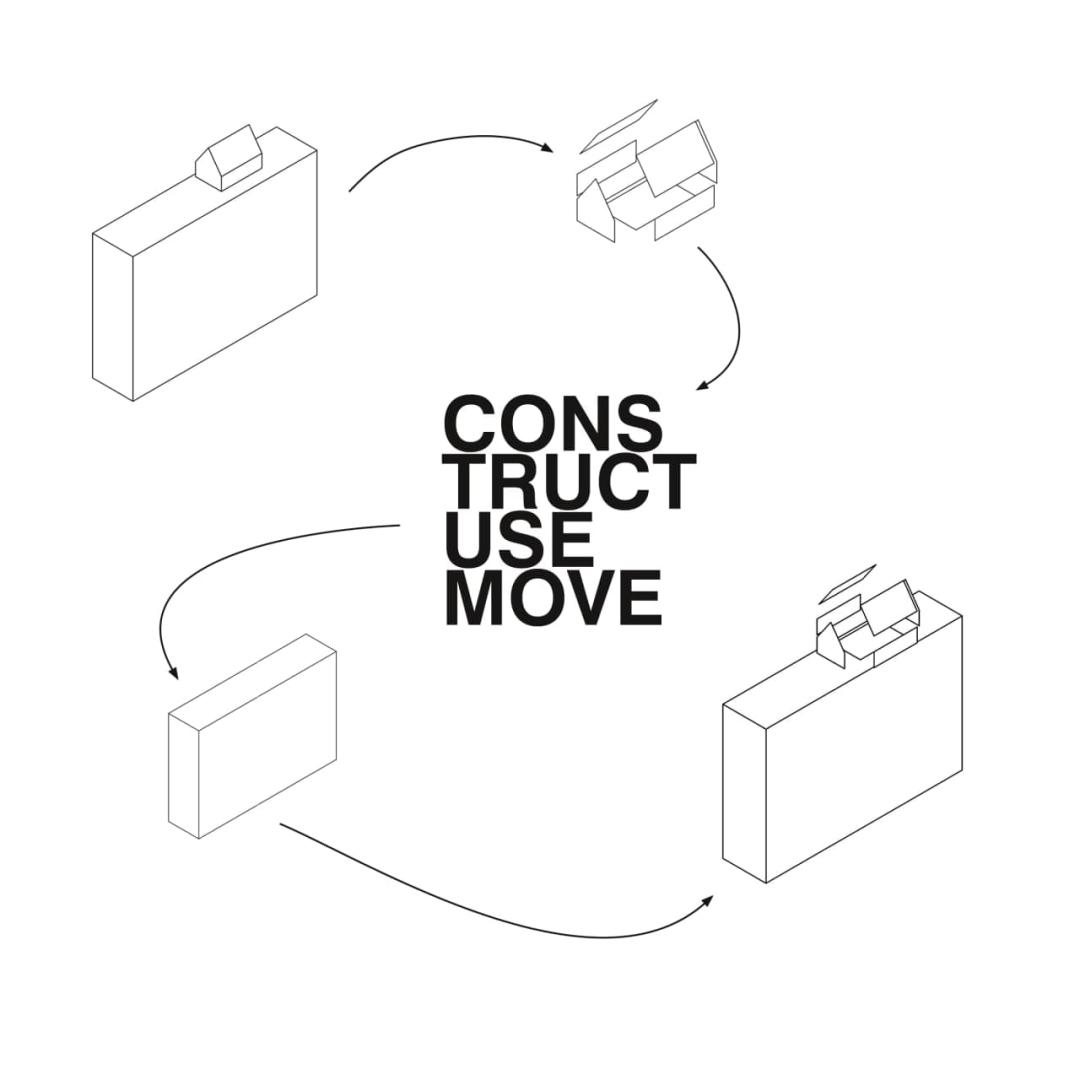
Just like the other goods in our economy, buildings should be mobilized. ConstructUseMove establishes a platform for this circulation, use and re-use of construction components to enable their use flexibly in terms of time and physical location.
This idea derives from already existing concepts like modular building, computer aided design and urban mining. ConstructUseMove combines these approaches to develop a digital platform where modular components, as well as construction plans, are traded and shared. With integrated mapping of the location, number and disposability of each component, it is possible to create a market to efficiently distribute the modular components according to changing regional demand and allowing assembly into diverse building types and uses.
Key objectives for sustainability
ConstructUseMove has two overarching sustainability objectives:
1. Sustainability through re-use of materials: Growth, decline and even disappearance have always been constant characteristics of human settlements. Abandoned buildings were either left behind, decaying for the most part due to the biological degradable materials, or their components were reused. This resembles natural circuits where there is a steady flow of matter and energy. By mobilizing building materials, the platform imitates those circuit processes and furthers the cradle-to-cradle approach in the building industry. Thus, each modular component of the building has more than one life cycle, reducing demand for primary commodities as well as waste. In addition, there is an economical potential for more efficiency. While buildings today cause high costs at the end of their lifespan (vacancy, demolition, dumping, etc.), the option to sell modular components on the platform can even lead to earnings. The basic condition for this concept is the use of predominantly reusable construction materials and the implementation of modular systems, that promote reassembling the modular components.
2. More sustainable spatial development of regions: ConstructUseMove also opens new possibilities for sustainable spatial development. When buildings are dismantled to reuse the components, there is unsealed soil left behind. Soil, that can be restored or used for new buildings. In this way, regional affords to diminish land consumption are promoted, what interacts with equal aims of European countries such as the German ’30-Hektar-Ziel’ (less than 30 ha land consumption per day until 2030). Another potential can be found in the network character of the platform. Along with the materials, building plans and knowledge of sustainable building techniques can be shared throughout Europe. The result is a pool of ideas, that strengthens the exchange of locally elaborated concepts between sites facing similar challenges.
Key objectives for aesthetics and quality
The platform does not directly form a particular aesthetic. Nevertheless, the modular designing and construction techniques promoted by the platform do so. Modular building is no longer the realm of bleak concrete post-war housing complexes. New digital-driven designing and construction methods enable more flexible and manifold ways for designing aesthetically sophisticated buildings. Many architects and engineers have already elaborated such innovative techniques and modular systems and put them into practice as unique and exceptional architectural solutions: for example, individual single family dwellings constructed on the roof of an existing housing complex in a growing area with high pressure on the housing market.
Since ConstructUseMove is not only a marketplace for modular materials, but also a platform for sharing designing ideas and even construction plans, it can become a broad network for discussing architectural and aesthetic issues. Key objectives include:
1. Enabling iterative design: Quality of experience in the end buildings can be improved through the diverse group of architects and designers responding to construction needs (climactic, use-based and user-based) with their own diverse perspectives. Through the modular approach, changes or re-designs of building elements is simplified compared to conventional construction.
2. Decentralized and transparent design: By combining the potential of modular building methods and the network, the platform creates a profound basis for a question as important as it is interesting: How to reach the claim for truly sustainable cradle-to-cradle architecture? The platform’s network functions as a public forum where architects, engineers and all participants work together. Information and exchange both on modular components’ specifications and capabilities is available, but in the forum, plans’ aesthetic features can also be debated and improved.
Key objectives for inclusion
Inclusion is at the heart of ConstructUseMove:
1. Improving affordable and sustainable housing access: The focus of the project is the social inclusion of groups with low socio-economic resources. With the help of the modular system and the European platform, it is possible to react flexibly to the demand for housing, so that the precarious situation of those affected can be addressed promptly. Several characteristics of the platform support both lower cost public and private medium- and large-scale building and participation of individuals or cooperatives in own small-scale projects. These include: low market entry barriers in the production of the modules, as all information for production is publicly available; marketing of the modules via the platform, thus preventing transaction costs; modular assembly is also low-threshold, so that, on the one hand, the costs for construction will be low, and, on the other hand, jobs for low-skilled workers will be created; open source building plans on the online platform will reduce costs for planning and can as well provide further benefits such as good-practice examples of handicap-accessible houses.
2. (Re)Densification in existing neighborhoods: Where cities and towns are swiftly growing, new housing areas are frequently planned and built as greenfield development. The necessary connections to infrastructure (water/sewer, transport, etc.) increase costs; and the physical separation from the existing urban network can exacerbate social isolation. At the same time, loss of greenspace has negative environmental and health consequences for the population and can reduce social acceptance of projects. ConstructUseMove will highlight in-build and accessory-style unit building plans which can be added into the existing urban fabric rather than promoting new suburb creation and is thus a further step towards gender- and discrimination-free planning.
Innovative character
Modular construction has been practiced for several decades and is established in the construction industry (cradle-to-cradle). But the potential of modular construction cannot be fully exploited because it is conceptually seen only as a cheaper manufacturing technique for houses. This project, however, reconceives modular construction as an approach to demand-oriented use of the modules where and when they are currently needed, considering local, regional and macro-regional needs. According to population changes and even service needs at the neighborhood, city or regional level, the modular buildings can be dismantled and the modules reassembled at a new location or in a new form.
No current international marketplace exists for public trade and exchange of modular building components. ConstructUseMove is an innovative and disruptive solution to this problem. It comprises an online platform that organizes the distribution of modules and plans, as well as supports exchange. Here, suppliers of modules - whether new production or recycling - can enter their stock of materials. Buyers of the modules can then select from the modules on offer on the platform and use them to build their houses. To ensure that there are as few market entry barriers as possible, all specifications for the production of the modules are specified online and open source on the platform.
In the first step, the project is intended to enable extensions on existing houses. This will result in advantages: On the one hand, no new soil is sealed by the densification. At the same time, however, this results in further requirements for efficient load-bearing structures. These can be met with wood as a building material. Wood stores CO2 and is therefore climate-friendly, lightweight, universal and modular.
The online platform for modular construction from wood materials enables a decentralized European circular economy that can contribute to the European Green Deal.