Biophilic elementary school Verwondering
Basic information
Project Title
Full project title
Category
Project Description
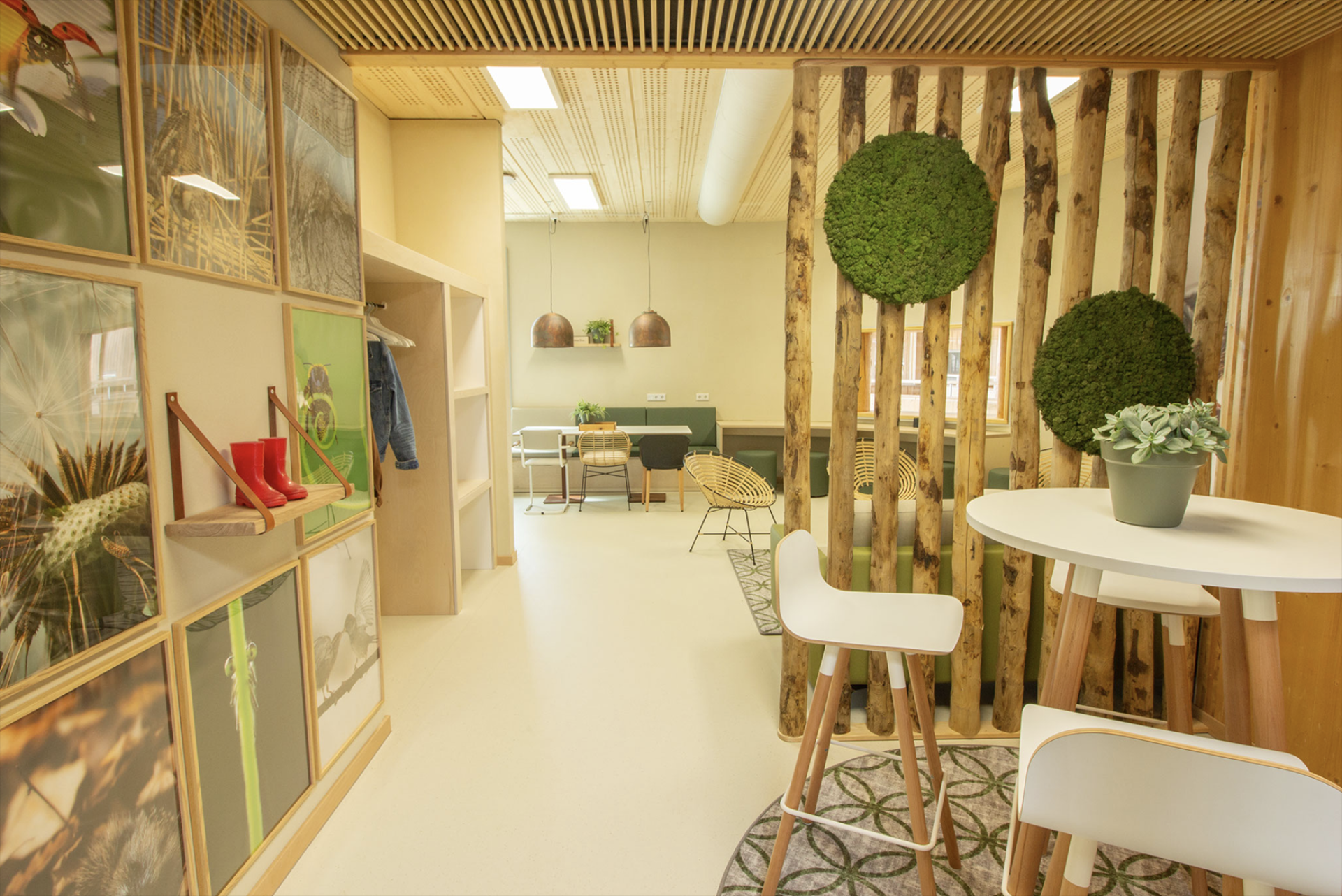
Elementary school De Verwondering is a biophilic school building and one of the first of its kind. The hybrid timber frame/CLT building has fourteen classrooms, an outdoor classroom on the roof and a spacious central area. Biophilic elements such as natural materials, plants and imagery are present throughout the building and playground. These provide a stimulating learning environment for the pupils that triggers curiosity and wonder in all things nature.
Project Region
EU Programme or fund
Description of the project
Summary
A wide array of natural influences and elements in elementary school De Verwondering helps to grow and shape the children’s intelligence and sense of identity. The design of the school building triggers instinctive reactions of curiosity and wonder in pupils when they come into contact with nature, increasing their attention span and ability to learn. Nature has been integrated in the design through all sorts of shapes and forms providing an optimised space for them to develop.
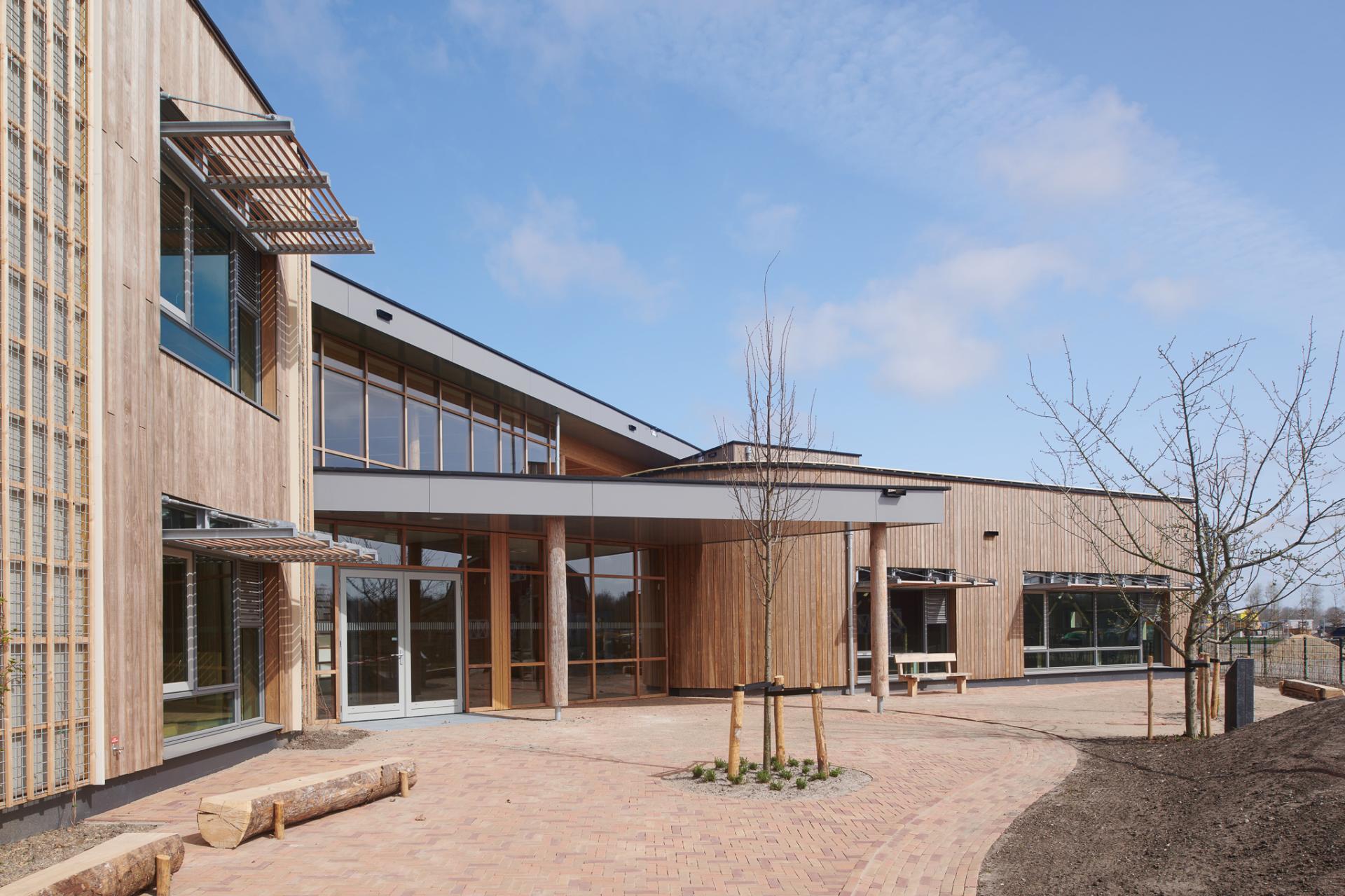
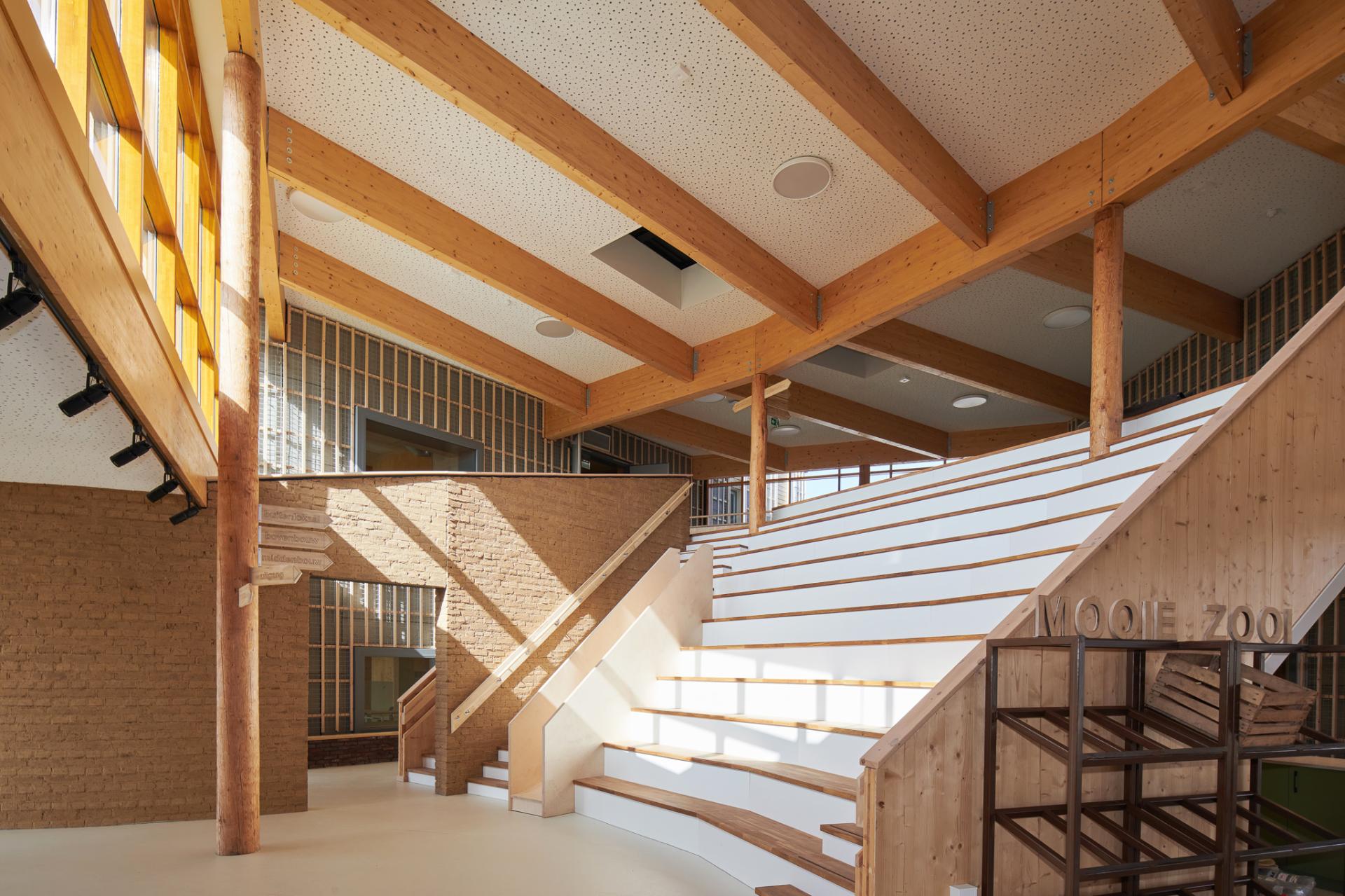
The building materials and techniques in the hybrid timber frame/CLT construction are sustainable, diverse and innovative: peeled log columns, wooden hollow-core floor slabs, (unbaked) loam brick inner walls for thermal mass, acoustic cork panels, natural ventilation shutters, an ice-based temperature buffering system and natural green walls on the indoor and outdoor facades.
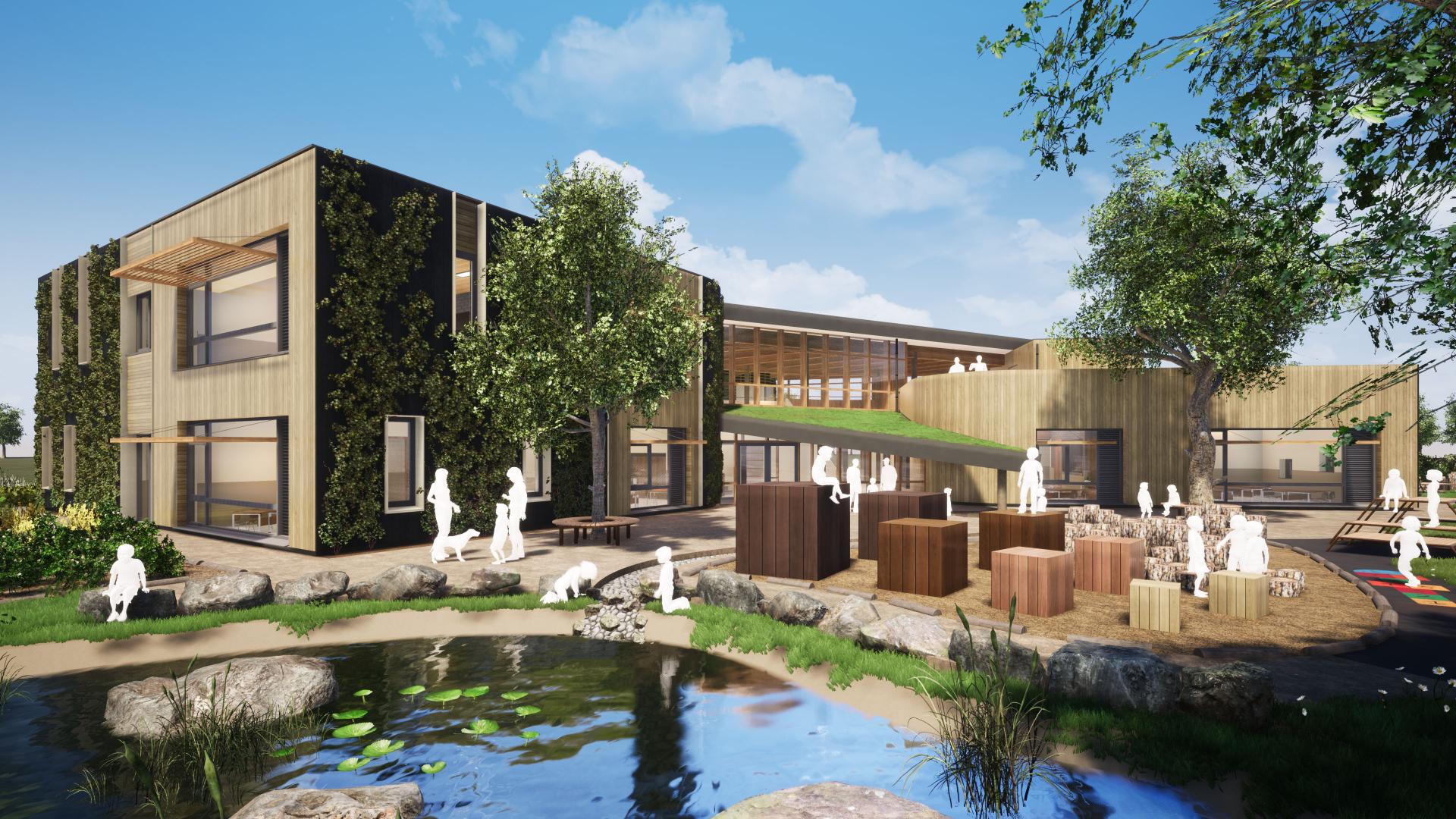
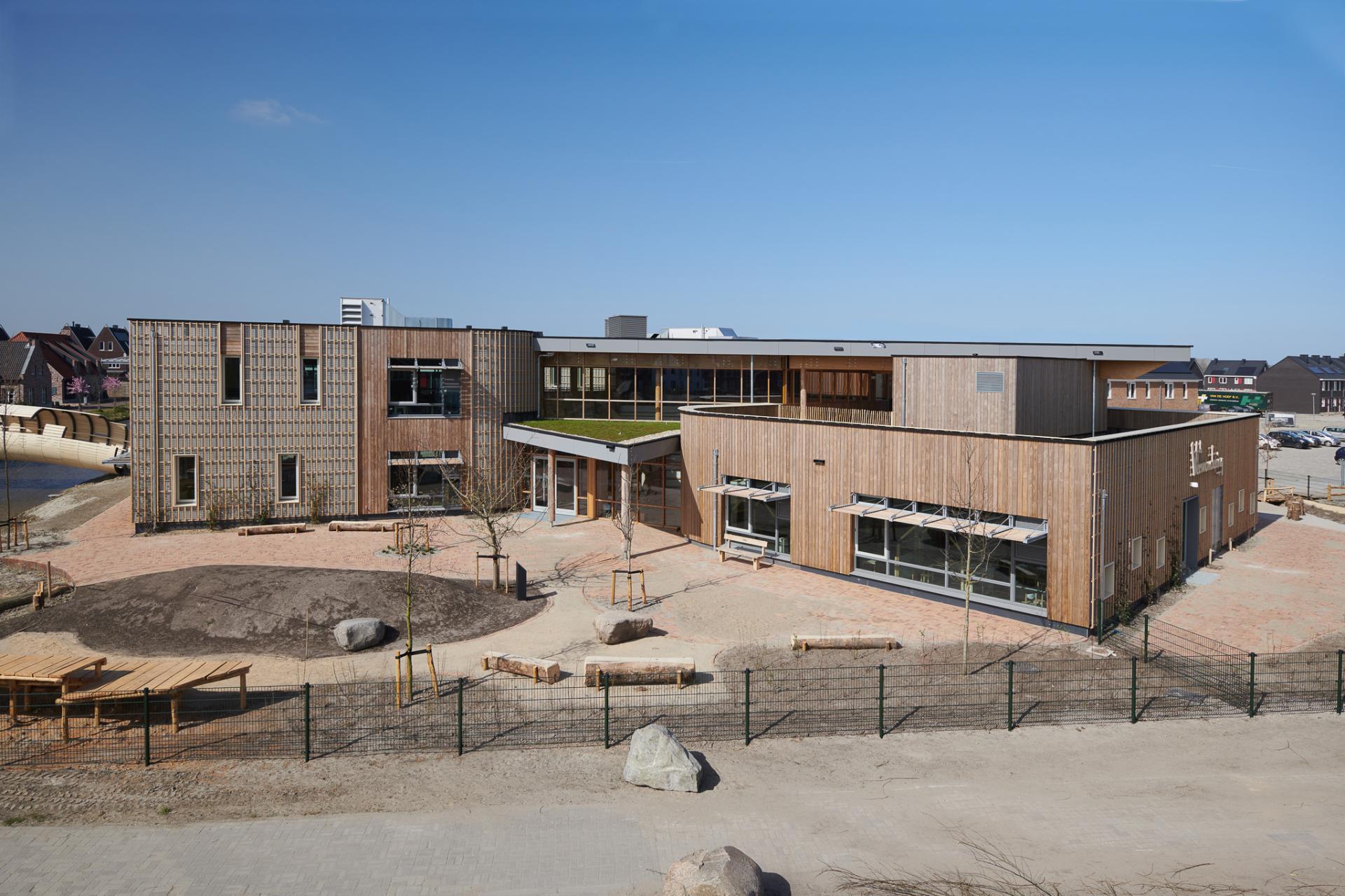
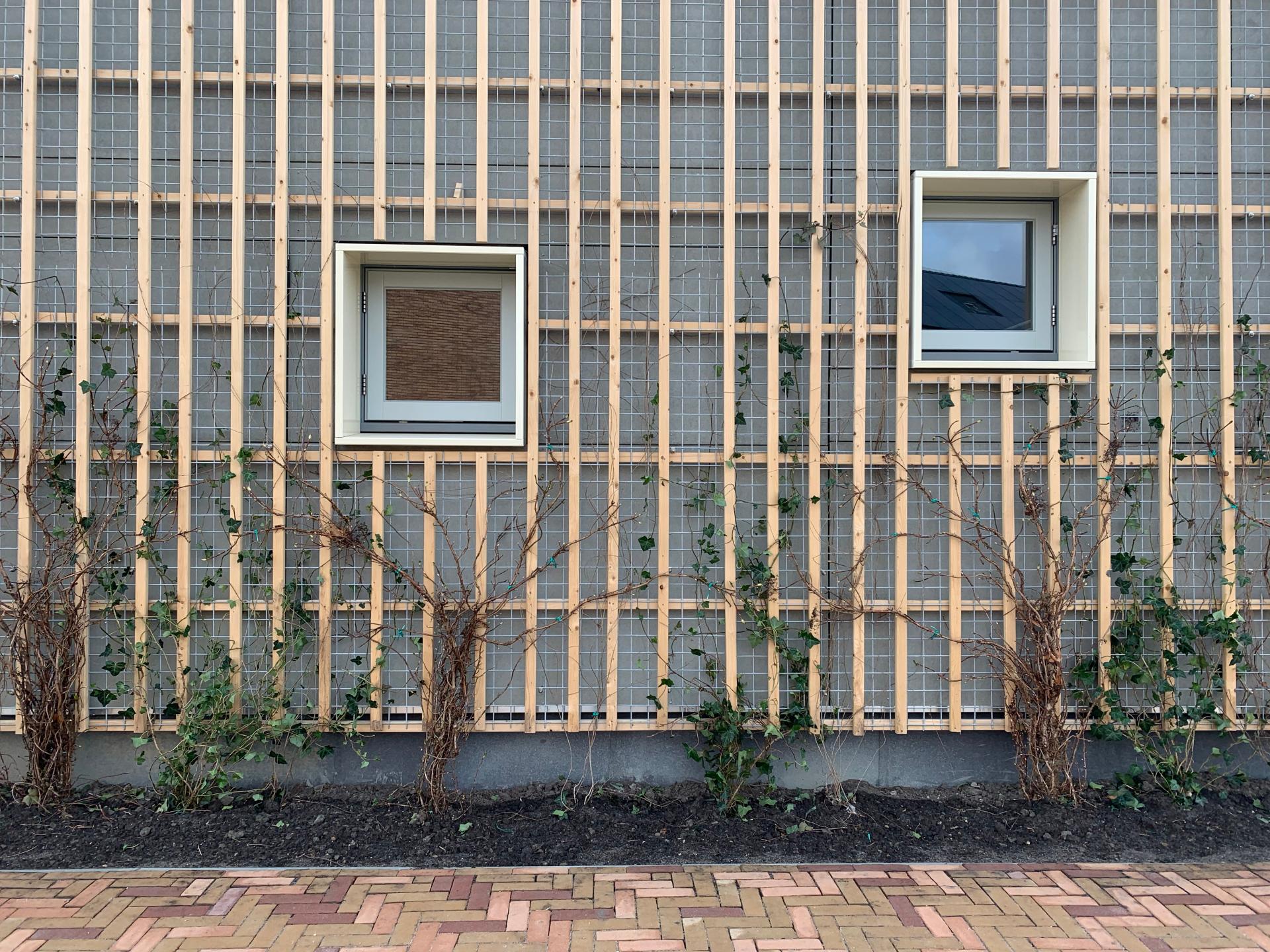
The school’s pupils experience nature as a dynamic process including the changing of the seasons. Rainwater flows down the roofs and is spewed straight onto the schoolyard and led to a nearby creek. Large parts of the inner- and outer walls are covered in self-growing green walls with nesting for birds and insects. Trees are strategically planted to provide a natural sunscreen and to offer hiding spots for local birds and animals boosting biodiversity in the area. There is even an outdoor classroom on the lower part of the building with a vegetable garden and chicken coop situated on a green roof.
The building was given the highest attainable energy label and was designed to seamlessly fit into the circular economy. It’s components are completely detachable and all materials have been registered in a Madaster building passport showing the location and quantity in order to facilitate re-use.
De Verwondering is the first example of a new generation of biophilic school buildings that recognize and utilize the powerful effect of natural principles on the learning abilities of young children.
Key objectives for sustainability
Nature and sustainability were the guiding principles in design, materials and construction. The goal was the creation of a natural environment where our children can develop and learn in a natural, healthy and energetic way.
The client's considerable ambitions for sustainability and natural education have resulted in a fully detachable wooden building that completely fits into a circular economy with a strong focus on the natural cycle. The building is largely constructed out of biobased materials: the timber construction is part cross laminated timber, part timber frame. Insulation, interior and exterior cladding and furniture are also of biobased origin. The building's components are easily detachable and an extensive catalogue of all materials used has been registered in the building’s material passport (Madaster) for later reuse. Trees and green walls are an integral part of the building.
Our guiding principle for the energy design was 'low tech/natural where possible and high tech where necessary'. Low-tech interventions such as optimal orientation to the sun, vapor open walls, natural ventilation and sun shading by trees are combined with high-tech installations that provide sustainable energy and seasonal buffering. The school has its own renewable energy source: an ice vat buffering system. The system uses an underground ice storage tank to provide a long term temperature buffering system which can heat a building when it's cold and cool down when it's warm. It utilises the exothermic capacities of the freezing process, meaning that as a liquid changes to a solid, heat is released and the other way around.
The school is ventilated as naturally as possible. Each room has its own climate shutter, which can be open 24 hours a day. The main hall has two large skylights which create a chimney effect by drawing out used air, providing the school with completely natural ventilation. All classrooms have large windows letting in an abundance of natural light.
Key objectives for aesthetics and quality
Nature was also our guiding principle in the architectural design. The floor plan shows an organic layout, roughly modeled after a tree leaf with two longer leaves, in which the three clusters of rooms are placed in a natural way around the central space. The biomimic roof construction appears to be a large leaf, with the wooden beams forming the veins. The construction is supported by large peeled tree trunks making the wood texture visible and tangible. Resisting the urge to touch these is seemingly impossible as we’ve noticed that nearly everyone who walks by runs their fingers over the smooth wood. Sightlines are directed at the green schoolyard from many angles.
The interior finish is made of wood, cork, clay and straw. All tangible and visible to the students. Inside, parts of the walls will also be covered by ivy over time For now, we only see the small plants at the foot of the growth rack. The roofs are covered with vegetation and the exterior finishing alternates between wooden planks and growth racks that will guide ivy all the way to the roof. Growing and flowering green walls out of ivy will get bigger and more beautiful over the years. This way, the students will experience the seasonal changes and ever evolving process of natural growth. The playground is naturally decorated: trees, edible plants, fallen tree trunks, water and sand. Both the building and the schoolyard are equipped with nesting boxes for birds, bats and other small mammals and insects. At night the building is dark for nocturnal animals. Living nature is part of the building.
This school looks different with every season and the building, just like nature, will only become more beautiful over time.
Key objectives for inclusion
Building with wood allows for fast and light construction, easy to apply and widely available. Simple solutions, such as an outdoor classroom, make the school affordable. The use of natural principles in heating and ventilation technology as much as possible also saves costs. There is also great financial gain in the operational costs. By applying natural principles, the building stimulates the learning capacity, the ability to concentrate, the productivity of the employees and students and has a stress-reducing effect. Absenteeism and staff changes are declining by large percentages.
The design of the school came about through intensive collaboration between the school board, the management, the municipality, the design team and external parties. We all had nature as inspiration. Innovative collaborations have been found in the sharing of expertise. Intensive cooperation between the various fields of experience and expert advisors, from companies, organizations and parties, such as education specialists, ecologists, biologists, tree experts, etc., who usually don’t get involved in a construction project.
Integrating nature integrally into the education system, the building, its environment and teaching program is only possible if you work closely with all stakeholders. Everything influences each other. The design team has worked integrally with the management from the outside in to create an elementary school where the elements reinforce each other. From the functional interior to the tomato plants and chickens on the roof of the substructure.
The management involved parents, students and local residents in the design and implementation.
There are few examples of elementary schools where the building is such a tangible realization of the vision of the administration, the education system and the curriculum.
Results in relation to category
In our view, co-evolution of built environment and nature goes much further than blending buildings into the landscape or integrating living nature into the construction. We are all genetically coded by evolution to exist in close association with nature and the more nature we have in our immediate environment, the better we feel. By applying natural principles and elements, the building stimulates the learning capacity, the ability to concentrate, the productivity of the employees and students and has a stress-reducing effect. Absenteeism and staff changes are declining by many percentages.
In that sense, the protection of nature and biodiversity is self-evident, but we also do more than that:
- we build ecologically and with natural and biobased materials, avoid the use of fossil resources and do not exhaust natural resources grondstoffen
- we protect and promote biodiversity and prevent pollution of water and soil through building and planning
- By making a natural building and making nature part of education, we teach children the value and power of nature and biodiversity
Buildings in which the identity and intelligence of our children grow and take shape should be designed in such a way that children can learn and thrive optimally. In this school, nature in all its forms is integrated into the educational environment. This has enormous positive effects on the health, condition, concentration and learning capacity of our children. Elementary school De Verwondering is a biophilic school permeated with natural principles, materials and references and thus forms the ideal healthy development climate.
How Citizens benefit
Children are the future of society. They are the directors, entrepreneurs and determinants of the future. It’s a strange sensation to determine that schools are among the most uninspired and unhealthy buildings in our society. The classroom is perhaps the most influential environment outside the home where young students will experience rapid brain development and expansion in social skills. It is critical to infuse these learning environments with as many positive natural attributes as possible. For example: in a study on student performance in daylit schools, attendance was found to increase 3.5 days per year compared with attendance at non-daylit schools. Good daylight improves test scores, reduces off-task behavior and plays a significant role in the achievement of students.
Integrating more biophilic elements to our elementary (and other) school systems would improve the experience of hundreds of thousands of children every year. An improved school experience may increase the rate of school retention as students move through the education system, which in turn has huge economic implications for our national economy. In addition to consultants from the construction industry, we also asked experts from other nature-related fields to contribute their knowledge for this project.
The students of De Verwondering, but also the natural environment and biodiversity, immediately benefit from the advantages of a more natural and biophilic building. Let it be an example for many other schools and buildings!
Innovative character
There are no examples in the Netherlands and only a few in worldwide education where biophilic design is the guiding principle in it’s architecture. The biophilic elements are integrated in the design in an exemplary way. Nature is part of the building in innovative ways, but also heavily integrated into the education system and curriculum. Biophilic elements work together to foster better test scores, optimal health, and increased learning rates.
Furthermore, enabling children to play in schoolyards that provide access to nature has been shown to provide means of mental restoration, better behaviour, and enhanced focus.
Exposure to nature has been found to impact the stress levels of society's youngest members. Children consistently prefer the outdoors; 96% of all children participating in a related study, who were asked to draw their favourite place, drew illustrations of an outdoor location.
De Verwondering is designed with nature-inspired architecture, full of biophilic elements, built from natural materials, blends in the landscape, protects nature, promotes biodiversity and integrates living nature in its construction.