Giardino Segreto 3
Basic information
Project Title
Full project title
Category
Project Description
We are carving a collective social and living sculpture. Local people, living beings, and temporary agents will build and take care of a garden in Gibellina - inland of North-west Sicily. Channelling energies from light and water, we will live together this common landscape trying to heal what is fragmented and socially distant. The exercise of our collective agency is to imprint, assemble, shape and play around a new aesthetic of a shared memory.
Project Region
EU Programme or fund
Description of the project
Summary
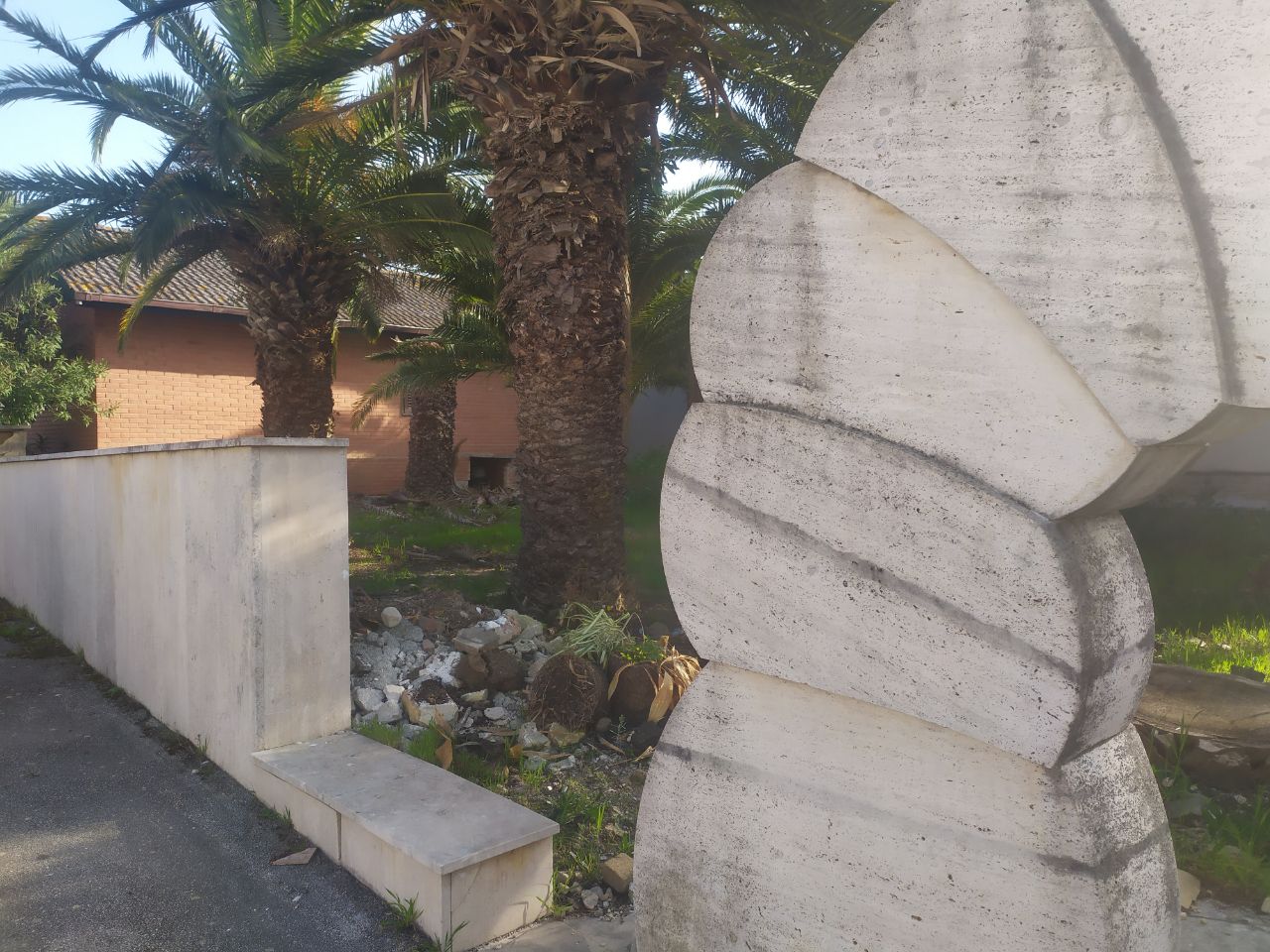
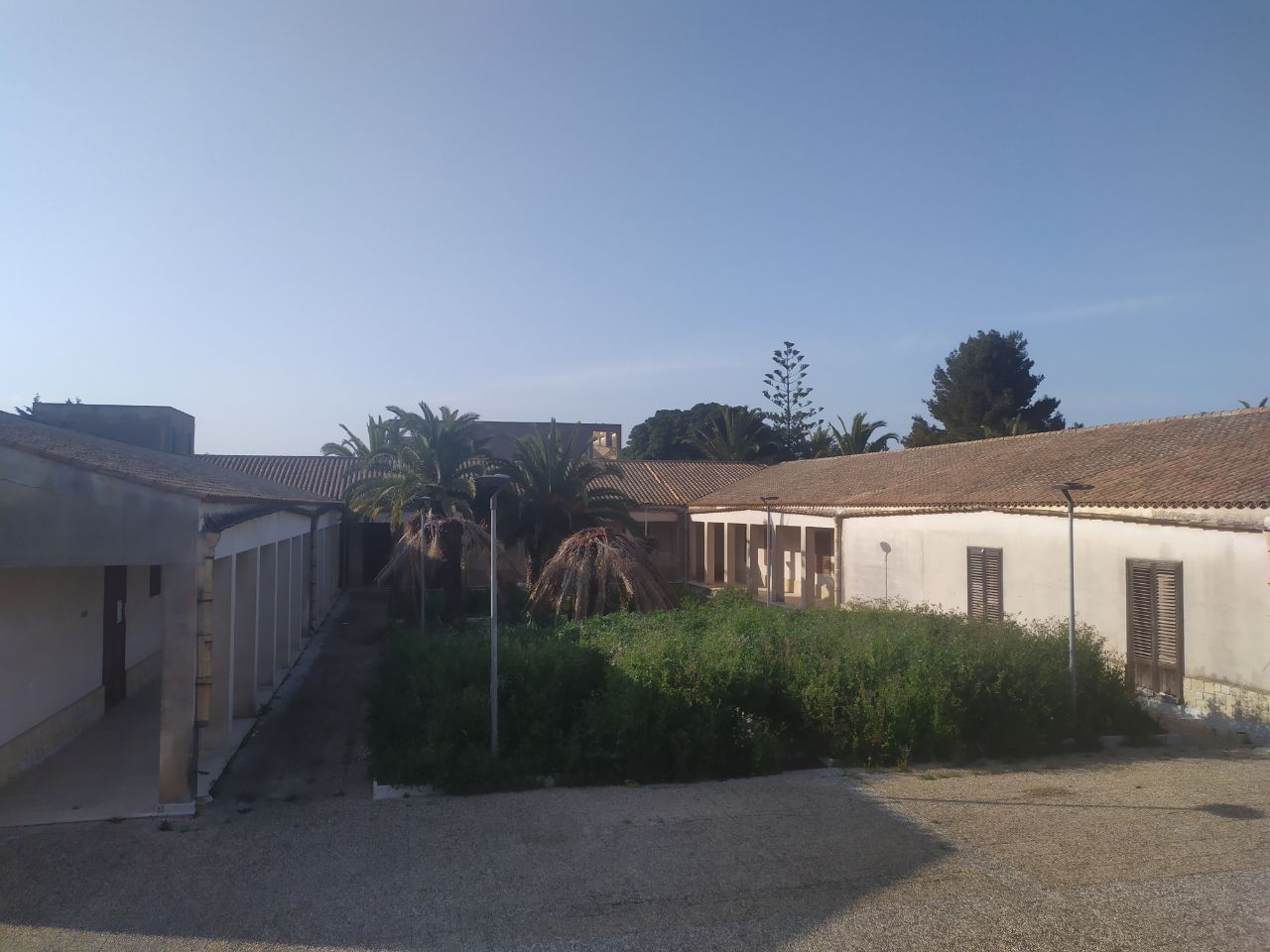
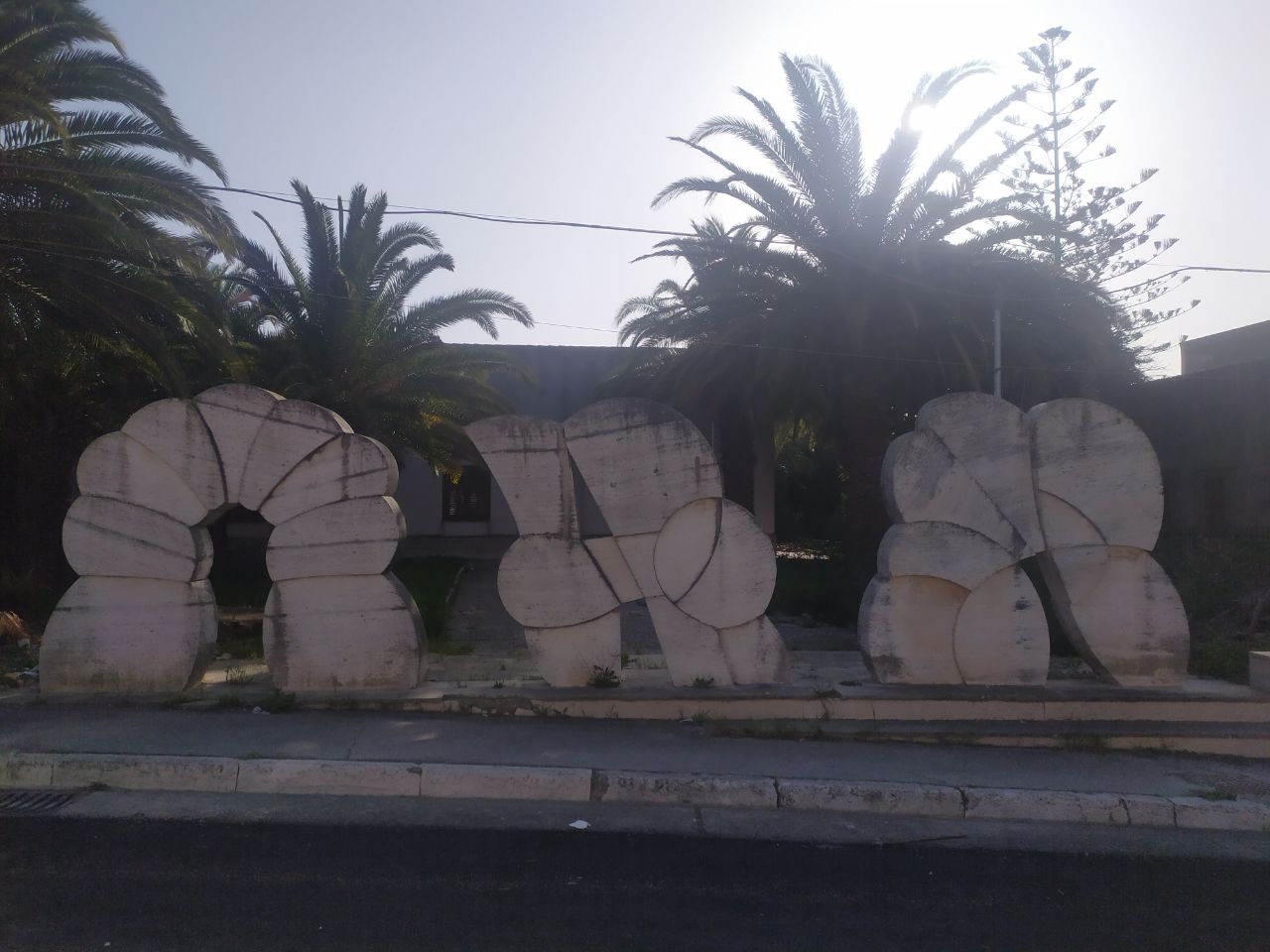
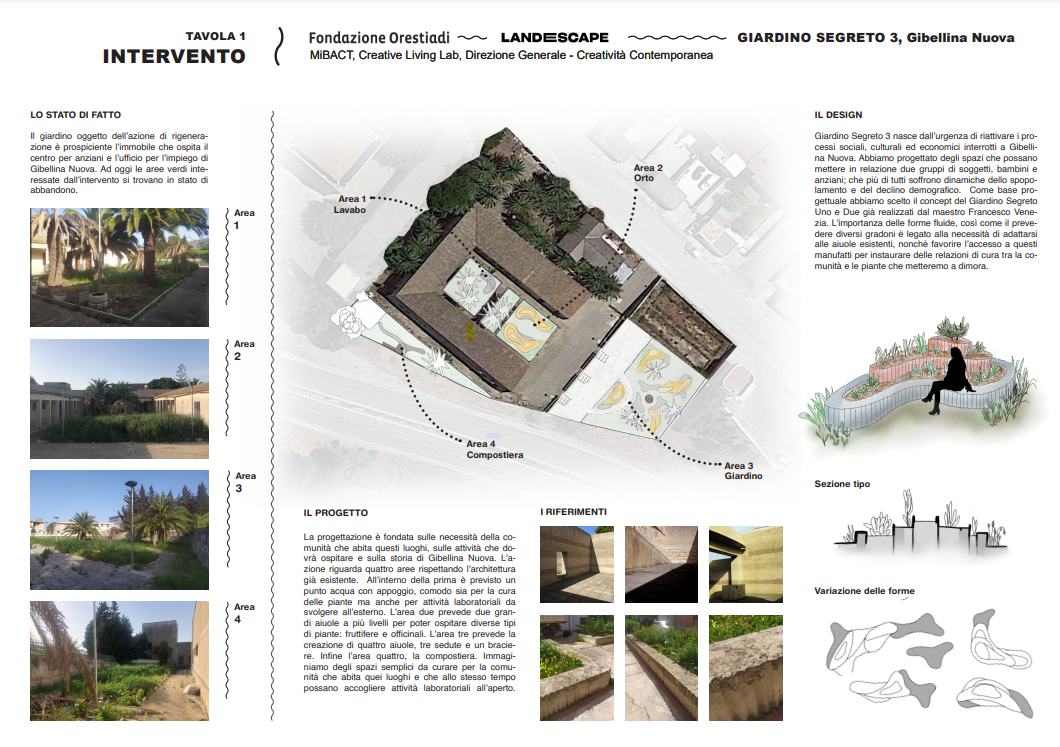
As active member of Landescape, Mediterranean non-profit association based in Alcamo, Sicily, I propose a project in Gibellina, a close inland area destroyed by the Belice earthquake in 1968. After this event, a new Gibellina was re-built on the basis of architectural principles willing to answer to the needs of its inhabitants. However, the project lacked a long-term vision and could not avoid the cultural and environmental desertification in the following years. For this reason, we propose Giardino Segreto 3, a social laboratory for the regeneration of Gibellina and its community. The place of intervention is part of the facility of the Church of Jesus and Mary designed by Nanda Vigo. The building includes a recreation centre for the elderly, an employment centre and some artworks by the sculptor Pietro Consagra. The pandemic has worsened the state of neglect of the area. We want to answer back by facilitating the connection between the space and its people, generating the missing collective vision left after the reconstruction. During the first phase, we aim at restoring the areas dedicated to greenery together with our target: the elderly of the recreation centre and children from nearby schools. On ca.3150 sqm of outdoor area, the regeneration intervention covers the green areas (ca.1000 sqm). In the second phase, GS3 will host four activities mediated by four artists and addressed to the Gibellinese community. The working group comes from the partnership between Orestiadi Foundation and Landescape association. On one side, the foundation holds the archive of the art works produced on site from the post-earthquake reconstruction to date. On the other side, Landescape provides the human skills gained experiencing the intersection between landscape, contemporary art and communities activation. Through this partnership, we aim at completing the social healing process started with the reconstruction of Gibellina and challenge the above mentioned desertification.
Key objectives for sustainability
The non-profit association Landescape is committed to the activation of a sustainable system in terms of both circular economy and the use of resources. Instead of promoting greenwashing practices for companies, we implement the sustainable protocol concerning the collective agency required by the specific project. Our mission is to shift from the production of carbon dioxide as ultimate waste to the production of oxygen as final waste. To attain this objective, the material resources we will use to create GS3 are plants and natural construction materials. We have already mobilized our sponsors: Sicilgesso S.P.A. and Gammara S.a.s for sourcing original constructive materials, while Green Code Farm - into regenerative agriculture - for the plants. In addition, we believe that the usage of human resources has to be sustainable. The DIY ("Do it yourself) approach, guided by artists, allows to cut down production costs. Unfortunately, this method helps the ecosystem only in the short term. To make it sustainable in the long term, we had to implement a strategy to involve all the stakeholders. Indeed, the local community, the elders of the centre, the school kids and the parish will take care of the garden. We can assign them the title of Guardians: they will take custody of watering plants and dreaming activities. The municipality has to cover costs of light and water, while the Orestiadi Foundation will give the institutional assurance needed to make GS3 a social sculpture of their cultural offer. The activity in the garden has to be projected according to the dictates of permaculture. Through which it is possible to produce food and regenerate the soil at the same time. This approach will also work for the social relations that will take place inside GS3. In the garden, we cultivate different ways of thinking, communicating, playing, imagining, doing what we like most.
Key objectives for aesthetics and quality
Gibellina Nuova is perceived in our collective imagination as a utopia and as a Cathedral in the desert. The narration of its environmental, natural, economic, cultural factors is the tool through which overcoming the fragmentation between meaning and signifier, between history and the forms it has taken. Our idea of design deals with the uncertain consequences of previous actions. Based on this, we aim at recreating a memory aesthetic. Memory undermines the perception of contemporary processes by influencing the outputs we aim for. In a context like Gibellina, memory is a crucial point in determining the social and cultural processes to which the project tends. The designing of GS3 started from the analysis of the context: its landescape and ecosystem nearby. The issue that has emerged as primary is the social, cultural and environmental desertification of the area. GS3 is considered an oasis in the desert. To aesthetically fit the garden, we started to plan starting from two simple parameters; light and water. Both of these elements are significant in the death and life cycle of human and non-human species inhabiting the area. The garden design was developed taking into account the needs of the community that populates these places, the activities it will host and the history of Gibellina Nuova. We chose the concept of the Secret Garden One and Two created by the architect Francesco Venezia. The importance of fluid forms, as well as the provision of different steps, is linked to the need to adapt to existing flower beds, as well as to facilitate access to these artefacts to establish relationships of care between the community and the plants that we will mansion. The action concerns two areas respecting the existing architecture. Inside the first one, there is a water point, helpful for both plant care and for laboratory activities, and two large multilayer flower beds to host both fruit-bearing and medicinal plants.
Key objectives for inclusion
Gibellina Nuova is an unexpected consequence as a result of different events that have affected the social and cultural background. From the earthquake before to the reconstruction afterwards, thanks to the Ludovico Corrao vision, the emigration of young people is only one of the unexpected effects. Over the past 20 years, Gibellina has consistently had a negative balance between births and deaths. From 2000 up to now, the Gibellinese population has decreased by 16%. Data on population and housing density place it at the bottom of the ranking of Italian municipalities. GS3 is the inclusive context in which we can socially heal this fracture. From the regeneration process to the activities mediated by the four artists, both the elderly and children will have a central role. Inclusion is the key point to embrace both sides of the coin: the firsts as a repository of knowledge, the seconds as intuition that creates. The activities projected are screen printing, role-playing games, weaving of fabrics and the production of ceramics. These projects have the dual purpose of reconnecting the community with traditional knowledge and creating works that speak art languages. They help to create an inclusive connection between the community since the activities are organized in groups. Moreover, they are processual activities for which mnemonic dispositive and knowledge exchange are crucial for a greater result. The shapes of these products will not be lowered from above by the chosen artists. The creative process will be performed collectively. We imagine forms of restitution that document and symbolize these processes (e.g: the installation in the garden of ceramics and fabrics, production of a notebook that collects documents created during the screen printing workshop and audiovisual documentation of the role play in the form of a fantastic utopian narration). These documents will be the first layer of a future archive collecting traces of processes that will happen in GS3.
Innovative character
Giardino Segreto 3 is part of a format that brings together rural regeneration, participatory decision-making processes and development opportunities related to education and contemporary art. This project applies the "Posto Segreto'' (Secret Place) model developed and implemented in recent years by the association Landescape in Alcamo. We believe that each community can create its own "Posto Segreto''. This can be reached with specific characteristics of the community and the territory, as well as the production processes that coexist there. The model is based on:
- the regeneration of space and the equipment of it to host a creative community of locals and non-locals, which dialogues with natural, anthropic and urban environmental factors;
- a decision-making process, distributed, collaborative and decentralized.
- a storytelling capable of making the place attractive on the basis of contemporary production processes, particularly art, tourism, agriculture, education.
- the aggregation of the demand and suppliers relating to the interstices between art/tourism, art/agriculture and art/education, proposing a product/experience that responds to the need of community-building, escaping the metropolis and learning new knowledge/visions.
To the urgency posed by climate emergency, GS3 is a change driver. The contemporary processes active in Gibellina are stale. In our opinion, making a change is to act directly on the causes: as part of a broader strategy aimed at impacting changes in progress relating to the ecological and digital transition, the role of Italy in the Mediterranean, as well as that of some key sectors of the regional economy such as tourism, culture and agriculture.