Houses beyond the Threshold
Basic information
Project Title
Full project title
Category
Project Description
‘Houses beyond-the-threshold’ is a project that has seen the transformation of condemned public housing in a peripheral district of Milan into living spaces for the transitory inhabiting of unaccompanied foreign minors, guided in a self-recovery path of the flats they would have lived until becoming of age. Not just a response to the need for a shelter, but an unprecedent model of welcoming based on reciprocity that keeps together the renewal of architectural space with site-specific artworks
Project Region
EU Programme or fund
Description of the project
Summary
This project has seen the transformation of public housing 'under threshold' in the Calvairate district of Milan into living spaces for unaccompanied foreign minors, guided in a self-recovery path of the flats they would have lived until becoming of age. The project introduces a new idea of welcoming based on reciprocity, within a cultural operation that unites the architectural space with site-specific artworks created for each of the apartments. Beyond the threshold of inhabiting as an answer to the need for a shelter, an unprecedented model of encounter between art, architecture, urban and social disciplines is outlined. By trigging new forms of relationship between migrants and inhabited space, the project suggests to urban planning a working perspective to deal with the issue of transitoriness increasingly characterizing contemporary city.
The project, realized between 2016 and 2017, originated from the need to open the city to a reception that can respond to the instances of contemporaneity. A need that found an answer in the meeting of wills between the architect Simona Riboni of Architettura delle Convivenze (a social architecture studio in Milan) the construction manager on site who designed the apartments; she has also collaborated with the scientist-artist Paolo Ferrari in conceiving the insertion of the artworks in the architectural structure; the artist Paolo Ferrari of Centro Studi Assenza (a non-profit scientific-cultural association that deals with the relationship between art and science in Milan) who is the author of the artworks; Cooperativa Comunità Progetto (Milan), which since 1991 has been dealing with people in fragile conditions; that has made available the seven apartments to be renovated and guided the young people in the process of learning building techniques, acquiring autonomy in living and in learning to take care of both private and common spaces.
Key objectives for sustainability
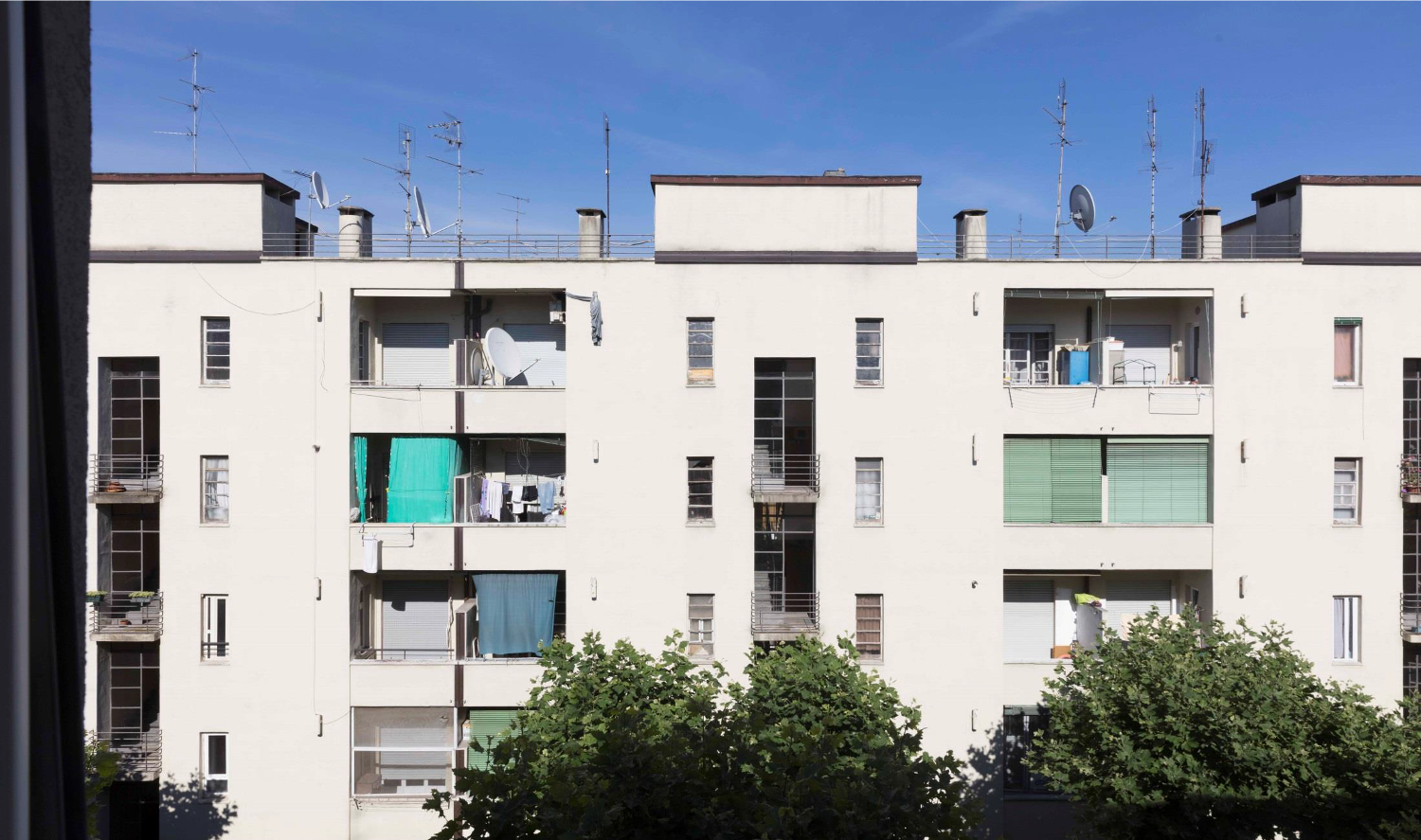
One of the issues that question current urban policies is the requalification of the degraded building stock, reinterpreting the use of the substantial existing heritage without constructing new buildings. The project responds to this issue by combining it with a strong social value since the flats are located in one of the historical social housing districts of Milan, characterized by a progressive precariousness of the structures and by important problems of coexistence between old and new inhabitants and between groups of different geographical origins. Here, introducing members of the most recent population that appeared on the urban scene, the migrants, with an active role in the recovery of spaces, represent the paradoxical impulse to a radical and complex reconstruction of the social texture. The apartments destined for the project are classified as 'under threshold': undersized with respect to the requirements of Regional Regulation no. 1/2004 or in such a state of deterioration as to compromise their habitability. Renovating these dwellings means freeing a part of public housing from degradation and making it habitable again. Moreover, involving young migrants in the restructuring work means cutting costs by 35%.
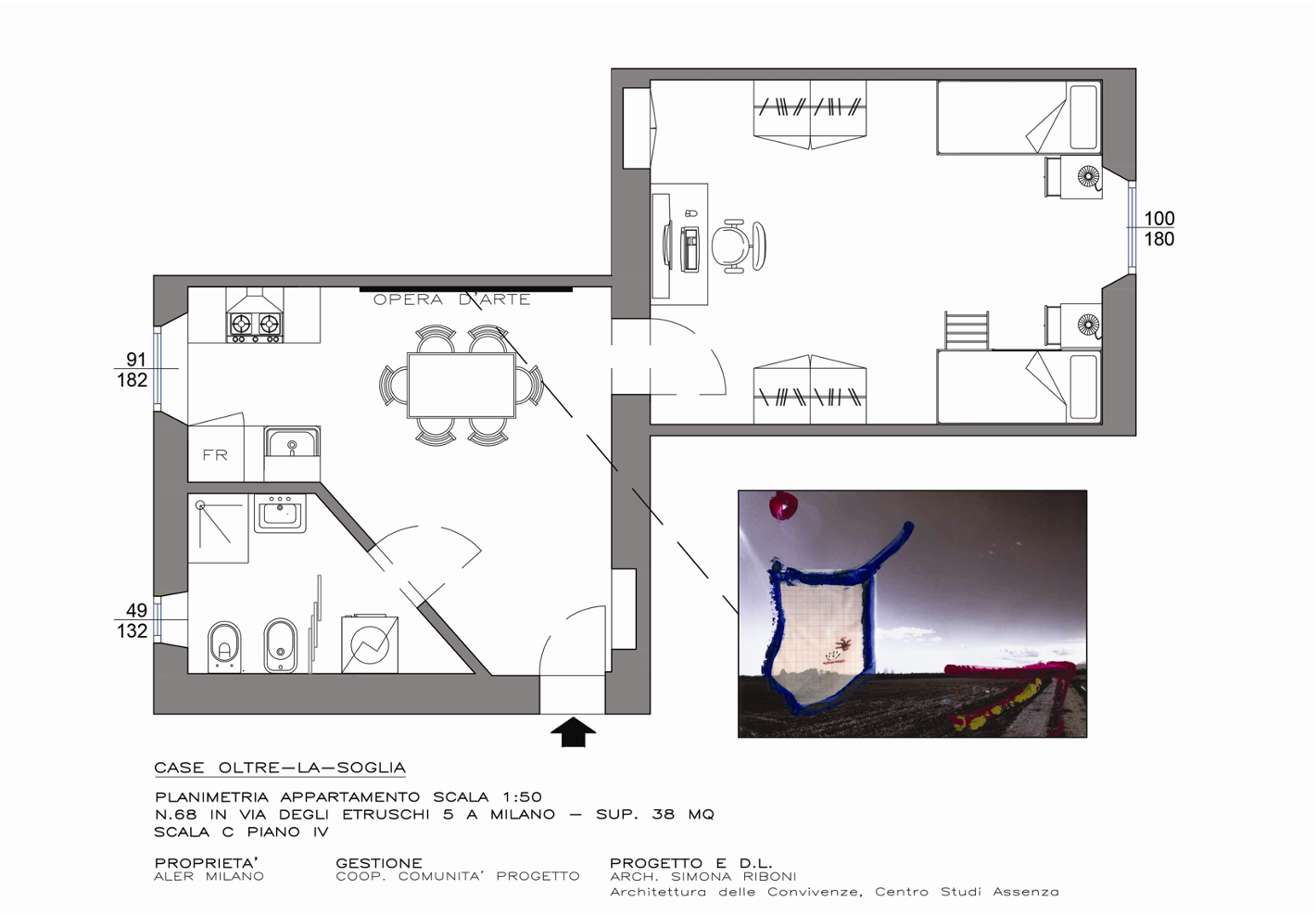
The architectural design of every single accommodation is designed to meet the requirements for housing eligibility. In all cases, they are two-room apartments consisting of a kitchen and a bedroom with three beds. The renovation is intended for a transitory living so the houses are designed to be easily adapted to different future groups of inhabitants for which finding affordable accommodation in Milan is difficult. The redevelopment project has provided that the kitchen and the living room area in a single space in order to promote opportunities for relationships between inhabitants of different origins for which coexistence is not a matter of course.
Key objectives for aesthetics and quality
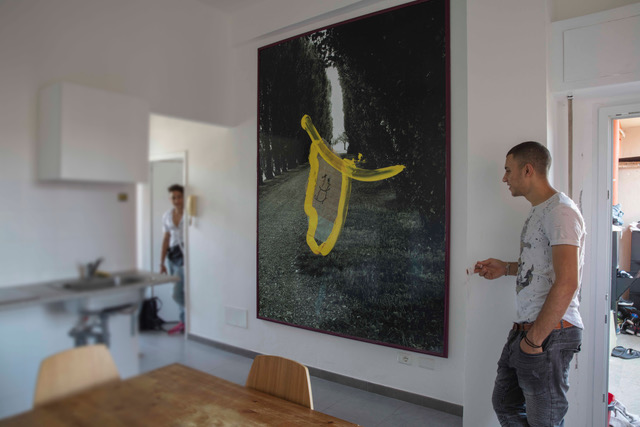
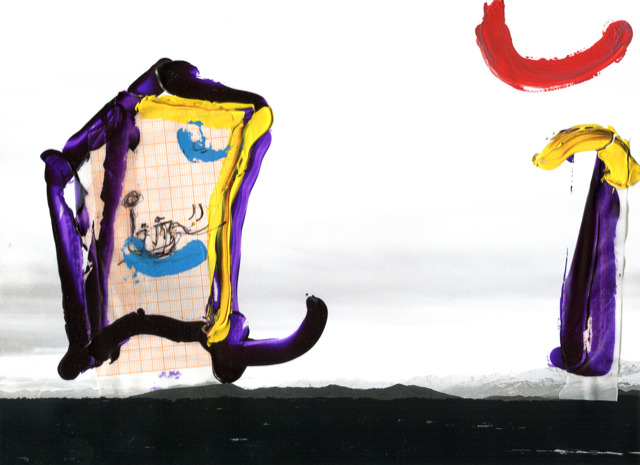
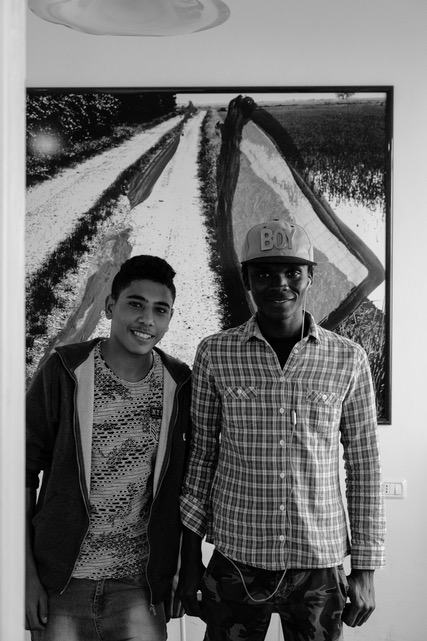
The architectural choice goes in the direction of strong frugality, simplicity, and functionality. Large windows ensure brightness and white walls provide ductility, necessary for the transitory nature of living in these flats. In each apartment, there is a site-specific artwork by Paolo Ferrari, artist, scientist, writer, and musician at Centro Studi Assenza. This works, B/W landascapes' photographs overlaid with graph paper and painted signs, like open windows on the world, introduce a horizon into the house: each level contributes to form a complex whole so that the landscape moves from its usual place, introducing a horizon where “the otherness” can enter. It meets the otherness of who will inhabit these spaces, that is also the condition of “otherness” that characterizes contemporaneity. The artworks expand the physical space of the apartments, inviting the viewer to explore the new landscape that manifests itself in the heart of each house.
Each artwork replaces almost entirely the central wall, which becomes a membrane permeable to observation and to the presence of the observer in relation to it: placing the further plane of an unknown universe, it welcomes the inhabitant and at the same time leads him outside, beyond the threshold. The result of an architectural project that places at its center an aesthetic operation full of social implications, the HBT houses form a network of flats 'doubled' and 'dematerialized' as a writing that overlaps the history of the district tracing a new narrative. The whole installation is part of a network of interventions, where other public spaces are transformed through the same process. The artistic gesture recognizable in each of the installations are intended to act as catalyzers capable of increasing the quality of life and its well-being at every level in the places with which they relate.The network of these artistic-scientific-architectural operations becomes a sign of welcome and defines a new kind of belonging.
Key objectives for inclusion
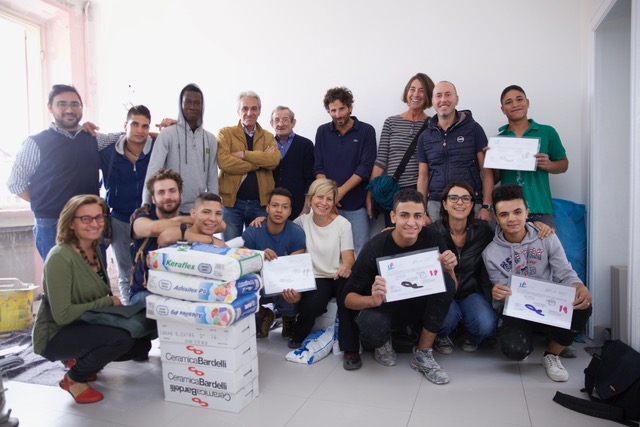
In 2016 Comunità Progetto, thanks to a public call, renewed seven apartments 'below the threshold'. Together Architettura Delle Convivenze and Centro Studi Assenza, it was decided to restructure the living spaces through a program of housing and social inclusion directed at unaccompanied foreign minors that provides the formula of self-recovery: the exchange of skills and common work are the basis of a new model of welcoming. Both from the point of view of the material intervention, both from the intangible one concerning the relational aspects that the recovery activity triggers, and from that of the type of population involved, the project responds to the instances of participation with a path of appropriation, integration and care of public space. The educational project provided 4/6 hours per week for a period between 6 and 18 months and consisted of training in the field, preceded by theoretical lessons and operational moments in which the single work was exemplified. The objective was to allow foreign minors between 15 and 17 years of age to acquire the social, linguistic and economic independence required when, on reaching the age of 18, they have to leave the protected welcome system.
This method overturns the condition of asylum seekers from that of waiting to that of an active disposition to build a place to live. For the receiving society, this also means having the work and skills of these young people at its disposal and offering them a welcoming system based on equality rather than charity. Finally, introducing young migrants into one of the city's historic working-class neighborhoods means including the new inhabitants in our architectural and housing culture. Through the involvement of migrants, the standards by which these dwellings were designed to accommodate, a century ago, a new urban society with changed needs, due to a rapid process of industrialization, are updated in an enriched perspective.
Results in relation to category
By 2017, seven flats were renovated, by 2020 eight more, in the same neighborhood and with the same method. From the cultural side, the project was part of the programming of the Association of Italian Contemporary Art Museums (AMACI): the houses were opened during the AMACI event, and migrants involved met the citizenship. From the economic side, due to self-recovery, renovation costs were cut by 35% and thanks to theoretical and practical training, some of the young people were able to access internships then became permanent jobs in local construction companies: Seven of them have found work and one has decided to continue his studies. Solid relationships have also been created between minors, educators, team and the artist Paolo Ferrari. Regarding the social aspect, both the renovation works in self-recovery and the presence of the site-specific artworks have been decisive elements. During the inauguration day, the young people guided the neighbors in the presentation of the work done and unexpected relationships were created between new and old inhabitants, which, mostly elderly people with a strong perception of insecurity in the neighborhood, previously unwilling to accept the arrival of foreigners, appreciated the care taken in upgrading the housing. Minors also began to take care of common spaces such as stairs, courtyards and entrance so the old inhabitants understood that this new presence improves the entire context, thanks to overall care of the common good. Today it happens that young people help the elderly to carry their shopping bags and that they share moments. This extraneity no longer triggers a feeling of mistrust but begins to emerge as an important contribution. The aesthetic sign and the cultural element become drivers of regeneration of private space, but also of the common good and the quality of living in these places. Today, the houses host other minors to whom is explained the care work of the young migrants in upgrading the flats.
How Citizens benefit
The project has strong social importance because the flats are located in a historical district of public social housing affected by changes of inhabitants’ economical conditions, progressive degrading of physical structures, and coexistence’ problems of people with different geographical origins. Here, in the last two decades, the results of the social texture dissolution became evident: a district originally inhabited by the working class, which breaks apart and produces conflicts and mistrust between old and new inhabitants, nucleus of deep poverty, loneliness. The entrance of migrants in this social context – the newest of the populations arriving on the urban scene – with an active role in space restoration, represents an input to a radical reconstruction of that texture.
A second issue regards the direct involvement of inhabitants and the contribution they could bring to urban regeneration. The project responds to the issues of participation through a process of appropriation and of public space care through different points of view: the material intervention on the building renovation; the immaterial action concerning the relationships generated by the restoration activity; the kind of the involved population. The learning practice whit the minors generated an appropriation process of the space they were transforming that allowed an identification with the place and the recognition of a sense of belonging necessary to start a citizenship process; at the same time, it has allowed a non-permanent belonging, since the apartments are designed for transitoriness. The work of self-recovering, affirming the minors' own presence in the place, is conceived as an activity for themselves and for the ones who will come after, in this way opening to that care of the common space.This process of appropriation and dis-appropriation gives important suggestions to urban planning: those people should become architects of the material and immaterial requalification of the city
Innovative character
Beyond the threshold of belonging: the project opens glimpses on transitoriness, which is increasingly characterizing the transformation of the city, while the planning tools are still tied to a permanent dimension. The project shows how a new paradigm of living, based on precise ethical instances, can be a model for a discipline called to measure itself with temporariness, intended in the functions of space as well as in the permanence of the inhabitants. Beyond the threshold of the current welcoming policies: the project is based on an idea of reciprocity and on an exchange with high cultural content. The complex artistic-architectural, educational and political program in which the work of self-recovery is inserted, aims to meet not only basic needs but to give life to spaces that are both places of learning and production of (new) culture. In this way, it tries to see in the “other” not a surplus but an extraneousness that asks to be welcomed on a ground of equality. Beyond the threshold of sheltered housing: the work with foreign minors is part of a wide-ranging care framework: starting a hospitality program with the active involvement of the beneficiaries themselves means creating the basis for a project of economic, social, housing, linguistic and relational autonomy. It is not a path of protected shelter, but a journey towards independence. A process that allows identification with the place to be inhabited and therefore the recognition of belonging that is indispensable to undertake a path of citizenship and, however, not a fixed belonging. The work of self-recovery is conceived as work for oneself and for others who will come after: the migrants become builders of welcome. Beyond the threshold of the everyday horizon: the project founds a new conceptual language in which the cultural-artistic element becomes a driver for an effective path of citizenship, new overall care of a common housing context, and a general increase in the quality of life.