Vertical Community
Basic information
Project Title
Full project title
Category
Project Description
The project is part of a wider masterplan in Porto di Mare and it aims to restore a sense of belonging to the context by constructing a sharing community inside a tower. This project displays great attention both to social inclusion and to environmental sustainability. Specifically, it is designed following the paradigms of the circular economy, benefitting from the reuse of local materials and dry-construction techniques that encompass the possibility of future modifications.
Project Region
EU Programme or fund
Description of the project
Summary
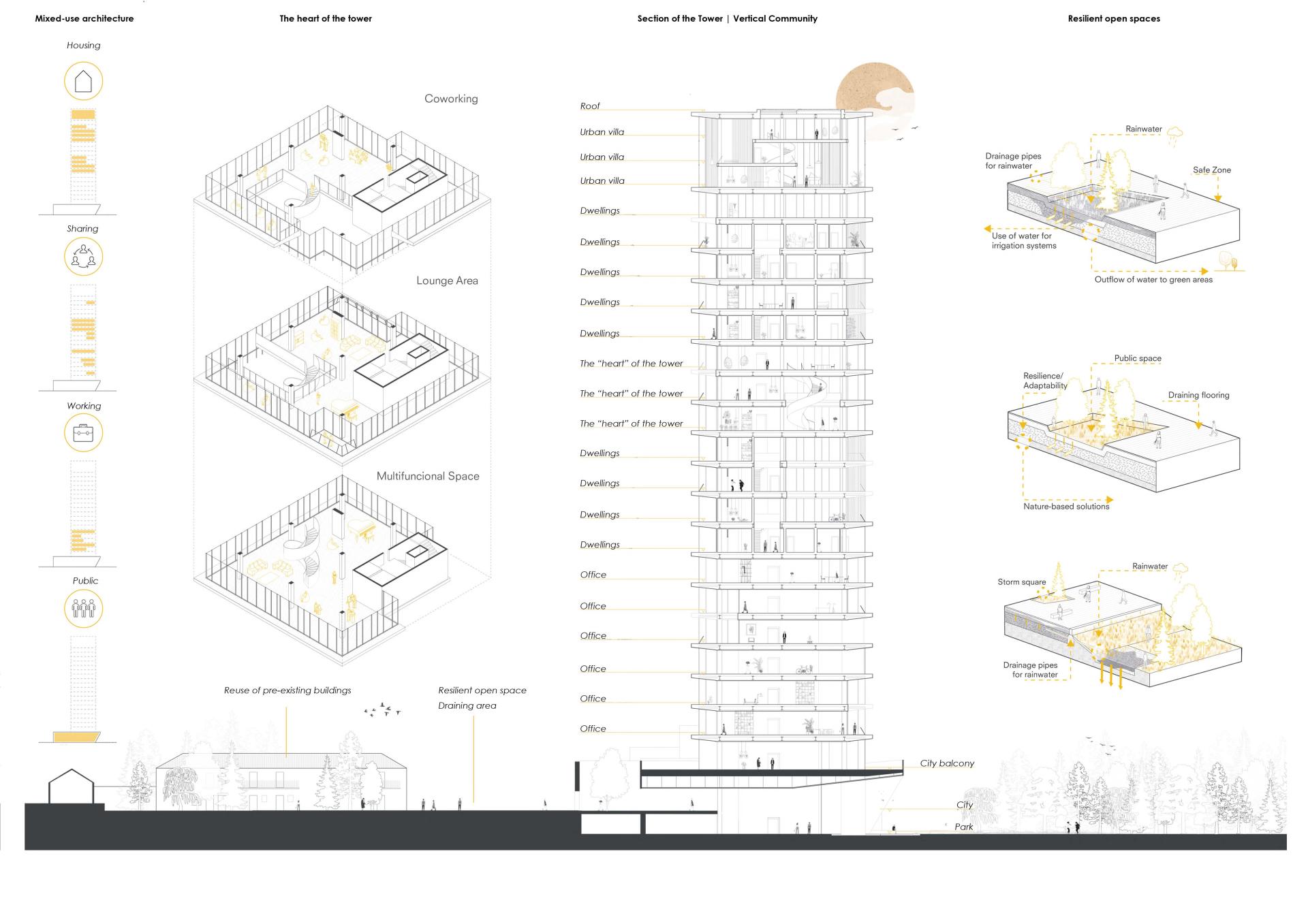
The project aims to restore a sense of community, unveiling the past identity of the place: previously it was a harbour, where water was crucial for social growth. The concept of the “rooting”, that characterizes this architecture, has a double connotation both physical and social. The former is declined through the position of the project, connecting the city level with the park. The latter considers the functional mix as a chance to create a vertical community.
The lower part of the tower hosts some workspaces (offices, co-working and hotelling) meanwhile, the higher one some dwellings. The “Heart of the tower” with its shared floors, becomes a fundamental space for social cohesion. The tower deals with social resilience aspiring to the creation of a vertical community that through a mixed-use layout, shared spaces and public space at the city level, bring social benefits. The relationship between the “Sky and the Earth” is considered a crucial element for the project; the building becomes, in fact, a medium of connection between these two dimensions. In this sense, the architecture is rooted to the ground through its “heavy” base but stands out against the sky with the tower; this concept is related also to a technological approach. The “light” part of the building is expressed by a dry construction that allows future modifications, instead, the “heavy” base is conceived as a permanent element, able to redefine the city of the future.
Key objectives for sustainability
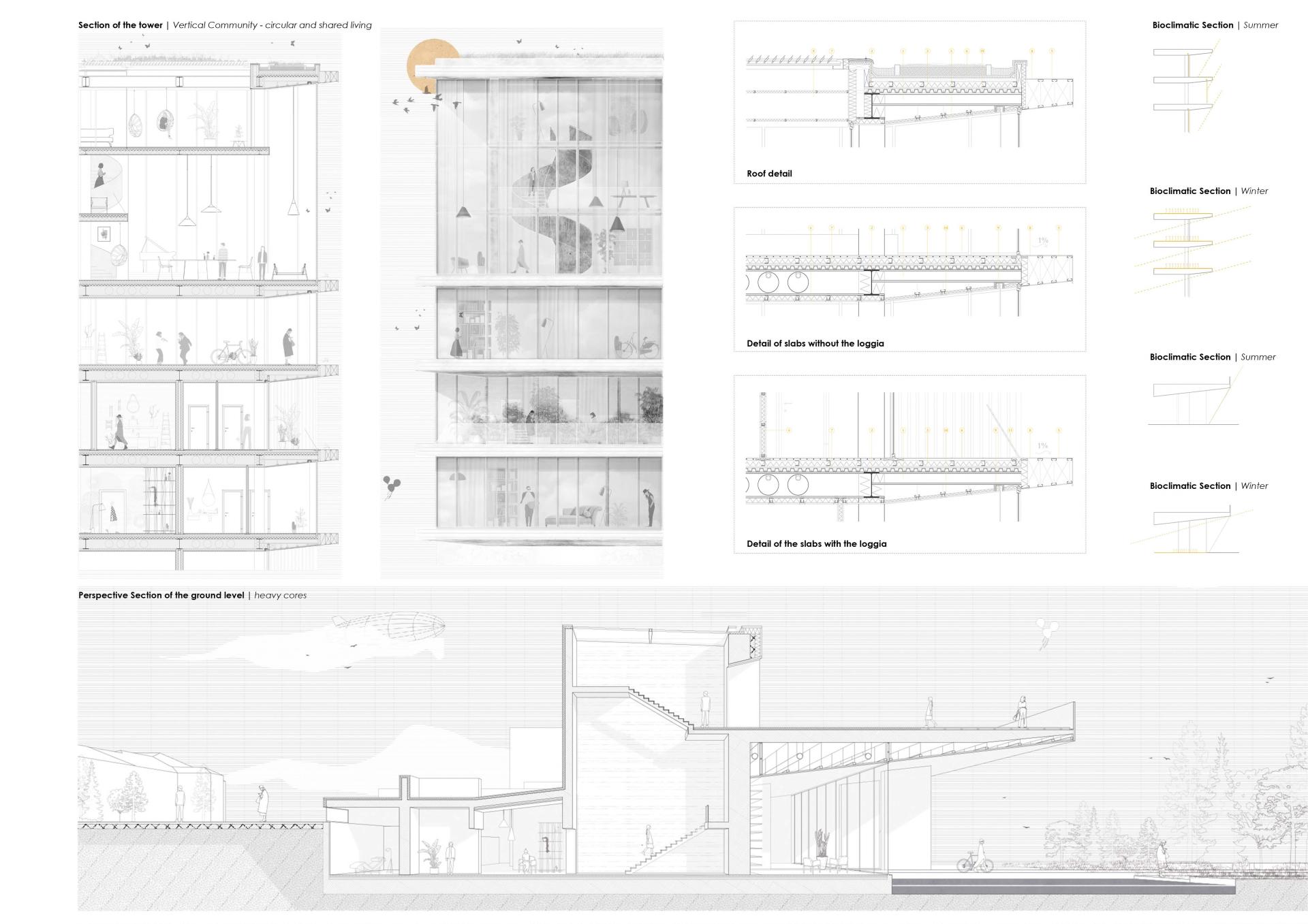
The aim of this project was to develop the entire process with a circular logic, renovating the urban periphery and, at the same time, giving new spaces for people. Implementing the circularity throughout the design process meant thinking about the specific material and construction technique to use from the very beginning of the project. In this sense, the environmental sustainability of the tower is thought through the concept of “design for disassembly” where the dry construction will give complete flexibility to the tower, reducing the waste and pollution for future modification of the building. Consequently, the sustainability of the project is achieved by thinking about the life cycle of the singular materials and of the whole project, imagining future developments and reuse of the building. On the other side, the basement, which is rooted to the ground, recalls the concept of permanence and creates a new access to the park thanks to some heavy cores that contribute to the construction of a city on multiple levels.
At the same time, it envisioned social sustainability, through the construction of a public library and public spaces for social cohesion. Environmental sustainability, moreover, is pursued thanks to the bioclimatic approach to design; the architecture is characterized by tapered slabs that allow the sun to enter during winter, shading it instead during summer. Moreover, the use of massive materials for the finishing produces thermal gains inside the building.
Key objectives for aesthetics and quality
Starting from a quote from Go Hasegawa: “Every Building is enveloped in the structure of the Sky and the Earth”, the relationship between these two dimensions is identified as a crucial element for the development of the project. The founding element is that which sees the building as an instrument of connection between these two dimensions. The architecture is rooted in the ground through the base and stands out towards the sky, with the tower.
The intent is to integrate the aesthetic of heaviness and lightness within the project, through the use of both mineral elements and lighter ones.
The access level to the park sees the mineral elements display more intimate spaces, enclosed within the library, creating, through their arrangement, different interiors. These heavy elements emerge from the ground connoting the upper space whose destination becomes a public space, with seats, raised platforms, reading rooms and mirador on the park, developing a sort of city on different levels.
The base, through compressions and decompressions, opens towards the park, projecting itself towards the open space, directing the view. This portion of the project - the base - defines a series of relationships with the city and is, therefore, the fixed part of the project, which instead changes its definition in its vertical development.
The experience of the building highlights the relation between light and shadows, making clear which are the permanent and flexible parts of the new tower.
Key objectives for inclusion
Inclusiveness is one of the core ideas that drove the project. Nowadays, the area is subject to severe phenomena of social degradation, marginalization, illegality, which strongly influence the management and way of living of these spaces. The project, therefore, investigates the notion of social resilience by structuring a new local community that avoids the idea of a monofunctional area, rather mixes different users and functions.
The building presents different grades of inclusivity. For instance, the public basement is designed to host the citizens and offer a variety of cultural and social initiatives. Indeed a series of public areas will link the public park with the city, defining new sharing spaces.
Moreover, the tower, through the mix-use spaces, aims to define a vertical community, in which private and public spaces interact. The multifunctional space will blend work, housing, local production, and sharing spaces, looking towards the site's future development with the Milan-Cortina 2026 Olympics.
At the centre of the project, the so-called “heart of the tower” presents a series of common floors, where people can gather together and share a series of facilities, to bond and connect one to each other. Rooting a community to this territory will re-activate this neglected area and could represent a step toward a more fair and inclusive society.
Innovative character
The project shows the paradigms of resilience and circular economy, considered as a chance to redefine sustainable growth for the city. Resilience is intended in its social connotation by creating shared spaces and public spaces for social cohesion. This is achieved by creating common spaces throughout the building, planning to have shared mobility and services.
In this horizon, the project envisioned the possibility to integrate circular logic and social perspective, in which the permanent spaces of architecture are the public ones, designing not only spaces but values for the territory.
The Circular Economy approach declined inside the project, in addition, is also related to the construction techniques used, studying the whole building as potentially dismantled, so implementing the dry construction as a driving concept of the project. This aspect is considered in a positive perspective not only from an environmental point of view but also from a social point of view since it allows easy adaptation, especially the internal spaces for users’ needs.
Finally, this resilient design approach is not framed as punctual technical solutions, rather as a systemic approach to reinforce the social and environmental quality of the peri-urban Milanese area.