The Standaert Site
Basic information
Project Title
Full project title
Category
Project Description
Since its completion, the Standaert site has become the beating heart of a dense, 19th century workingclass neighbourhood in Ghent. Formerly a hardware store, the site was developed into a much needed green city oasis and meeting place for the community. Located at the centre of the green space is a community centre that houses a great number activities and initiatives for the wider neighbourhood.
Project Region
EU Programme or fund
Description of the project
Summary
At the end of 2013, the City of Ghent purchased the terrains of the former DIY shop Standaert and organised a competition for its reconversion. The renovation of the site was a unique opportunity for Ledeberg, one of the most densely built neighbourhoods in Ghent with barely any green public space. It was important for the design team to keep a maximum of outdoor space and a minimum of built space.
The City of Ghent started a participatory process to temporarily open the site for neighbourhood initiatives and appointed BUUR study to draw up a widely supported masterplan for the site. Afterwards, Sogent, the Autonomous Municipal Ghent Development Authority bestowed the design allocation for the ultimate renovation to the joint venture of ‘ae-architecten’ and ‘H110 architecten and engineers’ with subcontractors ‘Murmuur architecten’, ‘Carton123’ and ‘Atelier Arne Deruyter’.
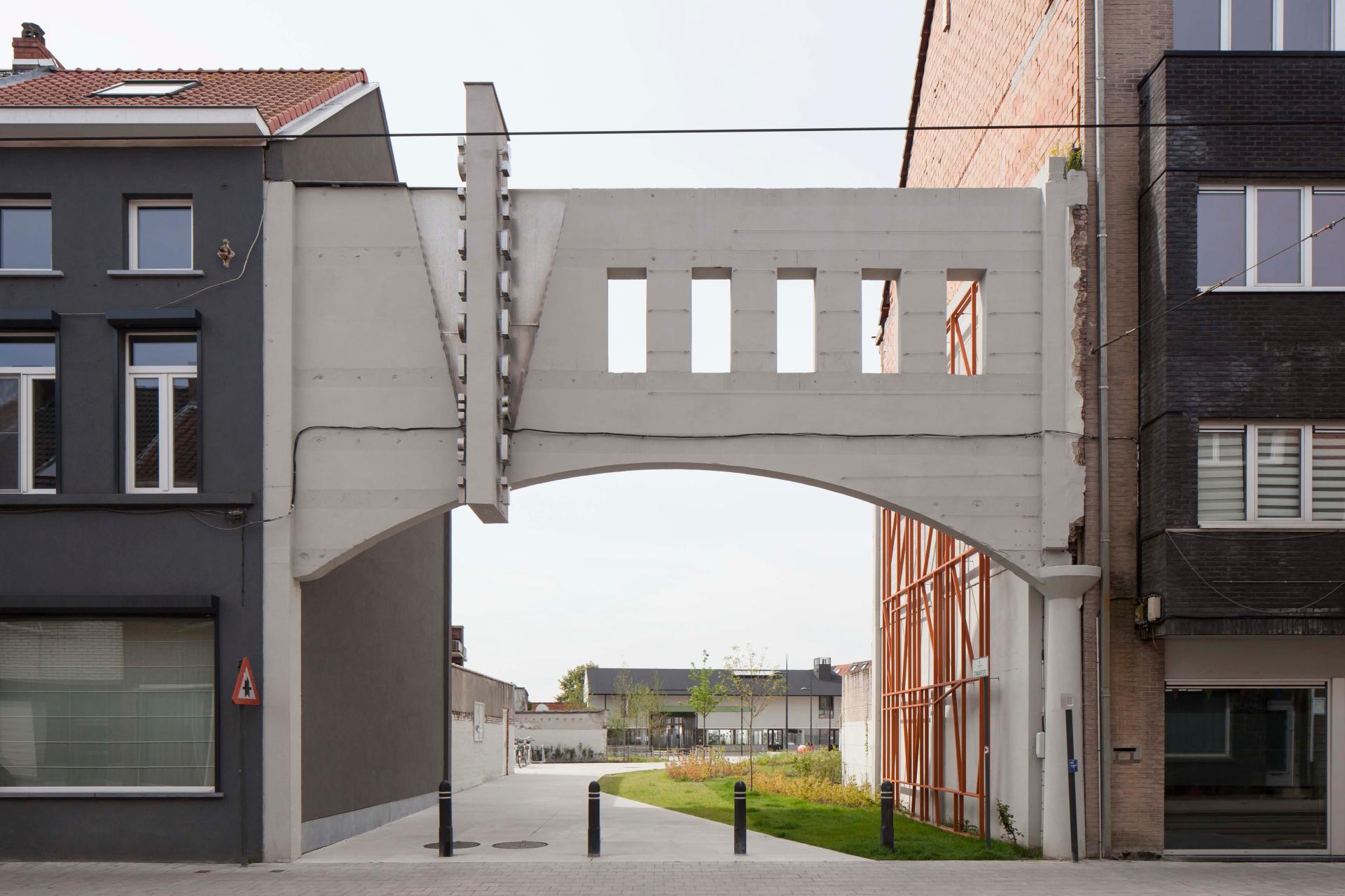
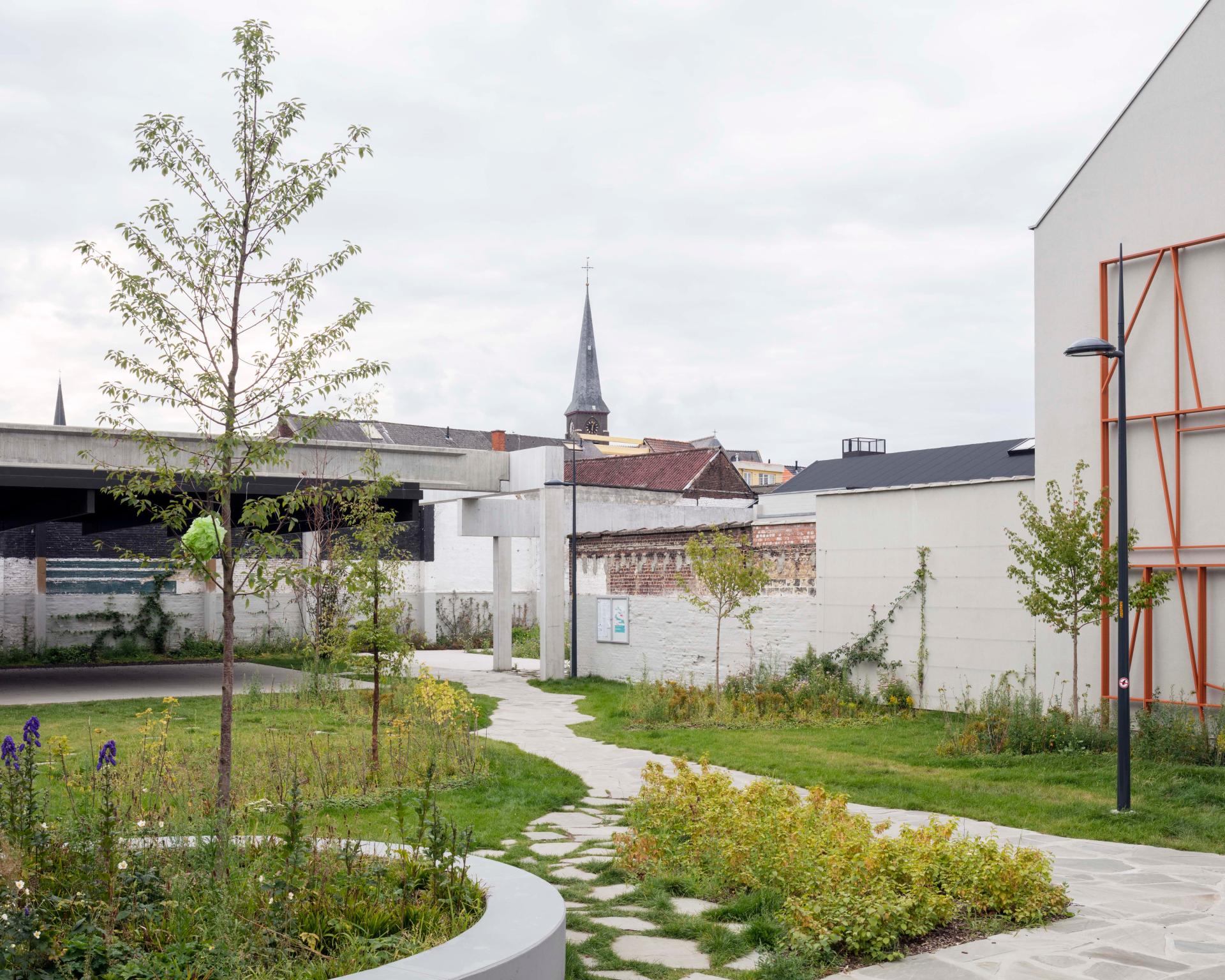
The nature of the site, having two points of access, enabled the creation of a passage through the urban fabric. Using a strategy of designed demolition, a process of carving out the interior of the urban block, we were able to provide a fordable sequence of green spaces.
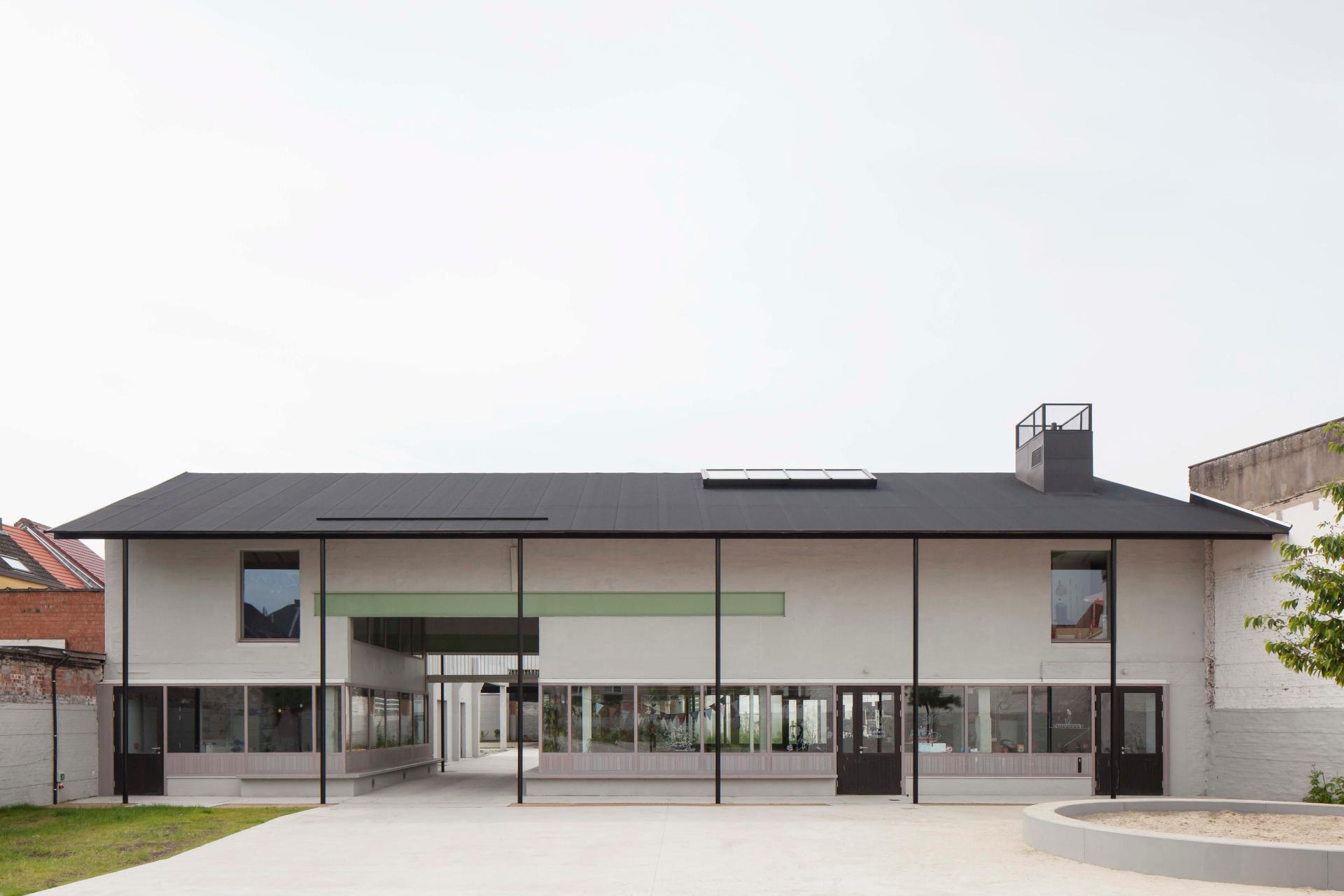
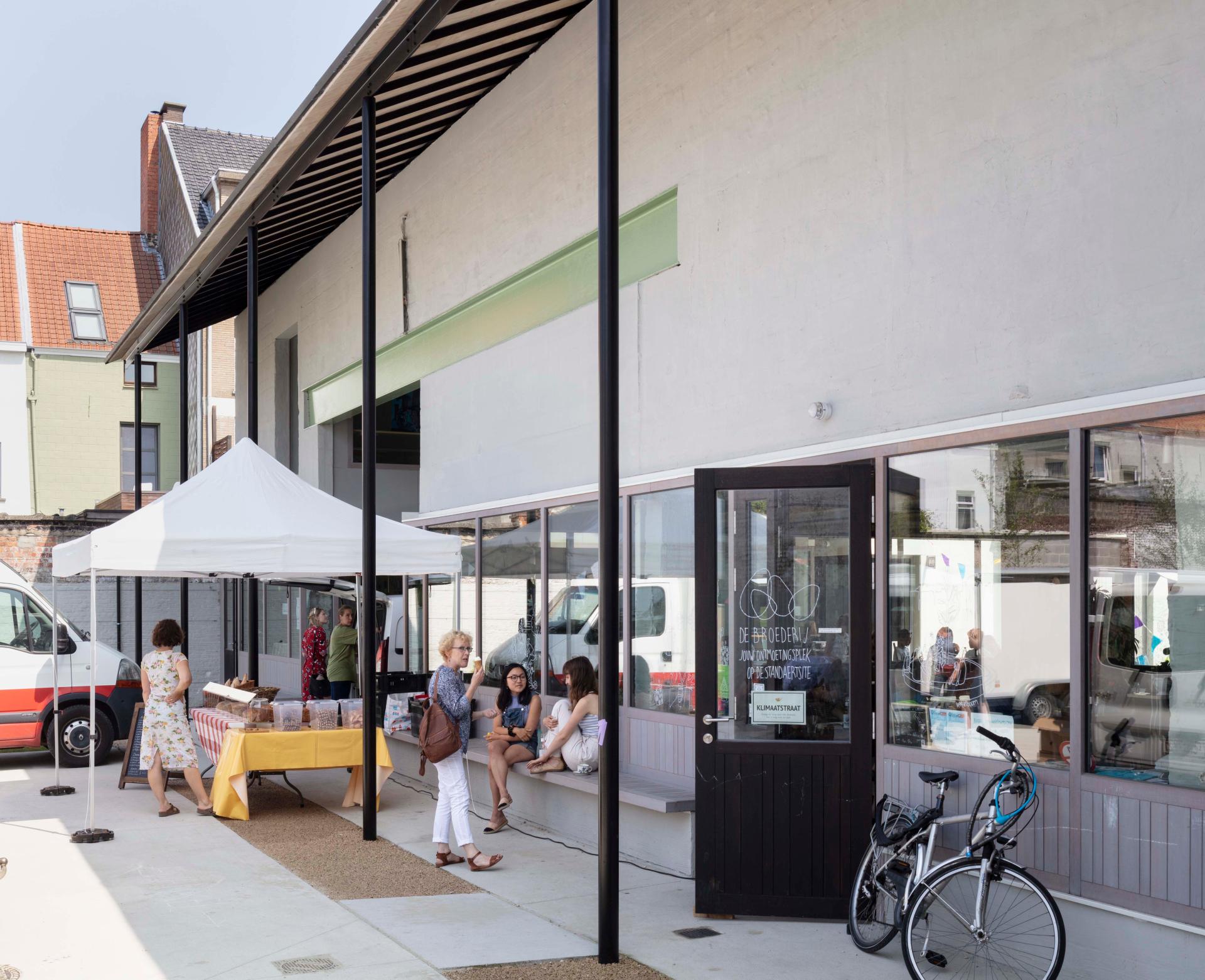
At the centre of this route, the beautiful shed with fine timber framing was restored in its former splendour. This slender building forms the pounding heart of the site, comprising a wide range of neighbour activities. The ground floor glazing, coupled with a large passageway through the building, provides a transparency that connects the two sides of the route. The multipurpose spaces located on the first floor are introverted. This gives the spatial appearance of the park flowing beneath the building above.
The built volume on the site is kept compact. A large awning in the corner of the site accommodates activities that have less need of heating, such as neighbourhood parties, concerts, markets, etc. It forms the backdrop to the park, seen from the adjacent street: the Hilarius Bertolfstraat.
Key objectives for sustainability
Because of the lack of collective and private green space in the densely built district, it was important to maximize the share of green space and to deploy the built area in a limited and rational matter, in order to bring more quality of life and air within the area.
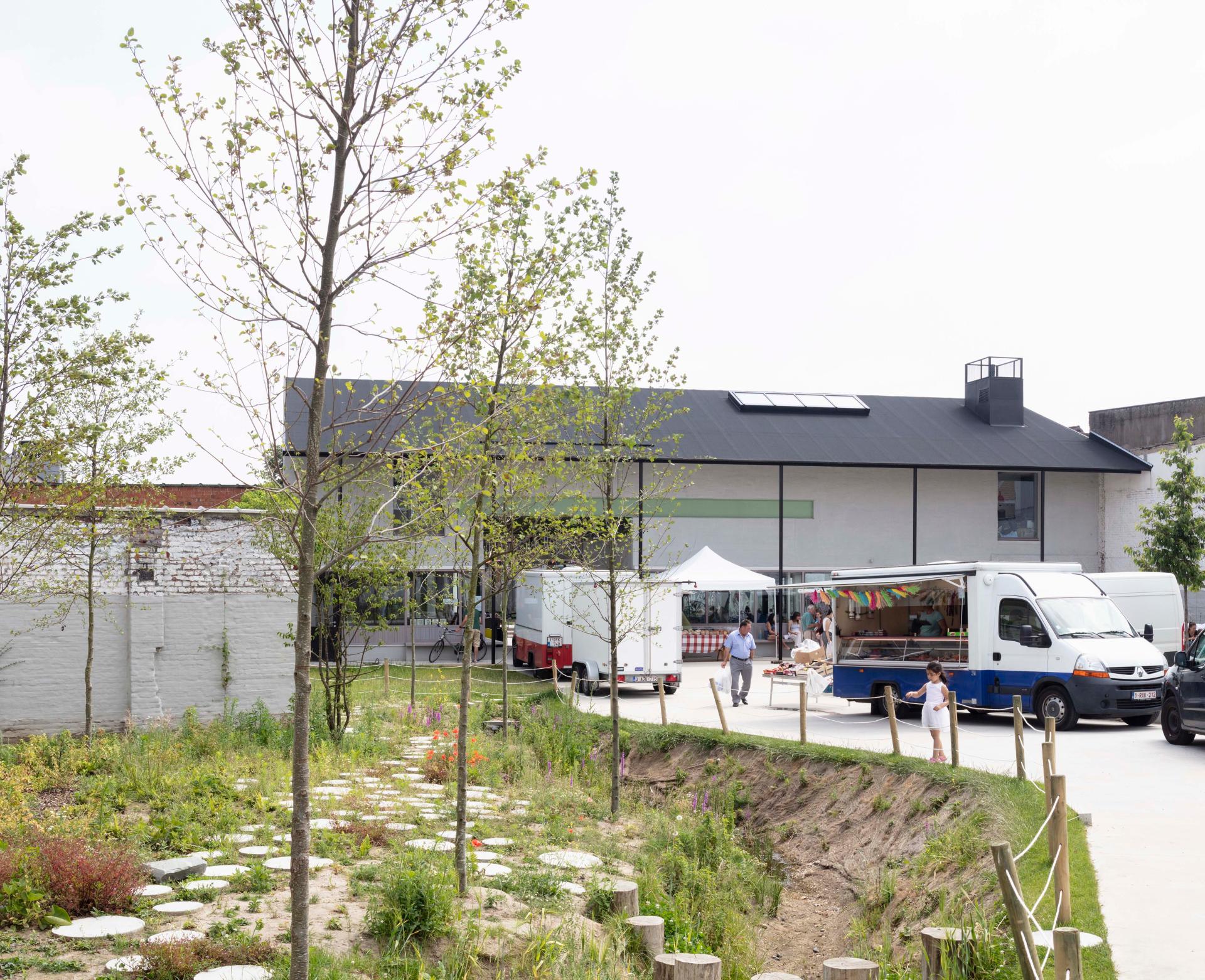
To the community centre building, which occupies the existing structure, a lightweight roof was added with large overhangs on each side. The rainwater from the roof leads to a porous gravel ground surface and from there is infiltrated via a wadi. This wadi ensures a delayed drainage and infiltration of rainwater. The rainwater from the roof of the sanitary facilities and the storage rooms is collected in a rainwater tank and recovered for the sanitary facilities and for watering the vegetable garden.
The reconversion of the site focuses on the recovery of materials and buildings. The canopy is made of laminated beams from the demolished sheds, which were carefully stored on the site during the construction works. The reuse also limits transport and the production of new materials.
The site is easily navigable for pedestrians and cyclists. The bicycle racks on both sides invite people to stop and explore the area on foot. In addition, the paving ensures a smooth and pleasant passage from the adjacent streets.
Last but not least, this project has a strong social base, is also fully committed to social sustainability. The community associations that occupy the building stand up for people in vulnerable positions. They address them on the site, organise moments of conversation, workshops, food distribution. All of this to stimulate the neighbourhood to mingle and to creativity in a very accessible way.
In the park, trees, berry bushes and flowery lawns alternate, and climbing plants on the many walls surround the site. By mixing "home cultivation" with flowering, scented plants and large shadow-providing trees, this becomes a "pleasure garden" for people, flora and fauna of great biodiversity.
Key objectives for aesthetics and quality
The Standaert site touches two streets diagonally in the dense centre of Ghent. Apart from this interface, the site extends deep into the inner area, surrounded by garden walls and buildings. The designers' main intention was to keep the park area as large as possible and also to allow it to have an impact on the two adjacent streets. The built area was deployed in a limited and rational manner. The community building at the centre of the site was retained and restored to its former glory. Here, simplicity is a key. The building was given a layer of paint and new exterior woodwork makes it radiate warmth. A green steel girder in the facade refers to the old opening in the shed. The building radiates in beauty in its simplicity while keeping a warm, accessible appearance. Moreover, it is extremely functional and logically devised.
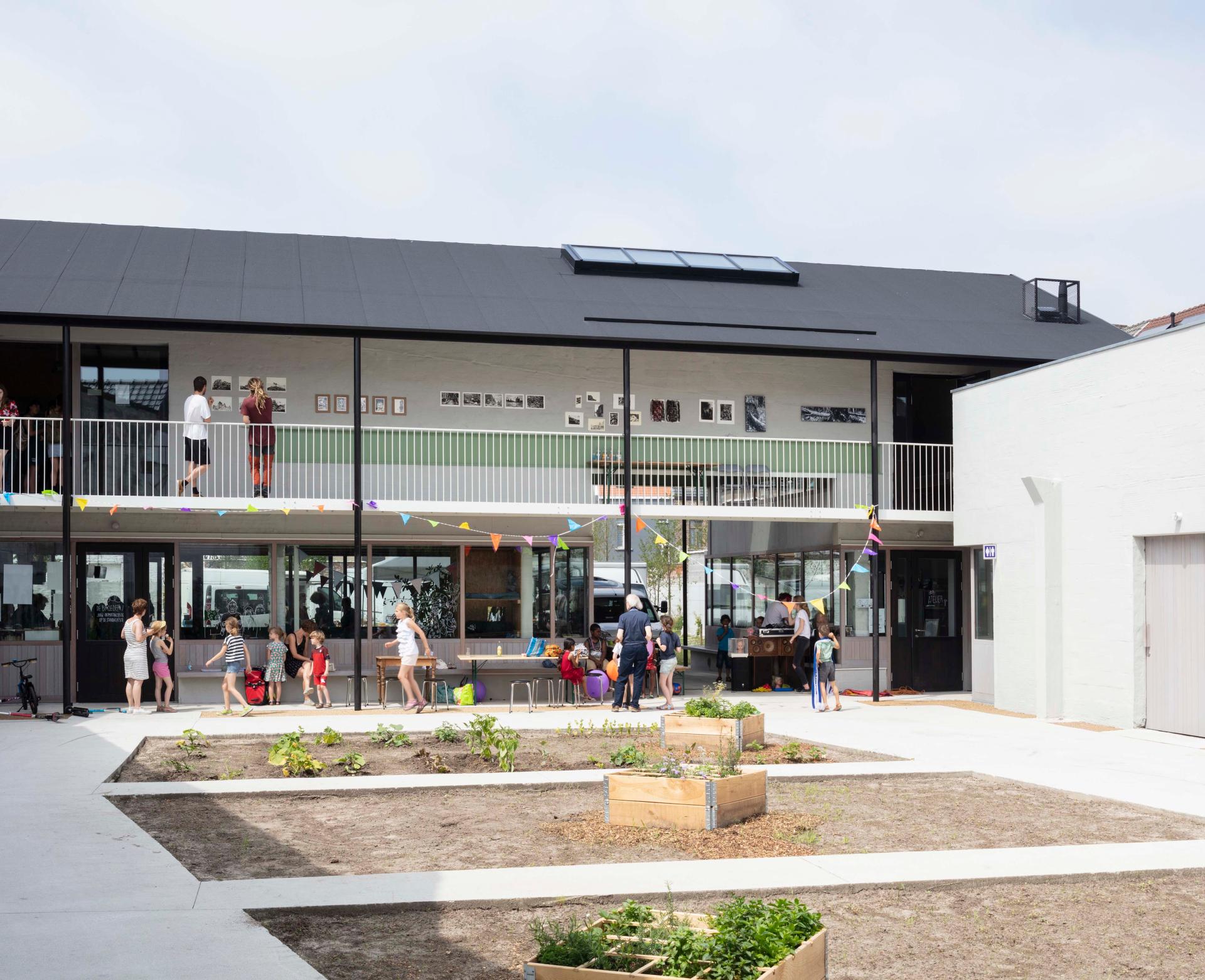
From the community building, visitors have an overview of a large part of the park. The architecture explores the possibilities of boundaries between the inside and the outside. Benches offer space to meet under the spacious roof overhangs. A transparent pedestal strengthens the view.
The large, clear awning in the corner of the site provides space for activities that don’t require indoor comfort, such as neighbourhood parties and markets, sports and games. The awning stretches between the site’s shared walls. It is free of columns, not to obstruct the flow of the park and constructed as a roof from the reclaimed laminated rafters.
The park extends to the streets and brings greenery to the edge of the pavement. It briefly breaks through the rows of facades. The entrances are kept clear and the provisional facades are completed. Works of art by Belgian artist Marc Nagtzaam adorn the provisional facades as steel line drawings, upon which climbing plants can grow.
Key objectives for inclusion
The architecture of the building is very open and accessible. The path crossing from Hoveniers street is made from smooth concrete and includes a gentle slope to allow a smooth passage for people in a wheelchair. There is also a lift to the central renovated warehouse so that visitors who are less agile can still access the first floor of the building.
Crossing the site from one entrance to the other also means crossing the building. This openness ensures that community associations have a very explicit and accessible presence. All community associations at the site support an inclusive society. The passway underneath the building, the glazed façades and the benches make it possible and pleasant to meet all members of the society. The activities in the community centre are also widely accessible for the entire neighbourhood. They include a diverse program for all ages with a.o. circus acts, photography and art workshops, yoga classes and choirs. Soup is made from vegetables grown on site and the farmers' market takes place every Wednesday.
In short, the Standaert site is there for and thanks to the neighbourhood.
Results in relation to category
This city district of Ghent is known to be densely built with a lack of public space and not many private gardens. The redeveloped Standaertsite proved to be a much needed engaging public place in a neighborhood that has too little of it.
The Standaertsite previously hosted a DIY-shop. However, when it went bankrupt local inhabitants had a feeling that the site is an important public part of the neighborhood and shouldn’t transform into something like a new housing or other ordinary real estate project. Locals were clear about one thing – the neighborhood is missing public spaces and this should remain one. So they formed an initiative “We can do it ourselves!”
As the City of Ghent recognized the lack of public spaces in that area, it was willing to join the vision of local inhabitants and work together with them. Therefore, the city bought the area in November 2013 in order to develop it into green, open meeting space for local people. Immediately after the purchase, a participatory process was started in which a temporary filling offered an insight into what was possible on the site.
The central location of the community centre makes it a perfect meeting place. The architecture and the green public space lead to informal and spontaneous encounters, to meeting and sharing. The passway and glazed facade create openness. The green gardens extend to the street sides, attracting people to discover the park.
In the building the spaces are seperately accessible and usable. The external lift with passerelle provides easy access to the first floor. The covered porch with benches and the awning make it possible to meet and organize activities outside, even when it rains.
In addition the deaf centre Emmaüs, a neighbor, has a direct access to the Standaertsite. The centre is a home for deaf people who often find it harder to make contact, or to access activities in the neighborhood. By openly and literally making the connection to the site, they are involved.
How Citizens benefit
When the do-it-yourself shop Standaert announced its bankruptcy, the City of Ghent was already in talks to buy the land. Within the framework of the urban renewal project 'Ledeberg lives', the City had been looking for extra space in the heart of Ledeberg, district of Ghent, for some time. It was immediately clear that the property, given its central location, offered a great opportunity.
Shortly after the Standaert family filed for bankruptcy, the residents' initiative 'Ledeberg Does It Themselves' was born, with united Ledeberg residents striving to make the Standaert site available to the residents. The initiative focused on creating an open, green and traffic-free outdoor space with a place for Ledeberg organisations. An important condition was that the people behind it could help decide on the final content of the Standaert site as well as its management. And so it was a unique opportunity to create a new green meeting place in densely built district, accessible for all local inhabitants.
In developing a new use for the Standaert site, the needs and wishes of the neighbourhood were first extensively questioned. The community initiative gave the starting signal by organising a referendum on the future of the Standaert site. The most important needs were clear: space to meet, both outdoors and indoors.
In anticipation of the definitive layout of the Standaert site, a group of residents temporarily set to work in consultation with the City of Ghent. They organised numerous activities for the neighbourhood together with other local actors. This way, associations and active residents could start to experiment and understand the future possibilities. This 'practice time' was also used to help shape the definitive content of the Standaert site.
This cooperation and participation by the neighbourhood led to a supported and successful project.
Innovative character
The innovative character of the site can be found in the participatory process that characterizes this project. The way in which local residents were involved in the redevelopment of the site from the outset is truly unique. They were able to contribute ideas from the very beginning of the master plan and have been shaping the site to this day. The local government encourages them in this and also listened to the request for a meeting place on the site for the many community associations in the neighbourhood.
In addition, there are few places where a community centre is integrated centrally in a city park. It makes the building very accessible to everyone and the people approachable. In a place that is highly susceptible to vandalism, the building acquires a kind of fragility and at the same time it is the rock to rely on, a place where everyone can feel at home.