Melopee
Basic information
Project Title
Full project title
Category
Project Description
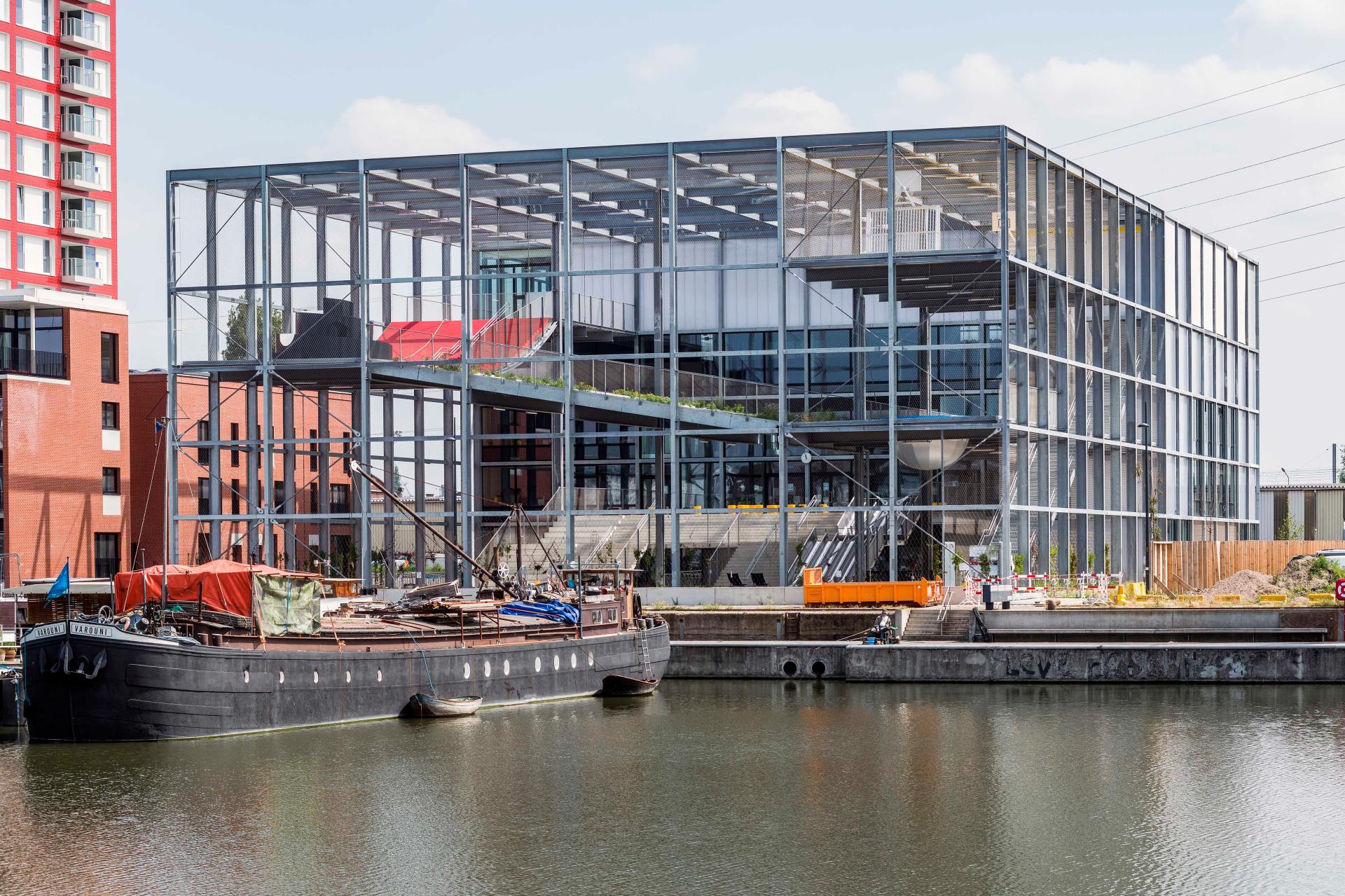
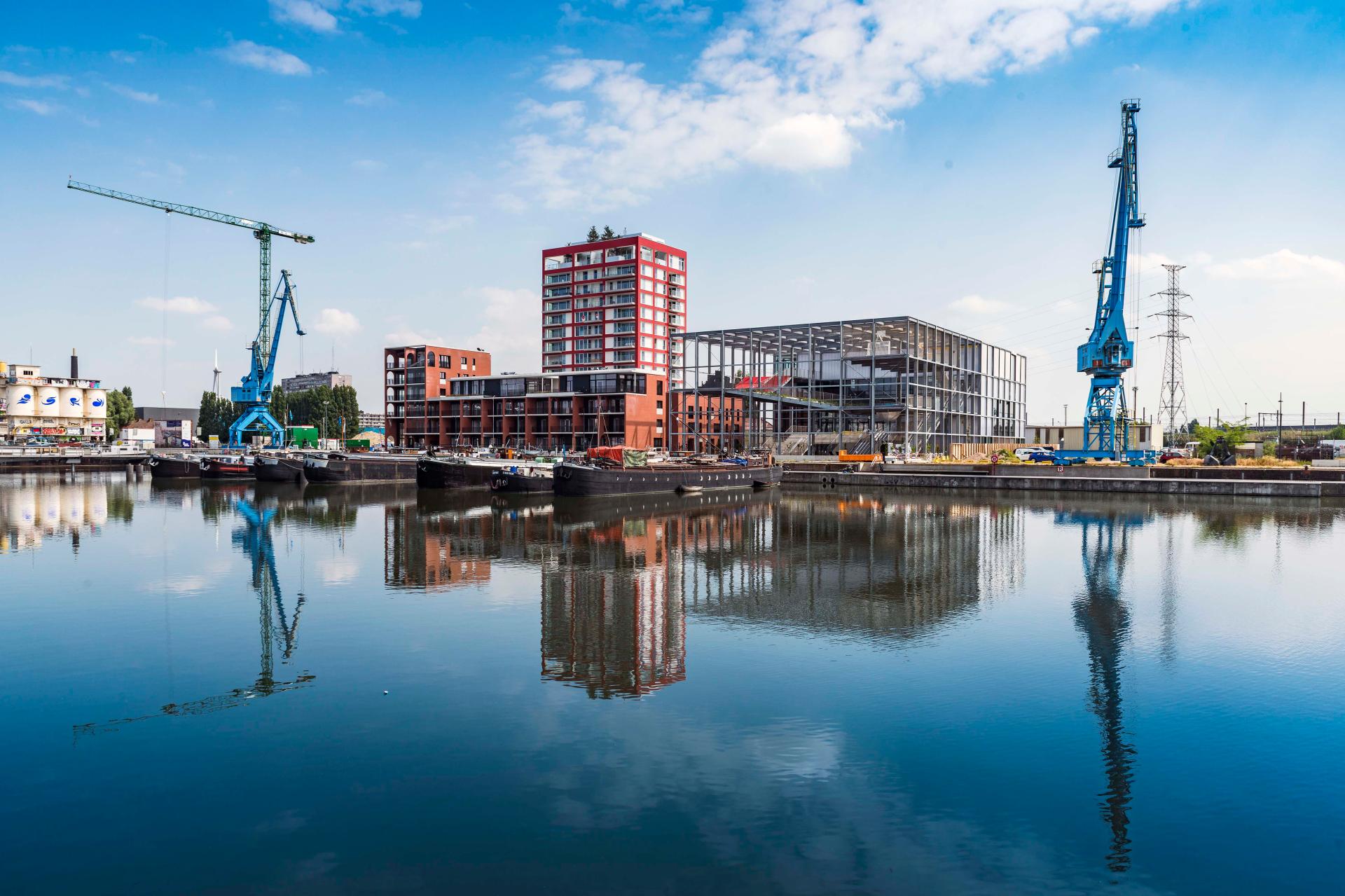
Melopee is a multipurpose building located in the Ghent docklands, a former industrial area transformed into a new vibrant city district. As its residential community gradually develops along its quays, this public city building takes on its role as a central hub that is both a school and a social facility. In a clever design, parts of the building are open and connected to the neighbourhood. It exemplifies a new and bold way of thinking about education, open space and social interaction.
Project Region
EU Programme or fund
Description of the project
Summary
In 2004, sogent launched an urban development competition which was won by the Dutch office O.M.A. It proposed a very simple ‘chopstick’ urban plan in which green public spaces alternate with buildings along the quays. As the new vibrant city quarter also needed public services, the city building Melopee was conceived and planned at the very heart of the district. The architecture contest was won by XDGA Architects from Brussels.
The requested program for the building, a combination of a primary school, an after-school care center, a nursery and community sports hall for both the school and its neighbourhood, is diverse and extensive. On top of this, the masterplan called for a public pathway as well as sufficient and varied outside playgrounds. All of this on a relatively small plot of land.
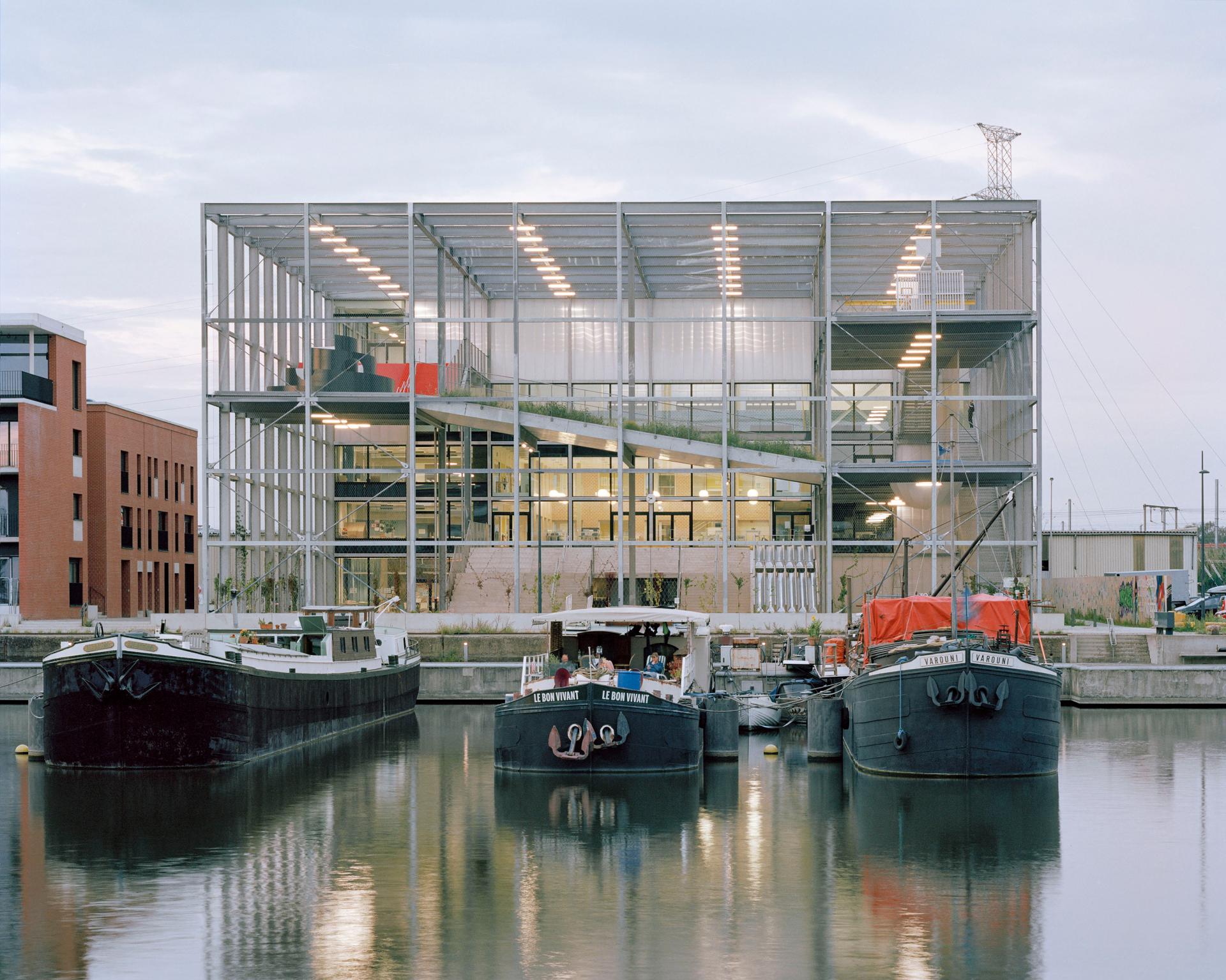
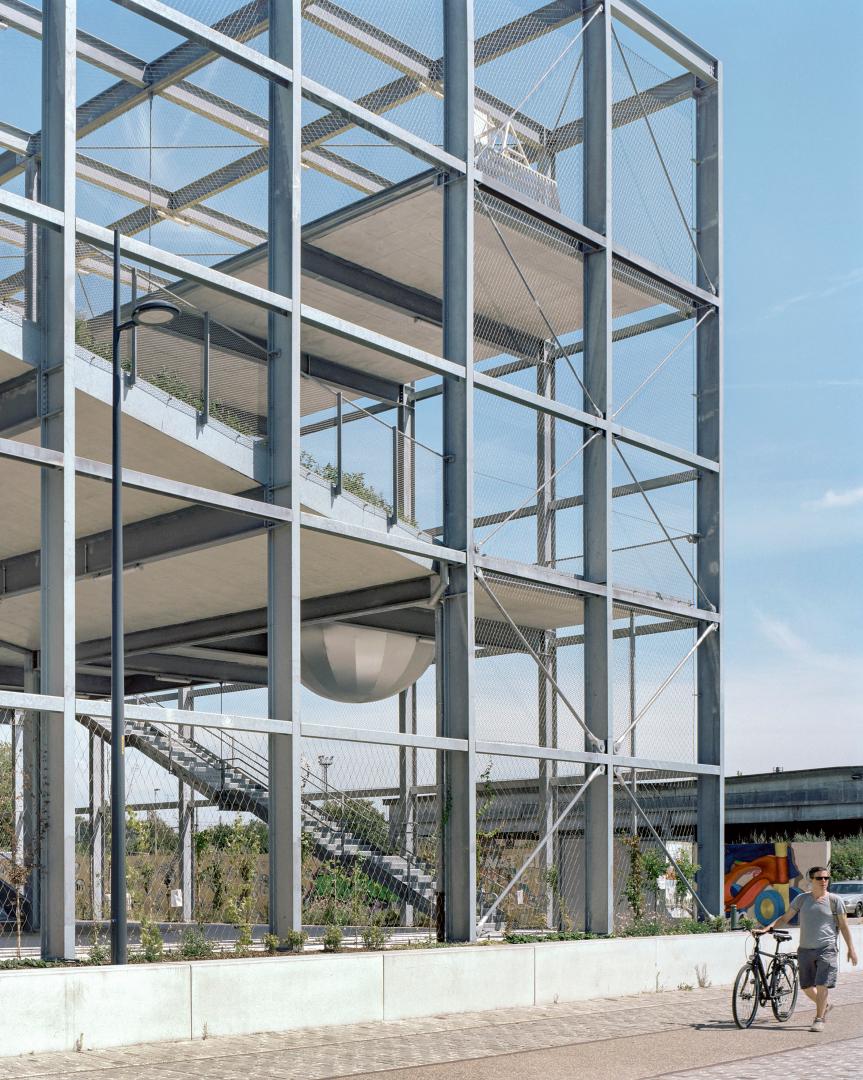
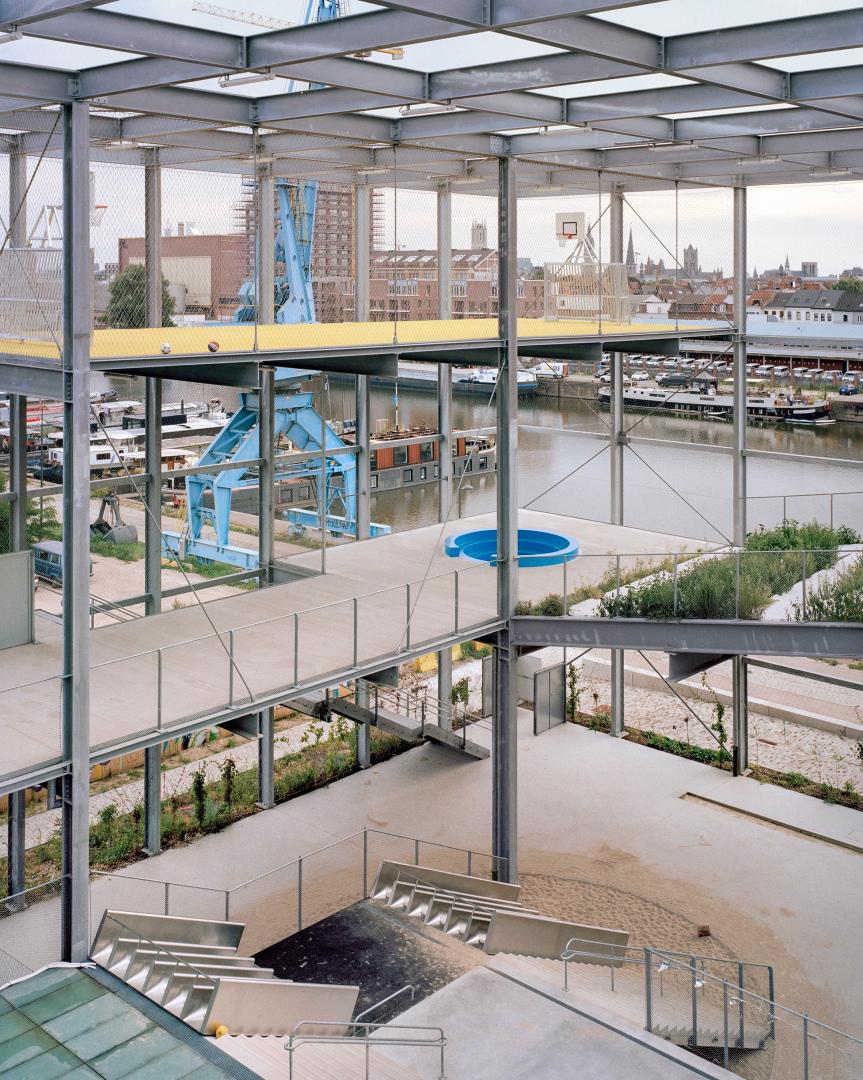
In order to maximise the use of space, the building was conceived with a bold and playful structure of open and closed spaces. The building envelope is split in two halves: a compact building structure on one side and an open framework with stacked playgrounds on the other. In between both, and under a first level playground realized in glass tiles, the public path crosses the plot. This stacking arrangement also allows the top floor sports hall to become a beacon for the neighbourhood with a fantastic view on the city. It allowed for varied, adventurous play spaces with slides, a sandpit, a suspended vegetable garden, climbing ropes and a steel spiral in which children can hide. All this is achieved without compromising the connection with the indoor spaces: despite the stacking, in fact, each floor has direct access to the outside.
Key objectives for sustainability
Sustainable and circular ambitions are high for the city renewal project of the Old Dockyards in Ghent. This includes Melopee, which is constructed as a low-energy and passive building.
The building is well isolated, offering the right balance between thermal insulation, daylight and heat control. This was tested in advance thanks to smart technologies.
A combination of sun protection on all non-north-facing windows and adiabatic cooling ensures that there is no need for active, energy-consuming cooling. The heat is generated externally in connection to the city network, with renewable generators as a source: the heat network is fed by the faecal discharge from various sites in the ‘Koopvaardijlaan’ and the residual heat from the waste water. The roof has photovoltaic panels and serves as a ‘green roof’ to create an extra buffer for the drainage of rainwater and to offer extra insulation so that less heat enters the building.
Typical for school buildings is the significant difference in occupancy depending on the time of the day and the time of the year. The choice for an intelligent, demand-controlled ventilation system D ensures a perfect tailoring to the schools needs and occupancy level. The system also extracts the heat from the discharged (polluted) indoor air to preheat the freshly supplied (colder) air. Using this method, the energy consumption of the continuous ventilation system is offset by a considerable saving on heating costs. Built-in sensors ensure that the flow rate is smartly adjusted in accordance with the measured CO2 values, thus reducing the energy consumption even more.
Next to being energy-efficient, these systems also contribute to a healthier and more comfortable working and learning environment, which has a major benefit on the productivity and focus of the children and teaching staff.
Key objectives for aesthetics and quality
Aesthetics and functionality of the building are so closely intertwined that colours, materials and their composition are an integral part of it, not merely an extra layer.
As explained in the question above, the choice for the facade techniques and materials was decided based on simulations of the inside temperature and daylight studies in function of the demands for a passive building. On the inside, choices for aesthetic finishes were largely defined based on demands for accoustics, sustainability and thermal inertia.
A functional logic was also applied when it comes to the stacked outside spaces.
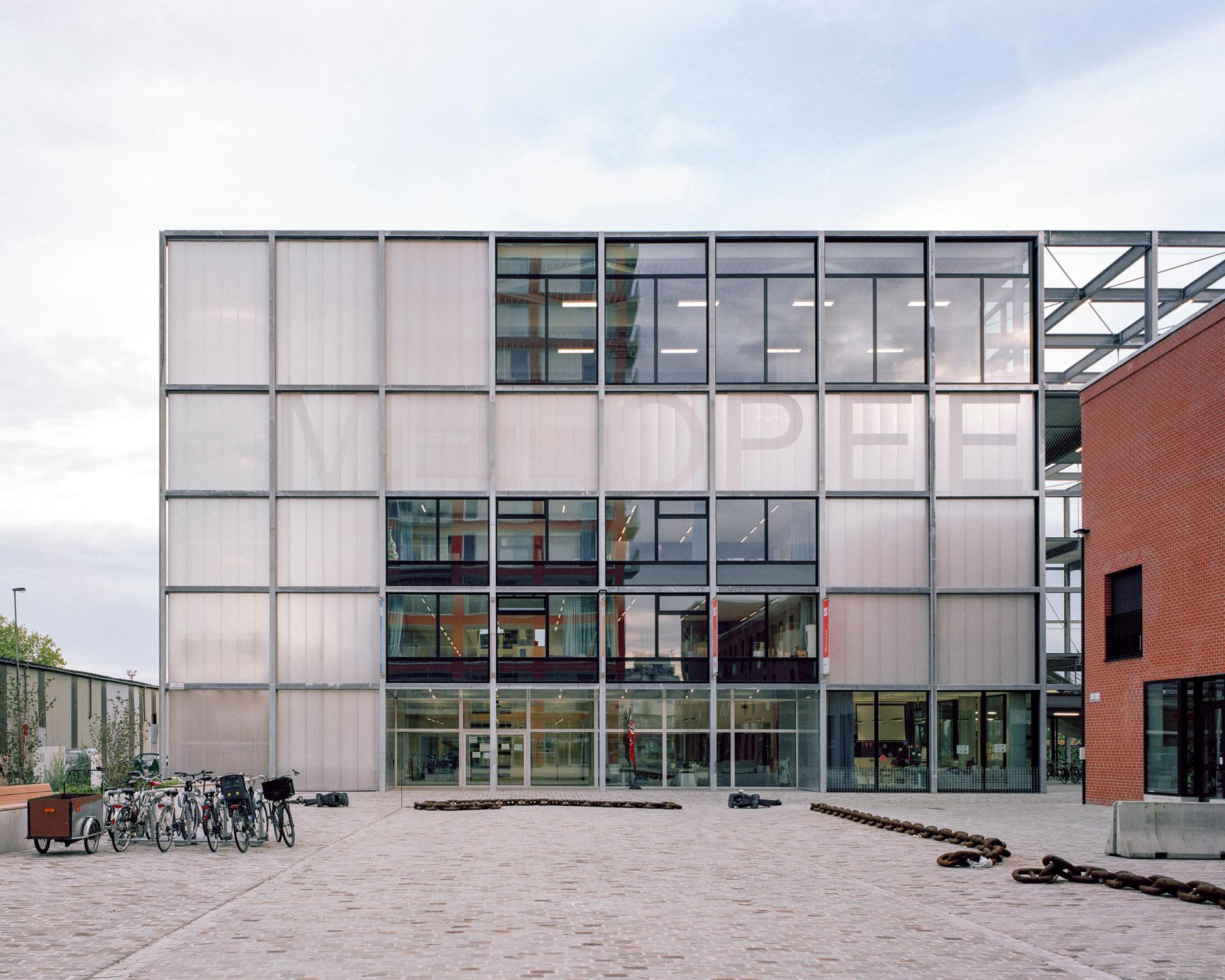
The placement of different materials on the facade is not only functional, but envisions a certain balance and visual layering. In this way, the same material (polycarbonate) is used to cover a closed facade, but sometimes it also functions as a translucent panel. This difference in usage is only visible when the lights inside are turned on, changing the view on the building from outside depending on the time of day. In this way, aesthetics is on its turn in service of the functional quality of experience. This enhances the readability of the building and its interaction with its surroundings.
The same can be said for the interior finishings. The glazed bricks in the cafeteria and the sports hall were chosen for their sound absorbing properties. The colours help maintain the building’s readability, from outside-in but also when circulating in the building. Colour choices were made in light of the overal colour and material pallet of the building.
Last but not least, the outside spaces also include a number of aesthetic choices such as the specific arrangement of the slides, the sandpit, the suspended vegetable garden and the steel spiral. Here, we also considered subjective criteria such as composition, colour pallet and balance.
Key objectives for inclusion
The school operates according to the "Community School" principle. This means that organisations from different sectors (such as sports or youth work) as well as the neighbourhood can use the building’s facilities, all with a common goal: the broad development of children and young people. The interaction between the different functions in the building itself is also crucial. Because of this well-considered vision, Melopee was selected as a model project for ‘building a multifunctional school’ by the Agency for Infrastructure in Education of the Flemish Government.
The open-air basketball court, on the 4th floor of the outdoor room, can also be opened up to the neighbourhood. We are currently also looking into the possibility to open some classrooms for music lessons. Special attention is paid to the interaction between the different functions in the building. In this way, Melopee will play an important social role in the neighbourhood.
Despite the strong interconnection between the various functions of the building and the outdoor spaces, each function also stands on its own. The sports hall is accessible from inside the school and from the school playgrounds, but at the same time it also has a direct and independent access from the main entrance outside through the outdoor room. The indoor spaces, such as the cafetaria and the meeting room, can also be accessed from outside the school and are organised so that they can operate independently thanks to the use of automatically locking doors.
The involvement of the building’s users is further enhanced by the various possibilities for interaction: the play equipment is part of the architecture, the children are involved in caring for the plants both in the facade and in the hanging vegetable garden, the oversized central staircase serves as a grandstand and a number of unprogrammed spaces leave room for creativity.
Results in relation to category
Melopee is more city than building. It contains almost as much outdoor as indoor space, and the boundaries with the public space are deliberately very thin. One public pathway literally runs straight through the project. The building is very open and transparent. The school and the sports hall show themselves to the city and the children are part of the city. This is more than a visual connection. The building also literally opens up to the city, according to the principle of the "Community School".
The structure of the building allows for good zoning of the various functions. The building has five floors. The nursery is located on the ground floor. On the first floor, we find the after-school care facilities, the nursery school and the cafetaria. The primary school is located on the second floor, around the double-height cafetaria. In the heart of the building, a broad staircase leads from the entrance hall to these floors. The staircase can also serve as a grandstand. On the third floor we find the sports hall, which is actually spread over two floors. The bar on the top floor looks out onto the sports field. A sports cage connects to the adjoining public park, making it accessible at all times. Multifunctional spaces can easily be opened up.
In addition to all the direct functional links between inside and outside, a double-height multifunctional cafetaria and the central part of the outdoor area together form the clear visual core of the school. From this space, and in combination with the central staircase, one has an overview of almost the entire school, both from inside and outside. The dynamic interplay of the building’s outdoor and indoor spaces can be read at a glance here.
Because of its very specific design, Melopee is a project that is easily appropriated by the users and the local residents. The steel structure, overgrown with plants, allows the building to evolve over time.
How Citizens benefit
The master plan creates a new district for the city of Ghent, on a site that was previously mainly industrial. Moreover, thanks to a number of new bridges over the canal, the district is very well connected with the city centre and can be seen as an extension of it.
Within the district, this building is the only public building, and therefore necessary for the functioning of the district.
At the opening, the building still stood somewhat forlorn between unfinished buildings around it. As the area continues to develop with new buildings rising, one can see that Melopee is becoming a central hub in the district. Although it is one of the smaller buildings of the entire area development, it very much defines the identity of the area.
The building can be used flexibly over time. It is a community school, which means that parts of the building have to be publicly accessible and that different parts have to function simultaneously. The school is organized over two floors around a central double-height refectory. A large central staircase doubles as a grandstand and meeting space, serving as the main means of circulation for the school, linking both floors with the main entrance. A second staircase and an elevator give direct access to the sports hall. The steel structure provides a third vertical circulation, that gives direct and independent access to parts of the school and also to an open air sportsfield on the top floor. Doors with automatic locks allow to make only the public parts of the building accessible, either during opening hours or during weekends or school vacations.
The nursery is the only part of the building which is not linked to the pergola structure; it has its own intimate outside space connecting to the park. This high degree of flexibility makes the building space and time efficient. Whereas a classic school building is usually empty at weekends and during school holidays, this building can be used intensively by local residents.
Innovative character
Apart from the energy management and the involvement of users and local residents, the innovation of this project also lies in the design of the stacked outdoor spaces in combination with a compact school building, and in the structural solutions that result from it. The project consists of a compact main building and a large open pergola with stacked playgrounds.
The open pergola structure had to be light and transparent. A collaborative structure of steel beams and columns, and slender concrete floor slabs cast on site, made that possible. The different elements are welded and galvanized off-site and afterwards bolted together onsite. Since the exterior structure required no measures for fire resistance, the steel structure is left exposed. As with the concrete structure of the main building, accurate detailing and execution ensures that the steel structure requires no further finishing. The outside structure will be overgrown with vegetation climbing along a steel mesh, in which some large ‘windows’ are cut out to connect the inside with the city centre.
The steel structure also wraps the main building, thus visually uniting the two parts of the building. At the same time this steel exoskeleton functions as a grid with different materials in function of the spaces. The facades form a patchwork of polycarbonate, glass and aluminium louvres.
The main building has a concrete structure that is (except for the ceilings which are clad for acoustic reasons) exposed. It gives the building thermal inertia, which helps to smooth out temperature peaks. At the same time, the concrete gives tactility to the building and due to the absence of finishing materials, helps to keep the budget under control. Due to the large spans (+/- 30 m) in combination with the height limit, steel was the most suitable material for the roof of the sports hall. Profiled steel sheets, perforated for acoustic reasons, span between steel beams with a variable height (100 to 135cm).