Valle Imperina Restart
Basic information
Project Title
Full project title
Category
Project Description
The project involves the recovery and reuse of the Valle Imperina as a cultural centre where to develop contemporary art exhibits with themes linked to the surrounding territory. Using the site organically, with integrated activities, is the only way to take advantage of its potential. It is not simply about setting up a couple of exhibits inside the buildings: it wouldn’t be enough. The objective is that of re-igniting the complex, turning it into a landmark for the territory around Agordo.
Project Region
EU Programme or fund
Description of the project
Summary
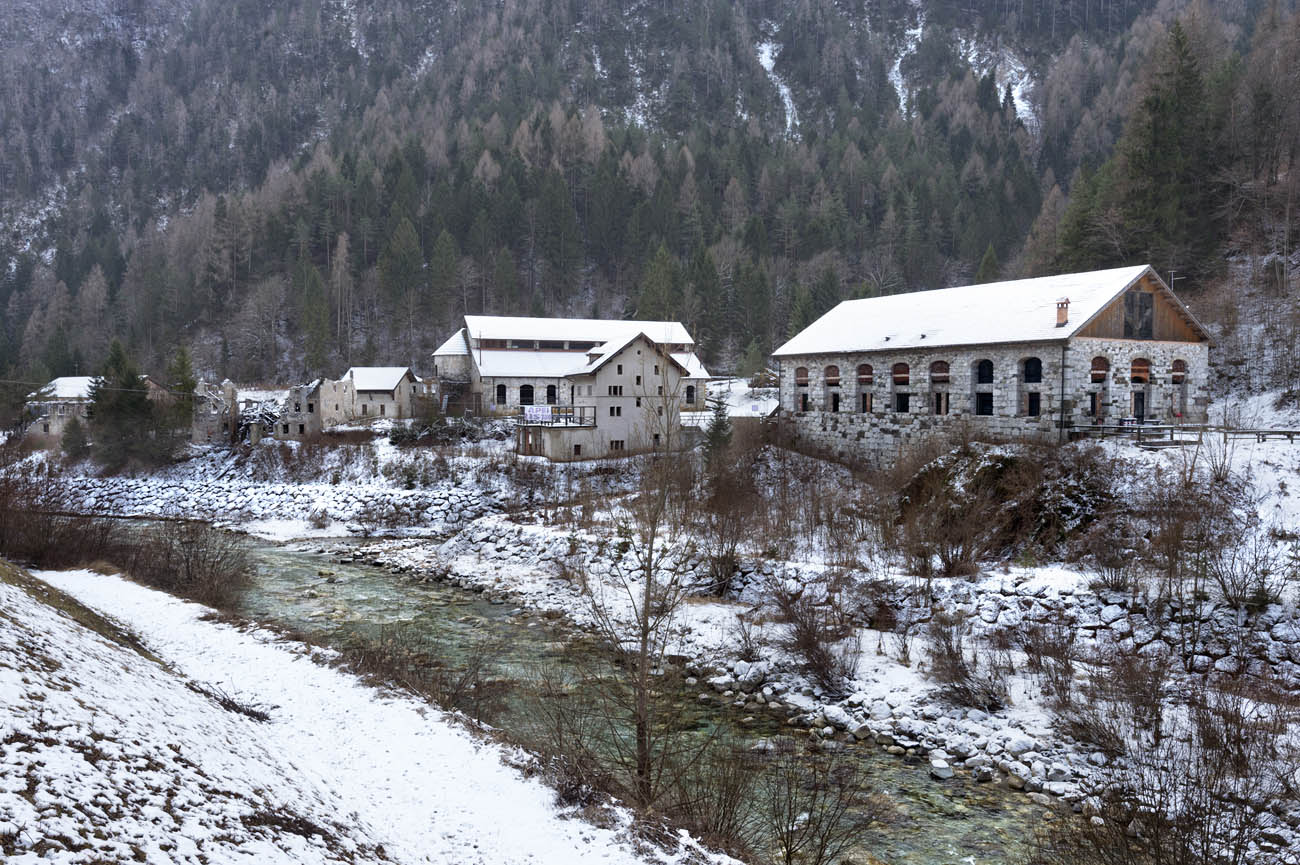
The Valle Imperina mining complex, which extends roughly throughout one kilometre, is one of the most meaningful industrial archaeology sites of the Dolomites area. This is because of its architectural quality, its urbanistic layout, its exceptional relationship with the context in which it is located, and its long history.
Here, mineral extraction reached its peak between the XVII and XVIII centuries. Its decline began from the end of the XVIII Century and continued throughout the whole 1800s. However, the production continued for the better part of the XX Century with the acquisition of the complex by the Montecatini company (later renamed Montedison).
Its eventual demise was determined by – as well as the restrictions brought forth by the Marshall Plan – the dreadful flood of 1966.
Various enhancement activities organised on the site, starting from the 1970s, have failed to bring about an actual, successful re-launch, despite the interest expressed by many individuals.
The lack of projects and incentives, together with the little faith expressed by local communities towards the site itself, have generated a depressive situation.
The idea is to transform the Valle Imperina complex in a creative citadel inside the Dolomiti Bellunesi National Park, creating an international Artistic Residency program inside its spaces, and using all the main buildings found in the site to carry out an intensive activity of exhibits and cultural events.
We are going to work – in collaboration with Dolomiti Contemporanee (a project for contemporary art, regeneration and innovative culture, and cultivation of local resources, active since 2011, which has already developed similar projects inside large decommissioned factories) – on the involvement of the other municipalities of the Agordo valley, the local authorities, the population, young people in particular, given the open disposition of the project, and their proven willingness to collaborate.
Key objectives for sustainability
In the context of this project, art acts as a platform for environmental communication able to inform and raise awareness in its public. The artwork is a powerful communicative medium with respect to potential themes. In this case artworks will be able to communicate content relating to local environmental and historical themes.
We would like to expand a reflection linked to the Vaia Storm, the devastating event which took place on the tail end of October 2018 and that struck the Triveneto area and its mountains, knocking down around ten million trees.
The fate of Alpine forests, significant changes in the environment, needs and opportunities related to the care of the environmental heritage, dangers, procedures, extraction of forest residues, renovation planning, fall in timber prices, its commercialisation, waste, biomass power plants, and opportunities to build smart wood supply-chains, are all going to be themes central to the debate we’ll be carrying out – through a number of talks and conferences – during the course of the first season, nourishing this reflection with practices, ideas, and holding the contemporary as a dowry, a critical instrument brandished by people.
More than a hundred companies could supply the various materials with which to create art. Many are the artists, research and education authorities that will be involved, and that have already worked with DC in the context of Cantieredivaia (a multi-year research project which Dolomiti Contemporanee launched about Vaia): Lorenzo Barbasetti di Prun, Giorgio Barrera, Veronica Bisesti, Simone Cametti, Enrico Coniglio, Cristiano Focacci Menchini, Dimitri Giannina, Anna Groaz, Corinne Mazzoli, Miriam Montani, Francesco Nordio, Obsolete Studio, Panem et Circenses, Michelangelo Penso, Filippo Romano, Giacomo Segantin, Caterina Shanta e Massimo Tevarotto, Padua University (TESAF Department), Portsmouth School of Architecture (Architecture and Environmental Sustainability Departments).
Key objectives for aesthetics and quality
The site is articulated in the following manner: smelting furnaces building, stables building, building which now houses the visitor’s centre, ruins of the coal storage building, hostel, smaller buildings, tunnels of the former mine.
All the spaces and the main factory “bodies” would be involved in the initiative, whose eventual aim would be that of displaying the aptitudes and potentialities of the site to a large audience and to individuals who may be potentially interested in an operative reflection on the future of the site itself (entrepreneurs, creative companies, possible investors, universities, research and local authorities).
The furnaces building and the stables building would become two main exhibition pavilions.
The stables building would become a secondary exhibition centre for the compound. The coal storage building would become the third site linked to artistic/exhibition activity. The storage location, tremendous and evocative, could be used to host performances, site-specific installation, concerts, and events with a large audience.
Naturally, all operations would have a non-invasive disposition with respect to the spaces and the natural environment surrounding them, as well as complete reversibility.
Another point on which it would be appropriate to act with an intervention capable of generating curiosity and appeal, keeping into consideration that the location can boast a favourable placement inside the road network (SR 203 Agordina and the new bike path), is the entrance to the Valle Imperina parking area, in the space where the railway carriage is located. Here, too, it could be possible to consider the creation of a situational/art piece able to capture the attention of tourists and motorists.
It would be interesting to be granted the usage of the Park’s Visitor’s Centre – “Uomini di Valle Imperina”. This structure, too, could be used for exhibition and workshop activities, for seminars and education.
Key objectives for inclusion
We intend to temporarily transform this site into an active hub, one which is going to operate as an incubator of ideas and objectives, thus showing its calling as a collector of life experiences, inside an integrated context of action, which is what has been missing until now. With this action we estimate to be able to lead to Valle Imperina – during the first year of events – at least 10-15,000 people, in addition to the ones already thought to be coming to this location.
There is already one hostel inside the site, as well as the former Cral building, which will be used to support the artists’ presence in the context of the Residency program, as well as guests, invited speakers and the staff who – during the active period of the project – would live in Valle Imperina. Fundamental, and already in place, is the involvement in the project of all administrative authorities, political decision-makers, and local residents, who will all guarantee adequate support and economic coverage.
The Veneto Region may act as the leading authority for the event, guaranteeing its funding, and the Dolomiti Bellunesi National Park is the other authority we need to involve in the project. Other resources would be made available thanks to local development authorities, such as BIM Piave (Mountain Water Basin Consortium), GAL (Local Associative Group of the Upper Belluno Area), Unione Montana Agordina (Agordo Area Mountains Union), and Brancher Funds.
If we can build this support structure on a solid base, intercepting all available and necessary forces, the Valle Imperina initiative will be able to be viewed as having absolute cultural value with respect to the development of this site and of its context.
Innovative character
The central dynamic and innovative element, which would be set up inside the Valle Imperina, and which would constitute the driving engine of this experience, is the Residency program for artists. The Residency program is at the heart of the project, it is the active element which would make it possible to transform the Valle Imperina in a great welcoming station, able to continuously rekindle contacts and meetings. The Residency would be hosted inside the former Cral building and inside the Hostel. Its upper floors would be minimally furnished with all necessary elements to house artists (beds, bedside tables, laundry service, lights, water).
On the other hand, a bookshop and a welcome area for the public would be set up on the ground floor. The underground floor, together with the small post service house next to the smelting furnaces building, would be used as lab areas, where artists would be able to work. Therefore, the artists would have the opportunity to devote their time to the designing and creation of their art pieces inside the site. More than a hundred companies already partnered with Dolomiti Contemporanee would be able to provide various materials with which to create the pieces.
It would be, then, a cultural hub which set itself the goal of rehabilitating and relaunching a network for this site, through a strategic, innovative reactivation mechanism, at the same time respectful of the environmental context, as well as of the history and identity of the location itself.