Impulse Project Stuttgart
Basic information
Project Title
Full project title
Category
Project Description
The Impulse Project Stuttgart exemplifies how blue-green infrastructure can be implemented in dense urban spaces. It contributes to the urban microclimate, alleviates the demand for drinking water through its substitution and enhances the quality of stay in and around temporary accommodations through vertical greening. The central modules with water treatment and storage functions are designed as both a public space with high aesthetic value and an open lab for science and education.
Project Region
EU Programme or fund
Description of the project
Summary
Greening cities is one of the major climate adaptation measures aiming to mitigate heat island effects and enhance living conditions in cities. With increasing temperatures and less summer precipitation due to climate change, the management of green spaces and green buildings is essential in regard to resilience and the sustainable use of natural resources. The Impulse Project Stuttgart was implemented within the scope of the research and design project INERESS-I. It creates a multifunctional open space that illustrates integrated blue-green infrastructure on the building scale.
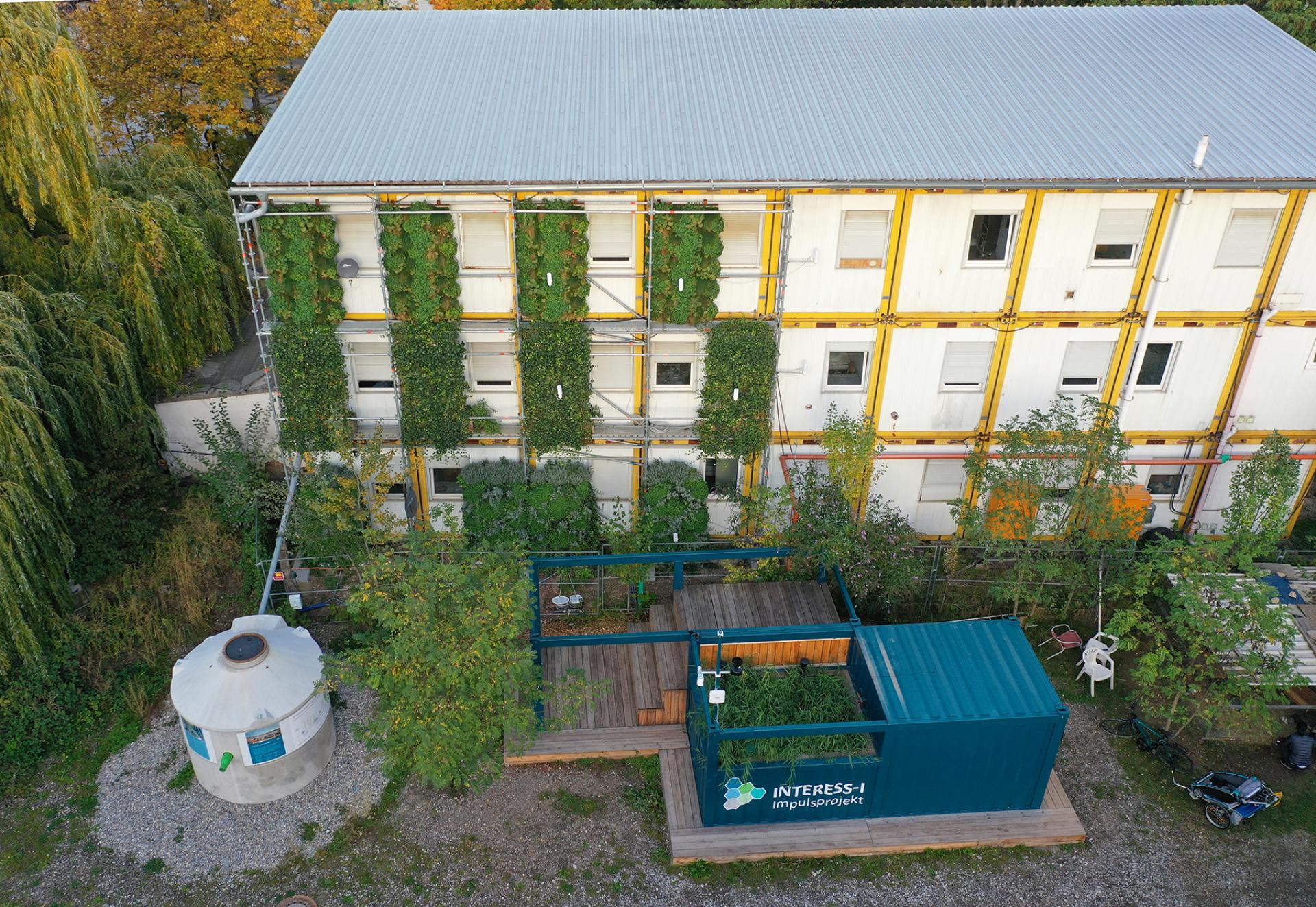
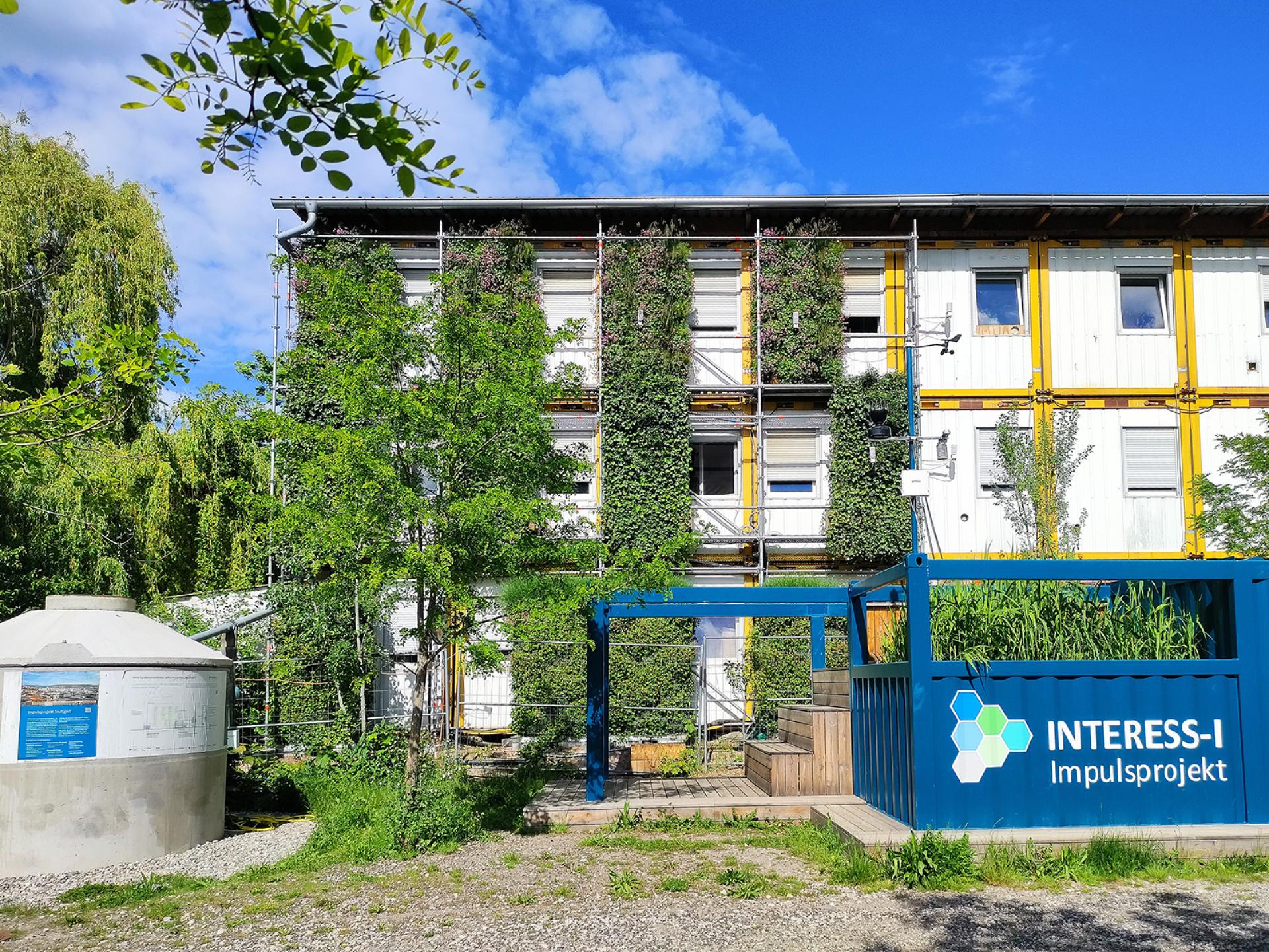
As a temporary intervention in an urban area undergoing fundamental transformation, the project sets an impulse for the future urban development and, more generally for adaptable temporary accommodations. It consists of mobile and re-usable features, the core elements being two standard container frames: one of which contains water storage tanks and is covered by a wooden deck as amenity space, while the other comprises an integrated vertical-flow constructed wetland, as well as a laboratory and control room. The two containers technically and design-wise represent the integrating component of the project, where water treatment and water supply come together in a multifunctional open space. For retaining storm water and storing rain water these elements are complemented by an above ground cistern that doubles as an advertising pillar to communicate the project goals.
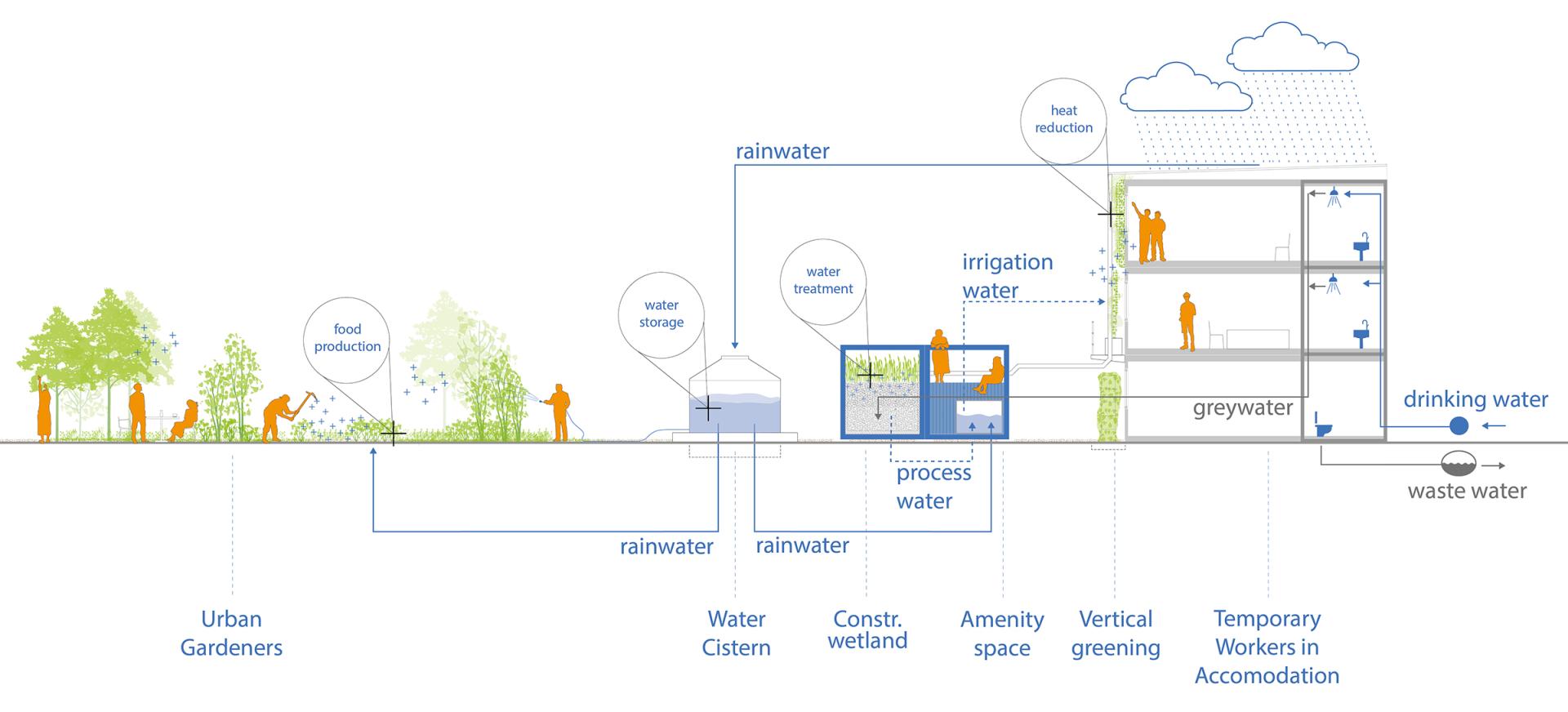
The water comes from neighbouring workers’ accommodations: Rainwater is collected from the roof and grey water from showers and washing basins. These two alternative water resources are mixed in the irrigation tank and used for watering vertical greening modules that are fixed to scaffolding in front of the workers’ accommodation – thus giving back benefits to its inhabitants: Waste water is reused to beautify and cool the living space. Furthermore, rain water is distributed to a nearby urban gardening project.
Key objectives for sustainability
As a model for building urban resilience the Impulse Project Stuttgart addresses sustainability on various levels. Alleviation of drinking water through the use of alternative water sources for irrigation is a key element of the concept: As a source with continuous flow but detrimental quality, water from showers and washing basins (so called light greywater) is collected from the workers’ accommodation, treated in the container-based vertical-flow constructed wetland and further disinfected in the storage tanks. Rainwater from the roof, a resource of discontinuous flow but superior quality, is stored in the above-ground retention cistern.
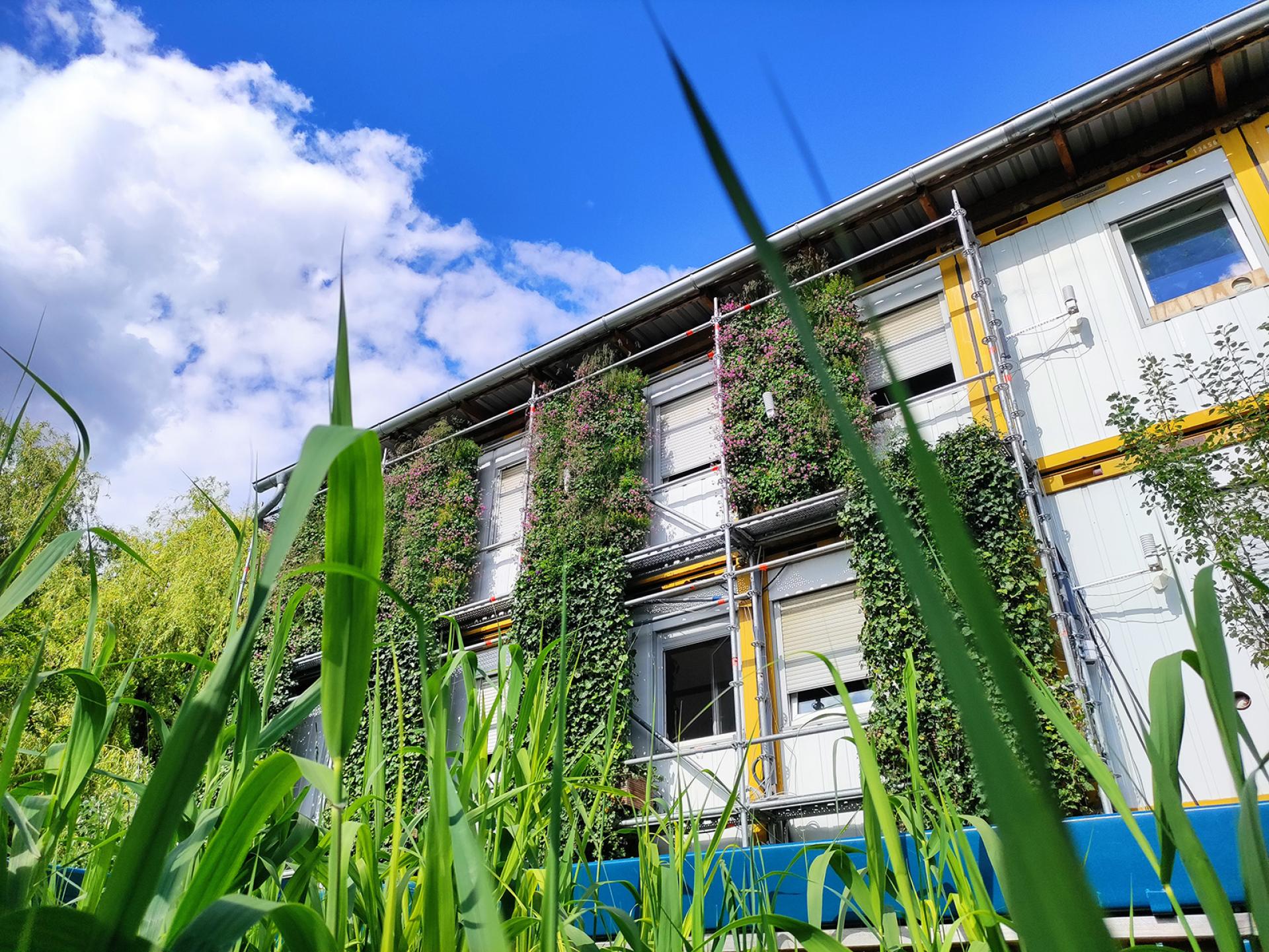
The vertical green elements fixed to a scaffolding in front of the façade enhance the local biodiversity e.g. by providing food for insects and nesting space for birds. They actively cool the surface of the building and thereby prevent overheating of the interior. Electric air conditioning becomes obsolete and the energy demand for cooling is drastically reduced. Further benefits are flood protection during stormwater events due to the retention cistern and the enhancement of the urban microclimate through additional green spaces that are irrigated also in dry and hot periods which allows for high evapotranspiration and cooling throughout the summer.
From beginning on all components were designed to be re-used: The cistern is a standardized element that was installed above ground to avoid heavy construction work and to allow for smooth relocation. The container frames including the vertical-flow constructed wetland are based on the modular system of standard containers and therefore are made for being transported and re-arranged in other contexts. The supporting structure of the vertical green elements is a standardised construction scaffold that will be dismantled and reassembled frequently in the future and the vertical greening modules will be used in long-term projects (pre-cycling).
Key objectives for aesthetics and quality
The Impulse Project is a public space with high aesthetic and amenity value. Although made for a temporary location the container modules and the surrounding wooden decks are well designed and precisely placed. The largest features, the vertical greening modules, were pre-cultivated and showed right from the beginning a very colourful facade made up of different species. They also cooled the façade from the beginning. The plant selection ensures not only in spring and summer but also in autumn and winter a vivid expression of the facade. They allow the inhabitants to experience nature directly in front of their living space: Birds and insects can be observed and the changing appearance of the green elements through the seasons can be perceived through all the senses: Besides the visual impression, the scent of the plants and the chirping of birds can be named here.
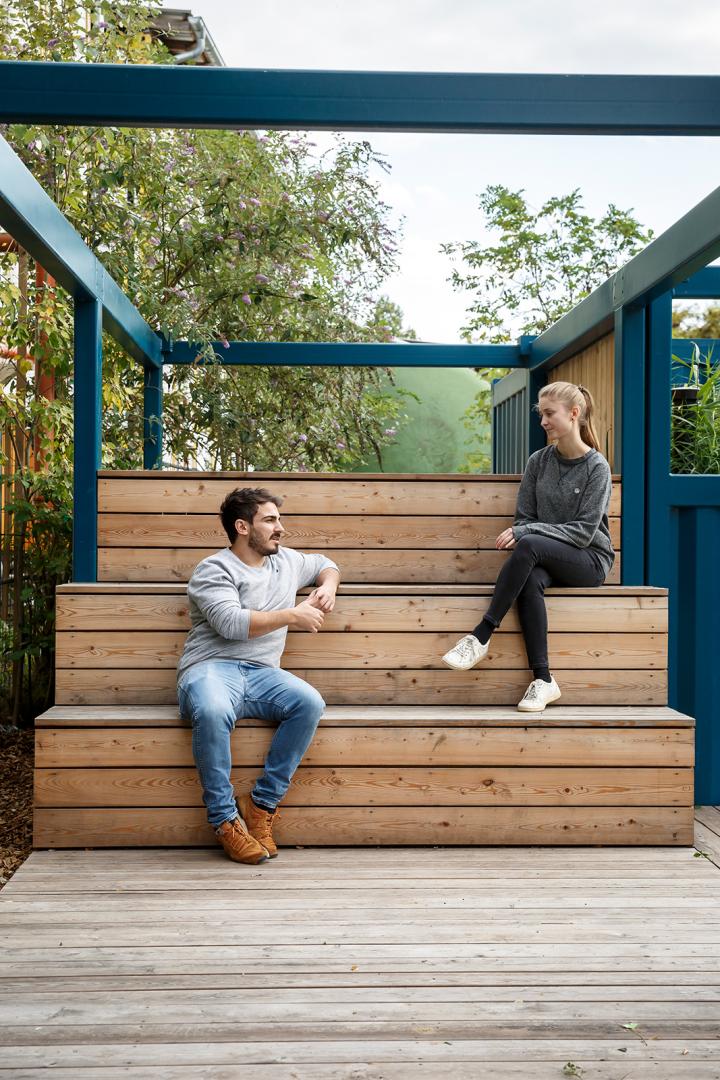
The two container modules are arranged in such a way that all features of the Impulse Project can be seen from the elevated deck of the storage container and a direct view onto the vertical flow constructed wetland with its reed plants is possible. The dense reeds sway in the wind and open up a new kind of associative space of nature in the city and stimulate interest in the constructed wetland.
Both the vertical greening as well as the reed plants of the constructed wetland are adding a wild and rampant impression to the very technical scaffolding, containers and cistern – a contrast that underlines the unique character of the place.
Key objectives for inclusion
The Impulse Project is designed as a meeting point for the workers inhabiting the temporary accommodation as well as for the urban gardeners and passers-by on their way to the nearby cultural hub Wagenhallen. The design process included not only the interdisciplinary team of specialists, but all stakeholders of the place. The urban gardening project was involved in finding the best location and ensuring that their interest in having a better water supply for their gardens could be met. Also representatives of the workers living in the temporary accommodation had an important voice shaping the final project. In the coming months surveys investigating the resident’s experience with the vertical greening and the overall project will be gathered.
By this inclusive approach the project brought together different actors that had been living and working on the site without synergetic interaction before. Due to restrictions of the corona pandemic further joint activities could not be conducted.
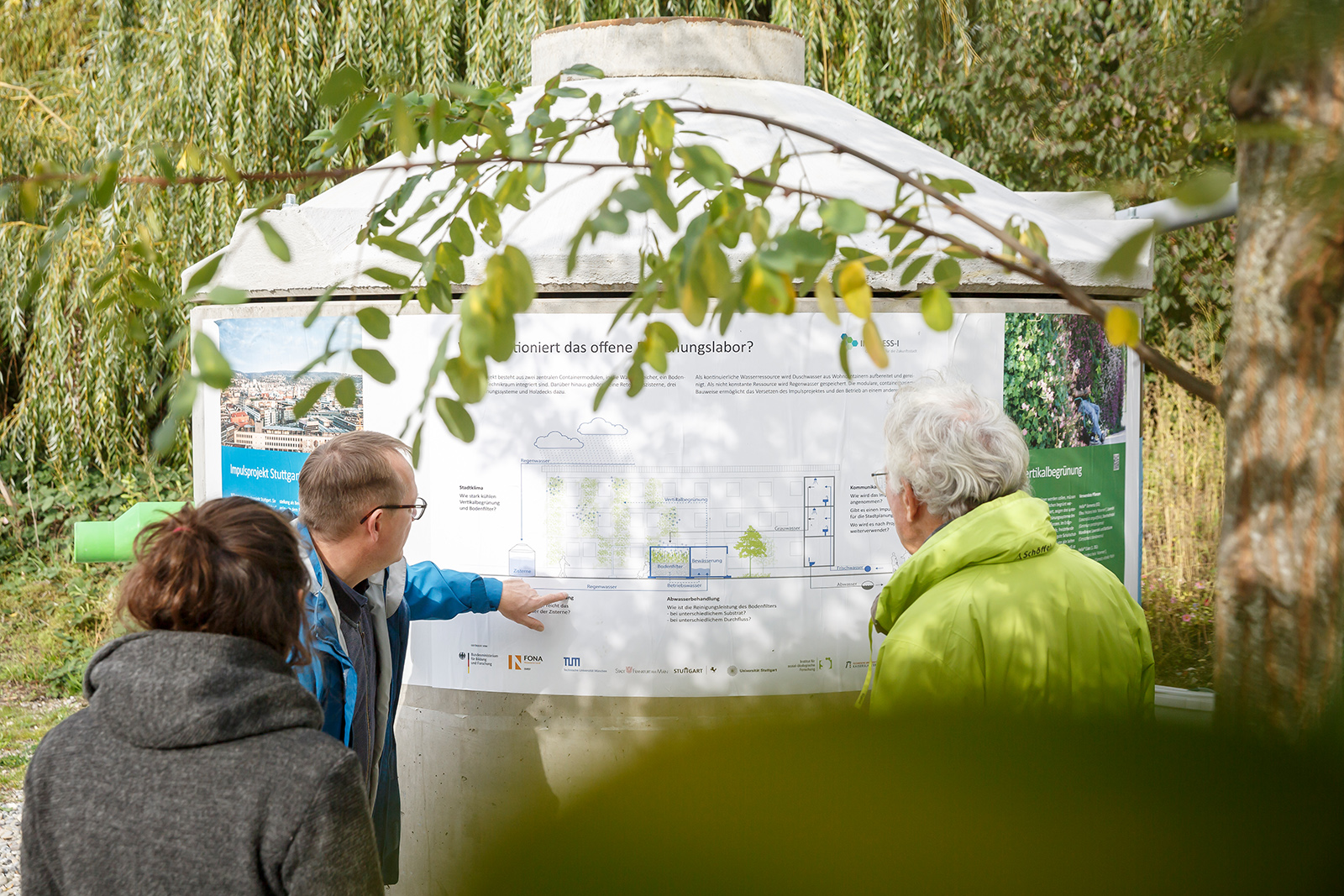
The Impulse project is also used for educational purposes, with a number of guided tours open to the public and schools within the district.
Results in relation to category
The Impulse Project is a model for modular, adaptable and mobile solutions for living and working environments in urban transition areas. The temporary nature of the project as well as the experimental setting opened up design opportunities that otherwise might not have been seen. The need to improvise, to create mobile and temporary design options based on the specific boundary conditions found in the urban development area, led to modular and temporary solutions that can and should be used elsewhere.
New technical and design solutions were developed, which help support the inclusion of the users’ and inhabitants’ needs. Temporary accommodations are everyday installations, enhancing their appearance and the living conditions through vertical greening should become an everyday solution as well. The use of scaffolding in order to place an instantly green facade element should and could be copied in many locations. Modularity – in this case the use of standard container frames – increases the transferability of the concept, signifying that planners can react in a more flexible way to distinct specific boundary conditions in the urban fabric.
The existing temporary accommodation was considered an asset with a simplified layout and separated waste water system that made the extraction of light grey water easy and the treatment in the constructed wetland possible.
How Citizens benefit
The concept idea of the Impulse Project is influenced by very good experiences of the project team with previously developed one on one models or “urban experiments” that take civil society seriously as a partner for debate. The central design ideas for the project have been inspired by local stakeholders: The wider area of the impulse project hosts a temporary container city for artists, and this unconventional way of using standard containers as well as the co-use of public spaces were the spark that brought the Impulse Project to life. Now the experimental new urban green space gives back inspiration and knowledge e.g. through constant interaction with the interested civil society via informative posters and public guided tours. Placing the Impulse Project as a Research and Design Project in the artists and urban gardeners “biotope” proofs to the public, that the place is a forward-looking urban laboratory.
The Impulse Project has also inspired the municipality to look deeper at the potential to implement blue-green infrastructure on a larger scale in Stuttgart’s largest urban development area Rosenstein. And on the very practical level the project makes urban gardeners' daily lives easier by making rainwater available for watering, thus contributing to a richer harvest
Innovative character
The Impulse Project Stuttgart is innovative on various levels through its integrated approach. Technically, it hosts the first mobile constructed wetland that works in accordance with all standards. And, it shows a solution to integrate constant and irregular water flows to secure water supply for various forms of urban green. Both, temporary vertical greening as well as mobile water treatment and storage may be a model for transition areas from plot size to city expansion.
The one on one model as such is an innovative means to communicate complex design and planning issues. All elements of the Impulse Project can be viewed and experienced individually, and with guided tours also technical details are presented regularly and the research results are communicated in the local context, thus empowering people to take part in the debate about greening cities.