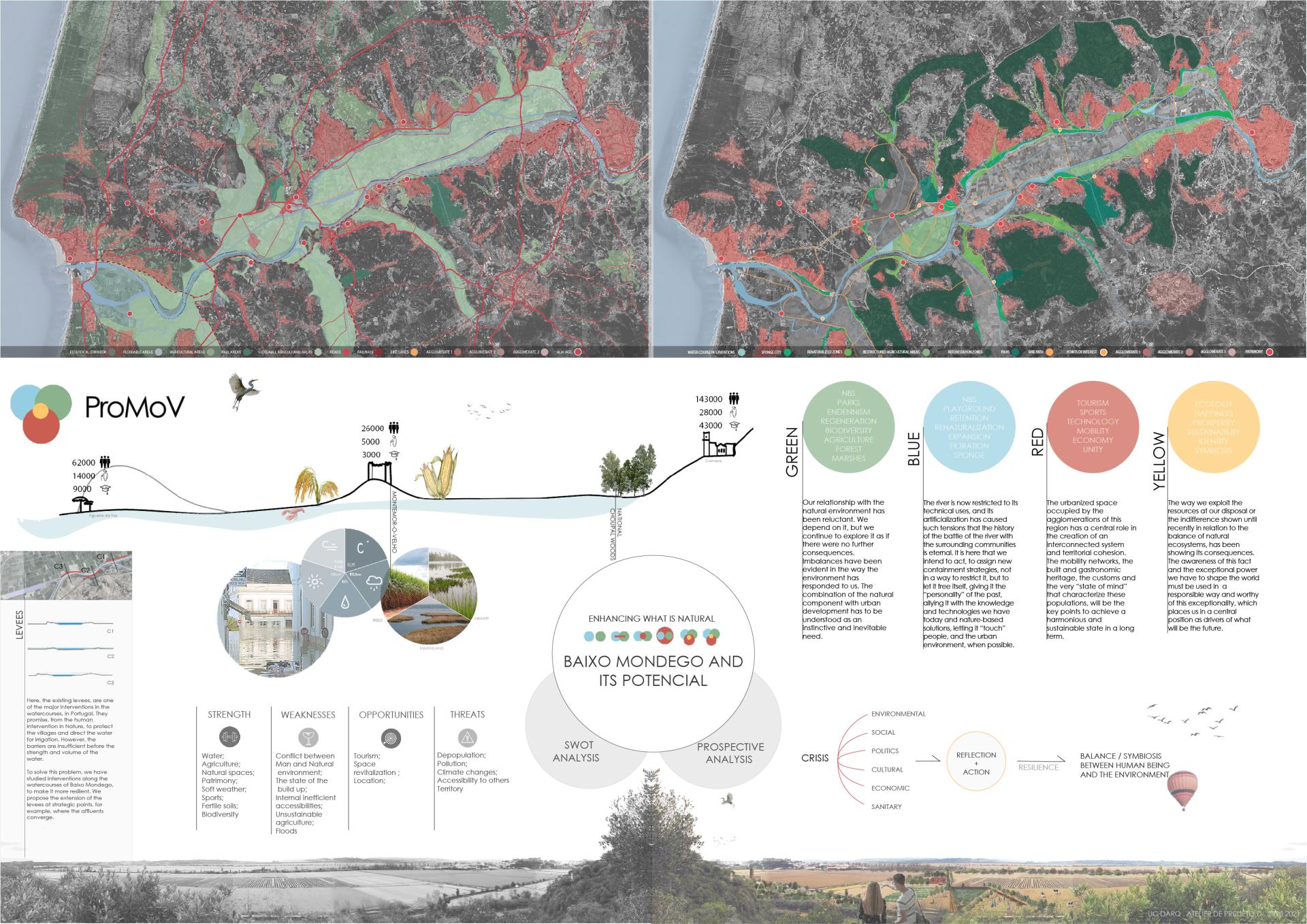
ProMoV - Promote Montemor-o-Velho
Basic information
Project Title
Full project title
Category
Project Description
We aim to promote the Low Mondego region, Portugal, and to revitalize local values that have suffered from institutional negligence, repositioning them by the Goals for Sustainable Development. Designing a strategy for regenerating systems, processes and productive cultures. To overcome segregation and lack of accessibility, surpassing the river barrier, betting on green mobility, inclusion programs, and landscape regeneration. Transforming it into an epicentre of culture, resiliency and equity.
Project Region
EU Programme or fund
Description of the project
Summary
To reinvent Low-Mondego, leveraging local values, which institutional inattention and management ideals of the past have conditioned or prevented from developing, preserving ways of life, and productive and touristic practices, almost always outdated. Stimulate a repositioning of political agendas and management modes in total harmony with the Sustainable Development Goals, namely: promote sustainable agriculture, well-being for all ages, sustainable management of potable water and sanitation, making inclusive, safe, resilient and sustainable cities and communities, protecting, restoring and promoting the sustainable use of terrestrial ecosystems, sustainably managing forests, halting and reversing soil degradation and biodiversity loss, promote peaceful and inclusive cities towards sustainable development. Balance the relative importance between economy, society, culture and environment, which are the true significant values, and matrix support for a more equitable and resilient future. Directly promote proximity, smooth mobility, social inclusion and the defense of the natural heritage, in total harmony with the leverage of productive systems and environmentally friendly forms of tourism. These fundamental objectives constitute the foundation of sustainable development for the valorization and regional potentiation, guiding the territorial intentions of: Transform a geophysical barrier and historic border – the Mondego River – into a cross-sectional corridor for approximation between the inhabited destinations of the dispersed network of urban places, established on its banks.Ensure interactions and dynamics – transversal and longitudinal – of continuity and the promotion of territorial and environmental regeneration and valorization. Promote nature tourism of excellence, between two classic destinations: the beach, in loss, practiced on the coastal city of Figueira da Foz; and that of the cultural heritage of humanity, emerging, in the city of Coimbra.
Key objectives for sustainability
The proposal revolves around the contrast between the natural areas and the urbanized nucleus, because they do not complement each other. Through the re-naturalization and re-interpretation of some of the infrastructures and mostly public spaces – e.g., the mobility system and the residual water treatment facilities – the strategy is designed around nature-based solutions or eco-efficient systems, to promote a sustainable development of the territory. In terms of blue areas – the dense and existent waterways network –, the proposal is to enlarge the transversal section of the central canal, in some strategic places of the river, to create public spaces, but also to mitigate the effects of the floods in a faster and more efficient way. We are planning phytosanitary treatment facilities for the residual waters near the riverfronts, in order to promote better water quality and, therefore, a bigger biodiversity of endogenous species. In terms of green areas, most of the territory is used for extensive and monoculture agriculture so we think a change in the agriculture practice is necessary. Therefore, the proposal promotes the construction of an experimental community, directly related with agriculture production that can change the actual perception of landscape. In addition, we propose multi-culture reforestation with native species and re-naturalization of some existent brown areas, and the urgent and effective integration of the patchwork of extremely fragmented existent landscapes. In terms of urbanized areas, the strategy revolves mostly around accessibility and alternative mobility systems. The goal is to rethink the idea of a long linear bike lane and to propose a net of signalized paths, mainly walkable and cycling lanes, using the existent rural accesses and connecting nearest towns and villages, throughout the agricultural fields, near riverfronts, wetlands and floodable areas, to promote the feeling of territorial cohesion and reduce carbon emissions.
Key objectives for aesthetics and quality
The Lower Mondego constitutes a dense network of spaces and environments, which have in common the proximity of an apparently slow water stream. This river provides the region great agricultural prosperity, however, given the occurrence of the still recurrent floods, it became a battlefield between people and nature. The coexistence between both was never confirmed as a friendly one. Today, the Mondego River runs channeled, corseted, as a reflection of the wishes and practices of local precedent communities. The objective of the project corresponds to rethinking these spaces and to proportionate a rediscovery of the river as a wide network of canals and water corridors. Thus, it is intended to ensure that all of the water lines, both artificial and natural ones, may be read and experimented as spaces of environmental discovery, and shared opportunities, giving strength to the regeneration process of the countless habitats which characterize this river basin — some of them are fantastic portions of what landscape architect Gilles Clément‘s called third landscapes. It is also of our deepest interest to integrate these spaces within the scope of the reinvention of present intensive productive agricultural practice. By promoting biological, regenerative and experimental agriculture as a new way to reinvent countryside life, which were so well defined by the geographer Álvaro Domingues, which should prevail on prejudice of intensive agricultural practices chemically assisted, privileging and promoting local products of great quality and increased added value. To achieve this, we believe we have to rethink space in a holistic way, with the purpose of generating an ecosystem of intimacy between mankind and Nature, adjusting the effects and the consequences of one and the other so that they can both manifest without noticeable interference, and decisively, in the integrity of the other.
Key objectives for inclusion
The strong landscapes of the Low Mondego valley and its several afluents define and characterize the region and its identity, but at the same time, accentuate the physical separation between the people and their daily flows. This duality stands out in the present territorial context, like it happened in the past, on the historical border defined by the river. It urges now that this rural adverse reality is reinvented. Our strategy lies on the necessity of developing an interacting and cooperative spirit. In that regard, one of the main ideas of our project is to give back to local residents the duality of the river banks and its dynamics. Preserving the local values and integrating new paradigms and necessities of the future, contemplating possible connections and ways for real and active proximity. It is intended to add value to the disconnected neighbouring villages, maintaining the scale, activating and valuing all the essence, nostalgic and picturesque qualities that still prevail almost everywhere, through the sharing of common collective values and dynamics of community valorization, in articulation with new urban strategies, framed in the objectives of sustainable development. As a strategy, emerges a network of places where specific actions are concentrated, whose mission is to cross generations and different daily lives, and to ensure that interactions in the community, and between its visitors and tourists, allow for inclusion and effective cross benefits. Approximating residents, scattered in bubbles across the river margins, and assure their interaction and inclusion, and consequent exchange for values — patrimonial, of pedagogies and knowledge, and cultural common bases — in a genuine and direct way amongst these riverside populations.
Innovative character
The proposed strategy aims, through the establishment of an urban grid of places, based on short-distance and soft mobility connections — walkable and cyclable —, to structure a network of proximity relations capable of turning the ecological corridor of the Mondego river valley into an integrating infrastructure, in contrast with the traditional frontier space which has always characterized it, in which the north and south margins progressively disconnected over time. When creating this integrating network, consisting of relevant historical and heritage values, and by cultural practices and values such as artisanal and agricultural knowledge, gastronomic traditions, and religious festivities, among many others, there is a real need to interconnect them with the truly endogenous, biological and geophysical values, which fully justify its existence. This makes absolutely pertinent an extensive communication, for the discovery and rediscovery of the true wealthiness of Baixo Mondego. Despite the insensitivity and aggressiveness of human actions that happened in the past, it became quite visible the resilient way the humid fertile area of the Baixo Mondego region faced all the changes to which it was subjected. In this way, it is now intended that this ecological and cultural corridor, of great value and potential, is able to preserve and enhance both environment and nature, promoting the soil regeneration and activation of positive productive practices, wherever agriculture may be reinvented, on betting in diverse types of crops and forms of production, more ecological and better suited to balance with the surrounding environment and natural habitats.