KLEOS
Basic information
Project Title
Full project title
Category
Project Description
To reveal the diversity and hybridisation hidden behind the everyday, we have set out to listen to the plant species of our cities.
Kleos is an initiative to explore urban vegetation relating botanical species with scientific, artistic and sound fragments which are activated and combined according to the proximity of the users to the plants.
The proposal involves citizens in mapping new specimens to complete an atlas that explores the dimension of the city as a garden of coexistence.
Project Region
EU Programme or fund
Description of the project
Summary
"The Greeks of Homeric times considered that kleos, fame, was composed of songs. The vibrations of the air contained the measure and memory of a person's life". The songs of the trees, a journey through the connections of nature. David George Haskell.
Kleos is an initiative to explore urban vegetation collectively and to perceive through carefully edited maps, images and sounds, the effects that these generate on the body (flowering, aromas or fruiting), the environment (capturing CO2 or harmful particles), or culture (probing the migration and linking of species to the place through texts, images and music).
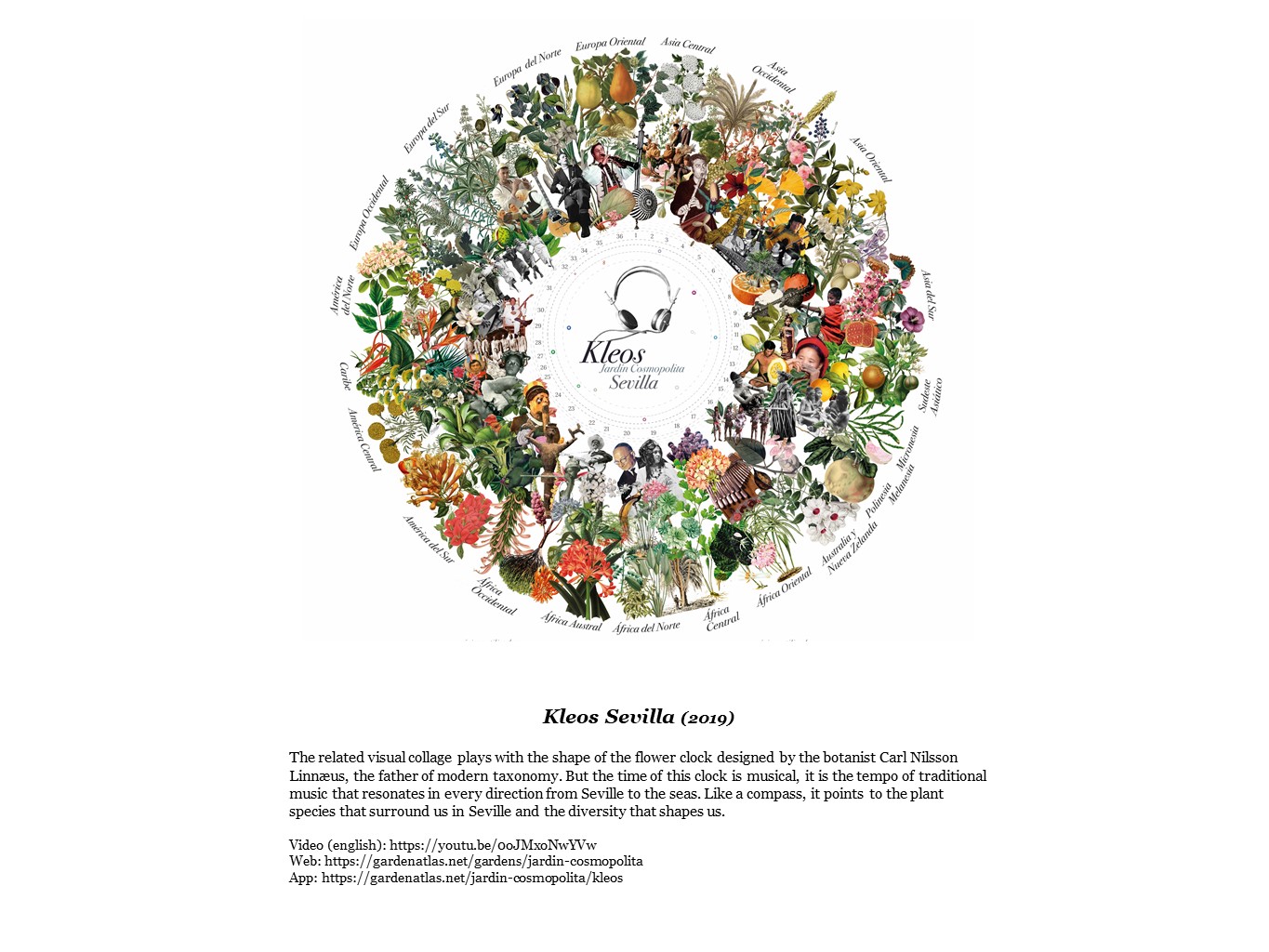
In this way, the project relates - in the manner of a cabinet of wonders - botanical species with scientific, artistic and sound fragments that are activated and combined according to the proximity of the users to the plants. An intimate experience that invites us to enter into urban nature to awaken the foreign memory of the species that surround us by remixing traditional music linked to their places of origin, highlighting our mestizo nature.
The proposal is therefore conceived as a synaesthetic experience that begins in enclosed gardens but gradually unfolds, involving citizens in the mapping of new specimens along their daily journeys. A strategy that aims to explore, through the creation of a collective atlas, the dimension of the city as a cosmopolitan garden of coexistence (Gilles Clément, Donna J. Haraway, Gregory Bateson, Isabelle Stenger, Alexander Von Humboldt, etc.). This means not closing oneself to a plan, an image or a purpose, but opening oneself to new creative alliances with the existing. Mapping, celebrating and pollinating the city as a Terra exuberantis is our wish.
Key objectives for sustainability
Kleos is a proposal born with the aim of starting a city map which explores the effects of urban vegetation on the body, the environment and culture.
To this end, we propose a citizen science process that encourages Europeans citizens to become cosmopolitan explorers, cartographers and gardeners, to create together with artists, scientists and designers new contemporary maps that will help us to perceive and investigate new alliances between culture and nature.
The journey began in 2019 in Seville (Spain) and it’s being expanded to other european cities as Las Palmas de Gran Canaria, San Sebastian or Madrid, with the aim to learn from the gardens as spaces of coexistence between humans and no-humans.
Core European aspects of the submitted project are:
- Highlight the cartographic, cosmopolitan and environmental aspect.
- Enable the collaboration between institutions, groups and citizens with a common goal: to identify, preserve and propagate vegetation in the European cities.
- Combine scientific approaches with supporting ethnomusical and cultural stories that bring out in us a renewed and integral sensitivity towards the urban habitat.
- Investigate more inclusive and democratic interpretations of the “smart cities” concept.
- Explore access to geolocated digital content in order to provoke an extended and synesthetic experience of the immediate physical environment.
- Integrate Urban Environment, Culture, Tourism, Education and Citizen Participation in a creative way.
- Bring the experience to other European cities.
- Align the proposal with the following Sustainable Development Goals of United Nations:
4. Quality education
11. Sustainable cities and communities
13. Climate action
15. Life on lan
Key objectives for aesthetics and quality
Synesthesia. Kleos is an initiative that explores urban vegetation through carefully edited maps, images and sounds, as well as the effects that these generate on the body, the environment or culture.
However, it is not conceived to be consulted in an autonomous way, but to be experienced as a complementary environmental experience to our presence in the space that is revealed.
With this in mind, Kleos is a experience performed by a choir -with as many voices as plants- but only accessible and audible in your most immediate presence, promoting a situation where the musical experience and the immanent experience of the garden (aromas, textures, colors, etc.) they synesthetically feed back into an improvised choreography.
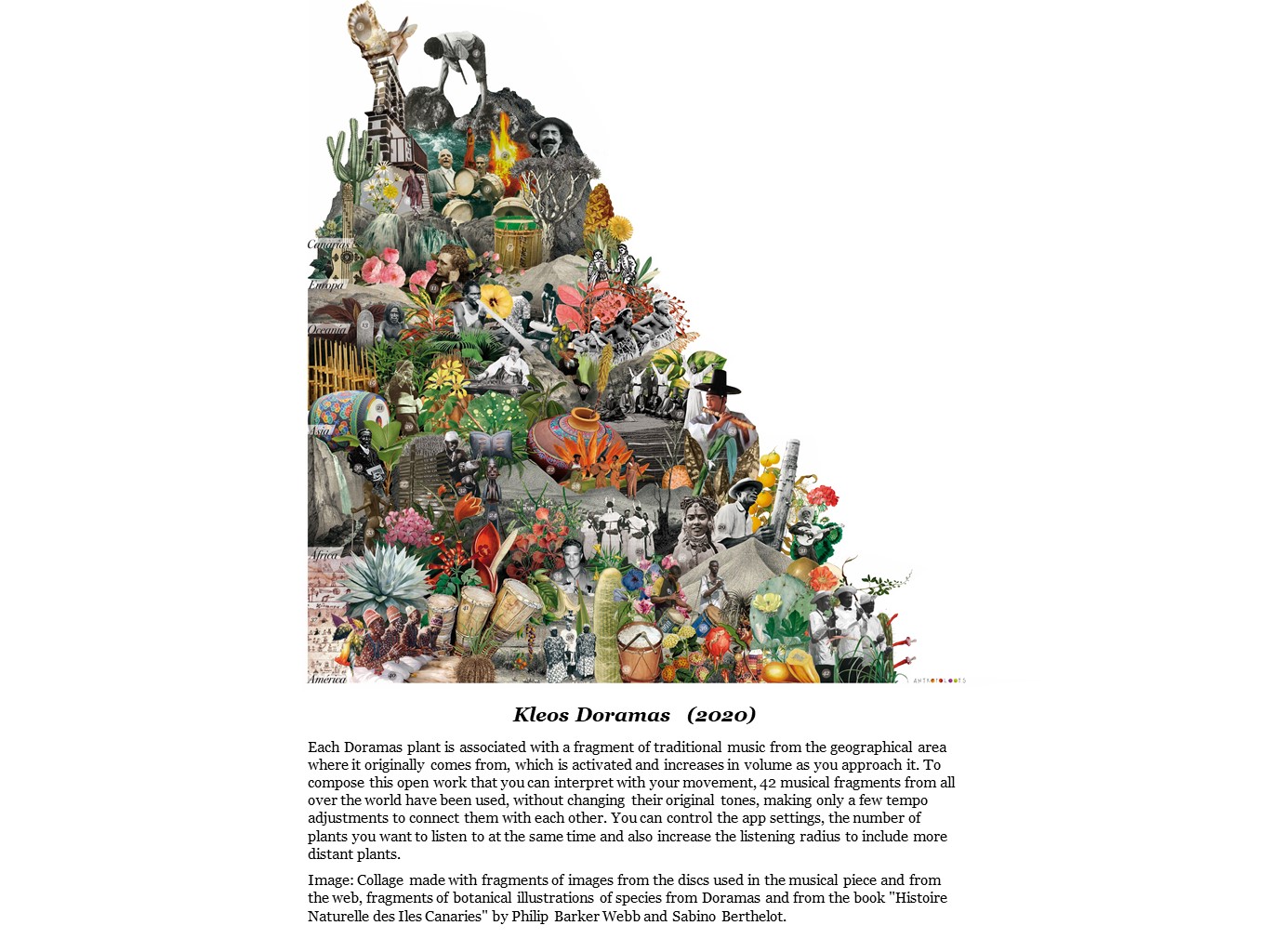
Collage. Kleos aims to reveal the complex and hybrid nature of our cultures and identities, based on the recognition of the diverse and cosmopolitan origins of the vegetation that inhabits our cities. Kleos promotes an imaginary based on the idea of collage, crossbreeding and hybridisation, opening up, through the botanical and musical memories of the species, a space in which nature and culture merge together.
The musical and visual remix that Kleos offers visitors to gardens, parks and urban forests functions as a vehicle through which to increase botanical knowledge of the species with which they coexist and of their mutual relations and synergies, hidden beneath everyday life.
Non Linearity. To complement this experience, during the health crisis we have created a web version that allows, without being on site, to trace routes through the map of the garden, transforming it into a score that connects at a compositional level the botanical species with their associated sound fragments. A new format of sound reproduction thus emerges which, as opposed to the linear reading of the classical score, encourages multiple interpretations of the same work, linking plants, sounds and stories through virtual walks traced by each user.
Key objectives for inclusion
Participatory process (citizen science). Kleos is conceived as a seed that starts in small gardens and then gradually unfolds, involving citizens in the mapping of new specimens along their daily journeys. A strategy that aims to explore, through the creation of a collective atlas, the dimension of the city as a garden of coexistence.
Creating new inclusive narratives. "Everything is interaction', argued von Humboldt, who saw the world as an archipelago linked by flows, currents and connections, where travellers and migrants operated as pollinators, collectors and archivists of symbiotic relationships. From his perspective, plants not only tell specific and independent botanical stories, they also tell us about the networks that link us and the migratory routes that have been connecting and shaping us in a mestizo way. The question is about transmitting the connections that are worthwhile, about composing -imagining- a more viable and respectful cosmopolitics, about entangling from what we have around us. And what we have around us are the plants of our cities, what matters to us are the stories that drag their foreign memories, what concerns us are the links that they knotted with humans and non-humans in other contexts, what seduces us are the rhythms that spread these intertwinings, what moves us is the conception of our cities as a Terra exuberantis, as a garden of coexistence.
From this desire arises kleos, a platform where species are intertwined with scientific, artistic and sound fragments, which not only reveal their biological qualities, but also the memory and wisdom of the migrants who share their origins with them. In this way, by awakening the foreign memory of the urban forest, we want to celebrate the mixed and open nature of European cities.
Results in relation to category
Kleos has already been developed in 3 cities ("Jardín Cosmopolita" in Seville, "Kleos Cristina Enea" in San Sebastian and "Kleos Doramas" in Las Palmas de Gran Canaria) and 2 are in progress (in Madrid and Gran Canaria).
A total of 15 collective mapping workshops have been held in different educational centres and other social entities.
More than 30 guided walks with Kleos have been carried out in different areas of the city of Seville and Doramas Park (Las Palmas de Gran Canaria). In Cristina Enea, due to the COVID pandemic, a virtual guided tour was carried out (https://youtu.be/gg0j9AT2hSA).
A total of 487 profiles have been registered as cartographers on the platform. Although these may belong to an individual or a group of people (associations or schools). We estimate that the number of people involved in participatory mapping is around 1,182.
The platform already registers 500,566 specimens of 703 different species, of which 231,475 have an associated sound fragment.
Just as the diversity of mapped botanical species comes from practically all regions of the world, so the sound fragments selected represent musical expressions of cultures linked to these regions.
Since the launch of Kleos (December 2018), 172,502 users have visited the web platform (272,610 sessions and 777,719 page views). .
Total downloads app: 2,460 users (151 Kleos Cristina Enea + 1246 Kleos Doramas + 1063 Kleos Sevilla).
Acknowledgements:
Kleos has been selected to be exhibited in the Spanish Pavilion within the framework of La Biennale di Venezia 2020/2021.
Kleos Sevilla is part of the project "Jardín Cosmopolita", project awarded with the Prize for social innovation in Culture, entertainment and tourism of the I Magellan-Elcano Congress (2020) and COAS Prize for interior design and ephemeral architecture, as part of the exhibition "Jardín Cosmopolita" (2019)
How Citizens benefit
Co-creation
Kleos is a proposal that arises from the collaboration between artists, urban planners, scientists, technicians or musicians collaborating with civil society. A collaboration that is articulated in two ways:
-The realization of educational workshops that pay special attention to botanical, ecological and environmental aspects of urban vegetation, but also to its origin. The aim of this attention lies in the search for potential links with the landscape and sound memory of the migrants who take part in them.
A total of 15 collective mapping workshops have been held in different educational centers and other social entities.
-Citizen mapping. With this objective in mind, and aware of the necessary knowledge required to identify urban vegetation, we improved a tool which allows people without previous knowledge to identify vegetation. Additionally, in order to encourage participation, we gamified the experience by generating contests that reward the most prolific cartographers with seeds of the city's plants on a monthly basis.
A total of 487 profiles have been registered as cartographers on the platform, and 1.,182 people have been involved in the cartography of 500,566 specimens of 703 different species.
Situated work
kleos emerges as a corpus of situated contents, which any citizen can experience for free through their daily walks. However, this process also requires their participation in order to complete the re-construction of the work and the contents, as it only unfolds and combines according to their drift and attention. We could therefore conclude that Kleos is a proposal that invites citizens to actively discover the botanical heritage of their environment as co-creators and not as consumers.
A total of 172,502 users have visited the web platform (272,610 sessions and 777,719 page views), and the number of downloads app raise to: 2,460 users (151 Kleos Cristina Enea + 1246 Kleos Doramas + 1063 Kleos Sevilla).
Innovative character
Sustainability. Kleos is an initiative to explore urban vegetation through carefully edited maps, images and sounds that show the effects that these generate on the body (flowering, aromas or fructification), the environment (capture of CO2), or culture (probing the migration and linking of species to the place through images and music). From this perspective, it is a proposal that mobilises new digital technologies to raise awareness of the vegetal heritage of our cities and the socio-ecosystemic services they generate. In this sense, the innovation lies not so much in the singularity of the data, but in the combination of the data, and how it is communicated.
Inclusion. Kleos emerges as an intimate experience that invites us to enter into urban nature to awaken the foreign memory of the species that surround us by remixing traditional music linked to their places of origin, highlighting our mestizo nature. From this perspective, we believe that it is interesting use the global origin of urban vegetation to reflect on the cosmopolitan composition of the city, developing new narratives that allow migrants to codify themselves in the construction of shared spaces. Symmetrically, we understand that transmitting through plants, stories and relationships of these cultures with nature, can open and enrich our own perspectives.
At the same time, Kleos encourages citizen participation in mapping, through functionalities and processes of double validation that favour the organic growth of the plant atlas of cities and also of its quality. From this perspective, the aim of Kleos is to become a sort of geolocalised Wikipedia.
Aesthetics. On an aesthetic level, we understand that the innovation of the proposal lies essentially in the three concepts developed above, which aim to promote a multisensory experience (synaesthetic), allowing the continuous reassembly of urban fragments into a new integrity (collage), but without reifying, keeping the story open (non-linearity).