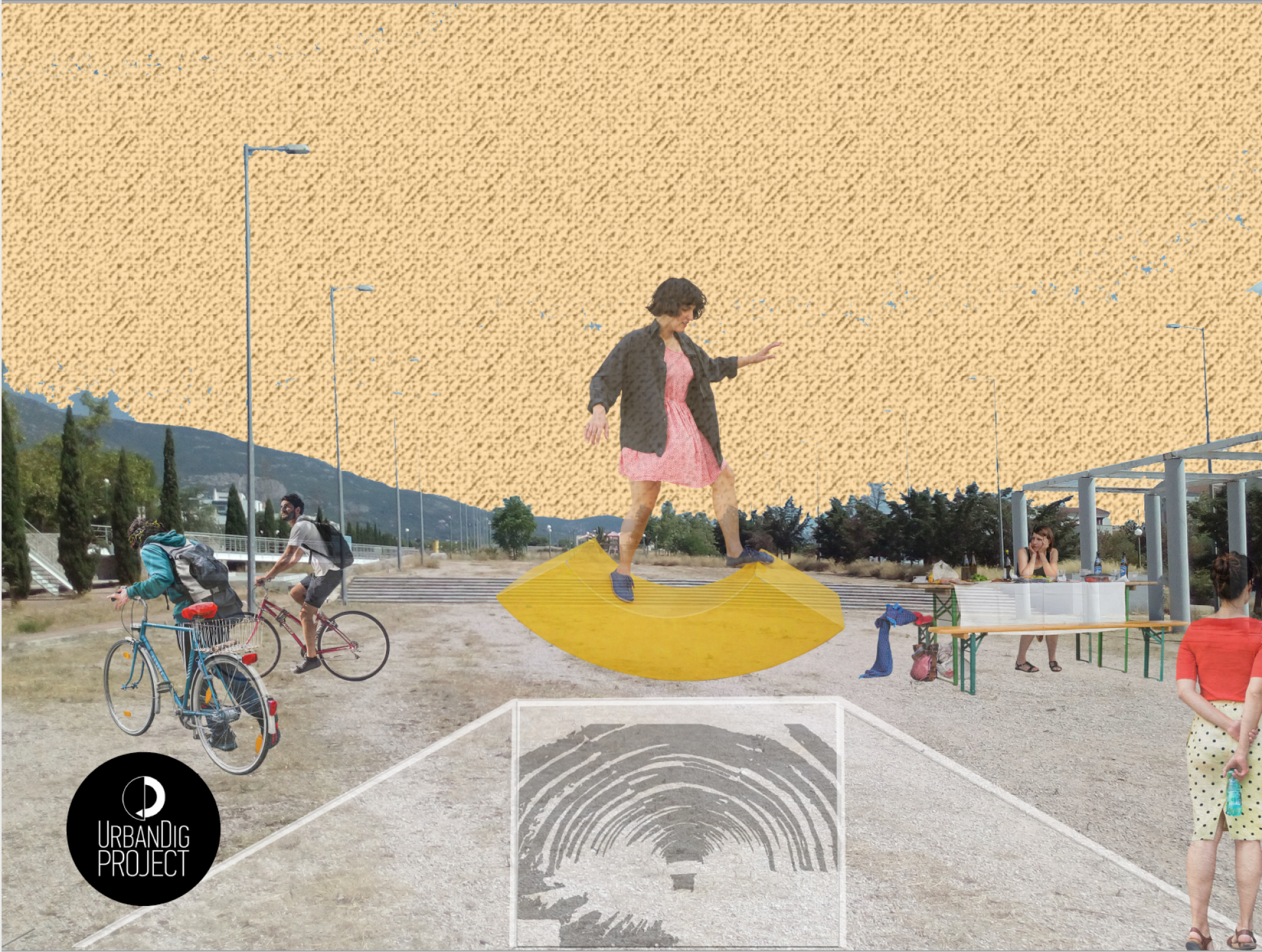
UrbanDig Adrianio
Basic information
Project Title
Full project title
Category
Project Description
How could an invisible cultural heritage site act as entry point towards a sustainable way of urban living, as networking possibility or as field of cultural practice? How can a heritage site narrate itself?
UrbanDig Adrianio is a platform that "excavates" in multiple ways the Athenian Hadrian Aqueduct, drawing inspiration from its triple status as an obscure cultural monument, an unused water vein, and an unseen underground route - an axis that connects many areas of the city with each other.
Project Region
EU Programme or fund
Description of the project
Summary
The Hadrian Aqueduct is a 20km long underground roman monument that crosses the city of Athens. Apart from its being a significant unused non-potable water resource, it generates new local and translocal cultural identities and new possibilities of inter-municipal collaboration.
The UrbanDig Adrianio's vision is to act as a platform of an interdisciplinary research and activities' roadmap producing knowledge, cultivating soft skills and empowering the communities around it to over-take the management of heritage, environmental and urban commons.
These three aspects of Hadrian Aqueduct are the three main pillars around UrbanDig Adrianio:
culture (monument) - environment (water) - society (community networking)
UrbanDig Adrianio focuses on four areas of outcomes:
- Community engagement activities with a vision towards a Hadrianic Neighborhoods Network
- Artistic research and production with a vision towards artistic adoption/highlighting of the Hadrianic route
- Educational tools, workshops and presentations focusing on the cross-section of its three pillars.
- Redevelopment of urban context towards a more sustainable infrastructural future and the improvement of the local "well-being"
These four strands of outcomes are being researched, developed and implemented through various programs funded by the EU-Commission and, thus, the Urban Innovative Actions Fund, the Active Citizens Fund, the Erasmus+ and the STARTS Grant and the greek Ministry of Culture.
Collective mapping, community empowerment, engagement, participatory design workshops, policy-making processes, site-specific cultural festivals, informative workshops, local archive creation, networking online platforms, infrastructural renovations, new educational approaches within different contexts and public-space interventions are only some of the wide range of activities that UrbanDig Adrianio platform brings along.
Key objectives for sustainability
Key Obj.1: Promotion of green urban policies on sustainable water use and quality green public spaces: Nowadays, Hadrian Aqueduct has a negative environmental impact, since it remains unexploited and its water is being poured into the sea. UrbanDig Adrianio within the UIA "CULTURAL HIDRANT's" framework, aims to re-use this irrigation water while cutting off the use of potable water (expensive and energy consuming) for irrigation. Moreover, it will regenerate 8.500 sq.m. of quality green, public and heritage spaces.
Key Obj.2: Empowering the local economy by strengthening endogenous and resilient development: The project aims to create a paradigm shift in the present perception of the periphery of Athens Metropolitan Area, which has very weak heritage branding compared to its core. The goal is to support the creative economy and local skills while developing new soft ones.
Key Obj.3: Cultivating the skills and empowering every community involved in a way that they could take the leading management role when the project is finished. Some examples are the following:
- Within the Erasmus+ "HADriAN" framework, educational tools will be designed together with school teachers and Educational Directorates, in order for the toolkit to be implemented into the greek educational curriculum in the field of environmental education.
- Within the Active Citizens Fund "Walkers on Water" framework, active citizenship will be addressed and residents of all different municipalities crossed by the Hadrian Aqueduct will sit on the same table with public local authorities to co-design a way of citizens participation in decision making that has to do with urban redevelopment, cultural activities and environmental policies.
- Within the UIA "CULTURAL HIDRANT's" framework, three main project outputs i.e. the Local Archive, the Non-Potable Water Network and an annual HIDRANT Festival, will create around them specific communities that will grow as specific organising committees.
Key objectives for aesthetics and quality
Key Obj.1: Re-introduction of cultural heritage asset beyond the usual “sightseeing” approach: Hadrian Aqueduct is a subterranean roman infrastructure monument. The goal is to reintroduce it to everyday life through its heritage values (ancient and contemporary) and its vital function as an unexploited water resource for irrigation purposes. Redevelopment processes including urban regeneration of neglected public spaces affect the every-day live of the inhabitants. The natural aspect of the underground water will be emerged and exposed to the dense urban context.
Key Obj.2: Increasing cultural heritage awareness towards the connection to local heritage: Residents of an area crossed by the Hadrian Aqueduct re-conceptualise the public space and acquire a new local identity. At the same time, local inhabitants cultivate a sense of ownership and belonging.
Key Obj.3: Improvement of the local well-being: A re-constructed public space that emphasises in green spaces will become a vehicle towards a new every-day experience of the city.
Key objectives for inclusion
Key Obj.1: Revitalization of the community/ies through participatory processes: Hadrian Aqueduct can create communities round both heritage and water commons. At the same time, the revitalization of the communities will operate as an innovative way to re-introduce the Roman monument.
Key Obj.2: Empowering active citizenship: Improvement of the relationship between local authorities and residents by involving the latter in decision making processes. Methodological tools of the "UrbanDig" toolkit will be activated, such as "DeMos the Game", an activity-based programme that encourages and endorses collective processing and management of different issues, addressing multiple communities, while employing play and performative arts.
Key Obj.3: Building a community engagement strategy: The Community Building Strategy will present the methodological approach on how complex, juxtaposed and sometimes contradictory communities of stakeholders could form a multi-layered community around a multilayered monument that acts simultaneously as water resource, a cultural heritage remains, hidden urban landmark and networking opportunity and could become a "best practices" example. This objective could be met via the inclusion of all community members in specific gatherings, the so-called “Yeast Meetings”, that are designed in a “world-cafe” mode, so as to know us better, understand each other's needs and aspirations, and commonly agree on the action plan to meet these goals.
Innovative character
Although not many countries have subterranean Hadrian Aqueducts, the core issue remains: how can cultural heritage and especially ancient heritage infrastructure be re-introduced in contemporary urban life, not in a ‘sight-seeing’ approach but through its actual function and use-value. UrbanDig Adrianio can add value in current mnemonic policies that possess similar approaches, introducing the role of communities in the co-governance of heritage and natural commons.
The project can be transferred and replicated as a whole or partially since its activities can fit in different contexts and cases, where the main challenge is to raise heritage awareness to improve local wellbeing. It can provide a transferable toolkit: (i) to engage communities in discovering and preserving their own heritage commons, helping existing or potential organisations and grassroots initiatives to work with performative social technologies; (ii) to raise awareness about cultural and natural heritage, in an inseparable way, following the urban/ heritage sustainability guidelines (UNESCO, New Urban Agenda, European Agenda for Culture); (iii) to share knowledge about the constitution of informal sharing and solidarity economy community in a mutual relationship to the urban authorities; (iv) to employ cultural heritage as a means to develop networks among diverse neighbourhoods (in terms of local economy, living standards, social fabric, etc.); (v) to enhance heritage branding out of the historical centres’ cores.