THE BETTY NANSEN DISTRICT
Basic information
Project Title
Full project title
Category
Project Description
The neighborhood behind The Nordic Square and Domus Vista, a high-rise sixties building, was once enclosed, and neglected. An urban space dominated by large windswept parking lots, and minimal recreational space. By means of a wise landscaping plan, renovation of high architectural value, relocation of a civic center, and a new nursing home, a complete transformation has taken place. Today a vibrant setting for a community, focusing on inclusion, with health and exercise as the unifying factor.
Project Region
EU Programme or fund
Description of the project
Summary
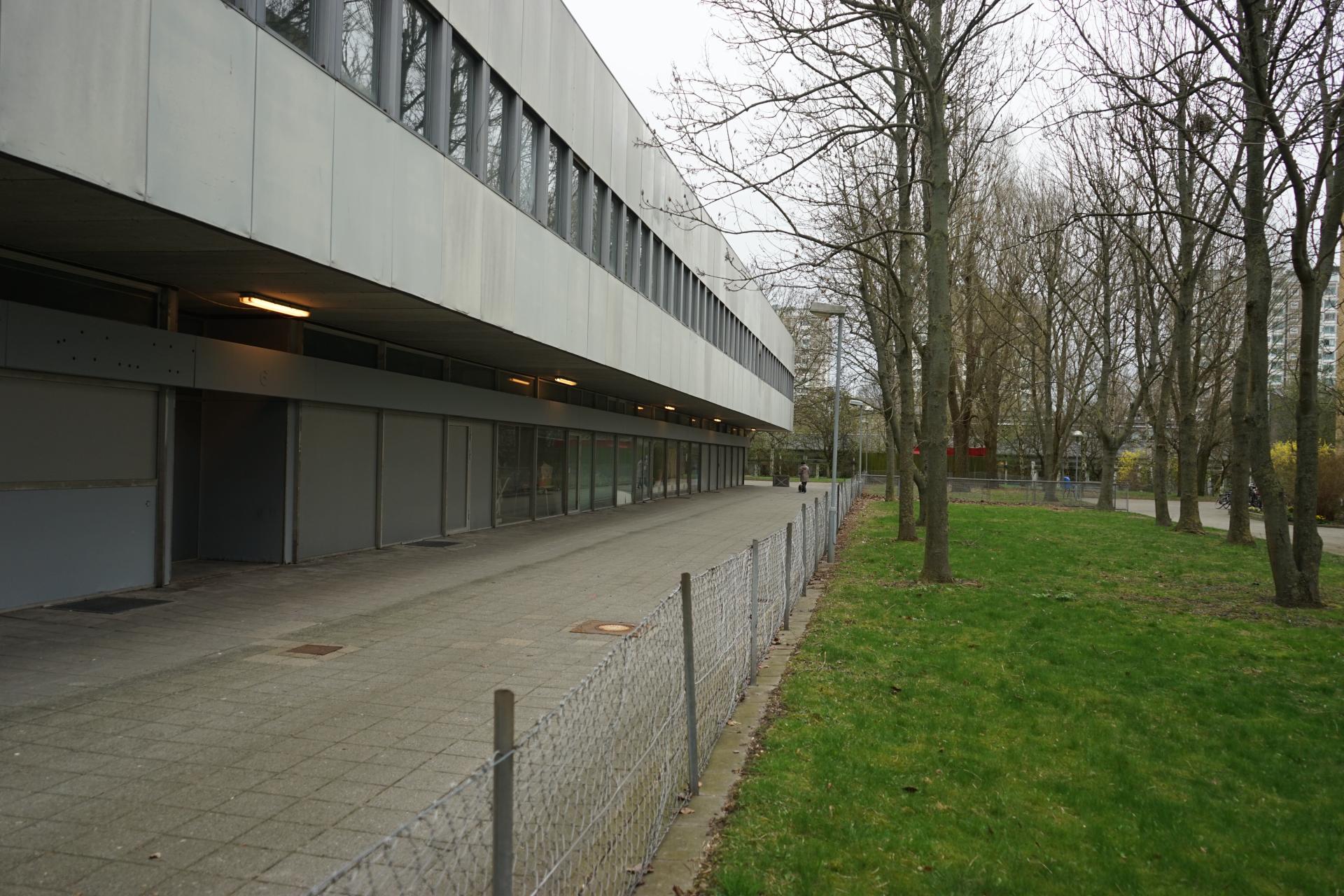
For many years, the neighborhood behind The Nordic Square and Domus Vista, a high rise building from 1969 and the tallest residential property in the capital area of Denmark, was enclosed and neglected. The neighborhood that is situated in the municipality of Frederiksberg was characterized by dark alleys, winding access roads and an outdoor area dominated by large windswept parking lots and tiled sidewalks, while grass and the tall trees in the area was fenced in.
By means of; a clever plan for the urban landscape; a thorough renovation of high architectural quality of existing apartment blocks; a new location for the municipality civic center; as well as the construction of a new nursing center; this scenario is history. Today it is completely transformed into a vibrant and inclusive neighborhood.
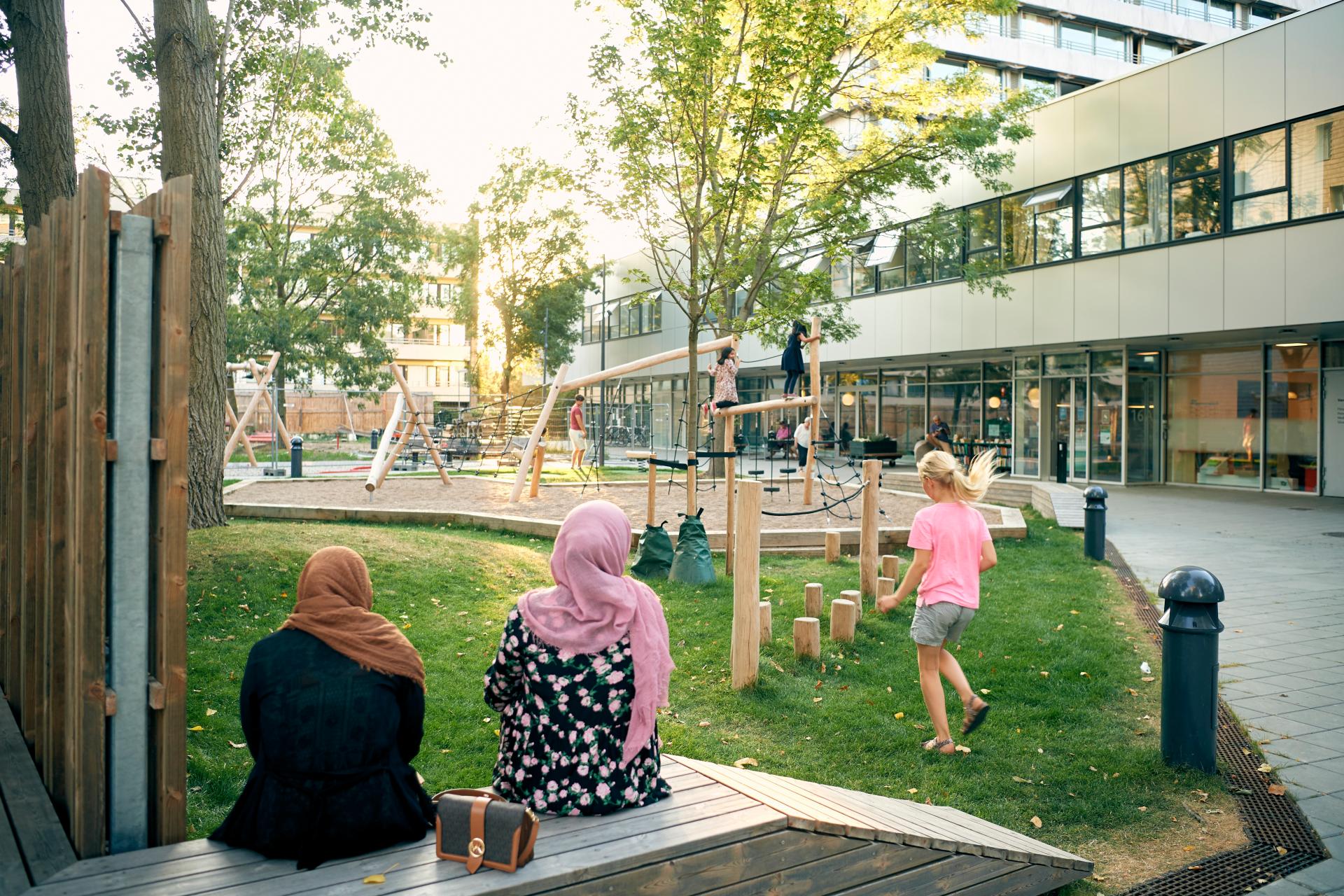
Keingart Space Activators has designed the new urban space as a carpet on which the area's functions and buildings are laid out upon. This creates a unified neighborhood and urban space which forms the framework for a safe, community-generating, and inclusive environment with social sustainability in mind. In this setting residents of all ages and functional levels can meet and interact, with each other, and with visitors, and neighboring users of the many facilities in the area.
The transformation has been brought to life by virtue of a pioneering collaboration between the non-profit housing association Frederiksberg United Housing Company (FFB) and Frederiksberg Municipality, facilitated by KAB an affordable housing construction and management company and with financial support from the The Danish Foundation for Culture and Sports Facilities, Realdania and The A.P. Møller Foundation.
Key objectives for sustainability
The overall project has systematically considered sustainability in all its three forms – social, economic, and environmental – from the very start.
The starting point of the project is social sustainability, where the landscape plan together with building design creates the physical conditions for an inclusive, community-generating neighborhood. Conscious emphasis has been placed on securing that the individual buildings; The care center, civic center, school, and the apartment blocks (non-profit housing) contains unique facilities that are inviting and therefore creates a flow of people and neighbor-relations.
Economic sustainability is fundamental since considerable rent increases has not been an option, especially considering resident composition and the social purpose of non-profit housing in Denmark. The economic sustainability has been attained by "pooling" contributions from private funds (The Danish Foundation for Culture and Sports Facilities, Realdania and The A.P. Møller Foundation) with area renewal funds, etc. from the municipality.
In terms of environmental sustainability, the strategy has been to transform and upgrade the existing buildings as opposed to tearing them down and building new ones thus securing a high degree of recycling. Furthermore, there has been a focus on climate change adaptation. Looking into changing weather conditions and with that expectations of more frequent and more heavy rainfalls, an extensive climate adaptation plan has also been a key element in this project. The key objective has been to get ahead of a future climate reality by including maximum capacity to collect and handle rainwater in a manner that also adapts to the recreational elements of the landscape plan. In the space between the apartment blocks, space is provided for living and moving, at the same time as rainwater from the surrounding areas is collected in connection with large cloudbursts.
Key objectives for aesthetics and quality
It has been a key objective to create a fluent connection and interaction between the public and the private space. This is achieved through gentle transitions between the outer and the inner spaces of the surrounding apartment blocks. This allows the residents - on a sliding scale - to be "public" - to be seen / exercise, to be "semi-public" - to observe / be present (called "legitimate peripheral behavior"), or privately where one withdraws to one’s own territory. This is a rare and very high quality that goes beyond functionality and aesthetics
The new neighborhood has been given its own visual identity with welcoming facade expression in raw wood and brick singles on the buildings, combined with the particularly inclusive urban space that elegantly merges with the civic center, health clinics and the upcoming cafe's premises on the ground floor. Thus, the neighborhood will be a gateway for cyclists and pedestrians from Valby to Frederiksberg, that invites to leisure and will make them want to linger before the trip continues, and work as an exciting new destination for the citizens of Frederiksberg.
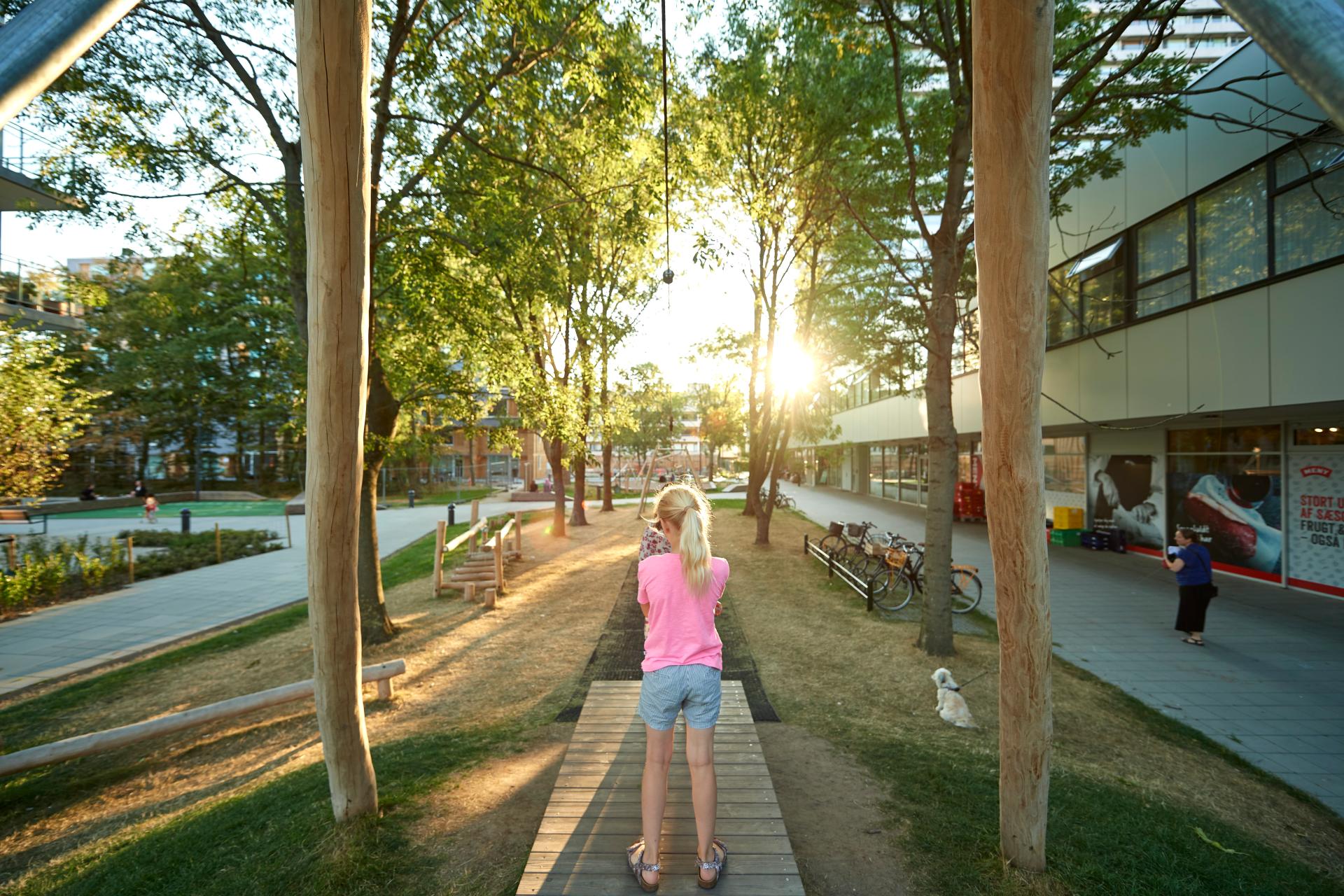
The qualities of the original beautiful old trees have been preserved as part of the green carpet. The outdoor areas have been organized to create a close interaction with the activities on the ground floors of Domus Vista and the two adjacent apartment blocks. To support the coherence within the urban space, one of the apartment blocks has opened its ground floor towards the activities in the outdoors. In the future the plan is to accommodate a cafe and thus support the neighborhood's many forms of activity.
Key objectives for inclusion
The vision and objective behind The Betty Nansen project were a neighborhood, conceived as a whole, that would enable a sense of community for a group of people with special conditions and needs, while at the same time also having a barrier-breaking effect towards other social groups. The space should not only be a safe and inviting place for the residents to meet and initiate in social and physical activities but also for passerbyers to pause and enjoy an inclusive urban space before moving on to their next destination.
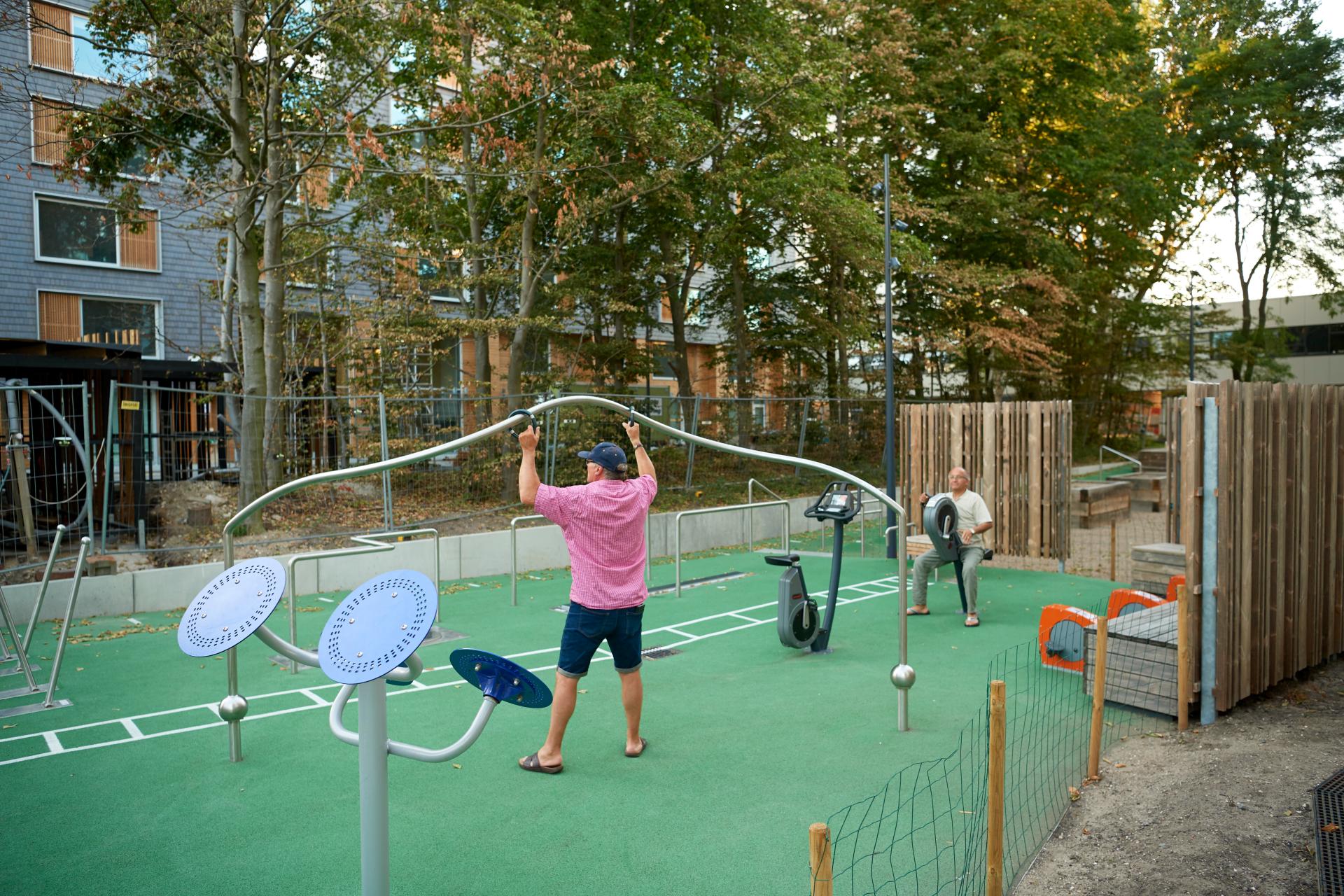
This has been realized by establishing areas where people of all functional levels can engage in movement, physical activity, and sensory experiences on the level they are comfortable with thus promoting a sense of inclusion and equality for the residents. While also providing new access points through the district for cyclists and pedestrians, connecting it to the surrounding community.
Well-thought-out locations of activities that consider human disabilities and same-level pavement between buildings within the area, creates an inclusive urban space that to a much greater extent invites citizens with disabilities to be active in the community. Equality in accessibility has been the objective and the result are a communal space where there is room for everyone and opportunity to be part of the community instead of just looking on from the sideline.
The transformation has also made room for a multifunctional meeting-, culture- and dining-house – envisioned as a social power center – located in the fantastic location on the ground floor of one of the newly renovated buildings facing the urban space. The center will form the framework for social community activities with the intention of connecting people - residents and visitors. This is particularly important for elderlies and the people with disabilities living in the area who are more prone to loneliness due to their limited ability to get around.
Results in relation to category
The Betty Nansen project is an emblematic example of territorial regeneration that combine sustainability, aesthetics, and inclusion as it has transformed an enclosed and neglected housing area completely into a vibrant and inclusive neighborhood:
- Aesthetically by means of urban landscaping and renovation of high architectural quality.
- Sustainabilityvise by considering all three aspects – social, economic, and environmental – of sustainability.
- In terms of inclusion by creating a safe community-generating neighborhood that supports relations and interactions for a group of people (disabled and elders) who are often left to their own company in their apartments.
How Citizens benefit
Throughout the process, starting in 2007, there has been broad involvement of residents and other stakeholders. The project has its departure in a user-driven origin and a crucial part of the process has therefore been the involvement of the residents in the area, who have participated in several different workshops designed to uncover their needs, wishes and visions for the new urban spaces.
Various organizations, authorities, professional scholars, foundations, as well as representatives from cultural life have over the years - in a rare symbiosis - contributed and/or been involved. These includes among others; Copenhagen Food House, The Betty Nansen Theater, The Knowledge Center for Disability Sports, Frederiksberg Disability Sports Union, The Real Dania Foundation, The Danish Foundation for Culture and Sports Facilities and Frederiksberg Municipality.
Through the renovation of the first housing block, a new concept was developed. An algorithm of five steps that ensures that the social dimension is considered from the very start.
The first step of the algorithm is formulating the social vision for the project, which i.a. answers what social purposes that it should serve and characterize. The process of generating the social vision includes stakeholder involvement through various anthropological methods like investigative interviews and vision-workshops with existing and possible future residents, other local stakeholders, experts, architects, and municipal representatives.
Other methods used to involve stakeholder perspective has been photographic self-documentation and anthropological observation.
This algorithm has guided the perspective on the social dimension throughout the process.
Innovative character
The innovative character of this project is the way the landscape plan elegantly creates the physical preconditions for an inclusive neighborhood that creates room for mutually rewarding relations between the residents and the many other users of the area.
By starting with the design of the urban space and the neighborhood identity, as an architectural landmark and guiding factor for value creation, the process has been turned upside down. At Betty Nansen, the urban space has been the foundation for the development of the remaining projects and the success of the area. In contrast, landscaping is usually the last element to be considered in new construction and renovation projects. As such they often become subject to both a tight economy and the physical conditions given by the construction structure.
The particular focus on accessibility is also an innovative example for future neighborhood formation and urban space designers to explore. As such it shows how construction can promote the framework for inclusive communities particularly for a group of people who are often indirectly excluded and isolated from community relations due to their physical disabilities.