Climate positive, zero-energy school
Basic information
Project Title
Full project title
Category
Project Description
Schools cover a high percentage of the city’s overall building area and operating costs are a significant item in the budget. Consequently, the science block offers a conscious alternative to the rampant use of technology in buildings.
As an active house, it maximises naturally occurring, cost-neutral environmental (light, thermal & geothermal) energy sources to ensure sustainable operation.
Project Region
EU Programme or fund
Description of the project
Summary
Building with environmental energy: Active building vs. Passivhaus
The school’s science block is a zero-energy house, meaning it produces in the course of a year locally&renewably at least as much energy as it consumes. This balance not only includes the building operations for heating, ventilating & lighting, but also the energy demands for user electricity.
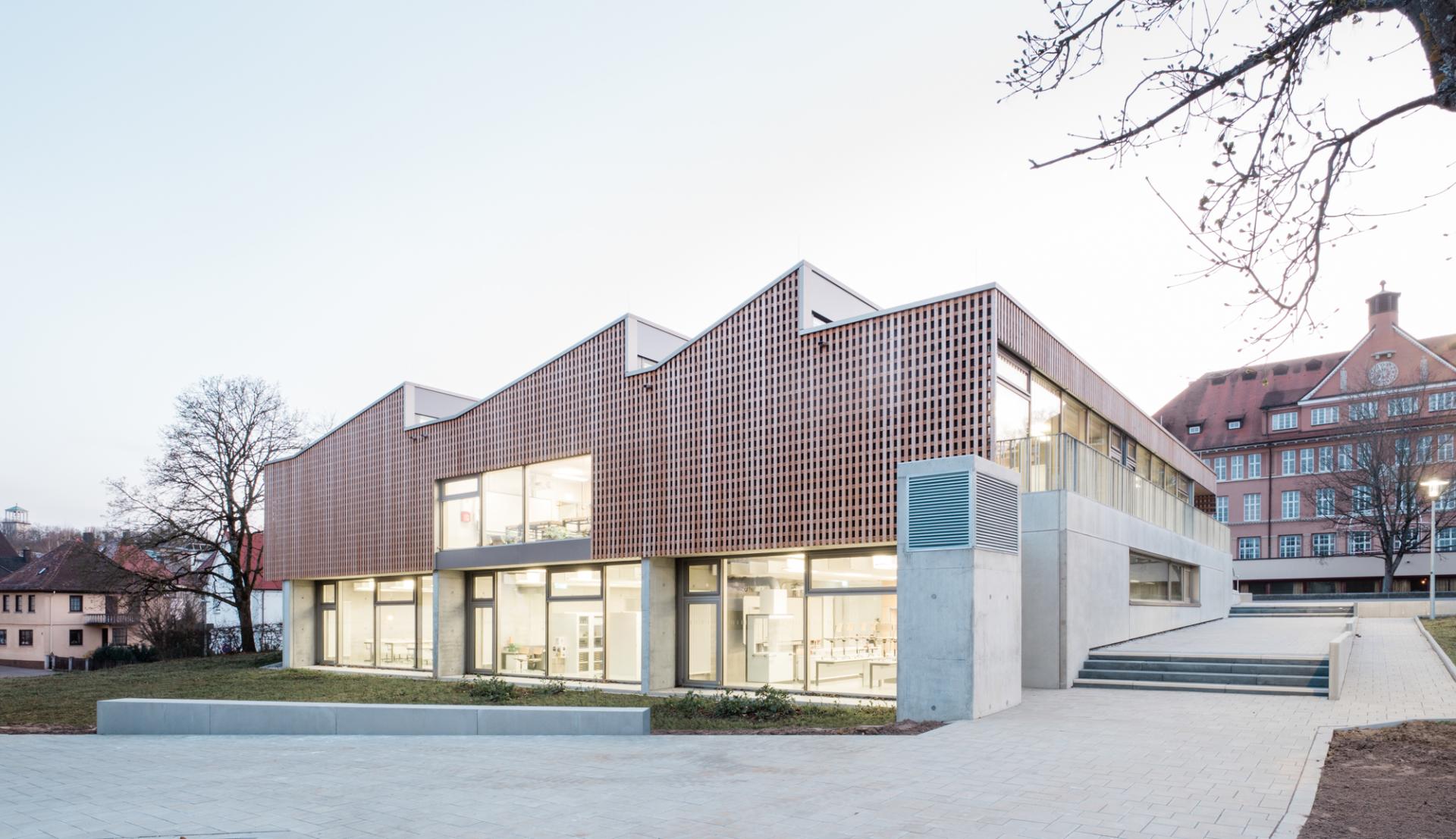
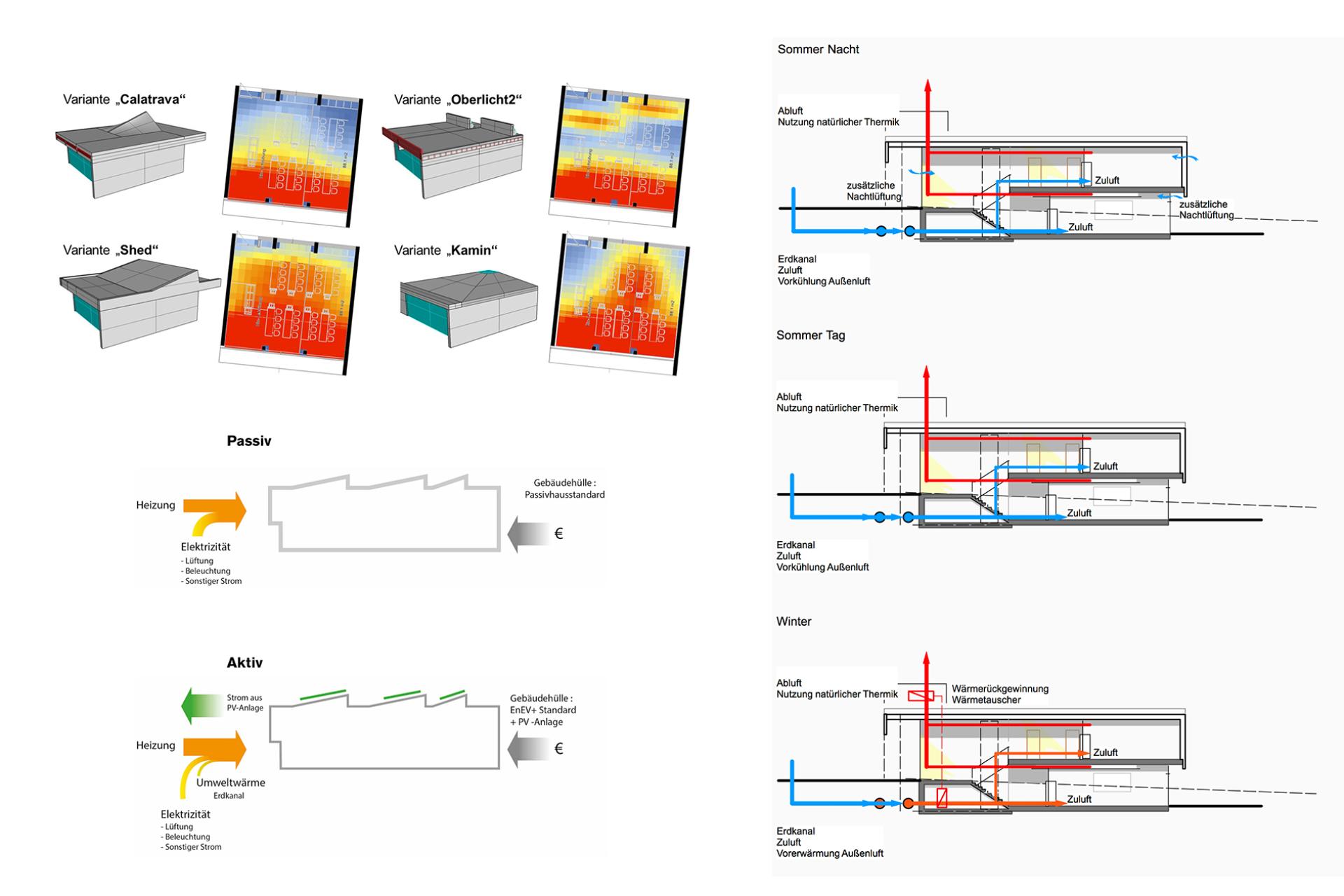
The block offers a conscious alternative to the rampant use of technology in buildings. It is an active building that maximises the use of naturally occurring environmental energy (light, thermal & geothermal) for the sustainable operation of the building. Passive measures include a roof optimised for natural daylight yield & night cooling (shed roof design) as well as a 45m-long underground conduit that exploits the difference between ground and external air temperatures, drawing fresh air into the building via a natural, hybrid ventilation concept. The active element is the photovoltaic system, which covers 100% of the building’s primary energy needs.
The block is cooled solely through the heat retention of its solid components. Planned largely as a timber construction, it was eventually realised as a timber-concrete hybrid building. The reason: data from the Weather Service was used to simulate longer, hotter periods and to take their effects into account. The upper floor combines solid & lightweight materials to create a thermally & climatically optimised structure. The timber construction reduces grey energy, while the concrete absorbs and stores heat energy and lowers temperatures in summer. The result: in July 2019 (outdoor temperatures of ~ 40°C), its indoors stayed 24-25°C-without any air conditioning.
The building is heated via an internal network. The heating system in the main building easily covers the low heating demand in the new block, which needs no system of its own. In exchange, excess energy produced by the new block’s photovoltaic system is fed to the main building
Key objectives for sustainability
The aim was to make maximum use of the available environmental energies so as to achieve the zero-energy standard. A life cycle assessment calculation was prepared during the planning process and used as an optimisation tool.
The building is cooled exclusively by thermal storage masses (i.e. concrete walls and a concrete ceiling in the basement level), which retain the night-time cool that penetrates the building. Motorised window sashes ensure effective night cooling in the form of cross-ventilation, an effect of natural thermal dynamics reacting to the shape of the shed roof. Passive thermal storage and effective night ventilation are the building’s only cooling in summer: no technical plant is required.
The hybrid ventilation system is a combination of window ventilation (which is only possible during breaks due to noise emissions from the busy adjacent road) and push ventilation. An energy-efficient, slowly rotating fan pushes the supply air slowly (due to large ventilation shafts) into the classrooms via a 45m-long underground conduit. The air is then freely directed into the foyer by means of sound-insulated overflow elements with minimal resistance. A heat exchanger extracts warmth from the foyer’s exhaust air and feeds it back into the supply air. The conduit has a purely passive effect. It pre-cools the fresh air in summer and preheats it in winter. This also ensures air quality without draughts, even when outside temperatures are low.
The science block is heated via an internal network from the main building, where a gas-fired block heating plant with sufficient power reserves to cover the new building’s low heating requirements operates.
Power is provided by a photovoltaic system on the roof of the new building (parallel to the electricity grid). In summer, the system feeds surplus electricity into the local, newly built power grid of the school complex, allowing both the new and old buildings to mutually benefit from one another
Key objectives for aesthetics and quality
The objectives we are pursuing are the same as those of our climate engineers: firstly, to deliver a new building of high architectural and urban design quality that meets a complex range of demands and keeps its focus on the users of the building; and secondly, to develop an integral climate concept that draws on natural resources and principles, thereby minimising the amount of technology required.
Architectural concept
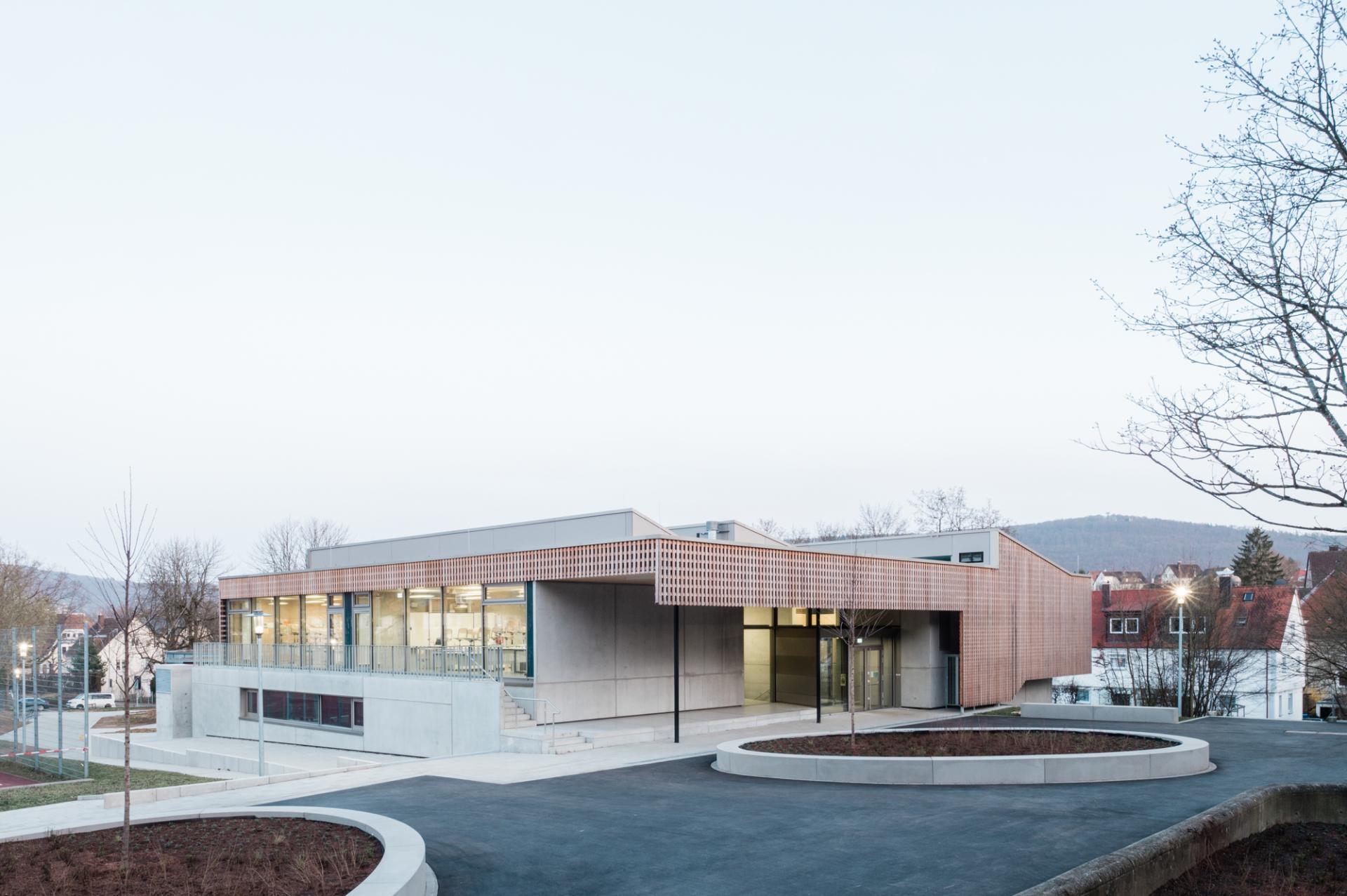
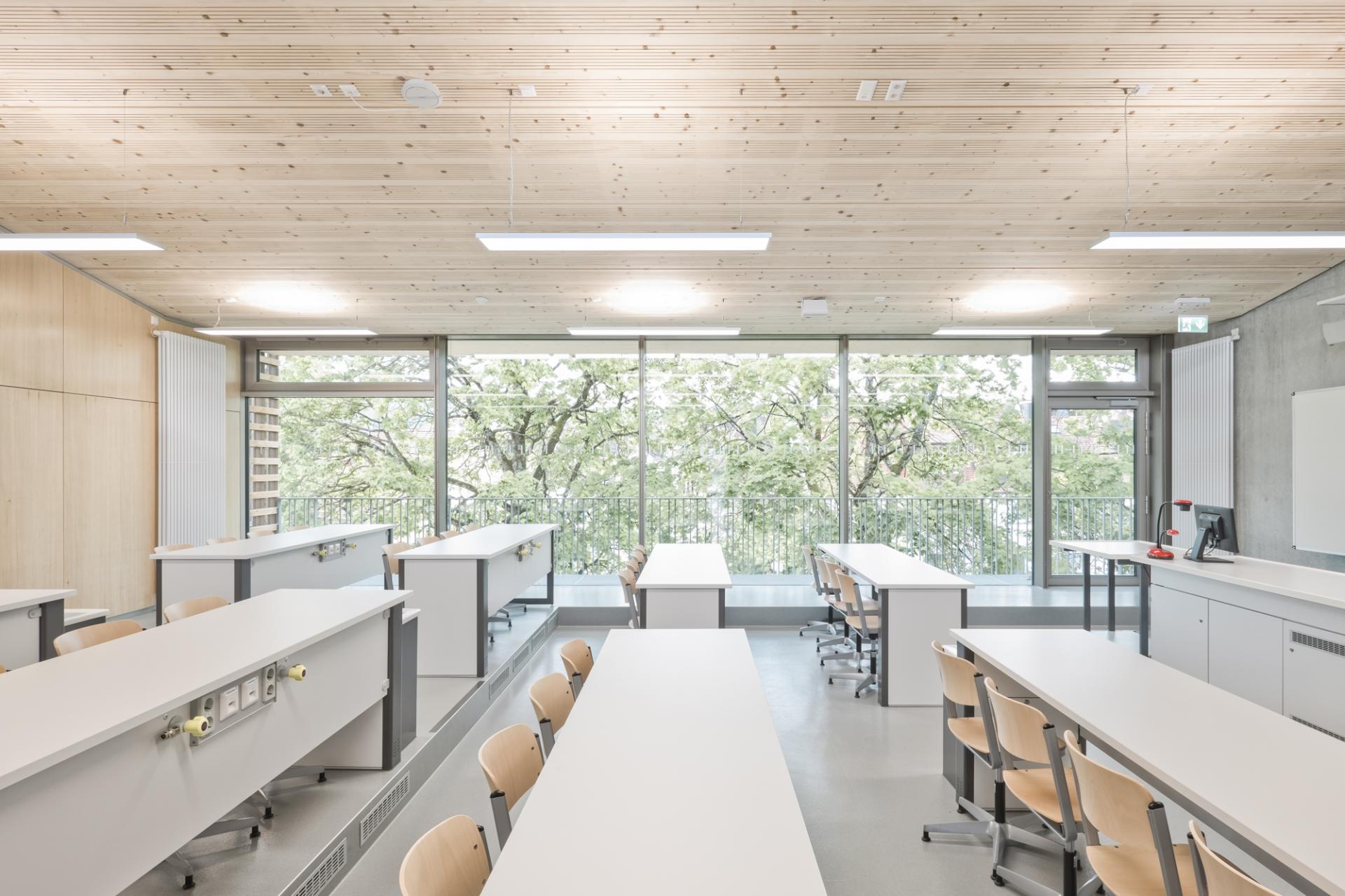
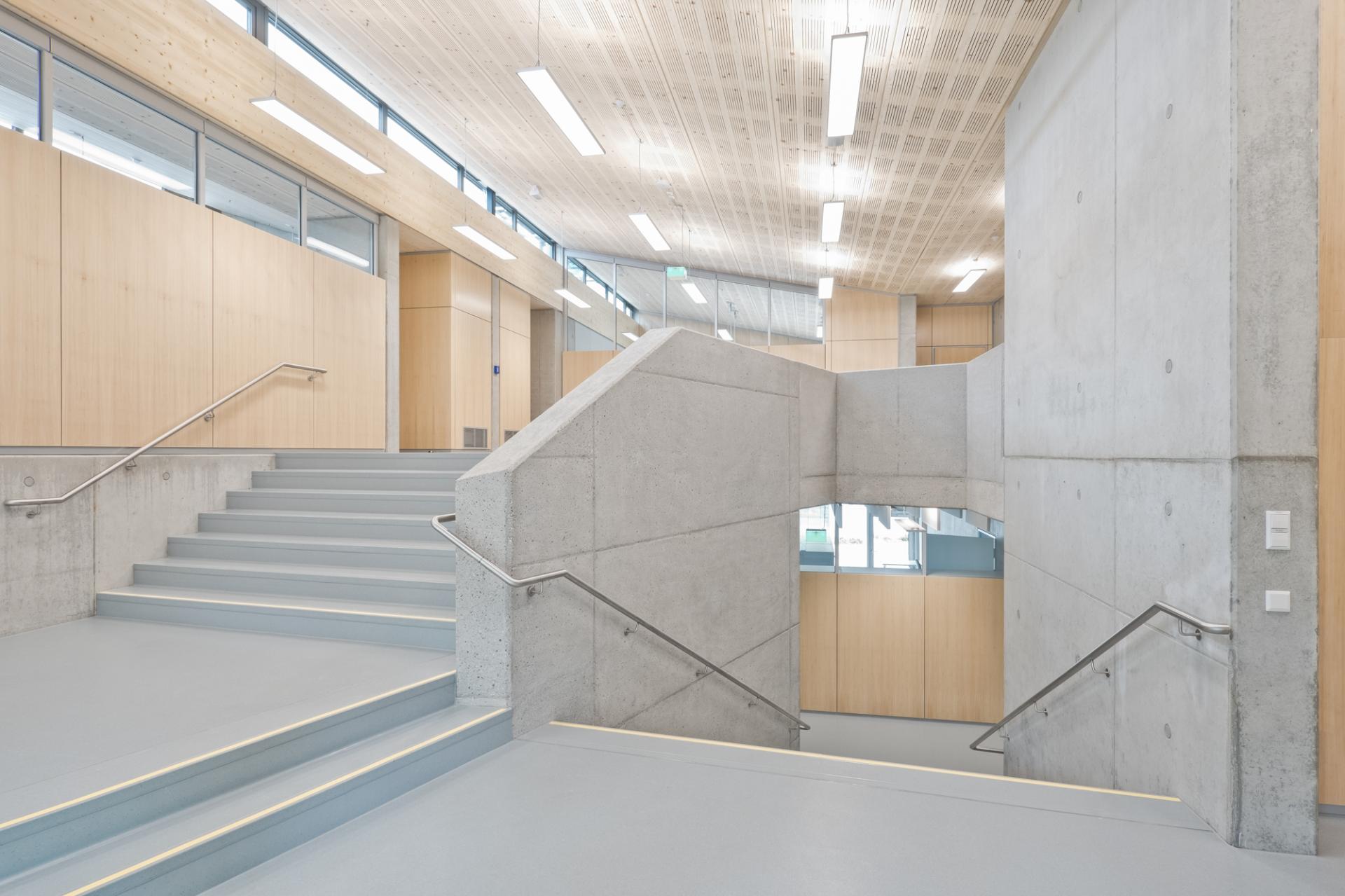
Out of respect for the old building, the newly constructed block for biology and chemistry classrooms is sunk into the ground so as not to obstruct the view of the listed main building. The cantilevered roof at the entrance and large, long seating steps invite people to rest, meet and communicate, and are actively used for this purpose. An incorporation of existing spatial axes has created a unified school complex out of the various individual buildings. A row of approximately 50-year-old deciduous trees was preserved on the south side of the building and deliberately factored into the building and climate concept. It provides heat to the building in winter and shade in summer.
Low-tech / high comfort
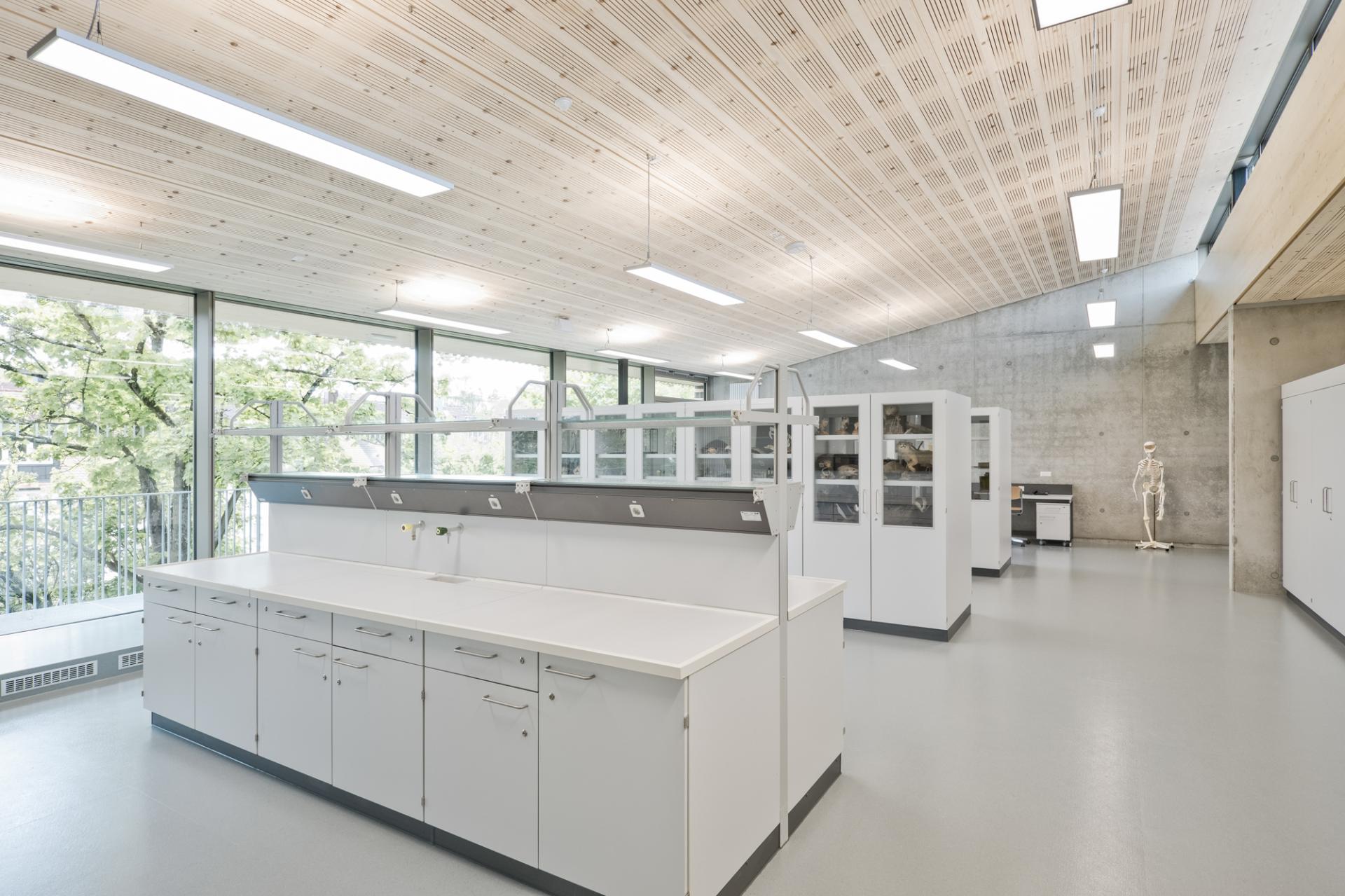
The shed roof design was deliberately chosen: pre-construction trials with various different roof shapes revealed that the north-facing shed roof design provided the most daylight. The science block enjoys high levels of natural, aesthetic and thermal comfort, a factor that provides the basis for efficient learning and has a demonstrable influence on educational success. Alongside good room acoustics and carefully chosen surface materials, the school building offers a high-quality interior environment. This fosters a sense of wellbeing that increases user acceptance, reduces vandalism, and helps create identity and identification.
Key objectives for inclusion
The new science block’s construction is barrier-free in all areas, despite the natural slope of the site. Supplementing the space distribution plan is a conference room - which was not initially envisioned - that also enables barrier-free parent/student conferences (the old, five-storey building erected in 1912 is not barrier-free).
Integrating the parent/student conference room and a wheelchair-accessible toilet facility, neither of which are available in the existing building, is the first step towards a barrier-free overall school concept.
A redesign of the outdoor areas has made use of these classrooms and the existing cafeteria completely barrier-free for the first time.
Results in relation to category
The values calculated in pre-construction simulations with regard to the zero-energy standard have exceeded expectations in actual operation. Due to the interaction of all components (architectural and climate concept, choice of materials, building orientation, etc.), the building went so far as to achieve a plus energy standard: the building is climate-positive in operation.
Some figures:
- Photovoltaic system: covers 100% of the energy consumption needs
- Push ventilation with extremely low air velocities and no exhaust air network: energy savings of approx. 80% compared to conventional ventilation
- Increased daylight quotient from 2.9 to 4.3 by means of skylights: reduces artificial light by approx. 50%
- Reduction of heat energy needed to warm outside air with the help of underground conduit: 17% or 1.1 MWh/ a
- Preheating of supply air in winter by approx. 5 K via 45 m-long underground conduit and cooling in summer by 5 k
- High-efficiency heat recovery: 75% efficiency - Cooling exclusively passive through use of the thermal storage mass
- Timber box section design of the roof: reduction of more than 50% in material as compared to solid wood constructions (with the same static efficiency)
Use of suitable materials for school construction in terms of durability, value and interchangeability of surfaces. The timber is sourced from local, sustainably managed forests. LIGNATUR elements are PEFC-certified and compatible with Minergie-ECO buildings. The site was closely monitored during construction to ensure that execution was consistent with planning. Plans/data/data sheets were handed over to the client in the course of the documentation.
Easy separability of structures upon demolition. Components are fitted additively (e.g. luminaires suspended, not installed), the wall construction and materials were designed to be recyclable, no gluing and composite building materials, few, recurring materials.
How Citizens benefit
Involving future users
School administrators and teachers were involved from the start of planning so that educational needs could be taken into account. Ventilation and energy concepts and correct user behaviour were explained to the future building users before the building went into operation. This information transfer and user involvement support the common goal of using the building sustainably. There was and continues to be considerable interest in this new block, and feedback from users is very positive. The concept is supported by the teachers and students alike because they are invested in it and because it has proven itself in everyday life.
An app is currently being developed in cooperation with Aalen University as part of a student research project; its aim is to convey the innovative energy concept and the sustainable construction method to current and future users. In this way, the educational mission of the school will be expanded beyond the curriculum and possibly arouse interest in the topic and our profession.
Integration into the neighbourhood context
By incorporating the existing spatial axes into the new campus, the area has become a popular gathering spot for people in the neighbourhood outside of school hours. Children, teens and students in particular can use it in a variety of different ways, including use of its sports field, climbing frame and skateboarding facilities. The large canopy of the new building creates additional opportunities to linger and doubles as a place to meet and converse.
Innovative character
Building with environmental energy: Active building vs. Passivhaus
Schools cover a high percentage of the city’s building area, and operating costs are a significant item in the budget. Appropriate planning can save resources and operating costs in a targeted way and on a large scale. With its innovative architectural and climate concept, the new block presents an already-realised and successful concept for urgently needed change in the building sector. It is a concept that can easily be adapted to other building projects.
One of the distinctive features of this project is its holistic approach to the issue of insulation. Detailed simulations revealed that the energy saving potential of additional insulation is only slight when pupils open and close the doors countless times a day, while the added cost is very high. A cost comparison between the Passivhaus (with its corresponding requirements for insulation thickness) and an active building (with a good insulation standard, but not a Passivhaus insulation standard) showed a price advantage for the active building; thus the active building (i.e. zero-energy building taking into account total energy consumption incl. user electricity with active energy generation, as opposed to a Passivhaus that continues to consume energy, in particular user electricity) was the better, more economical solution both in terms of investment (due to lower investment costs) and upkeep.
This is why we opted not to aim for Passivhaus quality, but ‘only’ for a good insulation standard.