SPACE AND LEARNING, A SYMBIOSIS
Basic information
Project Title
Full project title
Category
Project Description
Provide a solution to the learning challenges of the 21st century through the co-design of the new educational facilities for the LEINN degree at Mondragón University in Oñati. The new spaces go beyond the traditional classroom helping to enhance the learning experience with a social, open and inclusive perspective. The space stimulates learning, fosters creativity, participation and spatial appropriation by the users who inhabit it.
Project Region
EU Programme or fund
Description of the project
Summary
As a society, we need to reinvent the learning environments to host pedagogical models that provide the appropriate skills for young people to access the employment market. Flexible and adaptable pedagogical models require a space with similar characteristics. This refurbishment project responds to the need of the Business Faculty to adapt to these models.
The project involves the spatial design of the LEINN degree area and the main entrance hall to the Faculty. This phase is included in the scientific article that will be presented to the NEB call together with TeamLabs and Mondragon Team Academy, analysing it as a particular case study.
The design responds to the needs of the innovative LEINN bachelor’s degree; part of Mondragon Team Academy at Mondragon University. This is the only international undergraduate program in entrepreneurship in Spain and the only one that has implemented one of the most innovative educational methodologies from Finland; Tiimiakatemia. In this program, students are entrepreneurs, teacher are coaches, and classrooms are replaced by current work environments.
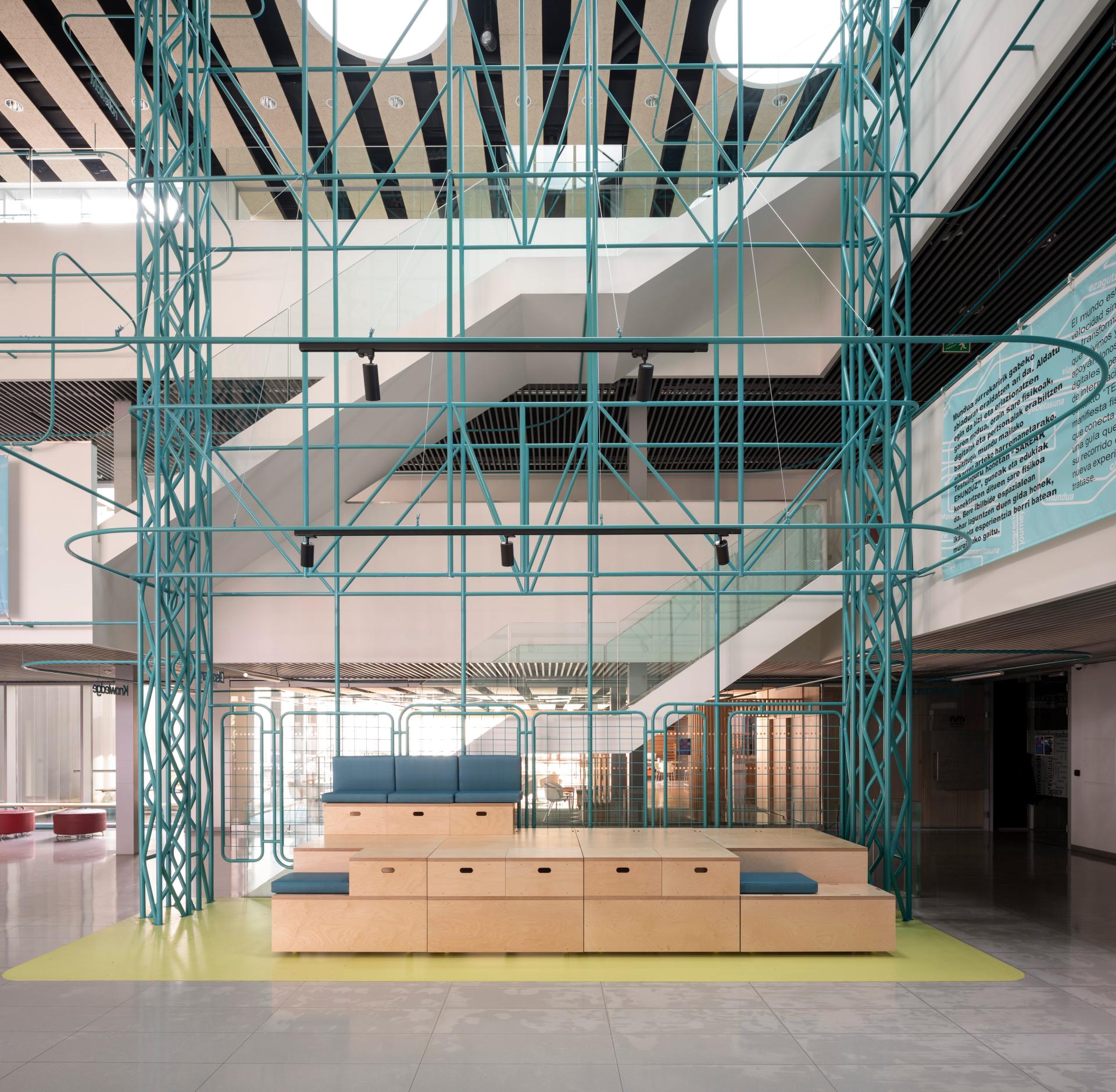
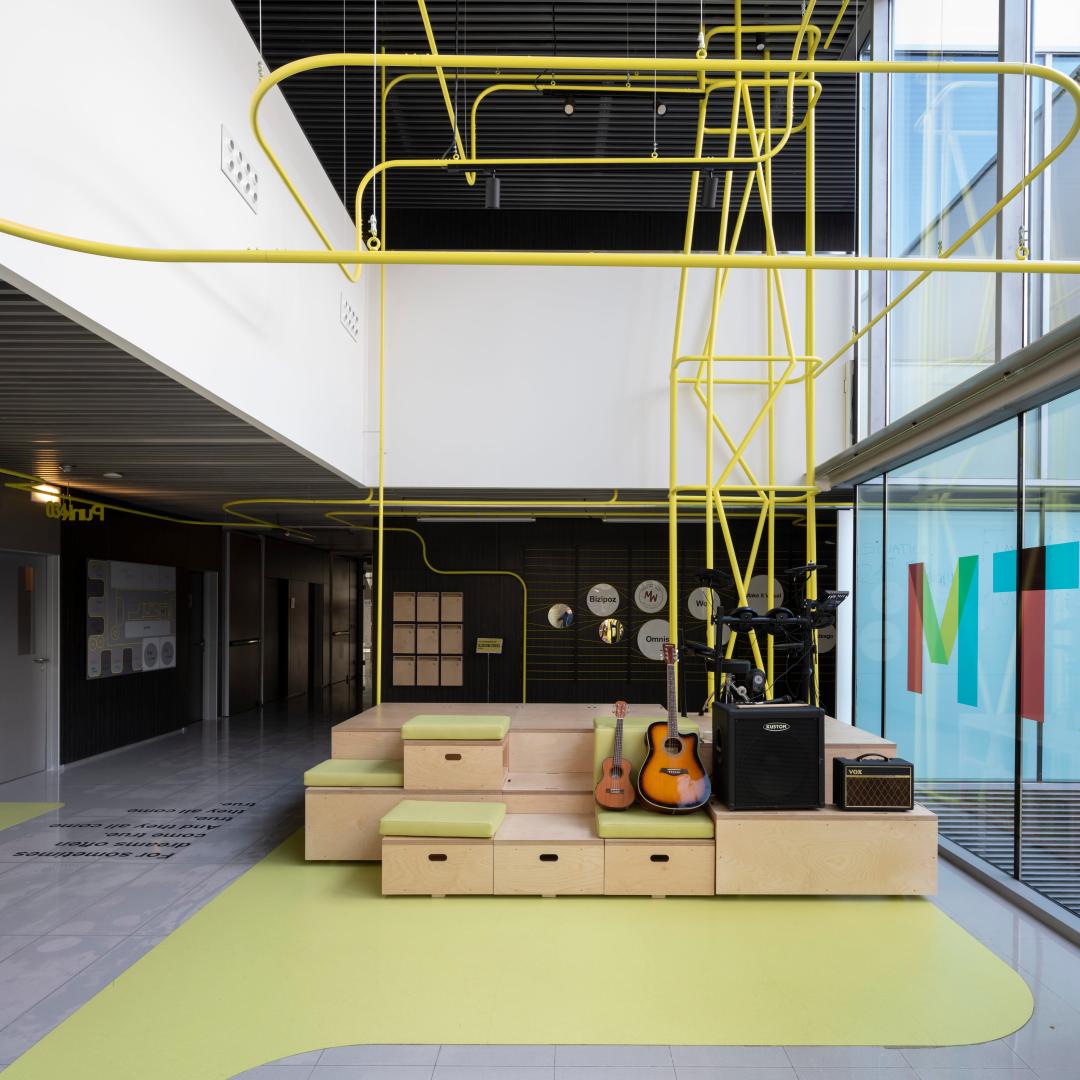
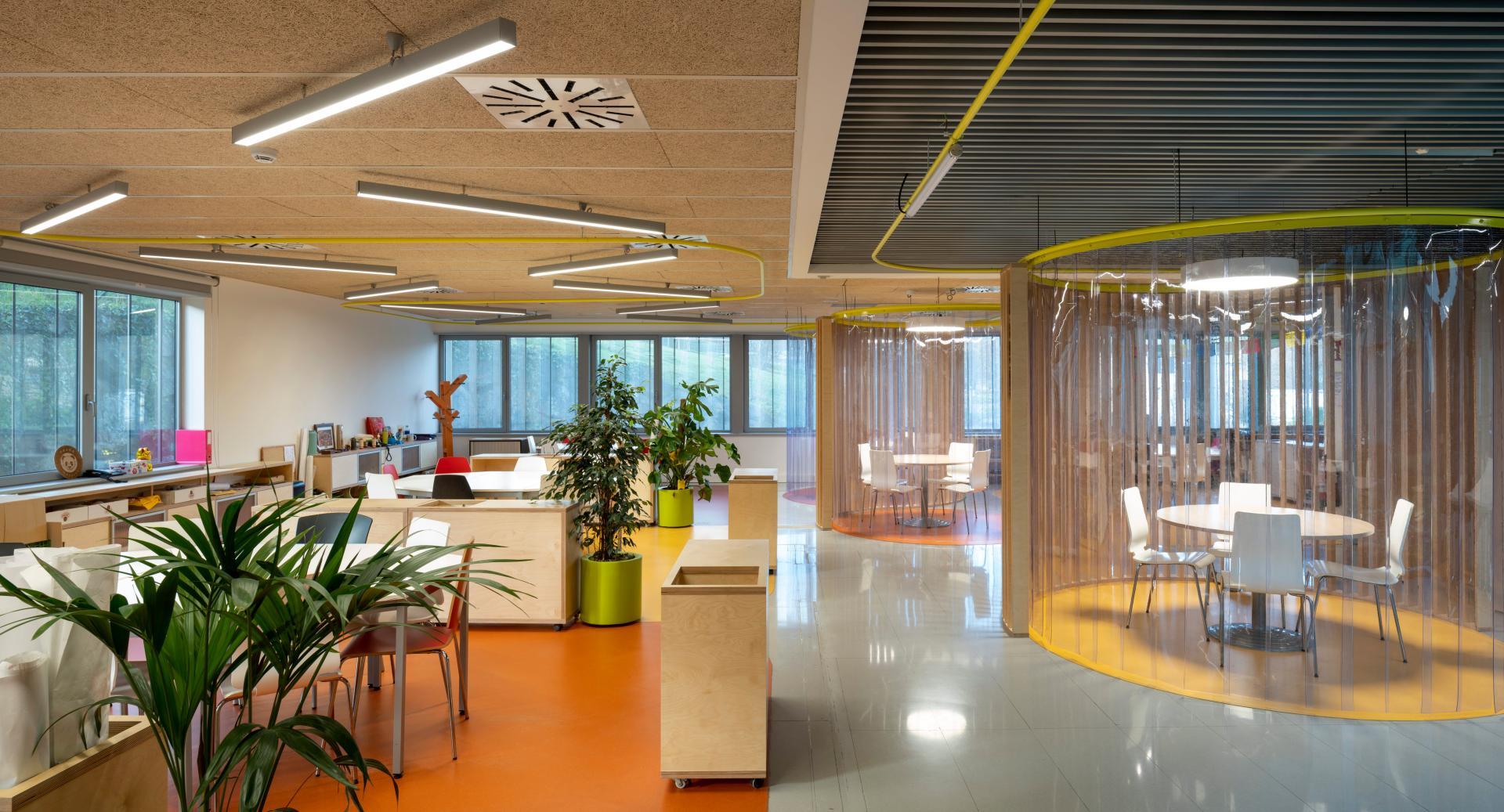
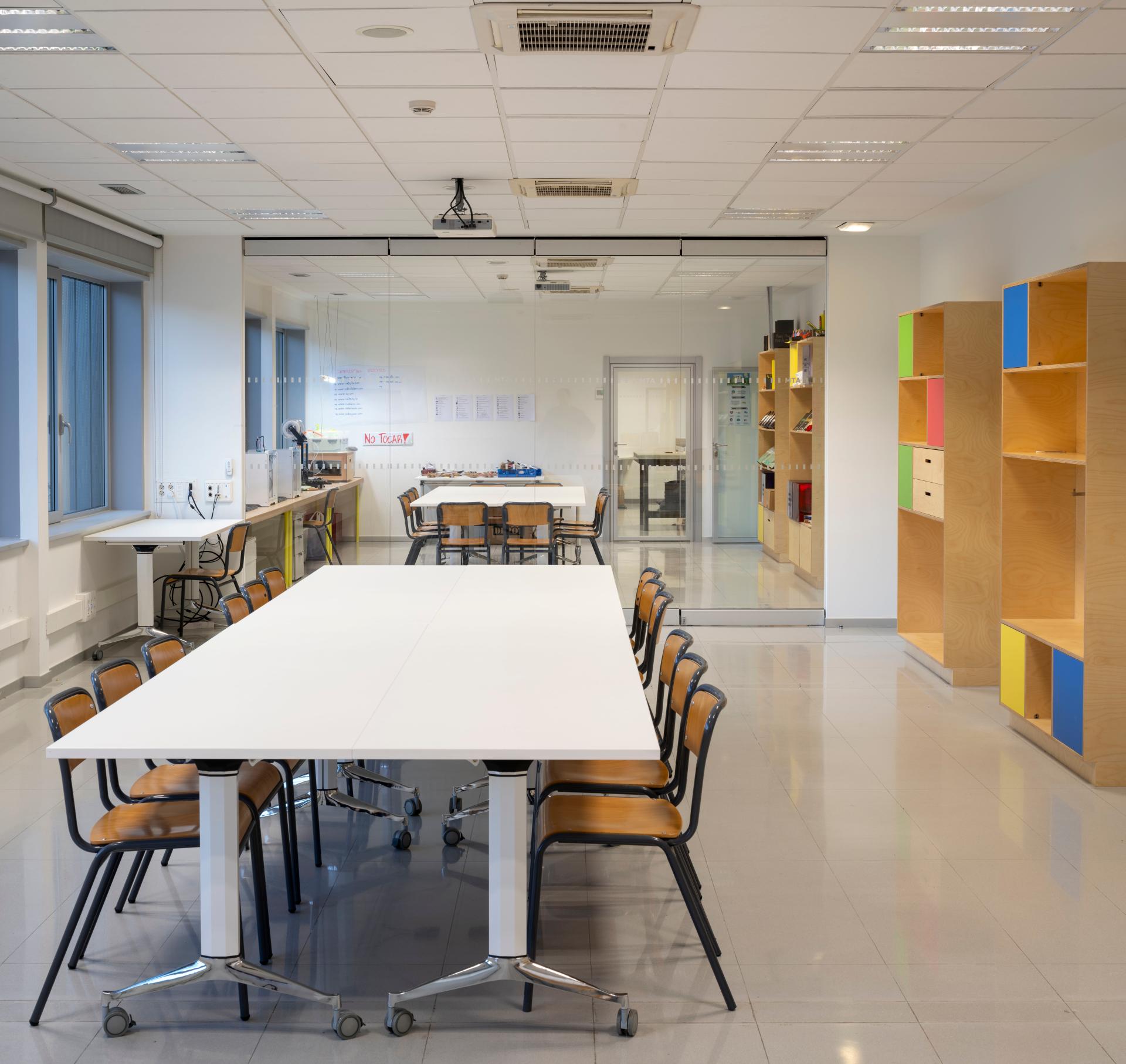
The project transfers LEINN's own character to the space with a design which includes an open plan workspace for the teams; prototyping rooms; communal areas to relax, foster dialogue and connection; exhibition spaces; alumni zone and special rooms like Rock&roll room and Wow space.
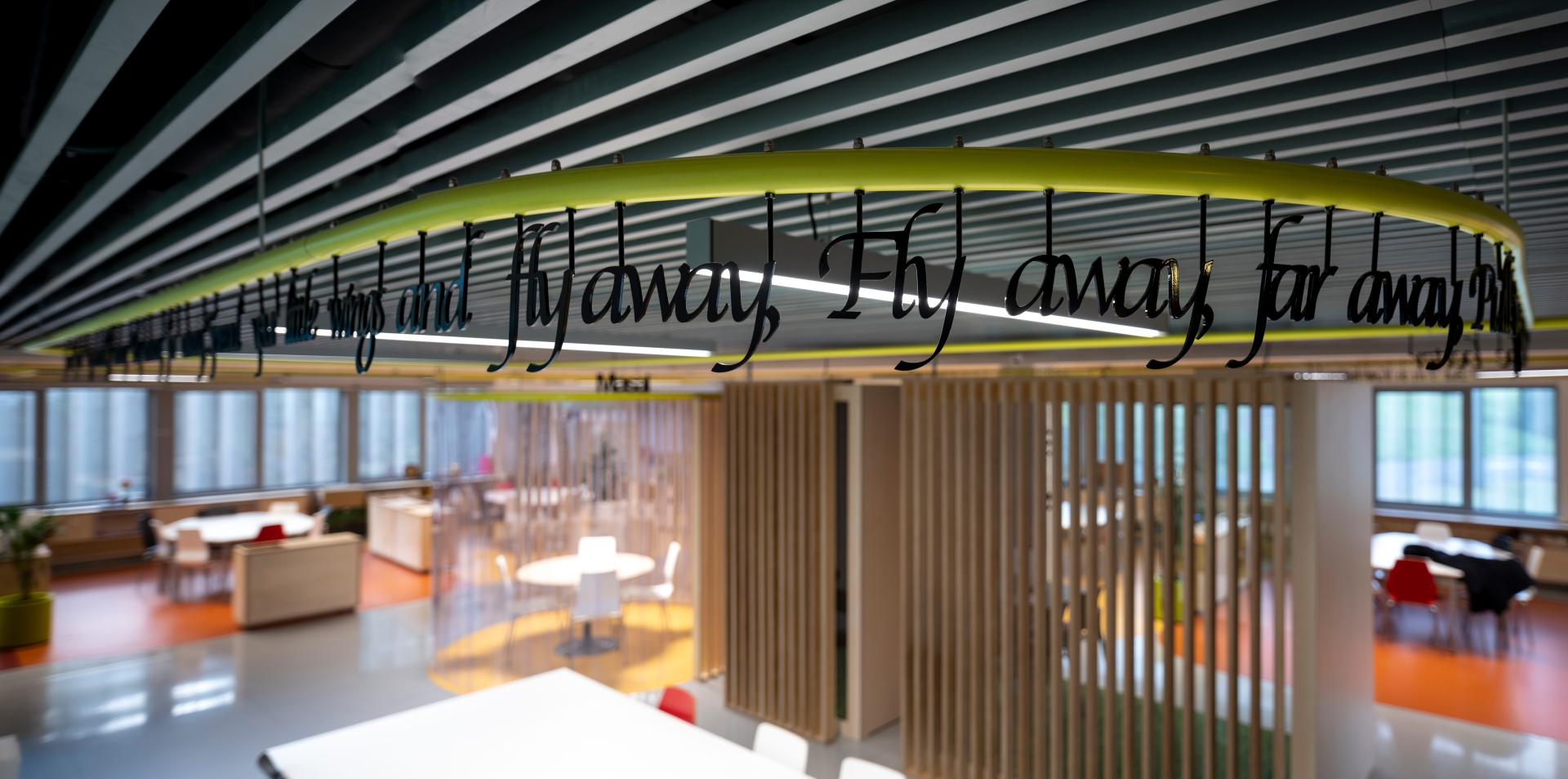
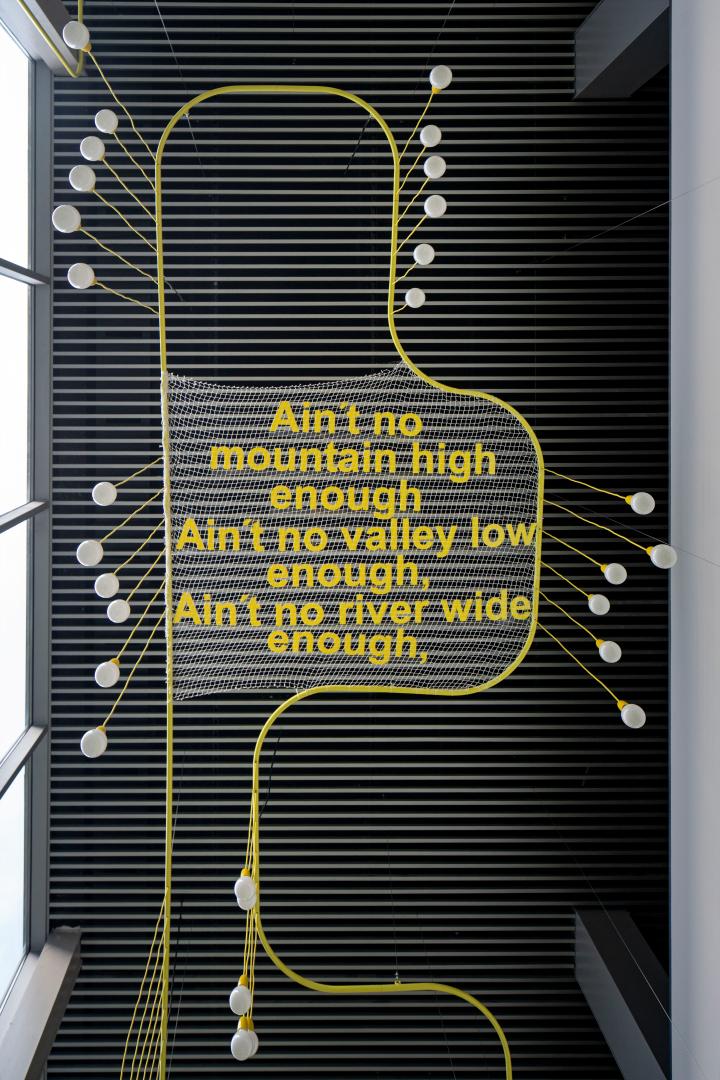
Based on the process of research, analysis and co-design with the different agents involved, the concept of “weaving networks” emerges as the guiding idea for the general intervention in the building. This concept is materialized in a series of unique linear tubular elements that extend through the building symbolizing the learning journey of a student and serving as support for signage, lighting, etc.
The project aims to identify design principles that enhance the learning experience and are aligned with new pedagogical models creating beautiful, sustainable and inclusive spaces.
Key objectives for sustainability
In line with the European Green Deal, a roadmap to provide the EU with a sustainable economy, the project embraces the following:
Environmental sustainability. This project is the refurbishment of an existing building and has maintained all the existing elements that were in good condition minimising the use of new materials and resources.
Buildings consume between 20 and 50% of physical resources depending on their design and environment. The increase of construction is partly responsible for the current deterioration of the environment.
Economic sustainability. The building is heated through energy exchange with a nearby battery factory. The heat dissipated in the process of manufacturing batteries is conducted through pipes to the building’s plant room to pre-heat the air and reducing the amount of energy required by the building.
In relation to sustainable buildings; the conservation of energy and natural resources, the reuse of these resources; the management of the life cycle, both of the buildings and of the materials and components used.
Social sustainability. The building provides a place of work and study to a large amount of people typically from the nearby region. The LEINN degree trains students to create their own companies which normally do well and end up creating more employment in the local area. This is beneficial for the circular economy in the region.
Key objectives for aesthetics and quality
Create new environments that allow new ways of learning:
-Environments facilitating new student-teacher relationships. The current teaching dynamics of this degree don’t respond to the traditional lecture hall or classroom where the teacher talks and the students listen or respond in a passive way. Here the classes become group sessions and practical sessions that require that the space and furniture adapt to these new arrangements, with the position of the teacher among the students, not in front of them, etc.
-Spaces with the capacity to host non-regulated learning. We break with the classic corridor to provide that space with functions that enable learning: spaces that are not mere transit spaces as in the past but that facilitate activities of all kinds (teaching and non-teaching) that create community and strengthen social relationships. The corridor is diluted to become a space for meetings, events, contemplation, inspiration, and exhibition.
Encourage spatial appropriation by the users.
-Spatial storytelling. Understanding the space through a story that its users can take ownership of is key to generating the feeling of belonging. In this case, we define a student's journey through the weaving networks that navigate through the building, personalizing themselves with musical verses as they enter the LEINN space.
-Spatial identity. Each educational center has its own character, principles and values. In the case of LEINN these were defined by a process of co-design with students. Our goal was to develop a space that promotes a shared feeling of ownership. This is what we call spatial identity; that users feel that they belong to the space and they can identify themselves there, making it unique, inspiring and their own. To achieve that feeling we defined the palette of materials and colours, the graphic design, the furniture etc that materialize the three pillars identified through the process of co-design: maker culture, rock music and Basque identity.
Key objectives for inclusion
1. Active participation of all the agents involved in the design process: The design started from a co-design process including all the parties who use the building (academics, students, service personnel ), approximately 1000 people who contributed to identifying the key aspects of the subsequent design. To achieve this, we designed a series of participatory events; group meetings, surveys, presentations, etc., which allowed the entire learning community to participate in the process and provide insights and define needs and desires to be achieved with a proposal tailored to their needs.
2. Opening to the outside: The space is open to other agents outside the Mondragon Team Academy or the Faculty of Business. There is a small coworking space where people can work, an open space for events that facilitates relationships with other users and a prototyping space with the intention of being used by anyone in the town.
3. Universal Accessibility: the space has been design with universal accessibility in mind so it can be used by all people regardless of their physical condition.
Results in relation to category
The project is aligned with the category 7 Reinvented places to meet and share. The design has created spaces that encourage people to meet and promote different types of learning through human interaction. Open and flexible spaces which facilitate several activities to be carried out in parallel, generating exchanges and therefore enriching experiences. All users of the building (students, teachers, admin personnel) enjoy these spaces, which stand out for their functionality, as well as for their aesthetic value which is a reflection of their own DNA. Analysing results and impact in the different areas:
- The main entrance hall has become a meeting point, where all kinds of events can be held (presentations, screenings, lectures, and fairs), taking advantage of the triple height of the space and the flexible modular wooden stage designed for this purpose. This is the first point of exchange in the building.
- The LEINN area is now an open plan work space for all Leiners with additional communal facilities for the wider community, which enables these students to foster relationships between them and with other agents. A place of co-creation where synergies are generated.
- The cafeteria is now a space open to all the people who access the building and facilitates uses other than catering due to the new layout and furniture. It is now a place to share, meet, relax, and have events, talks and presentations. A place to share.
Additionally, the project is also aligned with the category 10 Interdisciplinary education models, since it has been the result of work with the University of Mondragon and in particular with Mondragon Team Academy (whose objective was to design a space that would be a spatial reference for the rest of LEINN Laboratories in Spain). LEINN is an innovative study program in the area of entrepreneurship which requires innovative spaces that facilitate their specific learning experience which is very different from a typical university degree.
How Citizens benefit
This is a bottom-up project and all the agents involved in the Faculty of Business have participated in the co-design process: students, teaching staff (including the management team that coordinates all the programmes taught there) and services staff (administration, maintenance, computer services), approximately 1000 people in total. The implemented design is the result of this participatory process.
In the same way, all the agents involved are also beneficiaries of the project as it is a space open to the entire Faculty of the Oñati Campus, not only the students and faculty of the Mondragon Team Academy (called Leinners and teamcoachers) (100 people).
The location of the educational center in the town of Oñati (11,000 inhabitants as per 2018 census), and the fact that the Faculty itself is open to the community allows the beneficiaries to be the entire municipality. People are welcome to use of the cafeteria as a place to meet, use the maker space as a prototyping space, use of the lobbies as a stage space, use the coworking space and participate in the events organized there.
Innovative character
1) Participatory design process: A participatory process was developed with all the parties involved in the building to identify their needs, desires, objectives, and define the new spatial distribution and image of the entire Faculty. An in-depth analysis of the building and its surroundings was carried out. The objective was to identify the relationship between the building and the different programmes taught there and the different users, from students to staff including academics and services.
2) Design focused on the principles and values of an organization. The design was based on the principles and values of the Faculty of Business (Corporación Mondragon, one of the largest cooperatives in the country, with deep roots in the Basque Country Culture), MTA, and the specific values of the LEINN degree who are the users of the laboratory.
3) New role of the architect. The participatory process carried out captured the needs and desires of the users in a unique way achieving a result which is very different for the personal style of the design team. This is a substantial transformation in relation to the classic role of the architect or interior designer who decides the elements / colors / graphics according to their personal style but without taking into account the users. In this project, the architects become facilitators of design processes, adapting to the needs of the users and keeping their own personal style in the background.
4) Transformation of the traditional classroom arrangement. The classic rectangular classroom with desks facing the teacher is a model that responded to the needs derived from the Industrial Revolution. Nowadays learning spaces need to have the ability to contribute to the learning experience and be aligned with the new pedagogical models responding to their functional needs and providing the spatial experience required by each model.