Plan for Play in Barcelona Public Space
Basic information
Project Title
Full project title
Category
Project Description
Five projects of unique play areas are designed and co-created specifically for every location and with the children of the neighbor schools, which generate new dynamics in the daily life of the families. They turn everyday play into a sensory, aesthetic and symbolic experience that brings them closer to a world of imagination and exploration; become new spaces of reference in the city, building new social, sustainable, inclusive, community and intergenerational relationships around the game.
Project Region
EU Programme or fund
Description of the project
Summary
The Plan for Play in Barcelona’s Public Space is looking to move from a city with play areas to a playable city by 2030. Its aim is to improve and diversify opportunities for play and physical activity in public spaces, due to the great benefits these activities have for children’s and teenagers’ development, well-being and for health and community life.
The plan is the result of a cross-cutting process involving over 400 professionals, organisations and members of the public - both children and adults - and is inspired by pioneering play plans implemented in other cities, such as Dublin and London. It also responds to the United Nations’ recommendations to enhance the right to play, a specific human right for children and adolescents.
With this plan, Barcelona is seeking to achieve a paradigm shift, becoming a city with specific play areas that are more diverse, creative, accessible and inclusive while placing the entire city’s urban planning at the service of play.
The plan specifies 63 individual actions which reflect a comprehensive, cross-cutting vision that combines urban planning initiatives (ranging from micro-interventions and tactical planning to major urban development projects) and social actions (from touring animation activities to new concepts in public services).
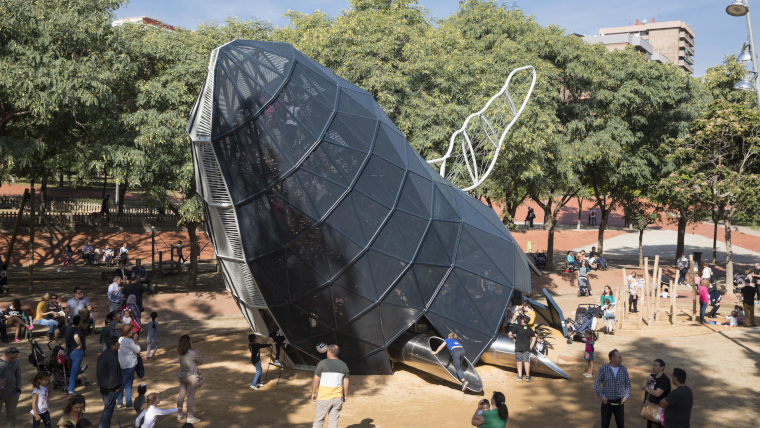
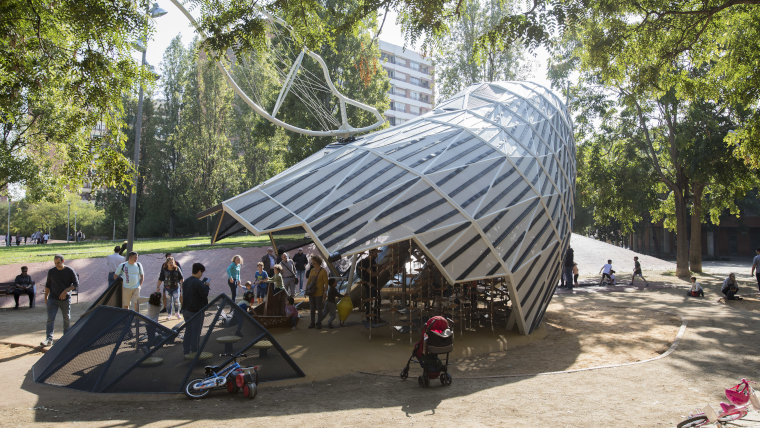
A way of exemplifying the policy change with regard to play in the city is to include unique and appealing elements of play that offer a variety of play and exploration opportunities for children. The first five elements were fitted in 2018 and 2019:
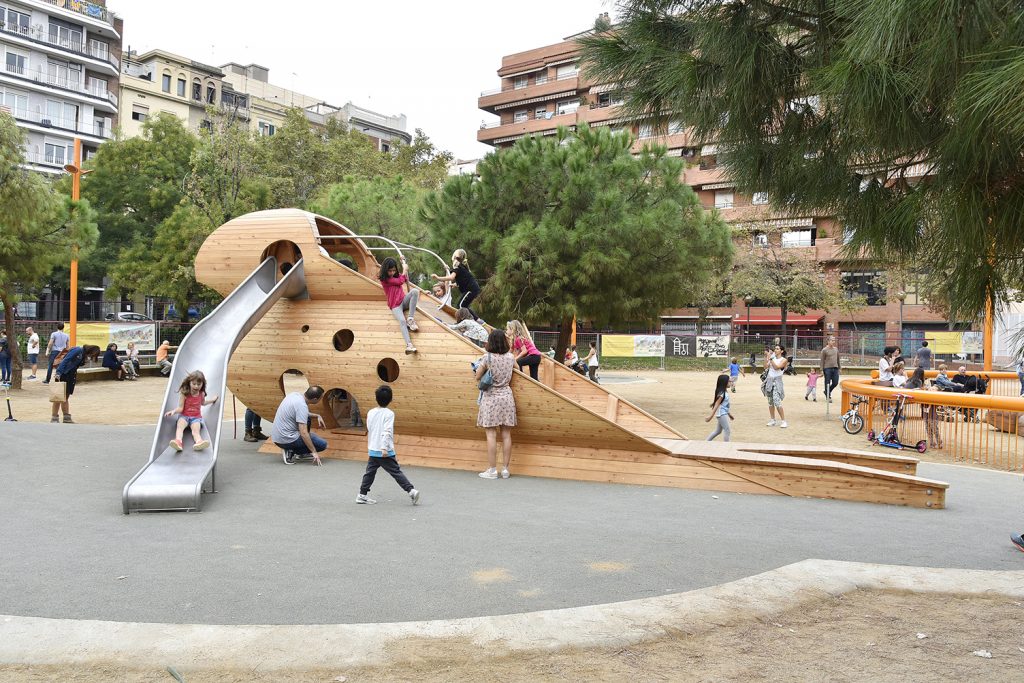
- Whale in the Parc Central de Nou Barris.
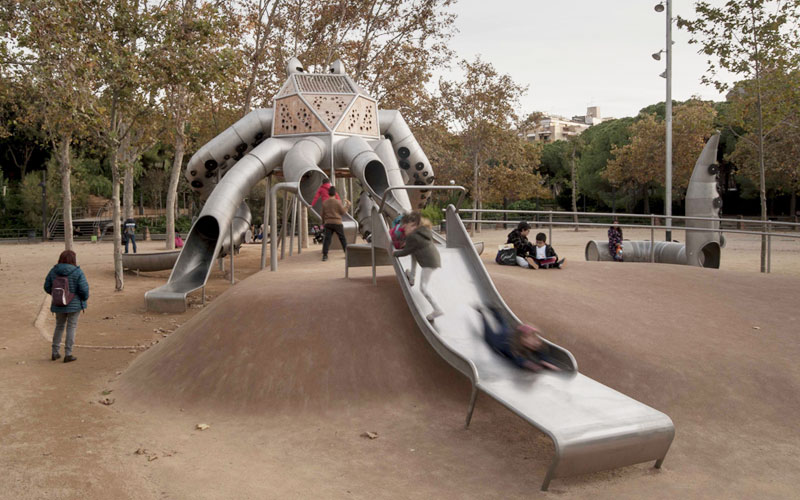
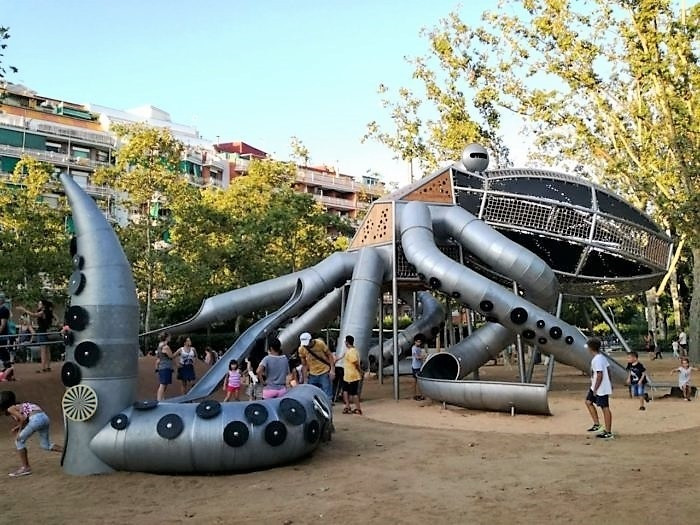
- Octopus in the Parc de la Pegaso.
- Swallow in the Jardins de la Indústria.
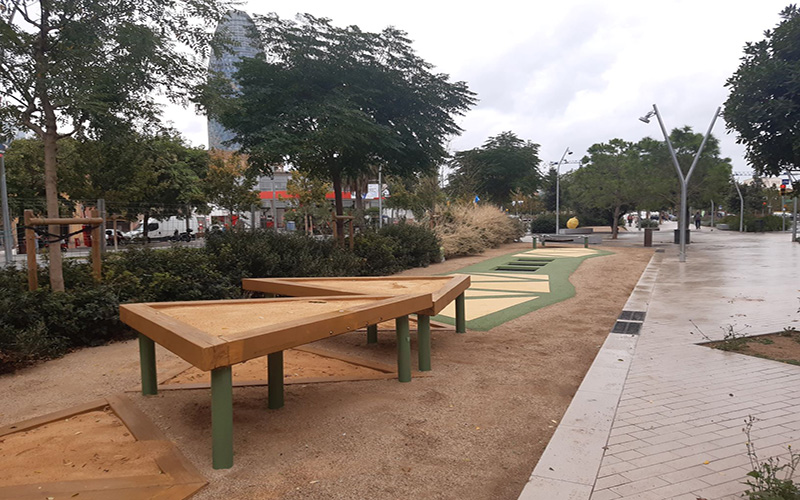
- Triangulation along the Avinguda Meridiana.
- Playcubes in the Plaça del Sol.
Key objectives for sustainability
The complexity of this project is addressed from a critical perspective that procures to explore strategic concerns, ranging over: how to work with the game in public space as a strategy to signify the place and build shared spaces; how to define a coherent game system, leaving room for imagination, free play and experimentation; how to constitute a sensory and material experience, where game at different scales assumes the participation of diverse ages and conditions, with the maximum possibility of itineraries, routes and actions.
Sustainability also lies in the materiality of games. All the projects promoted by Barcelona City Council require that some parts of the used materials have to be recycled; coming from local sources and, with regard to wood, there is technical instruction for the application of sustainability criteria. This instruction (2015) establishes the obligation to acquire wood and wood-derived products with guarantees of origin from sustainable forestry or recycled wood with certification (FSC certificate, PEFC or equivalent).
Key objectives for aesthetics and quality
In these five elements, mentioned before, narrative defines the space. Visible from the street, the playground becomes an attractor, a new urban milestone which triggers new dynamics in public space. The strategic power of this type of playable monument fosters the development of an enclosing narrative that redefines the place, facilitating the free appropriation of children and their families. The Whale in the Parc Central de Nou Barris was a finalist in the 2020 FAD Awards for “City and landscape” nomination.
Key objectives for inclusion
The playground as an urban milestone achieves a triple effect: introduces new dynamics in public space, promotes kinship, sense of place and feeling of belonging and activates the city through spontaneity and free action. Generating multiple playable itineraries allows personal discovery and free improvisation and enables a wide variety of actions.
The five elements of play addresses also different disabilities through sensoriality, accessibility and the multiple ways of approaching the object, generating quiet spaces and more dynamic spaces. The diversity of ways to interact makes it an intergenerational game, for children of all ages, teenagers and adults. Any child can find their play space.
The game elements are adapted to the needs, such as with the Pegaso Park Octopus, where one of the eight legs is not a slide but an access ramp for children with motor difficulties, to whom this access allows to play.
Plays located in Meridiana Avenue have sandboxes at different heights, with sand tables, which allow accompanying children and adults in wheelchairs to enjoy the fun activity of experimenting with sand.
Results in relation to category
These objects, designed especially for the place where they are located, generate new dynamics in the daily life of families as well as a new life style. They turn everyday play into a sensory, aesthetic and symbolic experience that brings them closer to a world of imagination and exploration.
Materiality and sensory experience capture the spatial narrative and run the mechanisms of a creative and versatile game that is based on the free manipulation of objects and textures.
These elements are not belonging to a specific fashion, but become timeless designs, references in the memory of children of different generations and creating awareness and pride of the neighbourhood and the environment in which they are located.
How Citizens benefit
The designs of the Pegaso Octopus and the Whale in the Central Park of Nou Barris have been the result of co-creation with the children of the surrounding schools.
Through a participatory process created specifically by the Institute for Children and Adolescents (IIAB), children determined how they were playing and what they were missing in those parks. Through drawings, they expressed how these spaces were imagined, and the co-creation process allowed the children to choose what they wanted to experience and what play activities they wanted to be contained in these designs.
This effective participation from the beginning has generated a sense of belonging and care for these elements, which they feel are their own and designed by them. The result of this co-creation is also reflected in the maintenance and care of these spaces, so that families and children feel them as their own.
Innovative character
The innovation in these new play areas is in the process of creation and design of the object itself: fruit of the work of the architect designer with the different municipal technicians, the children of the schools of the district and the manufacturers of games for children.
The manufacturing company is also part of this co-creation, adapting and offering material and design solutions for a better project. This process was carried out with on-site visits to the factories for the construction of the parts of children games, in order to obtain the best possible result.