Sustainable Greek School
Basic information
Project Title
Full project title
Category
Project Description
The Sustainable Greek School program tries to activate mechanisms for the transformation of the school into a sustainable one. The holistic approach of the school as an organization is adopted so that the teachers are encouraged to gradually get involved in the transformation processes of their school and to follow the course of the changes brought about by the sustainability of the school.
Project Region
EU Programme or fund
Description of the project
Summary
The Sustainable Greek School is a programme that promotes the philosophy of sustainability in the school. A school is considered sustainable if through its organization, existence and operation, it can be a model of good practice for both students and society, to provide students with knowledge and to cultivate skills for them to become active members of society capable of tackling environmental and social problems and shaping the future in terms of environmental and social sustainability. The holistic approach of the school as an organization is adopted so that the teachers are encouraged to get involved in the transformation processes of their school and to follow the course of the changes brought about by the sustainability of the school.
The programme is organized around eight pillars, in order to encourage teachers to be involved in their school transformation processes and to monitor their progress towards sustainability, based on categorized-specific pillars with the relevant criteria Immediately below are the proposed eight pillars of sustainability.
1st Pillar: Democracy and participation
2nd Pillar: Promoting Learning
3rd Pillar: Promotion of arts and culture
4th Pillar: Sustainable building and courtyard
5th Pillar: Energy saving / travel policy
6th Pillar: Saving resources
7th Pillar: Promoting Health
8th Pillar: From the local to the planetary scale
Through the strategies that a school has to develop, it will smoothly integrate and effectively manage these areas of its autonomy. Under the overall action policy the school will be able to develop, coordinate and execute action plans in the school or the wider community that will have a direct impact on the reality and image of the school.
The Pedagogical and Scientific team of the Program produces educational material, organizes workshops, seminars, summer universities and conferences, seeks the interaction of the between schools and discreetly supports the schools that wish it since 2013.
Key objectives for sustainability
A sustainable school is a school which can be a model of good practice for students and society, to enable them to become active members of society capable of tackling environmental problems and co-shaping the future in terms of environmental and social sustainability.
In this context, the aim is not only to encourage behavioral models to deal with environmental problems, but also to develop the ability of children to act. The ability to act is characterized by the critical investigation of local environmental problems, their holistic approach through the use of children's experiences with the aim of their active participation in tackling these problems. In other words, a sustainable school is a tool for an action plan that takes into account the above, in order to be a model of sustainable development for society, while providing learning opportunities for students, which will focus on action. The main focus in this case should be the connection between action and learning, the connection between what the school does as a community and what the people who make it up can learn: the students, the teaching staff, the directors. The way in which schools can develop sustainable ways of approaching and working is also considered very important. And since we do not want sustainable development to be just another topic that we need to negotiate in the classroom, it is good for students to see and work with it, in a "living" place, where they can explore, learn what means sustainable lifestyle.
The Pedagogical Team of the Sustainable Greek School, having as its motto “we all care, we all participate”, tries to plan the process that a school can follow in the direction of its transformation into a Sustainable. It also tries to set those quality criteria which will be the "roadmaps" for each school in its course.
Key objectives for aesthetics and quality
The Sustainable Greek School program is concerned with developing learning environments and learning experiences that will enable students to work towards developing their own aesthetic and having a good quality of life in a sustainable environment.
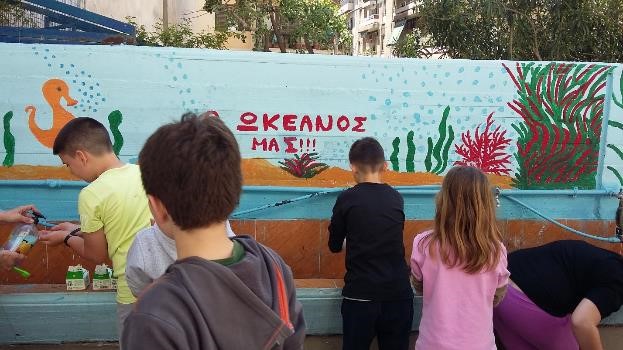
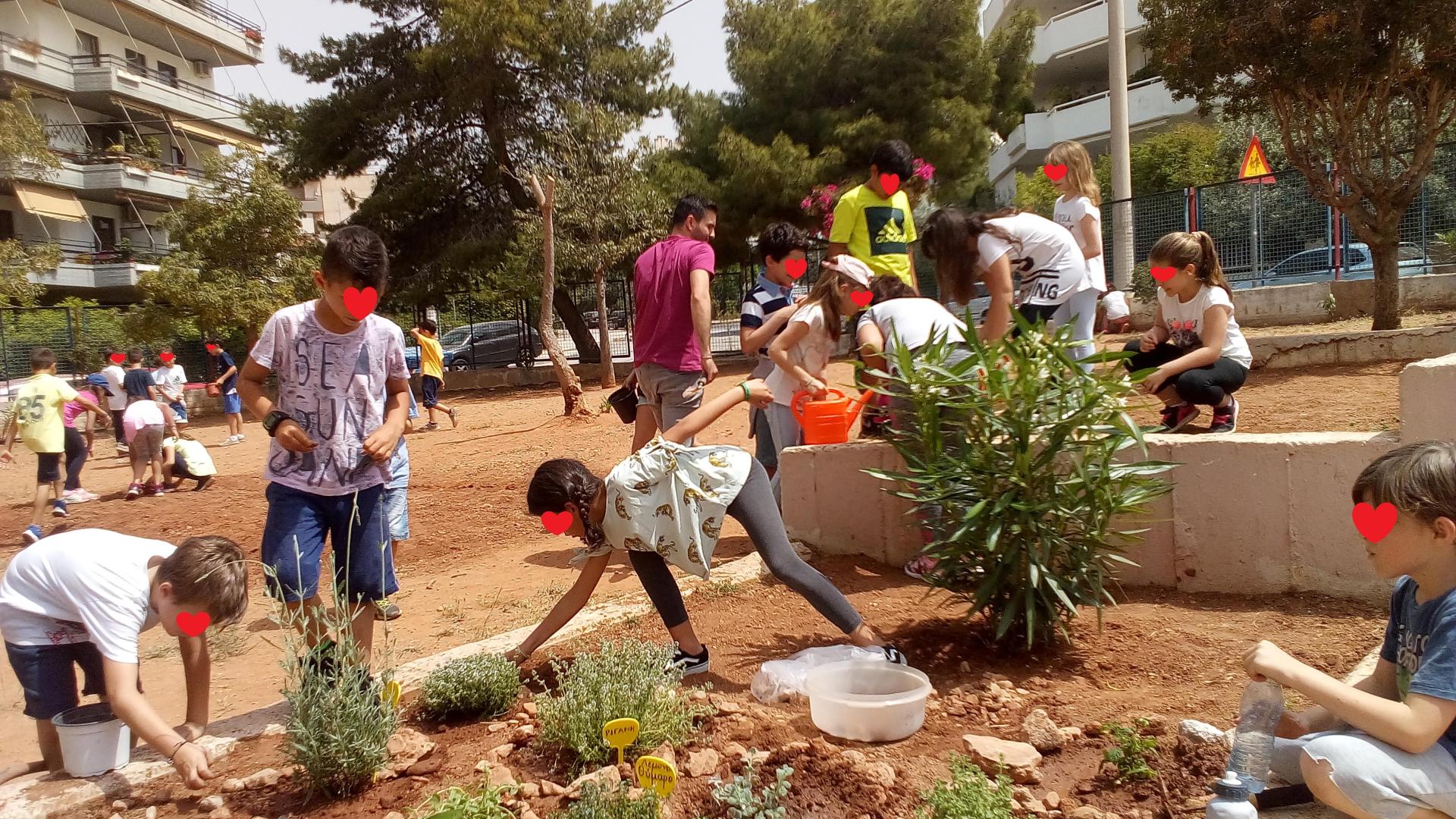
The remodeling of the current degraded image of the outdoor school space of the schools with the stereotype of the asphalt yard, undoubtedly offers an aesthetic and functional upgrade and contributes positively to the micro-environment of the school and the wider area. As the 4th pillar of the program indicates, a building is sustainable when it meets the needs for which it was designed ensuring the good health and comfort of users, while at the same time minimizing its energy needs, does not disturb the microclimate of its area and respects the local architectural heritage.
Through the 2nd pillar the students can be introduced to the philosophy of aesthetics through the world’s art and culture. Education is inextricably linked to all kinds of cultural development and is the best investment for sustainable development. Cultivating love and respect for artistic expression, arts and cultural works can thrive in the climate created in a sustainable school. Even the study and awareness of culture at various levels of life contribute significantly to building the identity of students in our country.
Including more than what is measurable is important to encourage students to not only copy what they are told, but to become creative and able to find their own solutions in the future. The aesthetic dimension might support independent thinking and imagination, crucial qualities in a democracy and for developing a future that we cannot yet see. Aesthetics is here understood in a broad sense and not limited to certain subjects. Moreover, aesthetical learning has to do with how life is experienced, how it feels and is perceived. The individual tries to understand how it is to be a human being.
Key objectives for inclusion
The participation of all members of the school (teachers, students, parents, local community) in decision making, the cooperation of students with each other, the teachers with each other, as well as the care of gaining relationships of trust and respect (sustainable relationships that is) they are structural elements of the Sustainable Greek School, as shown by the 1st pillar - Democracy and Participation. At the same time, the 2nd pillar - Learning Promotion - aims to promote modern pedagogical methods and providing every students with the best possible educational tools and experiences depending on their needs.
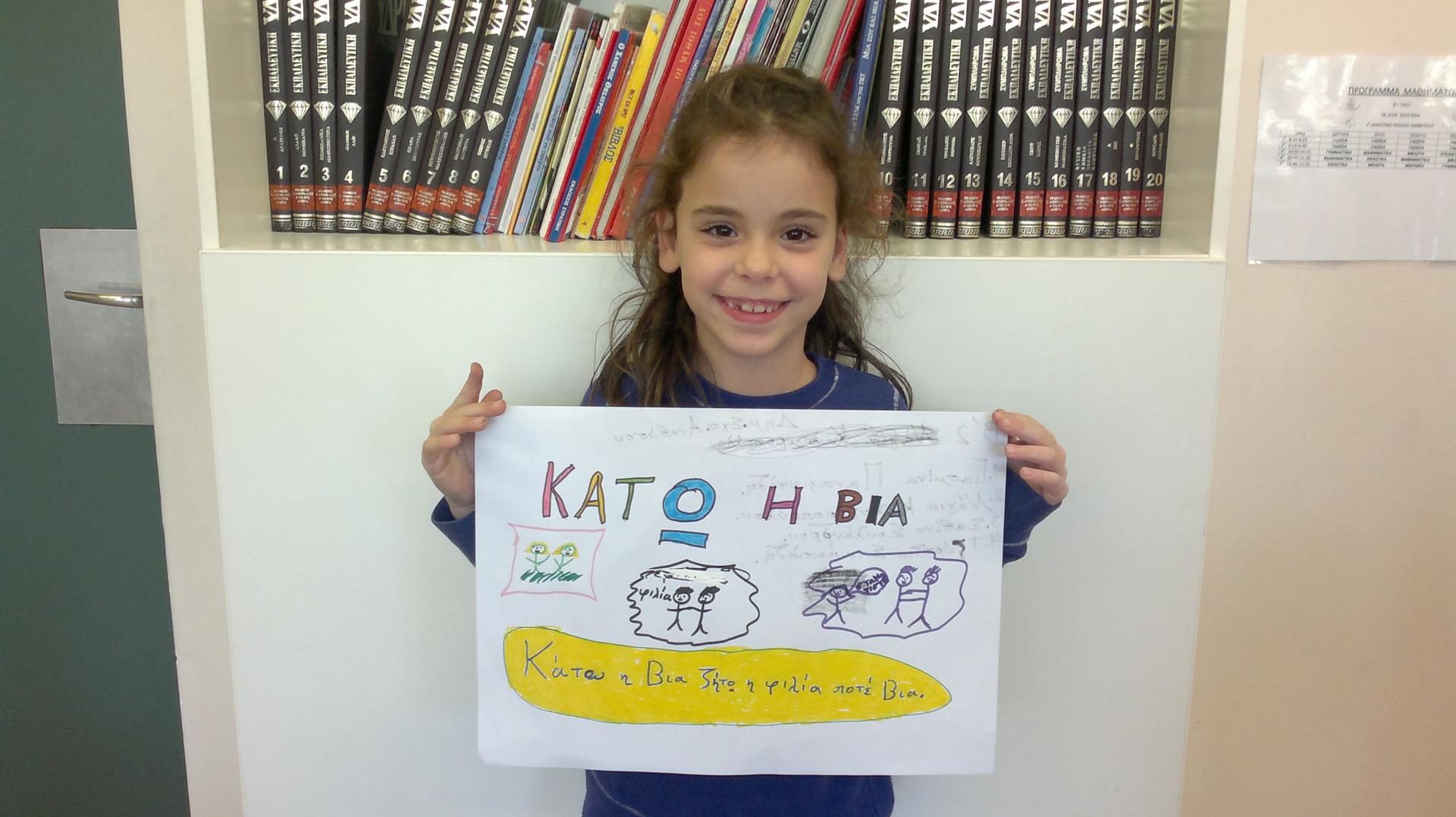
The Sustainable Greek School can be a favorable environment for the cultivation of democracy, as it cultivates the willingness to participate, take responsibility, the democratic decision-making process and cooperation between all members of the educational community. It can be a model of social acceptance that will allow all children to participate in school life. It can be a place where there is respect for human rights and different cultural forms. It is a school that gives opportunities for creative expression, gives time for reflection, understanding and love for all children, regardless of their performance in the lessons.
Results in relation to category
The schools registered in the program exceed 280 all over Greece and belong to all levels and branches of Preschool, Primary and Secondary, General, Vocational and Special Education.
At the beginning of the school year, the pedagogical team of each school enrolled in the programme prepares an annual plan as well as states the pillars in which they are interested in developing actions. During the year there was close communication with the teachers who inform us about the course, the way of implementation, the problems they encounter, while at the end of the school year 20219-2020 63 schools sent a report with their actions in which more than 10,500 students participated.
We collaborated with the schools that participated in the program and tried through our communication to give importance:
A. to the participation of as many teachers as possible.
B. to the involvement of as many students as possible in the programs that run in the school and the diffusion in all classes.
C. to the elaboration of small action plans, so that they are applicable and can be repeated.
D. Continuation of actions through distance learning during lockdown.
It is obvious that as the years pass more schools become truly sustainable and incorporate the programme and its teachings in their everyday school-life. There are schools that actively participate in the programme since its start in 2013. This means that their students were have participated in their schools action plans for sustainability for all their years attending these schools. Students that for 6 or more years were introduced to many aspects of sustainable development and most probably developed habits and a deeper understating of what sustainability means and on how to be active citizens.
How Citizens benefit
One of the goals of the program is to provide education and culture that will form active and cultured citizens, first and a healthy framework for organizing the social life of the country, then. Thousands of teachers work alone and their efforts bring results, satisfaction and optimism. Rarely, however, are they embraced by the entire school community so that all students can enjoy the joy of participating in creation and educational change. Our effort will be as much as possible that these efforts are not isolated, but run through school life and involve all members of the school and the wider community. Collaboration between the school and the community is essentially a special learning process. This process seeks to develop a strong bond between school and community on the basis of which individuals can be actively and effectively involved in order to achieve a better quality of life in the particular context in which they live.
The framework of cooperation between a sustainable school and a community is based on the fact that all participants work with the mindset of improving their community, which will lead to an improvement in their quality of life and that this can be done through collective effort. This type of collaboration has as a prerequisite a new learning framework through the opening of the school to the community, the utilization of out-of-school contexts in the community as basic educational and pedagogical tools. This process results in the promotion of an intergenerational communication and interaction while at the same time forming effective communication networks between the participants.
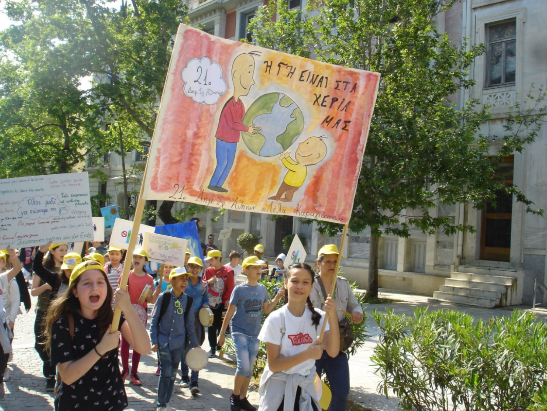
Every school that wants to move towards sustainability should design its own local agenda, enriching the educational process with important cultural and environmental issues of the place where its students live. The cultivation of public interest can be achieved by involving students in actions of local interest, but also in issues of global scale.
Innovative character
The Sustainable Greek School is not a new program but more of a philosophy that embraces all school activities (Environmental Education, Health Education, Culture) as well as school life as a whole (breaks, excursions, celebrations, relationships of school community members, relationships school with the local community, way of making decisions within the school).
It does not simply focus on a number of activities within the school but on a transformation of the school into a democratic school that recognizes and applies the principles of sustainable development.
Each school as a whole has to choose its own democratically, as a community its own holistic type of educational policy. Each school has different needs and problems and can make decisions as a community so that each school sets separate small goals from another. Objectives and decisions must be close to the specific local objective and subjective conditions and involve all students and teachers together with the principal.
If we look at the sustainable school as an evolving, innovative learning organization, where a framework of experiential pedagogy and active learning is formed, we will realize that its operation encourages the integration of sustainability education in the normal life of the school, not as an additional burden for teachers and the Principal, but as an opportunity to improve existing teaching, as an opportunity to learn and provide innovations useful to the whole school. Sustainability education means involving the whole school in a process of action-type research, recognizing that school development is not only a complex process but also partially unpredictable and constantly changing.
The sustainable school considers the fundamental reconstruction of the educational process in a comprehensive and unified way. Aims at self-improvement, development, and culture change not only for students but also for all those involved in the learning process inside and outside the school.