Extended use of Sippola Church
Basic information
Project Title
Full project title
Category
Project Description
Churches are a significant part of European cultural history. Today old church buildings no longer serve the needs of today. In order to avoid sale or decay due to low occupancy rates, churches must be developed to better meet the needs of today and future.
We have created a concept for a more versatile use of church space for Sippola Church, which aims to develop the church building to better meet the needs of the present and the future. This concept was created by Essi Aalto and Karita Asmala
Project Region
EU Programme or fund
Description of the project
Summary
The position of religion in society has weakened all around Europe. This trend of development has led to loss of memberships which has had a negative impact on the financial situation of churches. Around Europe, church buildings have been demolished and sold due to high maintenance expenses. Churches have been sold and transformed into apartments and bars. This jeopardises the preservation of cultural history.
In the 21st century, church events and services keep losing their popularity. Therefore, churches need to adapt to the changes of culture and environment to increase the occupancy rate of church buildings. Extending the use of churches for secular purposes, such as various cultural events and new types of activities can rescue the buildings from decay and sale, allowing the preservation of cultural history.
Sippola Church is a neo-Gothic church located in Sippola, Finland. The church lack of church goers and is at risk of being neglected. Our concept aims to make Sippola Church a new centre of the village. In addition to worship, we wanted to bring functions from the parish house to the church, as well as a workspace for the parish staff to avoid leaving the church empty. The goal is to expand the occupancy rate of the church and in this way preserve the cultural history it contains.
By bringing new kind of activities, such as cultural events and hobbies, we want to create a church that is open for all people, regardless their religious faith.
Key objectives for sustainability
What makes the project sustainable is that all changes are made to an existing building, avoiding the construction of a new building. At the same time, it is possible to increase the occupancy rate of a low-use church. When the occupancy rate can be increased, the church will be rescued from possible demolition or sale, allowing the preservation of cultural history.
There was a parish house nearby of Sippola Church, which had to be demolished a few years ago due to maintenance problems. Most parishioners still hope that a new parish house would be built to replace the old one. However, combing the church and the parish house would be a more sustainable solution. This would not only increase the occupancy rate of the church, but also cut heating and maintenance costs.
High-quality materials and the most skilled workforce have been widely used in the construction of churches. The alterations in our concept are designed to last for years to come, why it is important to invest in skilled workforce and high-quality materials.
Sippola is a small village, with almost no hobby possibilities. We aim to make facilities for different hobbies and activities in the church, so that the residents of Sippola would not need to drive to nearby cities for hobbies.
Key objectives for aesthetics and quality
Changes made in the space aim to respect the existing space through design language and material choices, without mimicking the existing architecture. The changes are subtle allowing the old architecture to stand out.
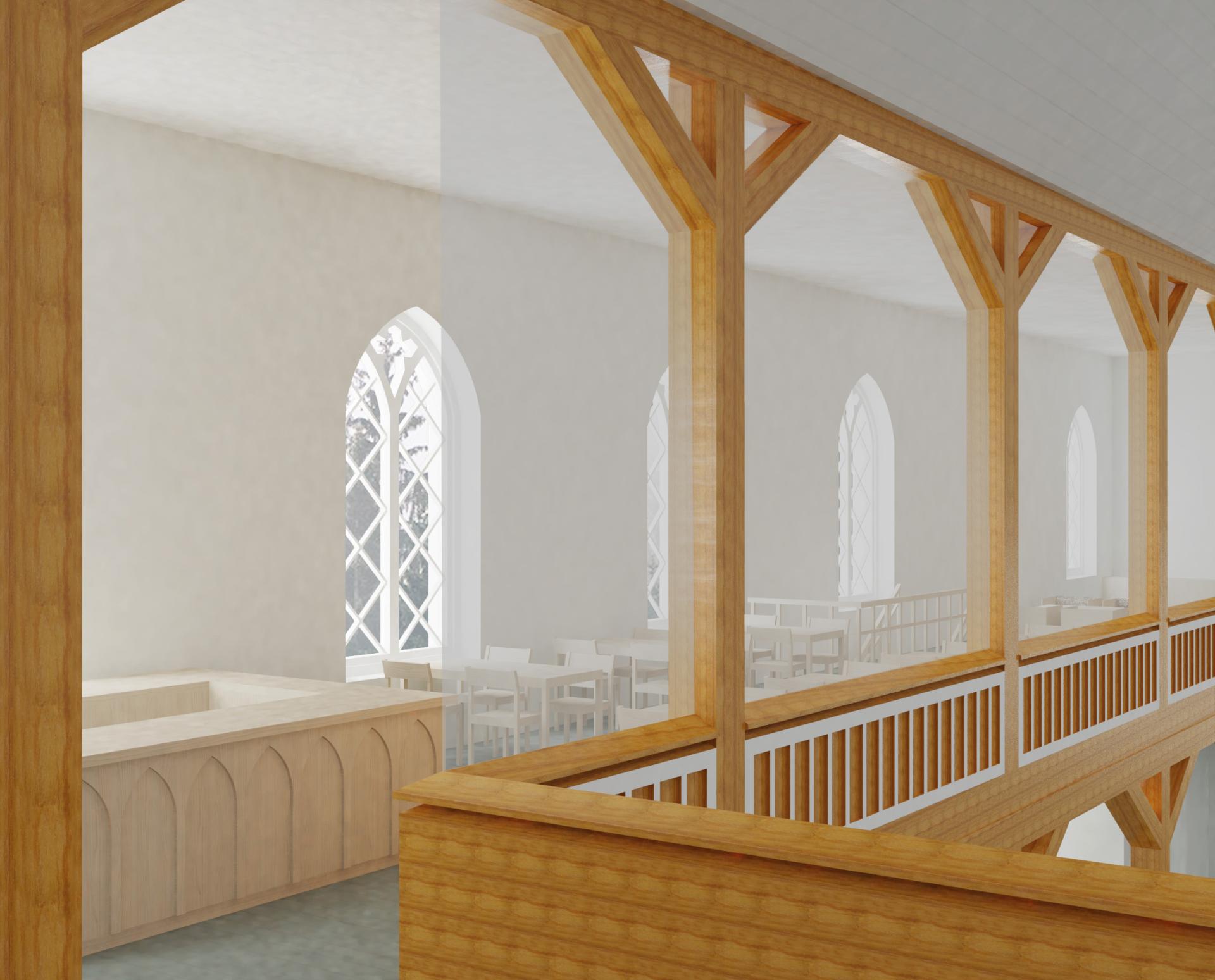
The most prominent alterations have been placed upstairs to remain the ambiance of the church hall. Viewed downstairs, the upstairs changes are not visible. The upstairs is divided into two parts: the staff’s side and the residents’ side. A glass wall is placed on top of the railings to avoid disturbing sounds in the church hall. Glass walls also make it possible for admiring the architecture. The furniture choices are modern but do not seek to compete with the existing space.
Key objectives for inclusion
The aim is to combine secular and spiritual activities so that the range of users could be expanded. In order to be able to expand the range of users, different kind of events, activities and services should be available. Secular activities for non-believers and spiritual activities for believers.
In order for the church to be better suited for organising different events and activities, the spaces should be adaptable. In the concept proposal some of the fixed furniture, such as bench rows and altar railing, have been replaced with loose furniture, as fixed furniture significantly limits the use of space. In addition, the upstairs in the church provide a space for parish workers, a café and facilities for children's games and hobbies.
Currently, the Sippola church is not barrier-free. In order for a church to be suitable for everyone, the building must be barrier-free for everyone to experience the building in the same way, despite disabilities. Accessibility has been improved by adding a lift to the second floor, where the café, the parish workers' workspace and the club room are. Also, a new barrier-free entrance has been added to the building. As stated earlier, the fixed rows of benches have replaced with loose chairs, allowing the wheelchair to be placed anywhere among the loose furniture.
Innovative character
What makes the project innovative is that extended use of churches is still a fairly new topic in Finland. In Finland, the renovation of churches has focused more on restoration, rather than in using the church space in a new way. However, in discussions with employees of various congregations, the need for more diverse use of the church was often raised.