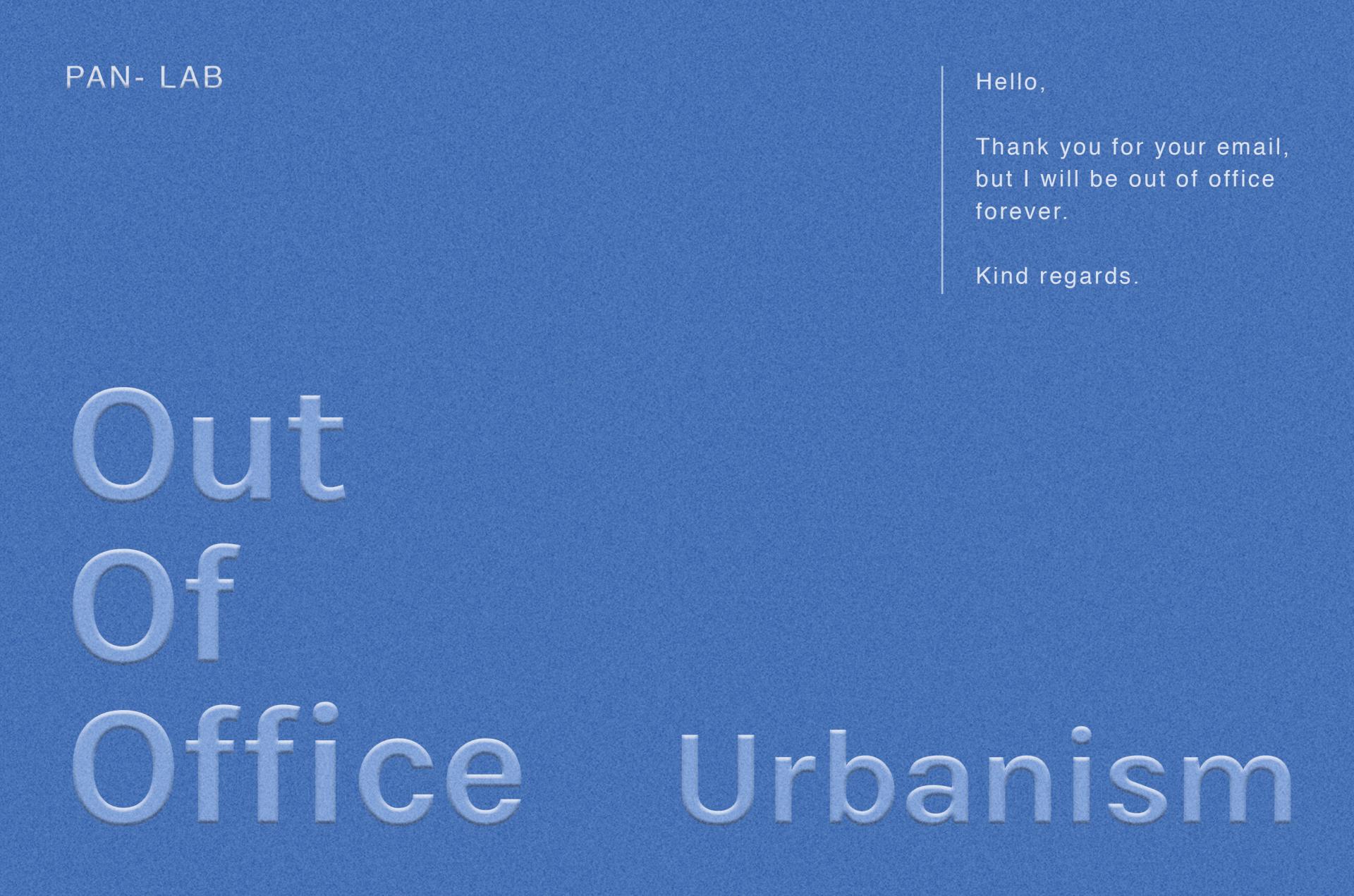
Out of Office Urbanism
Basic information
Project Title
Full project title
Category
Project Description
During 2020, many peoples working lives changed for good. The nature of work has always influenced city transformations, and once again the way we work has changed radically due to COVID-19. We want to question how this will shape cities around the globe by investigating the proposed cities of Copenhagen, London and Tokyo, three cities our studio has a strong connection with. We see the adaptation to remote work due to COVID-19 as an opportunity to improve the future of our daily lives.
Project Region
EU Programme or fund
Description of the project
Summary
Out of Office Urbanism is a response to the mass change in work we have experienced since the COVID-19 pandemic began, where the already rising trend of remote work was accelerated by about a decade.
This sudden change brought about huge revelations in how people want to live their future working lives, which will shift urban development just as working culture has always impacted city evolution. The changing nature of work has been reflected in the way cities transform over history. For example, the industrial era that was preoccupied with production brought about urban sprawl and factory typologies, and the post-war era that was concerned with economic growth saw the rise of modernism and the office building. Here again is another critical turning point in which the way we work has changed forever, and our ambition is to design new urban evolutions to accompany the change. .
We see this as an opportunity to discover how cities, suburbs and hinterlands can adapt to foster positive future scenarios set in motion by the imminent rise in remote working. The mass experiment from COVID-19 showed how individuals and companies were impacted by remote work, but once the pandemic (hopefully) subsides and remote work likely remains, it could shift the scale and scope of so many other domains. Health, relationships, community, professionalism, entrepreneurship, architecture, urbanism, demographics, elderly care, child care, infrastructure, politics, travel, internet culture, globalisation, environmental issues and societal systems could all be impacted by a rise in remote work.
Our ambition is to explore designing for remote work in a way that will have an impact on these larger aspects and scales as time goes on. We will look at the cities of Copenhagen, London and Tokyo to begin with. The huge change in peoples’ working lives is a chance to reshape our urbanism in order to empower communities and societies.
Key objectives for sustainability
The current culture of office work notoriously strains city centres across the globe, which has generated suburbanisation and a weary commuting culture. There is a general perception that suburbs are passive regions without much activity beside residence. The rise in remote work could be an opportunity to take pressure off the city centre while bringing business and employment to the suburban regions, making them more self-sustaining and resilient to shrinkage. By making remote work more attractive in suburban and rural regions, there are opportunities to reduce transportation and energy use.
While each of the three cities will have a different potential, it will be key to discover ways in which to innovatively reuse and renovate existing structures and regions to support a future in remote work.
Key objectives for aesthetics and quality
For many people, the workplace is one of the only forms of community they have, whether or not they are amicable with their co-workers. It has become increasingly common that people keep social circles within their professional field, which can limit one's experiences and personal development . A rise in remote work would almost certainly minimise connections that are formed in the office, but there would perhaps be a yearning for people to seek out and build community instead, which we hope our concept of Out of Office Urbanism could encourage. Our concept would strive to create opportunities where people could discover a new sense of locality by connecting with those who live nearby. By meeting people who are of different ages, abilities, skill sets and professions, there is a huge moment to develop more sensitive and inclusive societies. This in turn will diversify the programmes of areas which are typically monofunctional, such as residential suburbs. Once there is demand for more programmes, it will become clear how to create places that are diverse in activity and therefore more inclusive.. Our ambition with Out of Office Urbanism is to use the aspect of remote work as a key driver for future urban development, in order to create aesthetically beautiful and well functioning design for citizens. Our projects may range from small scale interventions to architectural design to larger projects in the urban realm, but each will be unique to their context by working with their existing conditions.
Key objectives for inclusion
We want to support a future in the rise of remote work so that people who are typically marginalised from the labour market ie. older people, mothers and disabled people can have easier access to employment. Commuting culture is suited to young and able bodied workers without much external commitment, who therefore have more chances in reaching the best paying jobs. A rise in remote work could therefore equalise the job market, and people who were once financially dependent will have better opportunities to become self-reliant.
In many countries, including Denmark, UK and Japan, the population is ageing and birth rates are declining. In the future, the working age may well be increased in order to support an ageing population. If this happens, it is crucial to implement ways of working for older people that do not require long and tiring commutes, but allow for jobs that enable flexibility and comfort.
Innovative character
This concept is innovative because we are taking the general theme of the future of remote work but then will apply it to the contexts of Copenhagen, London and Tokyo and work with a specific complex aspect of each city's urban fabric. Our strategy is to use the opportunity of remote work to amend existing problems that have existed in these cities for decades.
For example, in Tokyo there is an abundance of empty houses due to the short lifespan of Japanese prefabricated houses and a rapidly shrinking population. We are in contact with LifeFull, a company that registers empty houses across Japan and lists them for sale and renovation purposes. We see a potential in using these houses for a future in remote work, while also using it as an opportunity to address the problem of the empty houses and societal issues within Japan.
We want to find the potential within Copenhagen and London as these are the two cities PAN-LAB is based. For us it is important that we work sustainably with an existing condition that has current implications, rather than designing anew, for example London's suburban highstreets that have fallen vulnerable since the ecommerce boom.
Our ambition is that with Out of Office Urbanism, each city will regenerate its unique identity to adapt to the future of work. This new way of urban development has the potential to reshape cities that have been previously dominated by monotonous and inflexible office buildings.