Office PUUR interiorarchitects
Basic information
Project Title
Full project title
Category
Project Description
For our own office design, circularity, acoustics and functionality were approached in an innovative way with the concept, "Arsenale", as a reference to the exhibition site in Venice. All choices made throughout the design and construction process are supported by our future proof vision of circular building and sustainability. According to the concept, additions to the existing industrial building are conceived as objects and installations, each having its own story and use of pure materials.
Project Region
EU Programme or fund
Description of the project
Summary
A growing team of PUUR interior architects necessitated bigger office premises. PUUR chose an industrial building as its workplace and came up with the concept "Arsenale" for the interior design. The new office should support PUUR interior architects' operations in the most functional way possible.
A circular interior, an excellent indoor climate, good acoustics and the integration of exuberant green are some of the criteria that should be integrated in the new office in the most optimal way.
The concept, "Arsenale", is a reference to the exhibition site in Venice, where the Architecture and Art Biennale takes place. The experience of wandering around in an industrial building and drawing inspiration from art and architecture installations, is the atmosphere we wanted to create in our office.
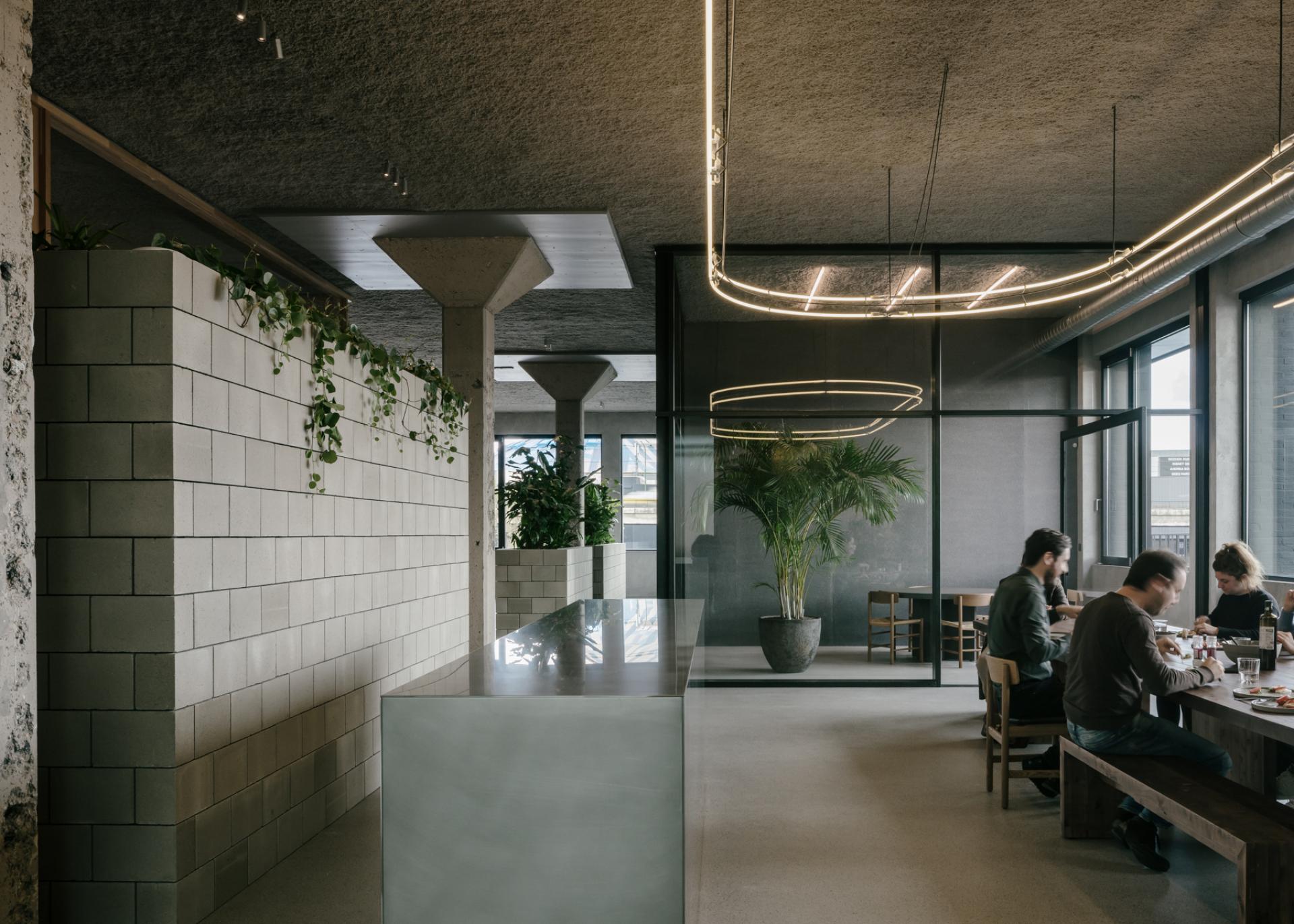
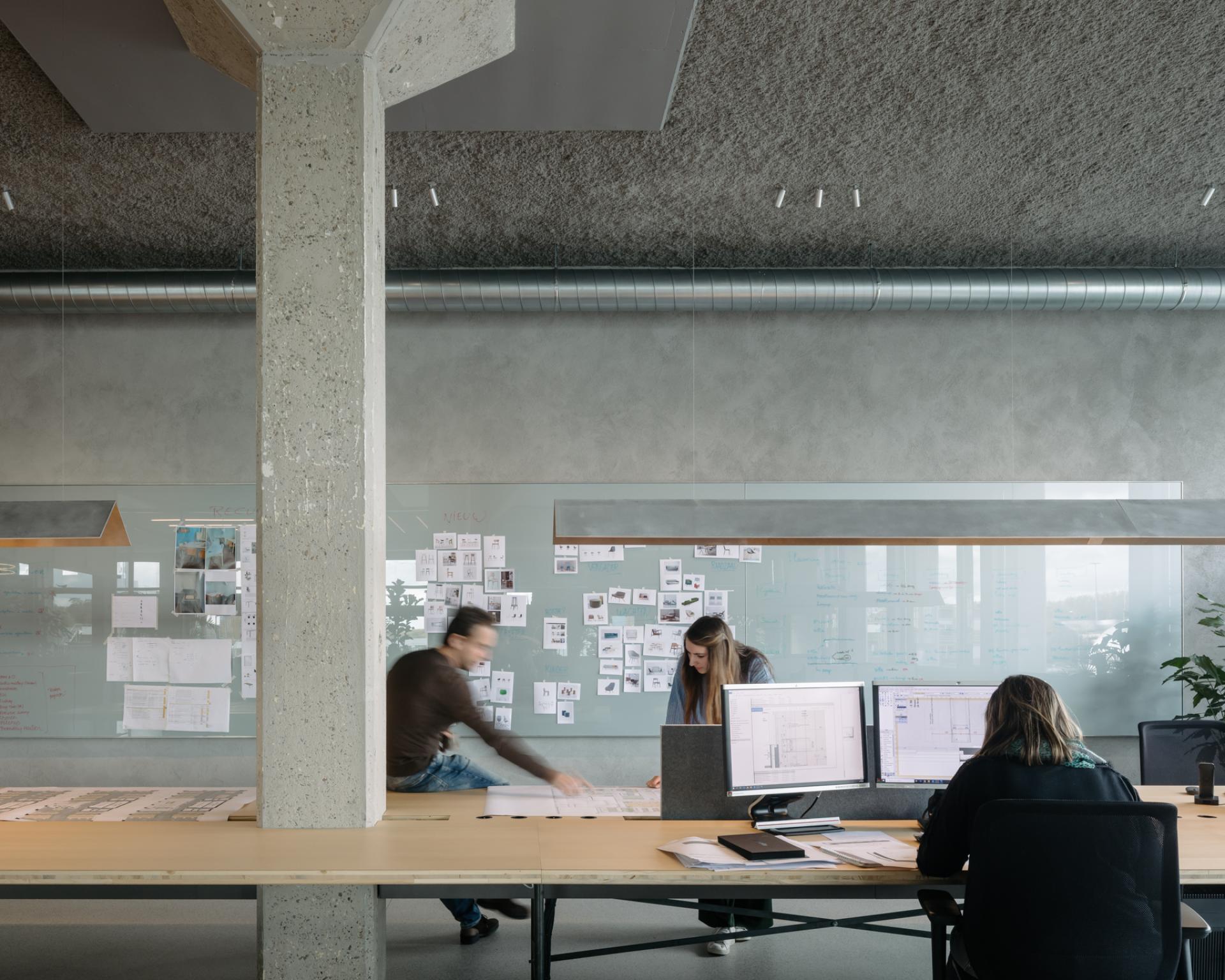
The industrial setting was the inspiration for returning the building to its original state as much as we could. This is why floors, walls and ceilings have been finished with rough materials. The position of the existing columns form a visual link between the reception area and the open landscape office.
According to the "Arsenale" concept, additions to the existing industrial building are conceived as objects and installations, each having its own story in terms of form and use of pure materials.
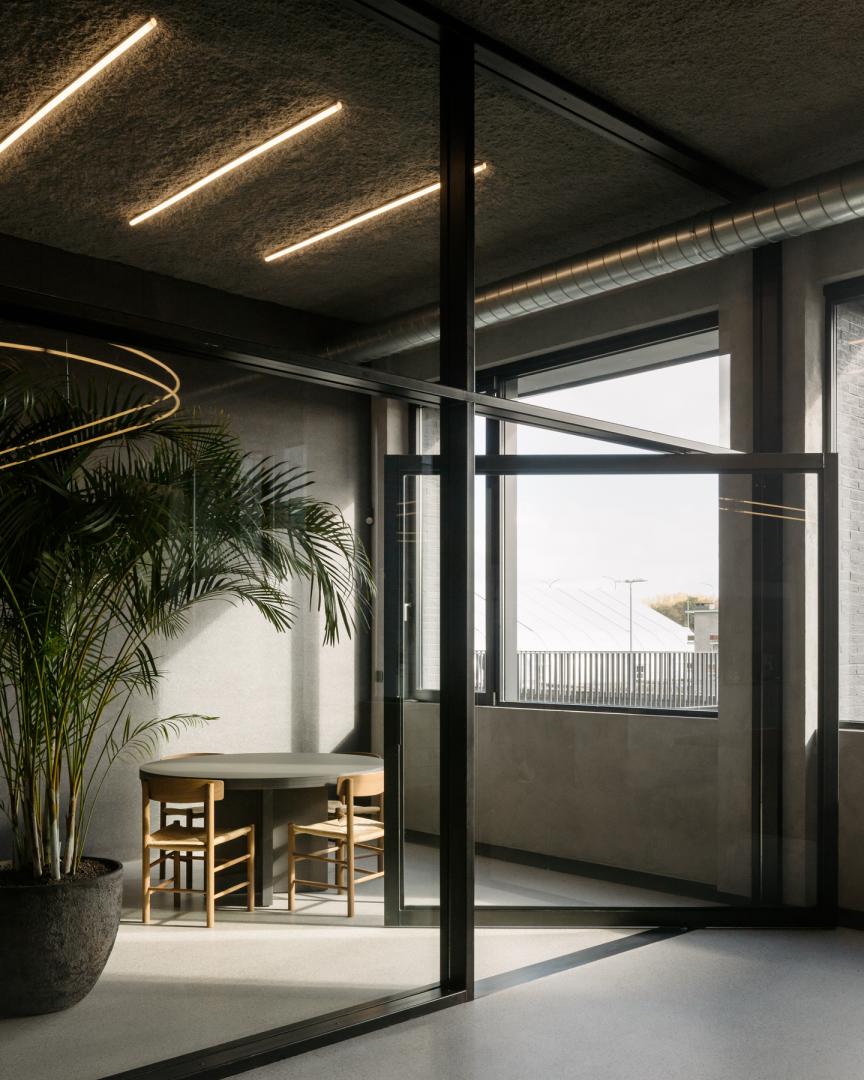
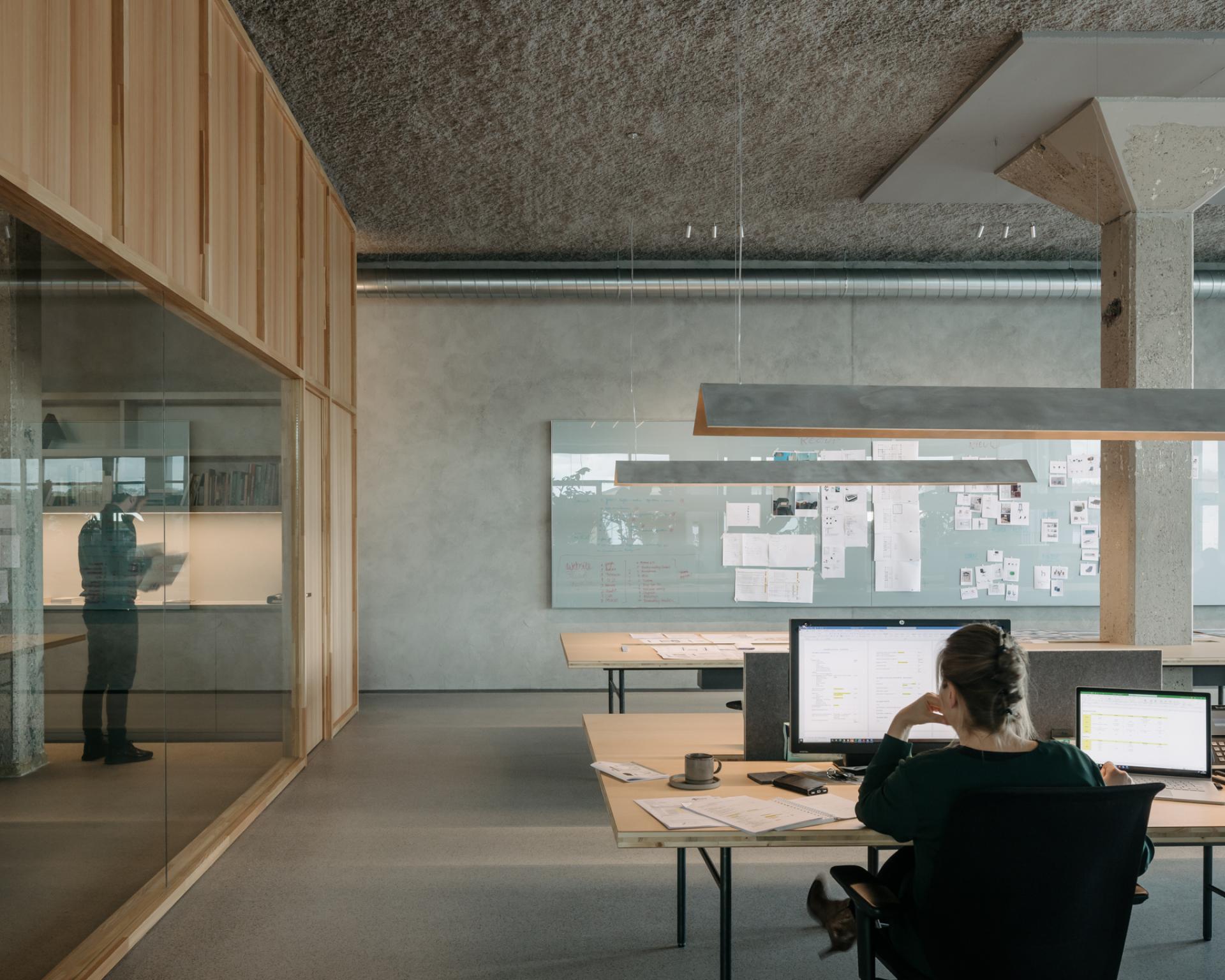
A steel made structure accommodates three meeting rooms. Counterbalancing the steel and glass structure, a closed wooden box is placed on the opposite side. It contains a collection of service functions and a large office with a glass wall facing the design studio.
The design studio takes of a large open area. Two rows of long working desks double as exhibition tables.
Lighting was translated to the essence. We choose apparant fixtures and custom-made pendant luminaires in uncoated aluminum.
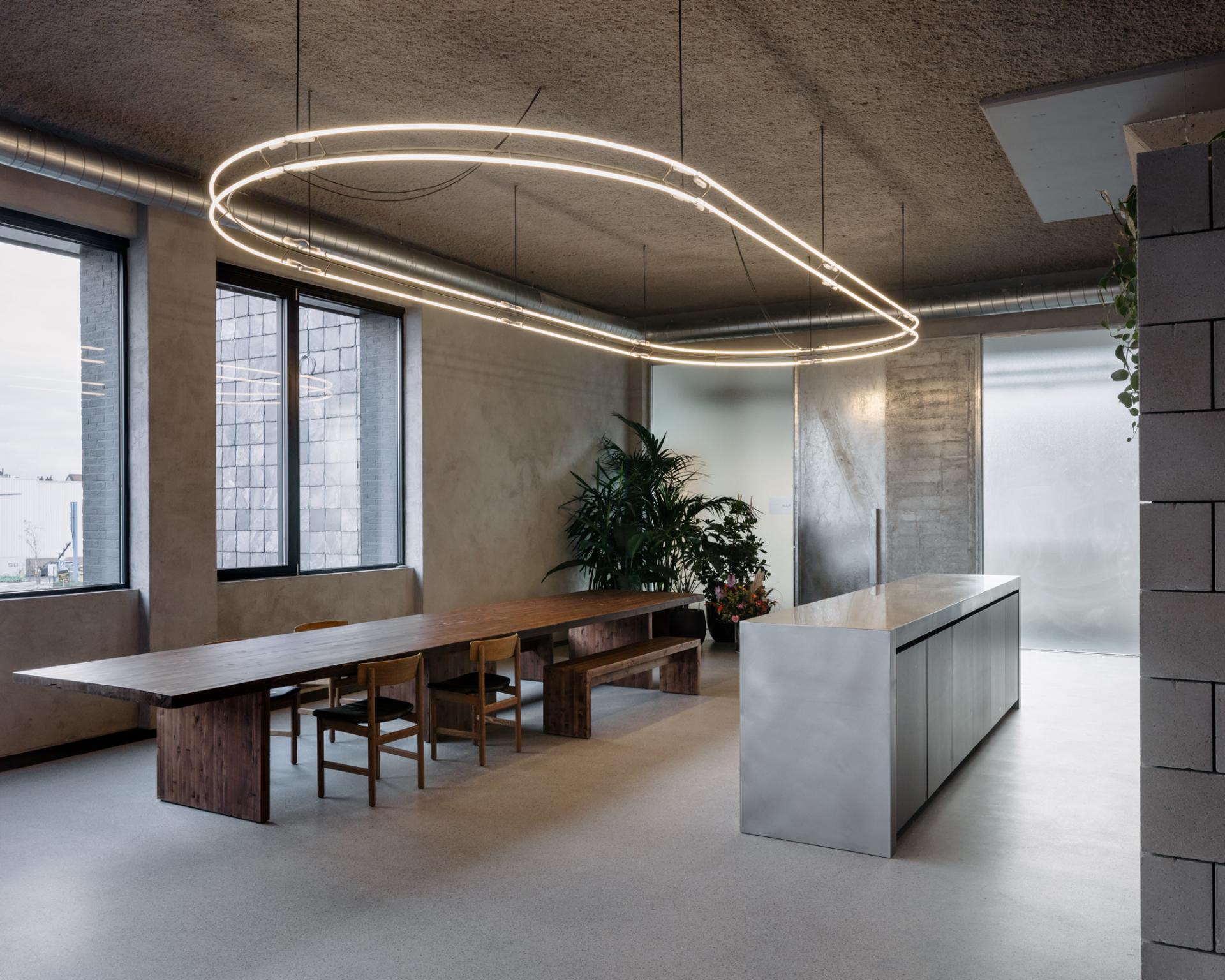
For the conference rooms and to place around the dining table, we re-upholstered vintage design chairs.
From industrial blank canvas to a hub for new ideas.
Key objectives for sustainability
From a sustainability point of view, we chose an existing building. An industrial space within an old factory building. The industrial space inspired us to return the building to its original state as much as possible. The "Arsenale" concept is translated into a rough material palette with a choice of raw and unfinished building elements.
We chose to work with an external and certified sustainability advisor and key insights were implemented in the design approach.
Such as the use of the same floor throughout the loft space. From a circular point of view, when all additional elements were to be removed in case of a handover to a new owner, a functional open floor plan is safeguarded.
For the same reason, the entire ceiling is finished with an acoustic spray plaster, made from grey-painted recycled newspaper shreds.
All walls are finished with a single layer of rough cement.
The steel and glass structure has been designed so that it can be completely dismantled.
The partition walls in the meeting rooms, made up of plasterboard, have been adjusted in width to the exact width of a standard plasterboard. Waste was kept to an absolute minimum.
These walls are covered with acoustically absorbent sheets, a circular product by Kvadrat, called Really.
The wood chosen for the closed wooden box, is European Larch, one of the most durable wood species.
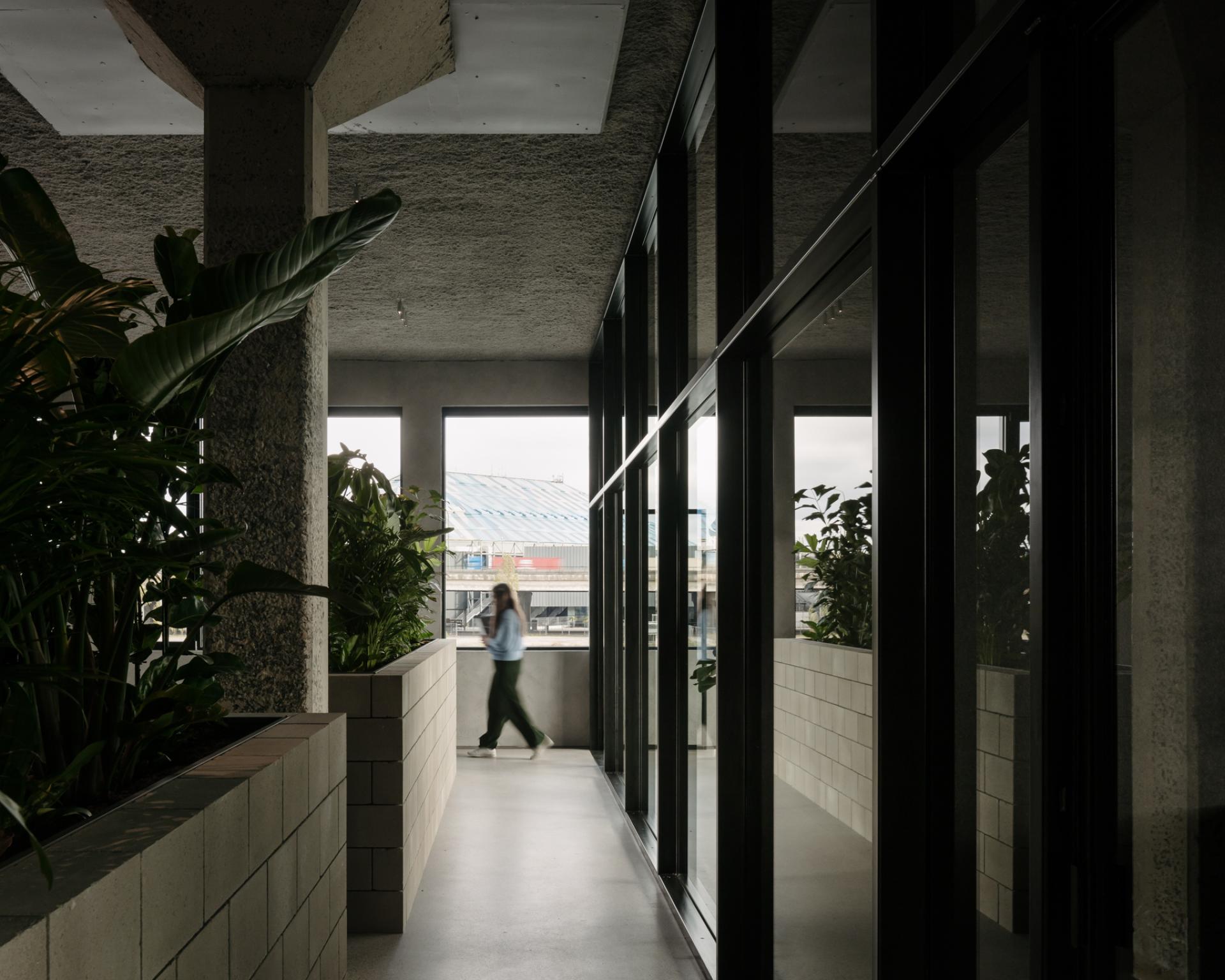
The stacked concrete blocks, used for the partition greenery planters, are placed without joints and can easily be deconstructed and re-used elsewhere.
For the conference rooms and to place around the dining table, we re-upholstered vintage design chairs.
The dining table was repurposed from wooden laminated construction beams that were recovered from the demolition of a building by the Brussels architectural collective, Rotor DC.
Key objectives for aesthetics and quality
The concept, "Arsenale", is a reference to the exhibition site at the Architecture and Art Biennale. The experience of wandering around in an industrial building and drawing inspiration from art and architecture installations is the atmosphere we wanted to create in our office.
The industrial setting was the inspiration for returning the building to its original state as much as we could. This is why floors, walls and ceilings have been finished with rough materials. A concrete floor that has been polished so that the river gravel is visible. This enhances the perception of depth upon entering the office. Sandblasting the existing columns, which were painted black, brought out all imperfections, which makes the columns authentic and adds character.
Within this industrial box, all additional architectural elements are conceived as objects and installations, safeguarding an open and functional plan.
The steel structure has an untreated look and the welds and bolts have been left visible. Mies van der Rohe’s architecture in steel was an important source of inspiration for this frame.
We work with apparant fixtures and custom-made pendant luminaires in uncoated aluminum. The organic shape of the impressive statement ceiling pendant made from neon tube lights refers to the slaughter line in the building's former function.
Lighting is translated to the essence., all the attention goes to the material and shape of the fitting.
The stacking of the concrete blocks without joints creates a graphic pattern. The blocks, a symbol of construction in itself, also refer to the architectural movement of 'brutalism'.
The desks were conceived as exhibition tables. Made from block boards, covered with a thin veneer and with a made-to-measure blue steel frame as a leg structure
The reception area was designed like the lobby in a hotel. The counter was made of stainless steel. The entrance doors in galvanised metal and opaque glass have an industrial look.
Key objectives for inclusion
When we first laid eyes on a casco building site in a misunderstood part of the city, we knew Antwerp's meat packing district was the right place for us. This district, defined by the characterless buildings, the highway flyover and the industrial water dock, has the avant-garde ambiance we were aiming for.
By choosing this particular location for our office, we collaborate on an upgrade of the weathered neighbourhood, making it more known and visible for our visiting suppliers and clients. From a short term point of view, we believe this can contribute to the future grow and the diversity of our district.
From a longterm point of view, our choice of location is based on the development goals that are set for this area. A large part of this district will undergo a major change since it is part of a complete urban make-over. The highway flyover will be demolished and it will be replaced by the construction of a underground highway tunneling project. Blueprints of the urban development show a large green area with parks and outdoor recreation. This will be our future view from our office window.
We aim to create a warm environment to invite visitors. The office space is conceived to be shared with professionals in the architecture and construction branche. Meeting rooms and work space are available for hosting a formal or informal meeting, a lecture or a networking event. As 50% of the office space is open for sharing, this transcends the classic idea of an office. We created a creative hub for meeting like-minded professionals.
Furthermore, we challenge all our building partners to participate in a futureproof vision inviting them to co-create and pushing them to think about solutions that unite design and longterm longitivity.
We believe we raised the bar and succeeded in creating an office where we and our team can be creative in the comfort of a space that reflects our values and dreams.
Results in relation to category
It is our vision to combine circular, sustainable design without compromising on the aesthetics.
By designing all additional architectural elements as stand-alone objects and installations, using standard sizing as the design starting point and implementing building methods that safeguard circularity, we prove a different approach to made-to-measure. We thrive on a nearly-no-waste mindset. Whether it is a waste of material, a waste of energy or a waste of time.
We challenge all our building partners to participate in this vision inviting them to co-create and pushing them to think about solutions that unite design and longterm longitivity. By leading by example, we challenge a change in the construction industry towards implementing building methods and construction systems that incorporate a futureproof vision.
To say it with a quote of Anne-Marie Bonneau: "We don't need a handful of people doing zero-waste perfectly, we need millions of people doing it imperfectly."
How Citizens benefit
When we first laid eyes on a casco building site in a misunderstood Northern part of the city, we knew Antwerp's meat packing district was the right place for us. The area, tucked away between Park Spoor Noord, Dam and Albertkanaal, was once a neighborhood full of slaughterhouses and factories. This district, defined by the characterless buildings, the highway flyover and the industrial water dock, has the avant-garde ambiance we were aiming for.
The city of Antwerp will invest heavily in the public space of the Slaughterhouse site in the next years. The site defined by the highway flyover will be completely transformed. By covering the ring road with a "green roof", the city will be more livable. It is one of the largest infrastructure projects in Europe, supported by the European Union.
We have explicitly opted for the Slaughterhouse site as it is also a burgeoning neighborhood. We act as enthusiastic ambassadors, proclaiming and strengthening the future development of the deprived neighborhood through our presence. To all visitors of our office, we communicate the plans of the neighborhood and we inform citizens on a constant basis.
Innovative character
Our design thinking can be translated into four pillars: analyze, reduce, reuse and recycle. We are constantly raising the bar by designing ideas for the future, challenging today's opportunities and envisioning to upgrade spaces or objects that were built in the past. We prove a different approach to interior design, made-to-measure and use of materials.
Reduce materials by using standard measurements of a construction material als the starting point for designing the space. By doing so we not only reduce waste to the maximum, but we also achieve to save on working hours during the construction.
The choice of materials is defined by its sustainable properties. For example the material Reallyfrom the brand Kvadrat, was used for the walls in the meeting rooms. It is similar to felt and made from cotton and wool that have reached the end of their useful lives. The acoustic spray plaster we used for the ceiling is another goods example that underwrites this vision.
Either we use recycled material for making a new design, for example the Rotor dining tabel, or we make sure that our designs can be dismantled to be re-used elesewhere.
We opted for a low-energy climate system.
Because of the high ceilings, underfloor heating was opted for. In the summer, this can also be used to cool the floors. Both heat and cooling are generated by means of a heat pump.
The outside air is brought in and filtered for fine particles by a ventilation system D. The purified air is preconditioned in winter by the hot water of the underfloor heating. In summer, cooling water from the underfloor system does the same.
Exterior blinds placed on the south side keep out the heat of the sunlight.
A study has shown that the office has no need for air conditioning.