Traceablity in Design and Contruction.
Basic information
Project Title
Full project title
Category
Project Description
Traceability of Design and Construction is an Applied Methodology that supports the implication of the project stakeholders and the local/ regional construction industry. Is leads the architectural design strategy to optimize resources and reduce energy consumption in the production, transport of goods and materials. It promotes and develops the local building culture, supports decision-making and supports future maintenance and recycle of building
Project Region
EU Programme or fund
Description of the project
Summary
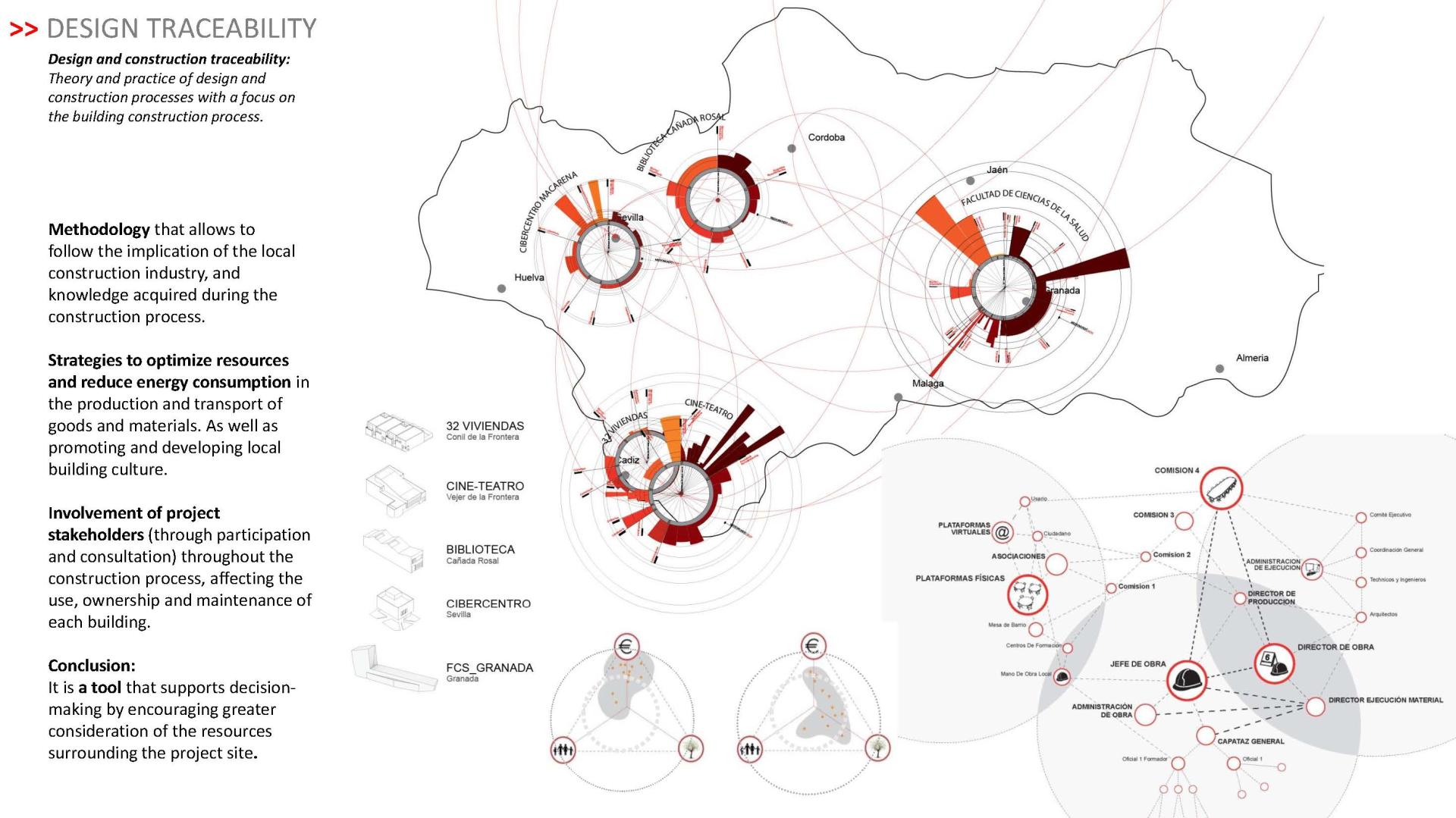
Methodology that allows to follow the implication of the local construction industry, and knowledge acquired during the construction process. Strategies to optimize resources and reduce energy consumption in the production and transport of goods and materials. As well as promoting and developing local building culture.Involvement of project stakeholders (through participation and consultation) throughout the construction process, affecting the use, ownership and maintenance of each building.Conclusion:It is a tool that supports decision-making by encouraging greater consideration of the resources surrounding the project site.
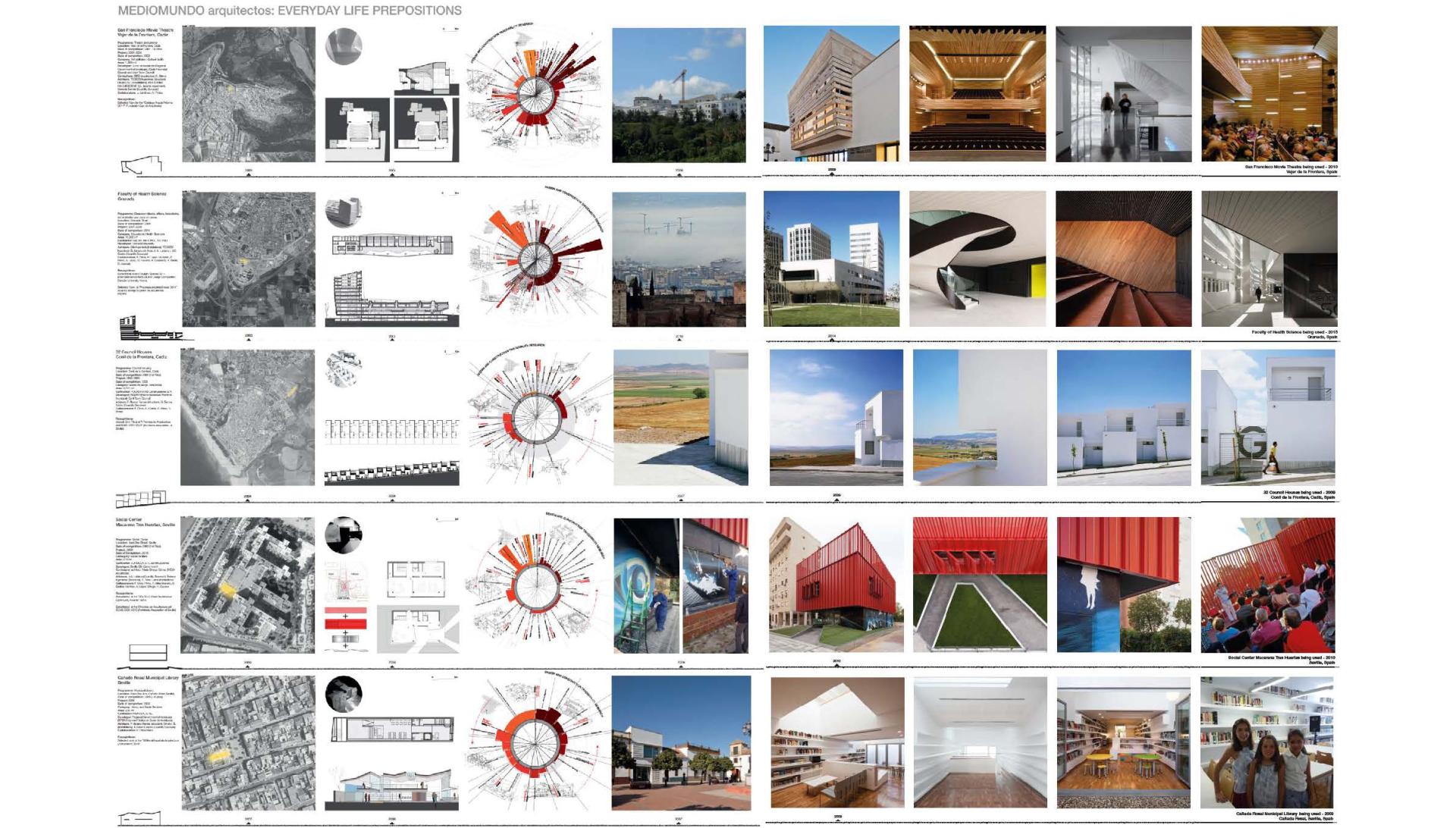
This research aims to explore the environmental impact of the construction process, through the collection, management and representation of information. The aims of this study are to explore who contributed to each project, what they do, where they came from, when they were on site, and most importantly how far they had to travel. To carry out this work we have analysed some buildings developed within the professional practice MEDIOMUNDO arquitectos: Library in Cañada Rosales (Sevilla), Theatre in Vejer (Cádiz), Dwellings in Conil (Cádiz), Cyber centre in Macarena Tres Huertas (Sevilla), and the Faculty of Health Sciences in Granada (Granada).
The methodology that enables us to visualize the involvement of local actors and the knowledge acquired during the process of construction. Therefore, we have developed strategies to optimize resources and reduce energy consumption in the transport of goods and materials. As well as incorporating project stakeholders (through participation and consultation) throughout the construction process, this methodology incorporates local knowledge and global techniques that affect the use, ownership and maintenance of each building.
The results obtained help to the decision making by knowing the implications, during the construction process, of the actors involved, the materials used and their origin.
Key objectives for sustainability
The objective of this research is the generation of a tool that allows:
- To analyse the building and design interrelation stakeholders and buidling industry factors involved in material production of an architectural work, emphasizing the impact of distance and time of regional construction indutry, materials and technologies and their impact on development of the architetural work.
- To generate a tool for analysis and support for the decision-making in processes of project and sustainable construction management.
- To make a comparative assessment of the buildings studied and the interrelationships between material agents and location, and to define the variables that determine these results.
We've successfully applied the reseacrh to 5 built case studies:Municipal Theatre in Vejer de la Frontera (Cádiz); Municipal Library of Cañada-Rosal (Seville); 3. Macarena Social Centre (Seville), Social Housing in Conil de la Frontera (Cádiz), Faculty of Health Sciences in Granada.
Key objectives for aesthetics and quality
This research has identified space-time interrelations between material and technical agents that occur in the case studies. As a result of this work we can see that there are several factors affecting the results such as the functional programme (use) of the building, its size, complexity and relative location with respect to networks, production, and concentration of agents, materials and technologies. It also identify the influence of the displacement from the sites of origin to its use in construction, in the insertion and interaction within the construction process and the environment in which a building is situated.
The results show the relationship between the type of work, its scale, complexity and programmatic uniqueness, characteristics of the environment, the scale of the place and its territorial status. We understand that this determines the possibilities of management and incorporation of media and techniques with varying degrees of ease and availability both in terms of supply and capacity and to the disposal of the management and the main contractor of the work. In this sense it can be shown that larger scale projects of greater complexity, greater specificity and greater restriction have implications on the type and size of the contractor team. So if the population is small or at certain peripheral location, and the project is of a certain scale and budget, processes are likely to be executed by exogenous contractors and managed by agencies or companies remote to the town. We are referring, for example, to cases where there may be requirements for specialist equipment such as a theatre stage or a programme with complex sanitary needs; where functional and technical requirements impede the availability of technical, material and systems within close proximity.
Key objectives for inclusion
For the development of the tool, the following methodology is proposed, based on the identification of opportunities and concerns involved in the design and construction stakeholders of the Andalusian Region and the City/council involved.
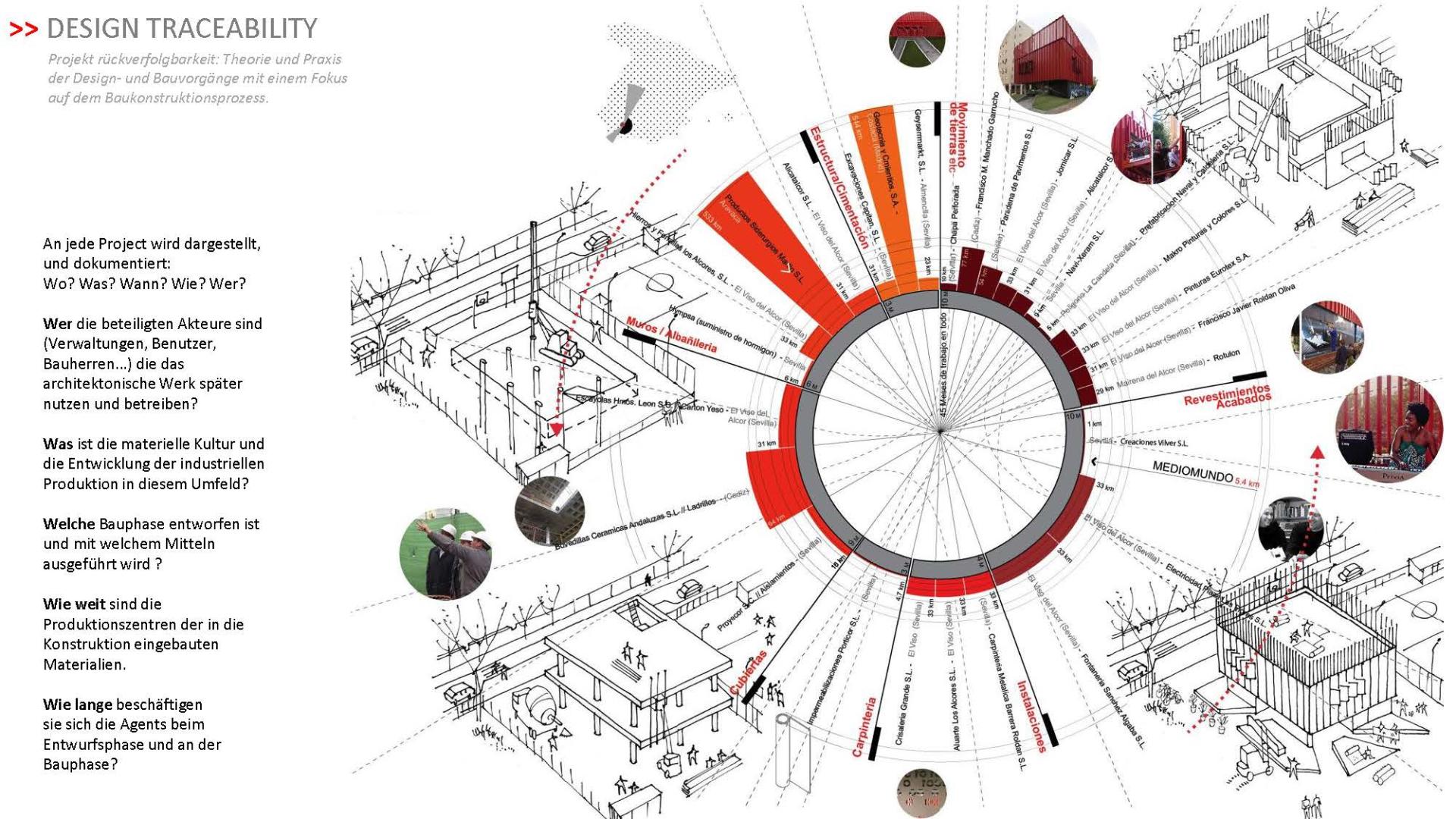
In the first instance we proceed to the documentation of data, where information is collected relating to staff (technicians and operators) involved in the construction of a particular work, stating their origin (distance travelled to work), the duration of their involvement (days, weeks, months), the material, system or task that they undertake or develop, and the price involved in material implementation.
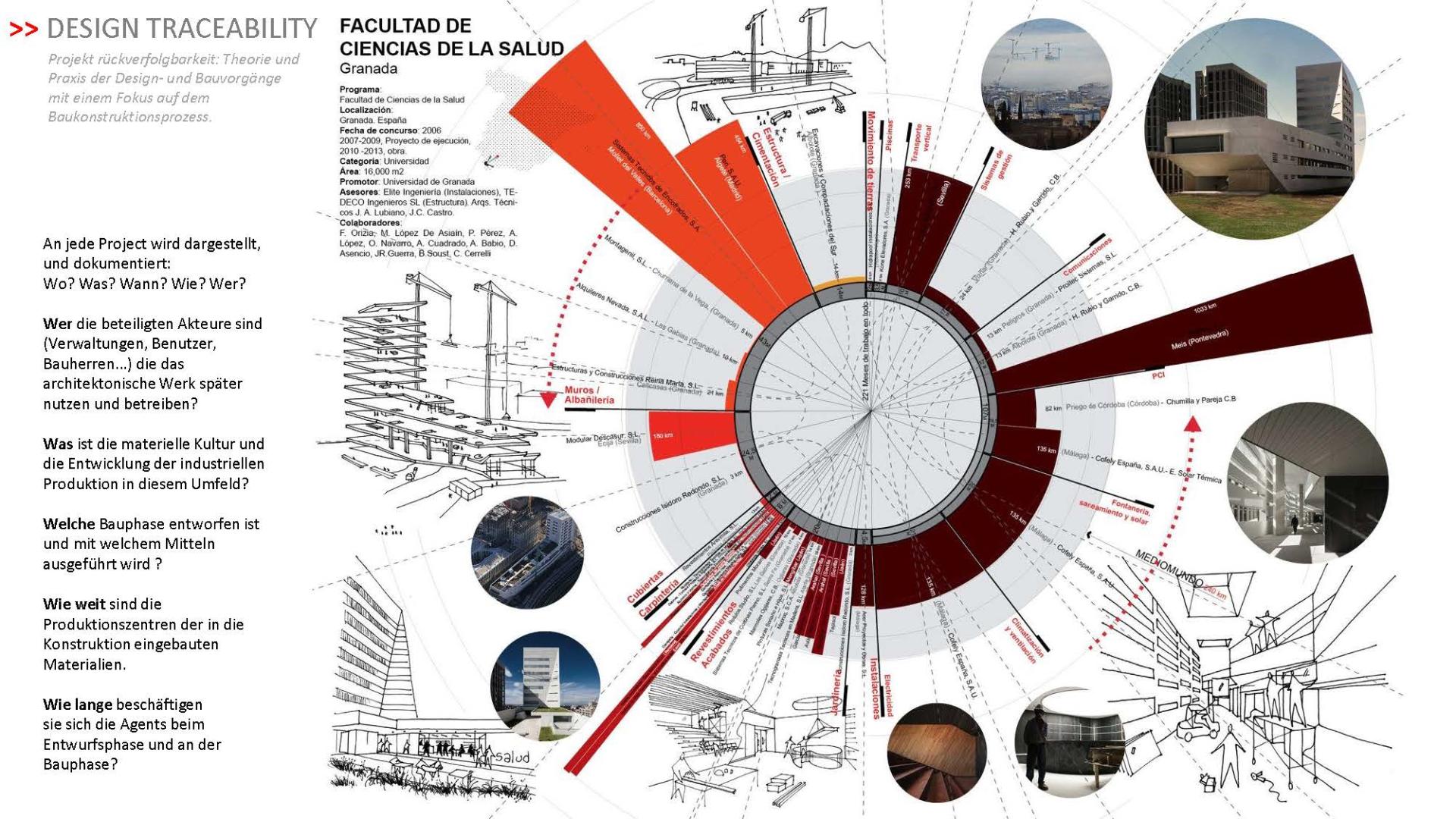
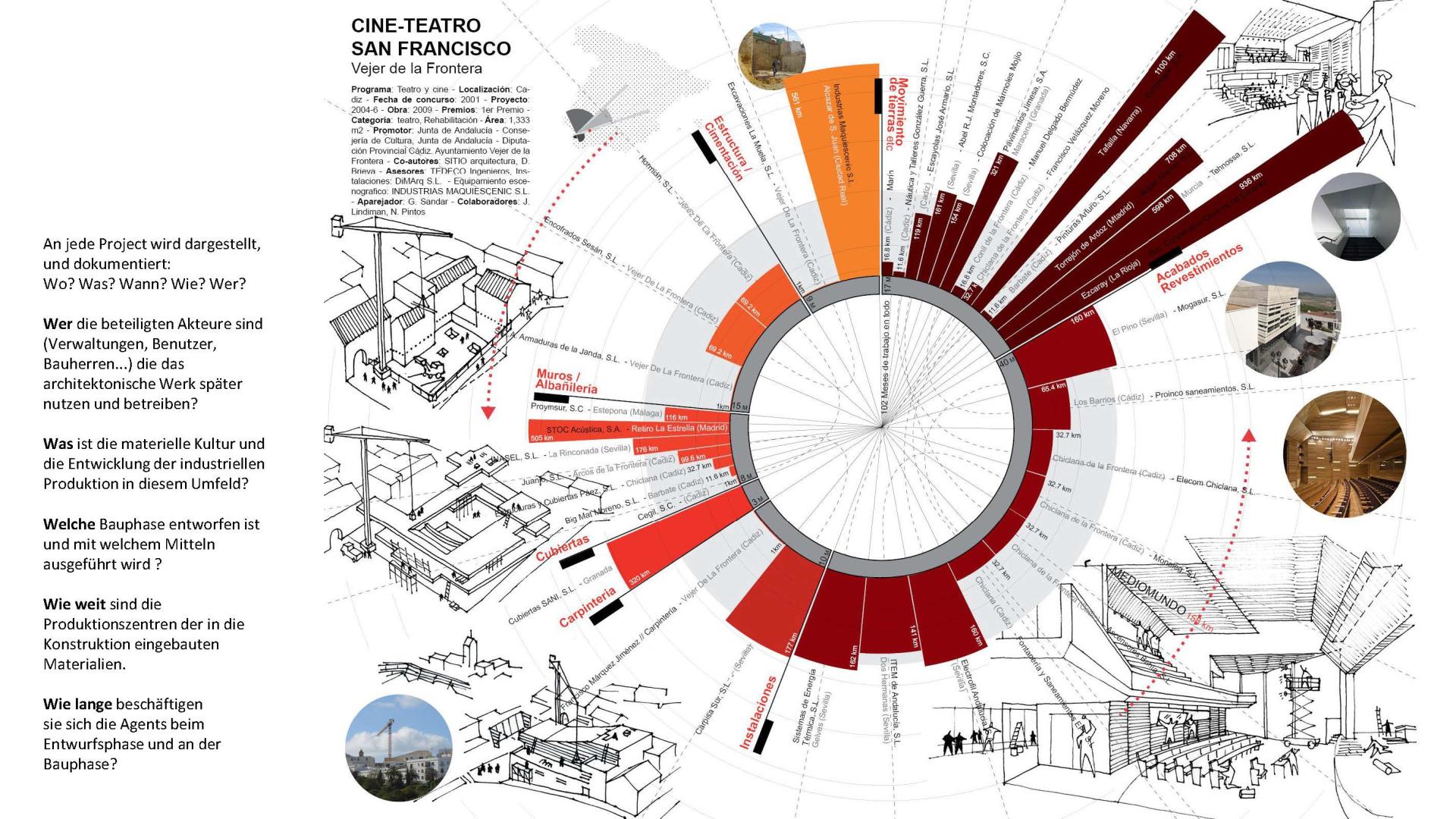
By adding the times for each agent we obtain a total time[1] employed or spent in work, of which each participant takes a percentage. (The total time spent on site is greater than the execution time and the different trades overlap their work time). In the second instance, with the data obtained we proceed to the preparation of corresponding graphs. The data obtained is made into a circular graph where the portion of time spent by each agent or system is represented by an arc.
On the same graph the distance from the origin of each actor responsible for the implementation of a task or system is described. These distances are represented by the length of each arc´s radius, which is proportional to the distance from origin of each agent. Thus each agent is represented by a portion of the circle determined by the time spent and distance from origin. This is a measured visualization of the intensity of time employed as well as the movement of the agents involved in each job or unit of work (subcontracting and operators).
[1] The total time of the work defined for this study is the work within the linear sum of the time consumed by all tasks (without considering concurrency or overlaps).
Results in relation to category
Moreover, analyzing the results we found that the Faculty of Health Sciences of Granada has had involvement of agents (subcontracts, labor, workers) whose average distance travel has been the longest. Moreover it is the building with the largest floor area (16,200 m2) of the five studied, the greatest complexity, and the highest cost. The data obtained in this study shows that 17of 37 workers come from industrial estate agents, transformer industries, suppliers or artisans, located approx.16 km from the construction site and originating from the city of Granada and its surroundings. The rest of the agents have come from places such as Seville, Madrid, Málaga, Jaén, Barcelona, Pontevedra, which distances travelled ranging from 115 to 1200 km. At the other extreme, in social housi built in Conil (Cadiz )province, the average displacement by subcontractors is the least of all the case study buildings, while the project constitutes less complexity and programmatic and constructive uniqueness. Both the simplicity of construction and the programme of the building permitted the utilization of local materials and agents from the region, despite the town not being an area of high centrality or concentration.
In the first instance we proceed to the documentation of data, where information is collected relating to staff (technicians and operators) involved in the construction of a particular work, stating their origin (distance travelled to work), the duration of their involvement (days, weeks, months), the material, system or task that they undertake or develop, and the price involved in material implementation.The data obtained is made into a circulargraph where the portion of time spent by each agent or system is represented by an arc.Thus each agent is represented by a portion of the circle determined by the time spent and distance from origin. This is a measured visualization of the intensity of time employed as well as the movement of the agents involved in each job
How Citizens benefit
For the development of this architectural and social research and related information, the following categories are introduced according to:
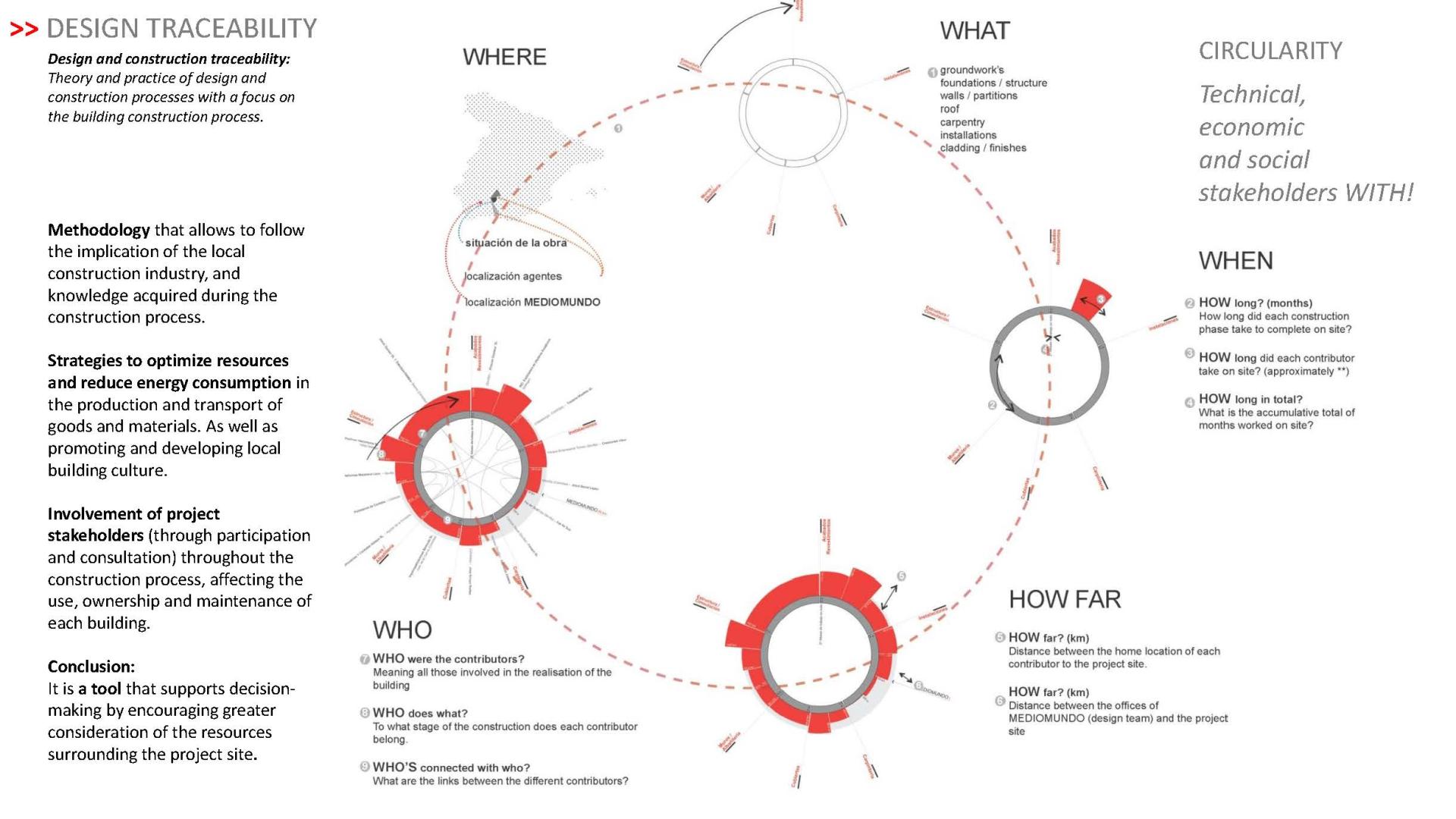
- WHERE. Geographic location of the project and the urban-territorial context of the intervention. The contextualization of the intervention is relevant for the understanding availability of products, systems, technology, human resources and capacities. It is also a decisive factor in the cultural and economic aspects of the work.
- WHAT. Tasks, systems or materials involved in the work. The enumeration and classification of tasks, systems and materials serves to define the temporal, economic and technological scenarios and determine project needs. In this sense, beyond valuation and economic planning of the work, the temporal and spatial organization of tasks is visualized, in order to be able to determine the level of involvement and influence that agents have developed in the process construction.
- wHO are the actors involved in the development of various tasks. What contribution did each actor make? What relationship did they have before construction? What relationship is maintained during construction? Attend the conditions and characterization of equipment technicians and operators. If an action has been made individually or as part of a larger team, whether it is separate from or through the main contractor team; the degree of expertise and knowledge, the form of organization, any previous collaborations, etc.
- TIME. Working hours on site for each agent in respect to the work. How long has each agent worked? How much timetime has been invested? Particular attention is given to the period each agent is involved in production. An absolute value measured in weeks or months is related to both the term/ duration of each actor´s work, as well as the amount of time taken by all the actors involved.
- DISTANCE. Origin and movement of each agent. relationships with other trades, and the social and economical assessment
Innovative character
Worldwide there are currently over 600 tools and methods of environmental assessment that assist us in making more sustainable decision throughout the design and building process (Reed et al, 2009). These systems mainly use indicators and benchmarks, focusing on management of energy, water, material resources, and the building's environment. Besides of it, we find that these systems are primarily geared towards assessing the provenance of the material resources regardless of the source of labor installing or the application of these materials. Studies show (Soust, 2012) which parameters such as the location of the labor involved in the construction processes are not properly evaluated, e.g. the LEED BREEAM, GREEN environmental assessment system, however, other methods such as HQE environmental assessment incorporate this variable in the process of environmental assessment of buildings (MIQCP, 2003).
It is clear that the parameters and indicators of environmental and energy sustainability through which some of the most widespread certifications and environmental assessments of buildings are governed in the context of Spain (LEED, BREEAM, GREEN), do not give adequate consideration to the location of production facilities or the location of labor related to construction processes and building maintenance.