architectures! collective inventory
Basic information
Project Title
Full project title
Category
Project Description
architectures! collective inventory is a democratic selection of recent architecture (2019), a collective book of 384 pages (2020), and a travelling forum (2021). Selected for the first time by public choice, 45 exemplary constructions are highlighted, covering individual and group-housing, workspaces, social facilities and public spaces. Also illustrated are 45 actions improving life in urban and rural landscapes: temporary occupancies, artistic projects, urban activism, and eco-responsibility.
Project Region
EU Programme or fund
Description of the project
Summary
architectures! collective inventory is:
- a democratic selection of recent architecture (2019)
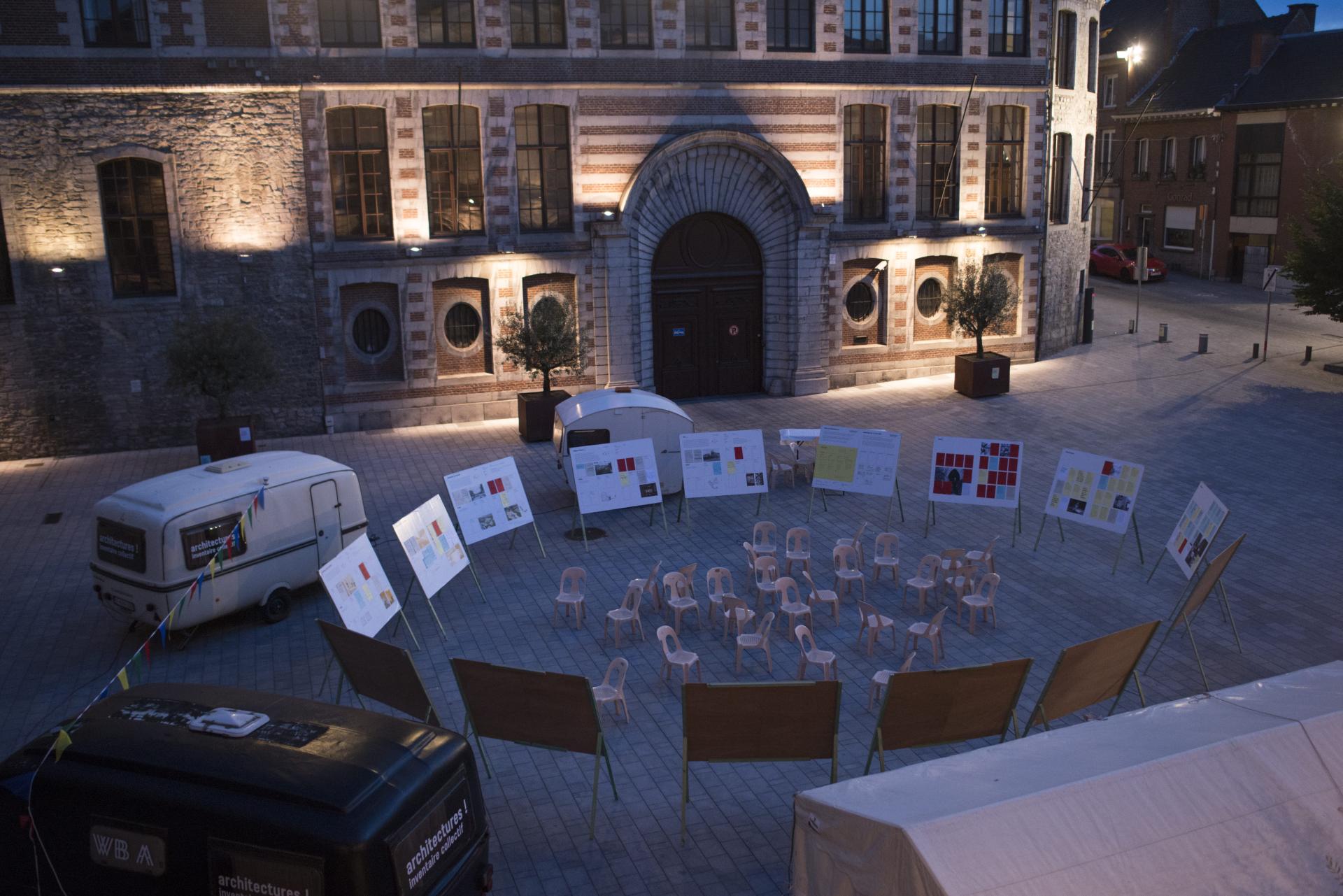
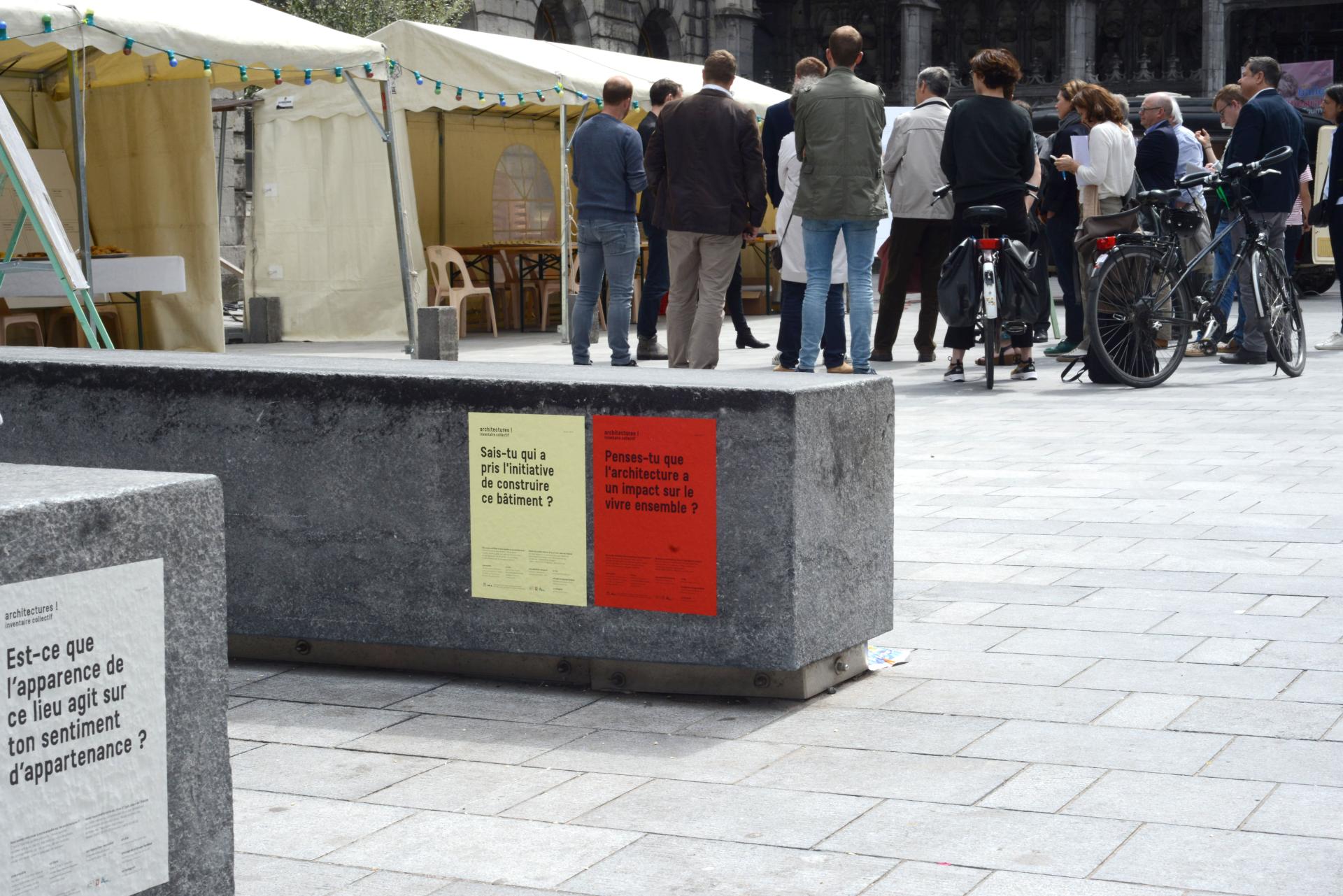
Between June and October 2019, we set up a travelling programme, camping in town squares, exploring pre-selected constructions, and sparking debate between architects and non-architects. Hand-in-hand with the local inhabitants, we established and refined four criteria for the evaluations: social, environment, governance, and aesthetics. On the last day of the tour, a public deliberation was held in order to elect exemplary constructions.
- a collective book of 384 pages (published in 2020)
Published in October 2020, the book is the fruit of this saga. Selected for the first time by public choice, 45 exemplary constructions are accurately highlighted, covering individual and group-housing, workspaces, social facilities and public spaces. Also illustrated are 45 actions improving life in urban and rural landscapes: temporary occupancies, artistic projects, urban activism, and eco-responsibility.
- a travelling forum (2021-2022)
We export an exhibition and creative debates around the book. We share our tools of the democratic process. We invite the selected architects, designers, artists, engineers, citizens, activists, city makers to meet and share experience with local architects, designers, artists, engineers, citizens, activists, city makers. architectures! collective inventory makes solid proposals for decision-makers involved in public and private works as well as everybody else who has concerns for the environment.
architectures! collective inventory is produced on the initiative of the Architecture Unit of the Wallonia-Brussels Federation, in partnership with Wallonia-Brussels Architectures, under the direction of Gilles Debrun (architect & teacher) and Pauline de La Boulaye (historian & curator) in collaboration with Habitant.e.s des images (artists).
Key objectives for sustainability
During the democratic selection (2019), the artistic collective Habitant·e·s des images interviewed and portrayed inhabitants, studied their statements, and retained thirteen key questions assessing architecture. These questions became reference points for the selection process.
The environmental questions were:
- Is consideration given to the density, compactness and use of land?
- Does the project promote biodiversity?
- What lifestyles, production and consumption patterns are linked to the project?
In the book (2020), the 45 constructions selected by public choice cover mainly renovations and conversions: farm renovated into a family house, renovation of an industrial building in 24 public housing units, conversion of a castle into a town hall, renovation of the visitors centre, circuit and gardens, conversion of a farmhouse into a rural centre...
The 45 actions describe the initiatives of the pioneers who concretely re-invite ecological transition on a daily basis: from land use to material use, from circular economy to a lighter approach to living on earth: BC materials, rotor...
The chapter "architects talking" designed by the artistic collective Habitant·e·s des images highlights the great concern of the selected architects for the environment.
The travelling forum (2021-2022) aims at sharing the collective knowledge of this book.
Key objectives for aesthetics and quality
During the democratic selection (2019), the artistic collective Habitant·e·s des images interviewed and portrayed inhabitants, studied their statements, and retained thirteen key questions assessing architecture.
The questions about aesthetics were:
- What dialogue does the project establish with the local identity?
- Is it aesthetically pleasing for the users?
- Does this building offer well-being and sensations?
- What story does this place have to tell us, what imagery, what symbol?
In the book (2020), theses dimensions of aesthetics became reference points for the selection process of the 45 constructions.
The chapter "arts and architecture" is focusing on the art of bonding with places:
- A passage between two houses, a doorway to the invisible and a house on the border of reality.
- Concrete metamorphosed by children in a school in Wallonia and by mystery on a social housing high-rise.
- Revitalising fictional stories for architecture and for Brussels.
- The collective unconscious of a slag heap in Charleroi and the extraction of a piece of soil, a subterranean memory.
- A sculpture of the void to be traversed at 120 kilometres per hour and a memorial uniting all Belgians around their dead.
The travelling forum (2021-2022) aims at sharing the collective knowledge of this book.
Key objectives for inclusion
During the democratic selection (2019), the artistic collective Habitant·e·s des images interviewed and portrayed inhabitants, studied their statements, and retained thirteen key questions assessing architecture.
The social questions were:
- Does the project provide spaces for socialising and exchanges?
- Has economic accessibility been considered?
- How do users and neighbours appropriate and use the space?
In the book (2020), theses social questions became reference points for the selection process of the 45 constructions.
The chapter "empowerments" is focusing on this specific issue: "They are researchers, architects, artists, sociologists, urban planners, and activists. They want to change the image of a neighbourhood, the use of a square, the design of a building or the perception it gives. Most of them took the initiative to start by themselves: in the face of a social emergency, in reaction to extreme precariousness, feeling a growing awareness, in response to a desperate need to rise up and do something. Standing up was not enough: considerable energy, imagination, determination and endurance were all required to carry out the following projects."
- Matrimony days
- Parc urbain de la Jonction
- Place de Houf'
- DoucheFLUX
- Brussels Community Land Trust
- ...
The travelling forum (2021-2022) aims at sharing the collective knowledge of this book.
Results in relation to category
architectures! collective inventory is both artistic, scientific and political.
In 2019, the democratic selection was an experience in the field, with 500 people and architects. Besides architecture being a construction or a seductive image, we wanted to focus on architecture as being a vessel connecting people and a vector linking us with nature. Right from the start, we wanted our architect/historian duo to break away from the established “architects talking to architects” model. These two professions rarely speak the same language, so we turned this into an asset. The artistic collective Habitant·e·s des images joined the project with unique participatory tools addressing issues of “living in”. Our differences helped us to interact with people from all walks of life: politicians, locals, children, civil servants, and pensioners. Our whole approach was to be coherent with what we are defending here: co-construction. Consequently, the book promoting cooperation between architecture and civil society, is designed to be collective.
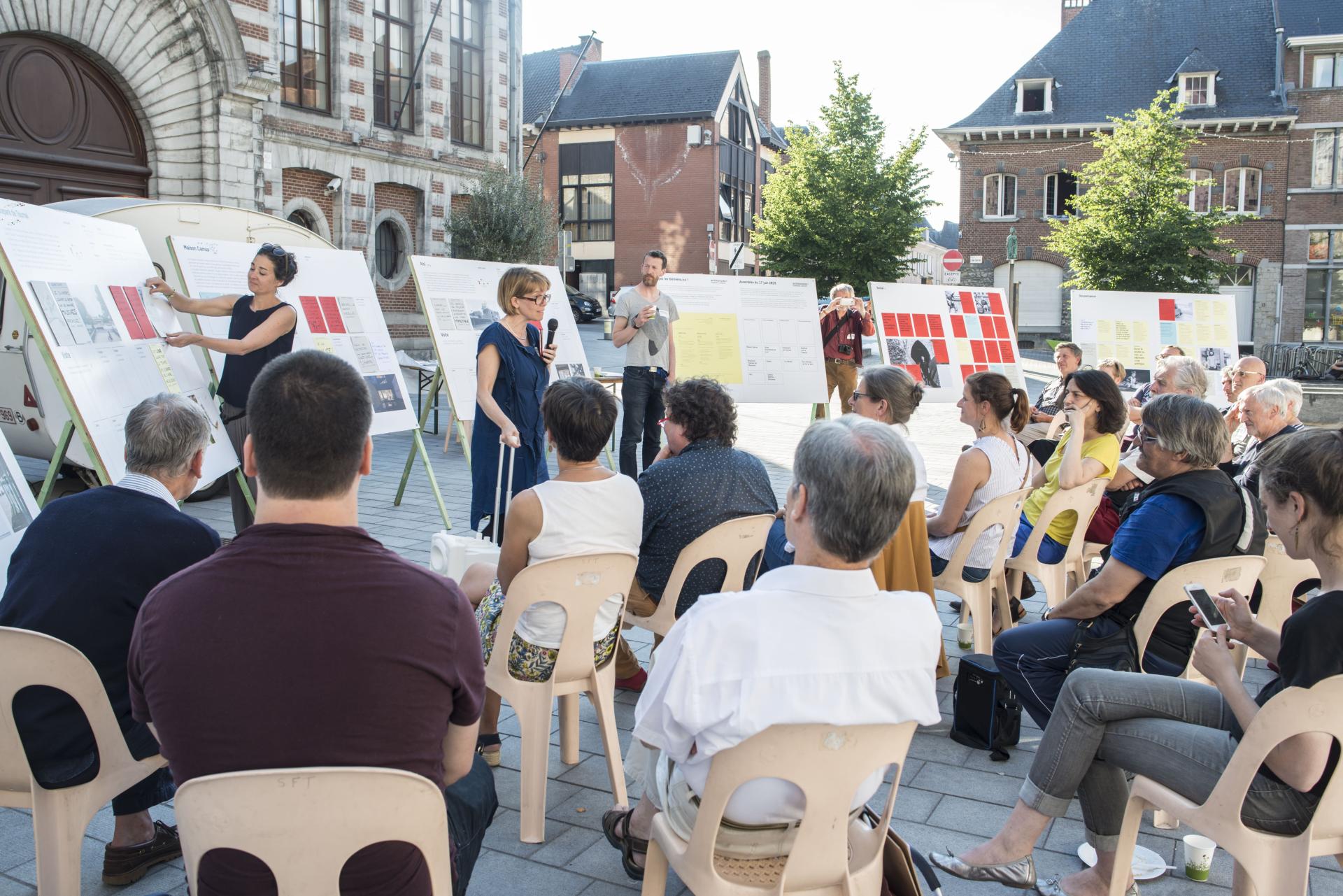
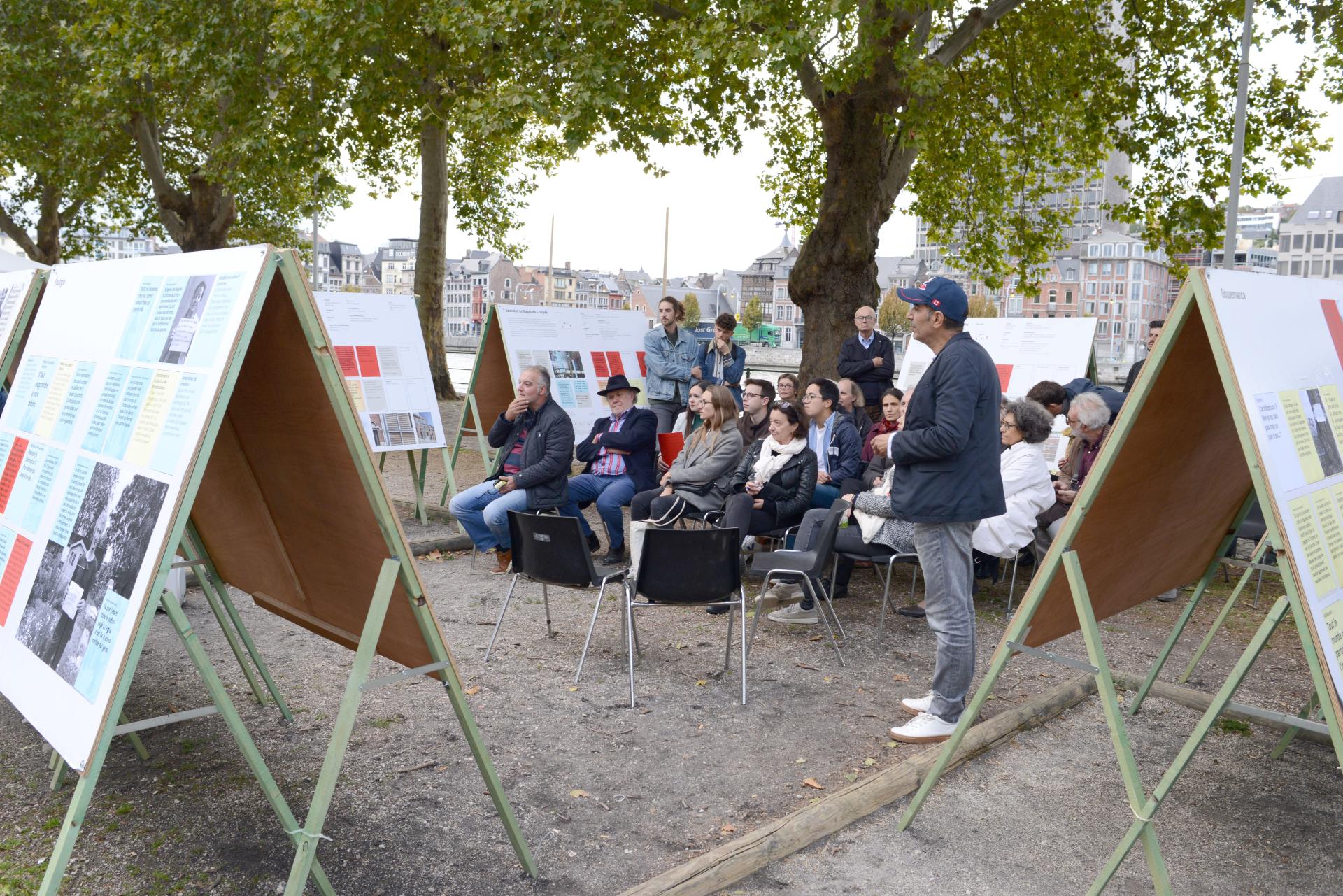
Over a four-day weekend, we were transient neighbours. The inhabitants would see us at any time of day or night; the easiest and most efficient way to encounter them was to stand in their way. A few weeks before our arrival, we announced our visit with posters, flyers, articles in the local press, and television. At every stop, the camp was made up of three caravans, fifteen panels, two arbours, fifty chairs, eight tables, a printer, a cutter, and a resource library. Starting from this base camp, we would embark anyone who wished to come on board for half days spent visiting and meeting with architects and users. Coffee, croissants, picnics, we thought of everything! We travelled 2,233 kilometers, just like an architectural circus.
The book edited in 2020 by Belgian institution has an important legitimacy for the city makers in Belgium.
The travelling forum (2021-2022) supported by WBA aims at sharing abroad.
How Citizens benefit
Public have their say on the most inspiring and liveable buildings!
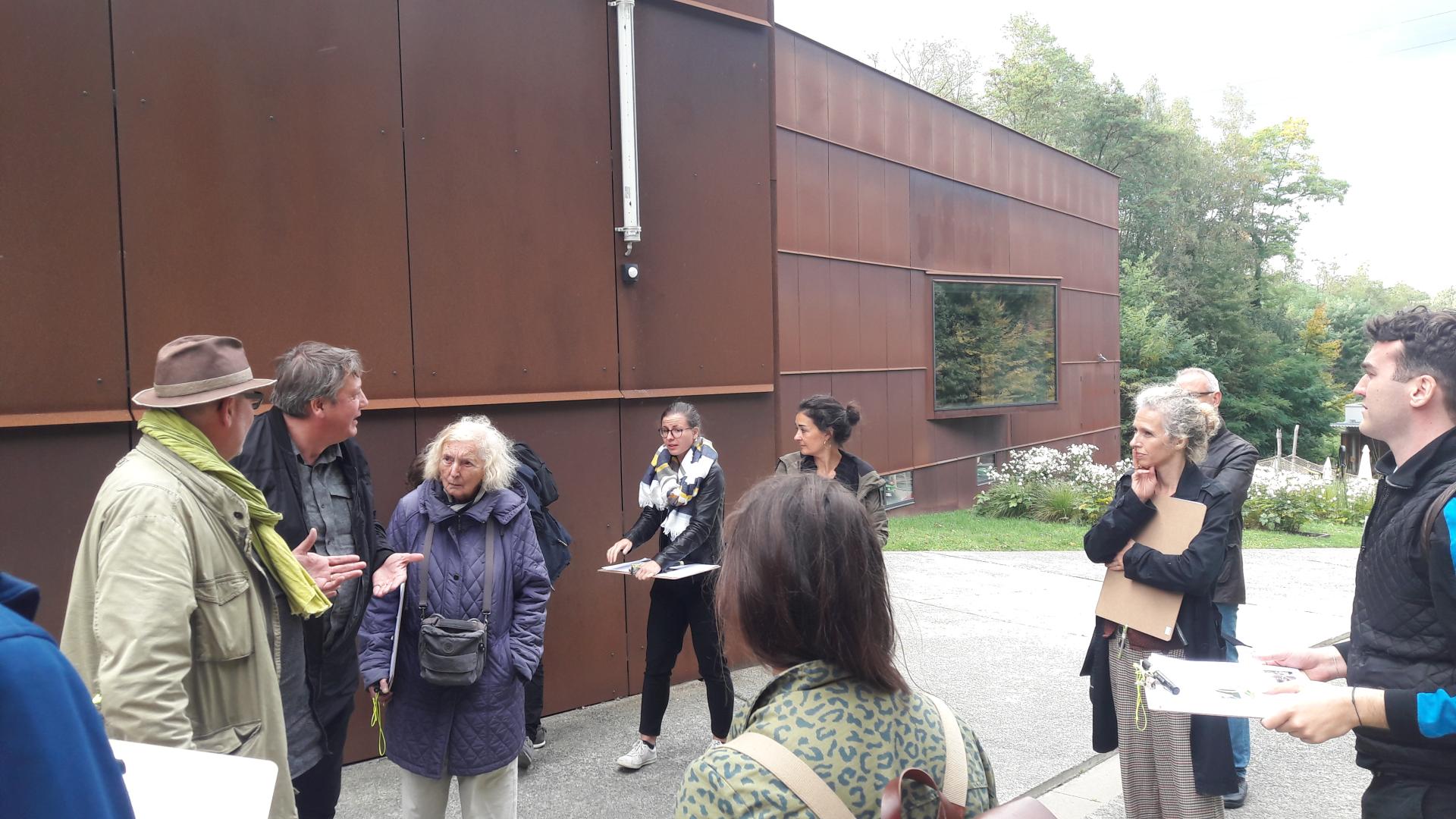
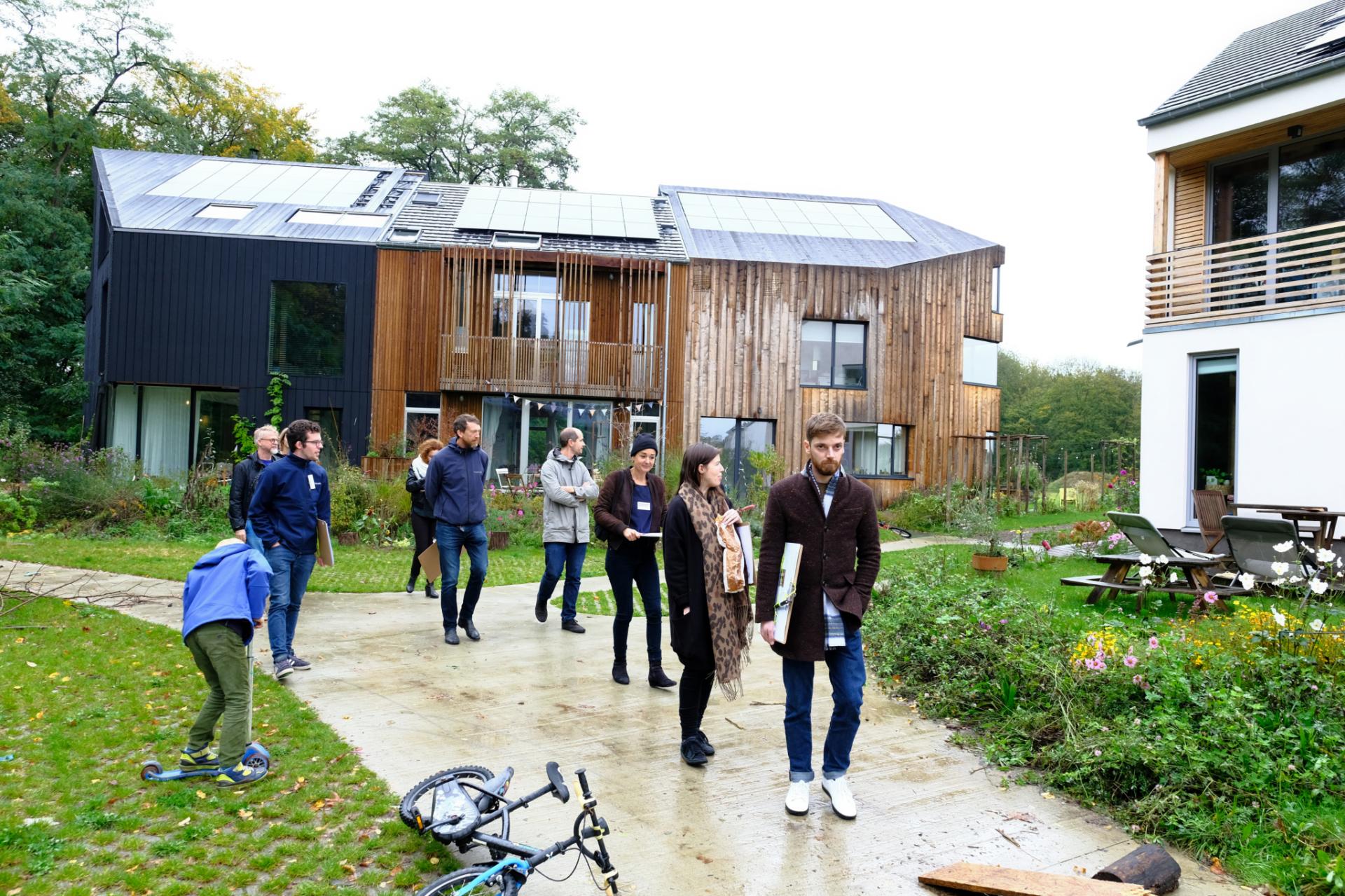
Equipped with a tour kit, each participant could easily explore, study and experience the architecture of the buildings in the inventory. We asked them to develop and transcribe an analytical and sensitive interpretation on the pages of the kit, with drawings, comments, or the recollection of a memory. We encouraged participants to go on at least three visits to sharpen their eyes, senses, and mind.
Back at camp: we would select the most powerful quotes and post them on the panels. These comments enriched or even contradicted the information we were given by the architects on their buildings. Each panel was designed by the graphic designer Nuno Pinto da Cruz and the Habitant·e·s des images as a mock-up of a double-page spread of the book. The camps were the live factory for the inventory, co-written with the architects and visitors. Along the way, we were crafting collective consciousness.
On the last day of the tour, a public deliberation was held. Armed with coloured stickers, everyone could leave their mark on the building that was the most aesthetic, the most societal, the most interesting in terms of governance, and the most environmentally friendly. The panels were adorned with colours indicating a preliminary trend even before the deliberation took place. Our guest expert would observe people’s reactions to prepare her/himself to facilitate the debate. Each construction was then debated. We invited visitors to defend their favourite building on the microphone. At the end, each person elected one, two or three favourites. A reception buffet rounded off the evening.
Innovative character
"No one is immune to architecture.
Everyone lives, works, studies, and travels in a three-dimensional world built by and for people. So how can we unveil this architectural knowledge accumulated over the course of our lives? How can we bring this natural knowledge and the insights of experts together to evaluate and decide on the architecture we want for the future world?
Convinced that this could not be done from a room, we vacated our offices and went out into the field. We then set up the conditions for the emergence of a critical in situ dialogue and to genuinely listen to the inhabitants-users.
We embarked on the adventure with Habitant·e·s des images, a collective of artists headed by Adèle Jacot and Mélanie Peduzzi. Together with the inhabitants of Brussels, they are responsible for the creation of significant micro-publications. Working together, with the contribution of our graphic designer Nuno Pinto da Cruz, we developed special participation tools for this collective inventory."
Gilles Debrun & Pauline La Boulaye
"Every aspect of this process was an invitation to meet, share, debate, and compare ideas. From the discussions between citizens and experts during end-of-camp sessions to the nal jury for the selection of the chosen projects, we have – once again – had to acknowledge that a so- called “high-quality” architectural space can never meet a univocal de nition, and that quality cannot be reduced to aesthetic concern or a technical prowess alone. It is only when architecture ees the exceptional dimension to assess the daily lives of citizens that it opens up the possibility of putting shared words on what we call high-quality architec- ture, thereby restoring this artform to its status of cultural asset and public good."
Bénédicte Linard, Minister for Culture & Chantal Dassonville, Deputy Executive Director Architecture Unit