Addaptable
Basic information
Project Title
Full project title
Category
Project Description
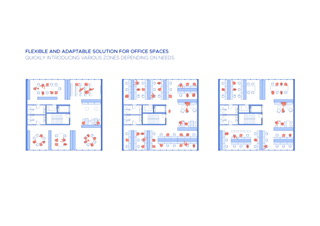
The Addaptable project is developed in response to the needs of modern society, based on the premise that better living does not necessarily mean using more space and resources, but rather optimising the use of available resources through flexibility. It explores adaptability in configurations of residential, commercial, educational and hospitality spaces in an inclusive environment. It relies on the analysis of various parameters to generate solutions through algorithmic processes.
Project Region
EU Programme or fund
Description of the project
Summary
The Addaptable project is based on the creation of flexible spaces for the housing sector, both owned and rented, residences, hotels, offices, educational, hospital or commercial buildings. It develops ideas of adaptability such as OpenBuilding, in the sense of creating a system of furniture and interior partitions of a dwelling that are built in a workshop and installed in dry construction in the building that serves as a support. The strategy is created in response to the needs of dynamic living groups that are increasingly common in modern society in these rapidly changing times. The aim of the project is to build an architecture that adapts to people considering all ages, varieties of family situations, cultural and/or functional diversities.
This adaptability is achieved in the spirit of sustainability, on the one hand by ensuring a long life span of the buildings without the need for renovations which are very energy and resource intense. In this respect, it is in line with the postulates of the circular economy. On the other hand, the materials used, and the processes of analysis and monitoring of environmental parameters ensure compliance with BREEAM strategies.
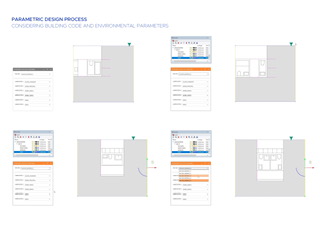
The design process is supported by computer tools for the generation of a multitude of possible configurations in an iterative process. The evaluation of solutions is based on input data obtained through analysis or simulation. This process helps to ensure optimal use of space and it is informative for both the architect and the user.
This parametric process is integrated with an extensive BIM database, which in turn allows for good coordination between the different entities involved in the production process and ensures maximum accuracy and speed of execution.
Key objectives for sustainability
The project was created on the basis of a main premise related to the OpenBuilding strategy, which is based on the separation of the support of the building from the infill made up of partitions, installations and furnishings. This creates buildings that are flexible in their function and the use is defined by the elements of the "infill" that are the focus of the project. Consequently, changes of use do not require interventions in the rigid part of the building (the support), extending its useful life and allowing for a reduction in the resources needed for construction, renovation or demolition.
The project follows the premises of the BREEAM strategy, which includes the reduction of resources for transport through the use of local materials, waste management (industrialisation and minimisation of traditional construction work), which also leads to a reduction in pollution. In addition, the flexibility of use allows better use of space and therefore reduces the surface area required, which leads to energy savings, especially in heating, air conditioning and lighting.
The integration of workplaces into dwellings or flexibility of building uses over time, leads to greater diversification of the urban fabric. It also enables frequent changes of users, favouring use over possession, leading to a more sustainable city, with better use and less traffic of people, resources and energy.
As a result, we achieve an absolutely sustainable development, with a zero-carbon footprint, and certifying the circular economy process, which is so needed in this type of product. Our firm is a certifying agent for all official sustainability processes. This helps us to find the best solutions to adopt from the initial design, which help the best development of the product, and consequently the final economic savings.
Key objectives for aesthetics and quality
The aesthetic experience with the Addaptable system begins in the design process, where the user is included in the choice of the wide catalogue of solutions and finishes to form the furniture and partitions of the house. Thanks to this, the product adapts not only to people's functional needs, but also to their personal tastes. Moreover, as it is a global solution, the aesthetics of the space is unified.
The materials used in the construction of the modules have numerous quality certificates, such as low volatile organic compounds VOC. Likewise, the high degree of industrialisation means a reduction in building execution times and greater perfection in the finishes, as industrialisation leads us to carry out this work in specialised, technologically advanced and robotised workshops.
During the design process, parameters such as natural lighting and ventilation are taken into account to ensure the best quality of the interior space. The close integration of the system with home automation applications allows these parameters to be monitored throughout the use of the product and changes to be made if necessary. Moreover, the mobility of the walls makes it possible to clear a large part of the surface, turning it into an open-plan space and enhancing people's well-being.
The product was developed using WELL certification, which is a dynamic scoring system for buildings and communities that identifies, measures and monitors the characteristics of built spaces that impact the health and well-being of occupants.
Key objectives for inclusion
Inclusivity is one of the key concepts in projects created for modern society and one that has been taken into account in the development of this product, working from two approaches. On the one hand, the flexibility of the housing configurations allows a multitude of different situations to be accommodated in the same space, such as single-parent families, large families, people living alone or with caregivers. In addition, the ease of adaptation of the system allows it to respond to temporary or unexpected situations, just as the automation of movement and the connection to the home automation application allows easy use even by people with functional diversities.
Better incorporation of workspaces in housing helps to combine work and family care and the flexibility in the dimensions of the rooms, especially those dedicated to the reproductive cycle (kitchen, bathroom, laundry area, etc.) allows them to be large enough for several people, limiting the isolation of people who dedicate themselves to reproductive tasks, which is another step towards a society with full gender equality.
On the other hand, reducing the amount of space required reduces the costs of purchasing and maintaining a property. Additionally, one of our target clients are developers of high-turnover rental buildings, where flexibility helps to maintain high occupancy and reduce rental costs. Equally important, a catalogue of furniture modules and partitions was created in a variety of standards and finishing levels, allowing to adjust to the different purchasing power of families. All this affects the creation of more accessible housing for all social groups, including immigrants.
Results in relation to category
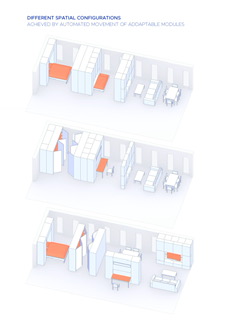
The Addaptable project provides a solution to the demand for flexibility in housing, increased and evidenced in recent years. The modular solution of furniture and movable partitions allows a much higher degree of adaptability than traditional housing. Its automated movement system makes it possible to switch quickly and easily between different configurations to respond to the real and changing needs of each cohabitation group, such as single-parent families, people who stay alone at the house, large families or situations of care for the elderly or disabled. In addition, the spatial flexibility over time allows work spaces to be incorporated into the house if necessary. It is an architecture adapted to people.
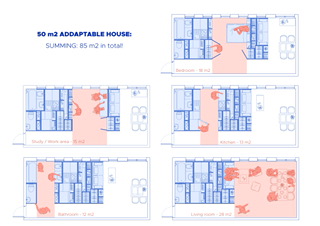
The addaptable system helps to make the best use of space, allowing to achieve in an exemplary 50m2 house: a living room of up to 28m2, a bedroom of 18m2, an office or second bedroom of 15m2, a kitchen of 13m2 and a bathroom of 12m2, which separately would add up to 85m2.
Furthermore, the product is of great use in dynamic residential environments, such as high-turnover rental housing or student residences. In these cases the room sizes can be varied thanks to the movable partitions, ensuring the highest possible occupancy at all times.
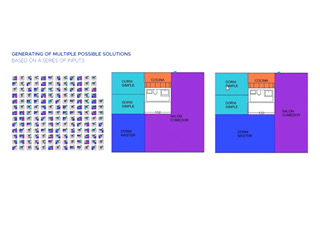
The configurations used in each case are generated through a parametric and iterative design process, in which a multitude of possible solutions are continuously generated and evaluated based on different parameters such as: environmental (sunlight, ventilation), usage (people flows) and social (end-user input).
Simultaneously, the product is being developed for other sectors, such as education, hospitality, commercial, etc.
How Citizens benefit
The parametric design process is based on the generation of a multitude of configurations and their evaluation based on a set of parameters. The customer is included both in the establishment of the important parameters and in the evaluation of the results. This guarantees a product tailored to the user's needs as closely as possible.
Throughout its lifetime, the system allows for changes in the previously programmed configurations, but also allows for replacement of building elements or partitions and changes in programming to allow for new configurations adapted to changing needs over time. This is especially important in rental situations, where the end user is often not present in the design process and where design decisions are made based on market research and input from the first users.
In addition to adapting the different spatial configurations, the modules themselves exist in a multitude of variations to suit the varied needs of customers. There is a catalogue of manufactured modules described in detail and controlled through the BIM system, where dimensional product varieties are included (e.g. double beds of 140, 150 and 160 cm width, wardrobes and desks of different dimensions). Moreover, several standards have been created within the same project, including finishes and automation systems of different price levels. The end customer can choose from this variety during the design process.
The software tools used in the architect's design process also serve to inform the users of the various possibilities of use of the available space, just as the client's input influences the architect's decision making.
Innovative character
Innovation in the Addapdable strategy begins in the design process, based on the creation of a multitude of possible solutions thanks to computer processes with the use of visual programming. This process is based on data such as the geometry of the building, the contributions of users, current regulations, and the results of studies of sunlight, energy flows, or movement of people obtained through computer simulation. The different solutions are then evaluated, always with the help of computer tools that can handle a large number of databases.
The chosen configurations are programmed in the domotic application to allow automated switching between them. For this purpose, a domotic application system is used, which also allows the Addaptable system to be coupled to any person thanks to voice control, a mobile app or an adapted controller. In addition, this solution allows the product to be equipped with presence detection systems, built-in smoke sensors, etc., which not only allows to receive inputs on the usefulness of the configurations for continuous adaptation, but also creates a much safer environment.
Finally, the disruptive character of the project is based on the development of a highly industrialised production process, in which various parties involved are coordinated through BIM methodology and where a high degree of customisation is ensured thanks to parametric tools such as Grasshopper.