KARTING
Basic information
Project Title
Full project title
Category
Project Description
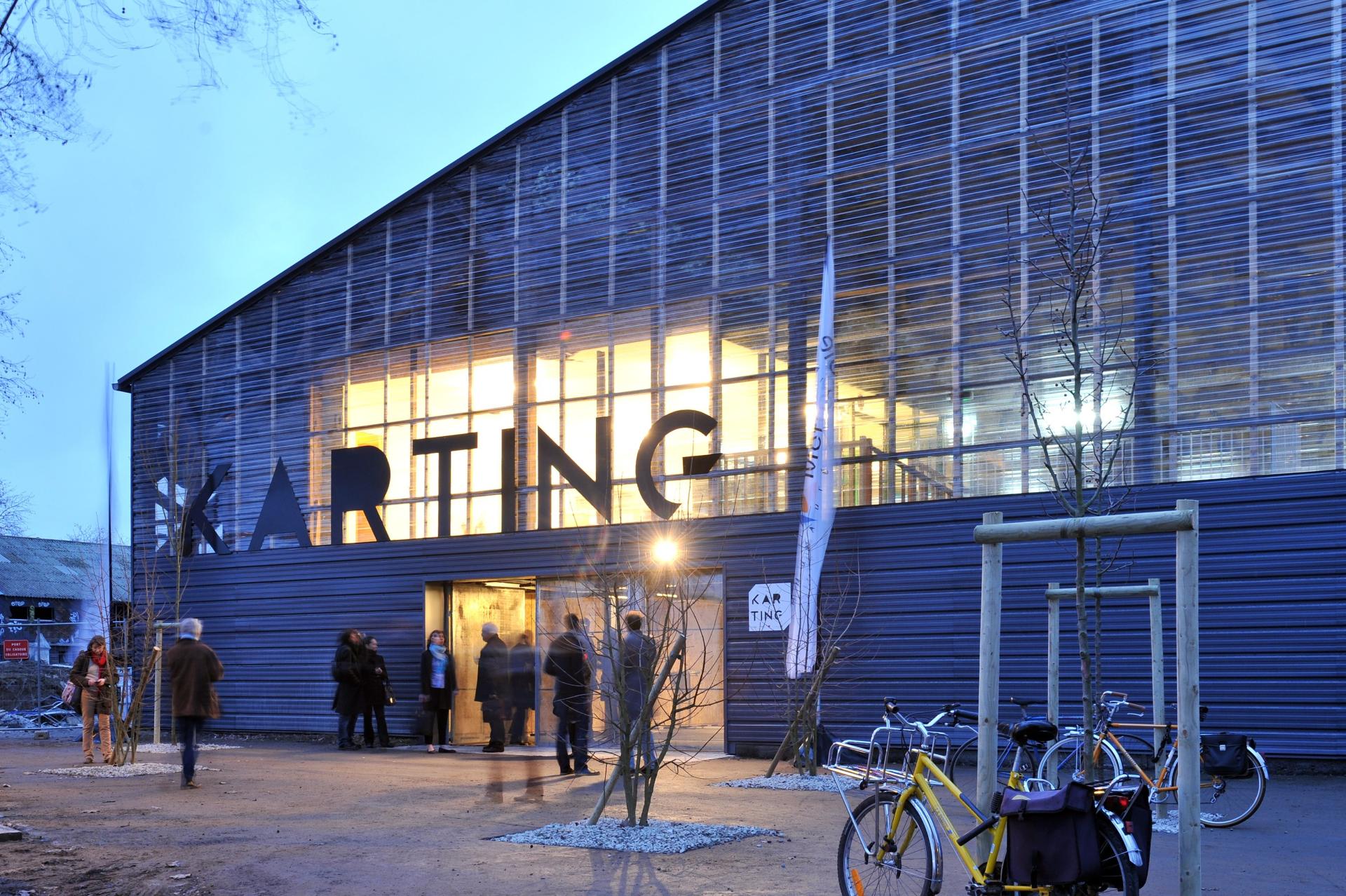
KARTING is an eco-concept for creative startups based on the rehabilitation of a vacant indoor kart-racing track. Two guiding principles led this temporary use project: high sustainability requirements and controlled exit prices. A “minimal design” concept was developed to achieve these objectives, allowing modular, affordable and below-market price office spaces for young artists and entrepreneurs. KARTING hosts around 40 creative startups and collectives each year.
Project Region
EU Programme or fund
Description of the project
Summary
KARTING is an eco-concept for creative startups and collectives. It was developed as part of the temporary use strategy led by SAMOA, urban planner and creative developer of the île de Nantes in the city of Nantes. Based on a vacant indoor kart-racing track, the KARTING temporary use project aims at supporting cultural and creative sectors with affordable and modular spaces, mobilizing the local wood sector and reactivating a deserted area before the final urban masterplan is defined.
KARTING was developed by SAMOA in 2012 along two guiding principles: ecological requirements and controlled exit prices. It was lightly rehabilitated in order to maintain affordable renting prices and the viable exploitation of the building for a period of at least 10 years. The concept was based on “minimal design” to minimize non-essential intervention on construction materials and limit waste production. The project also relied on local production and distribution chains.
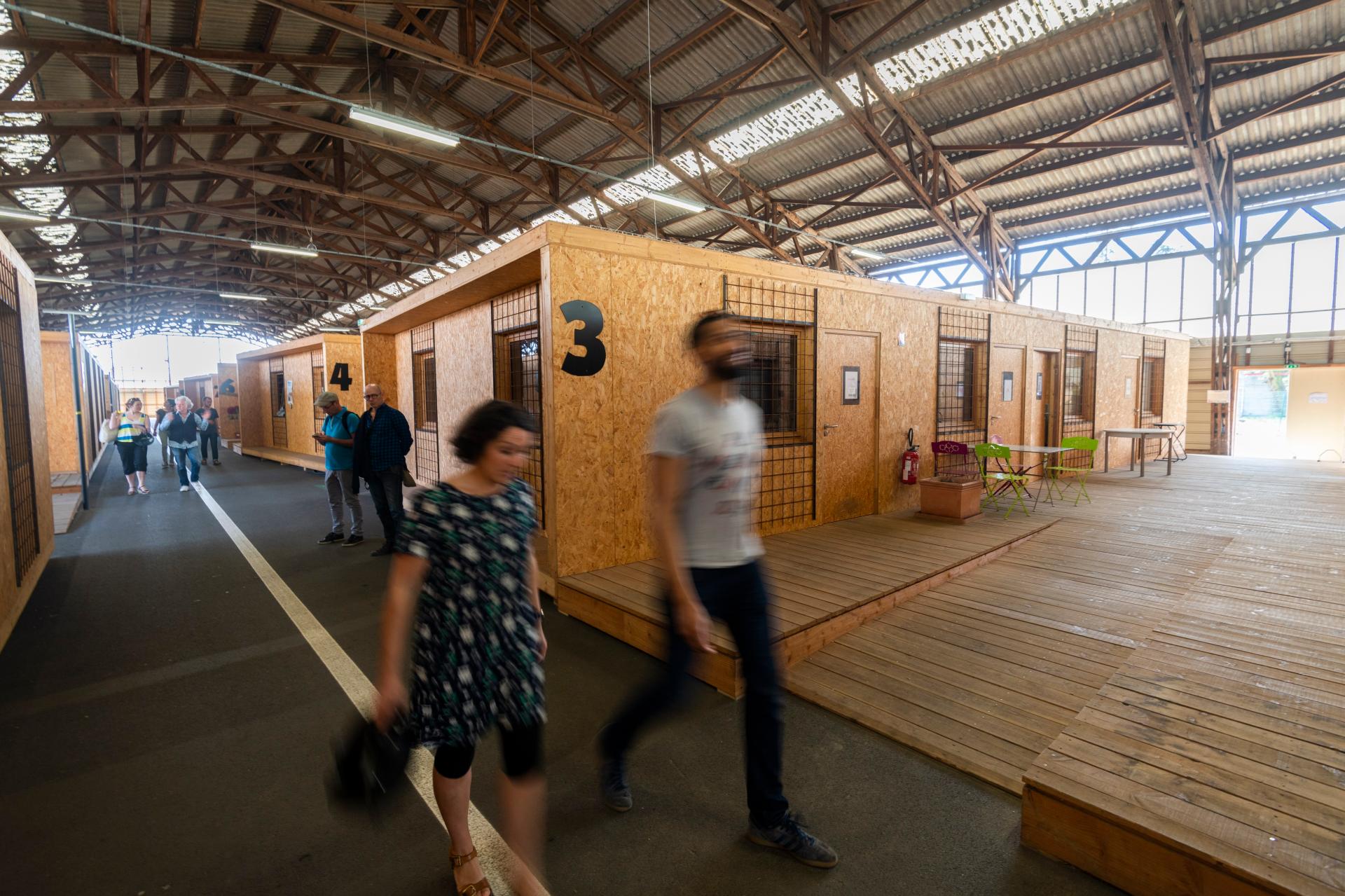
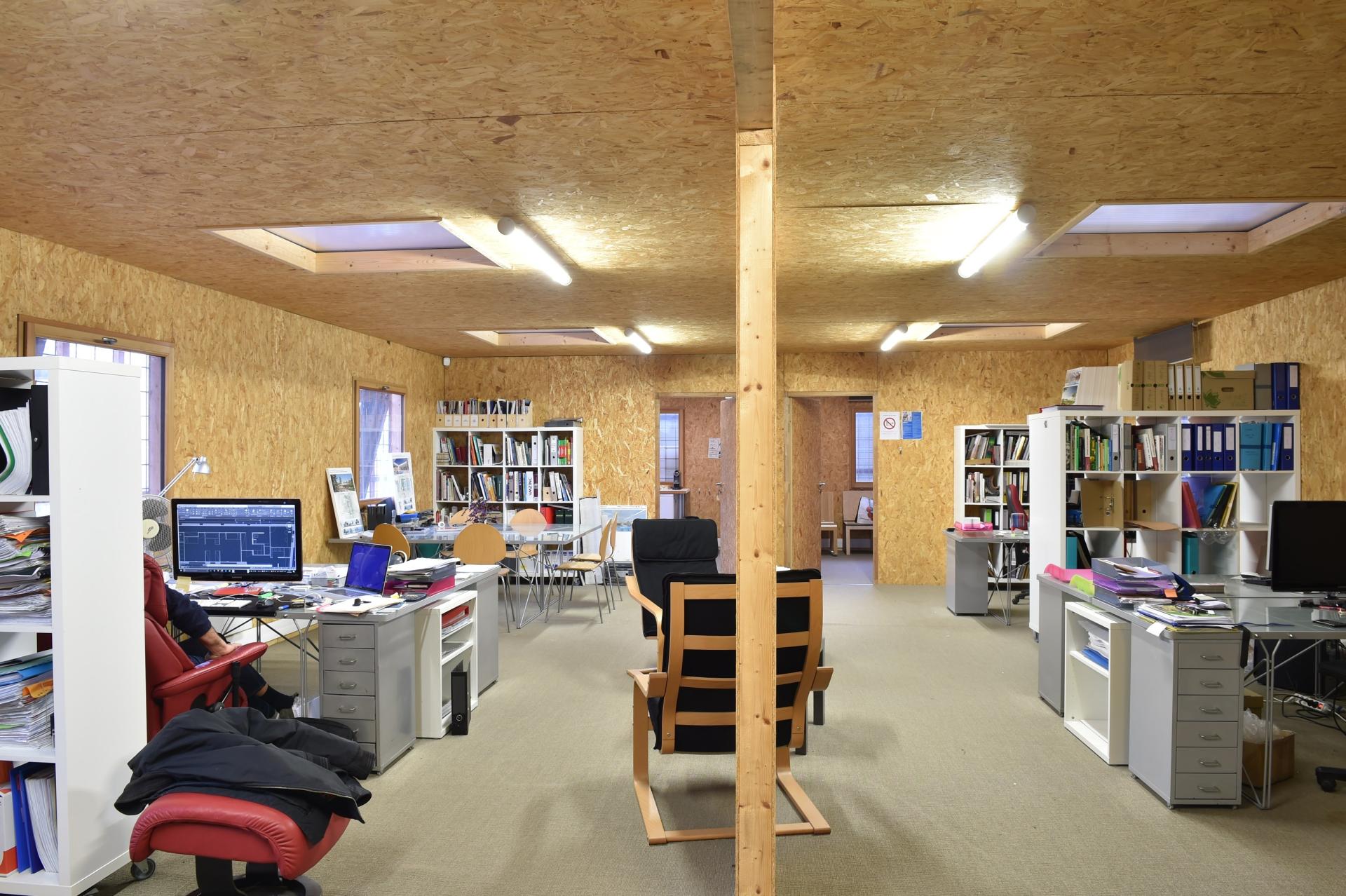
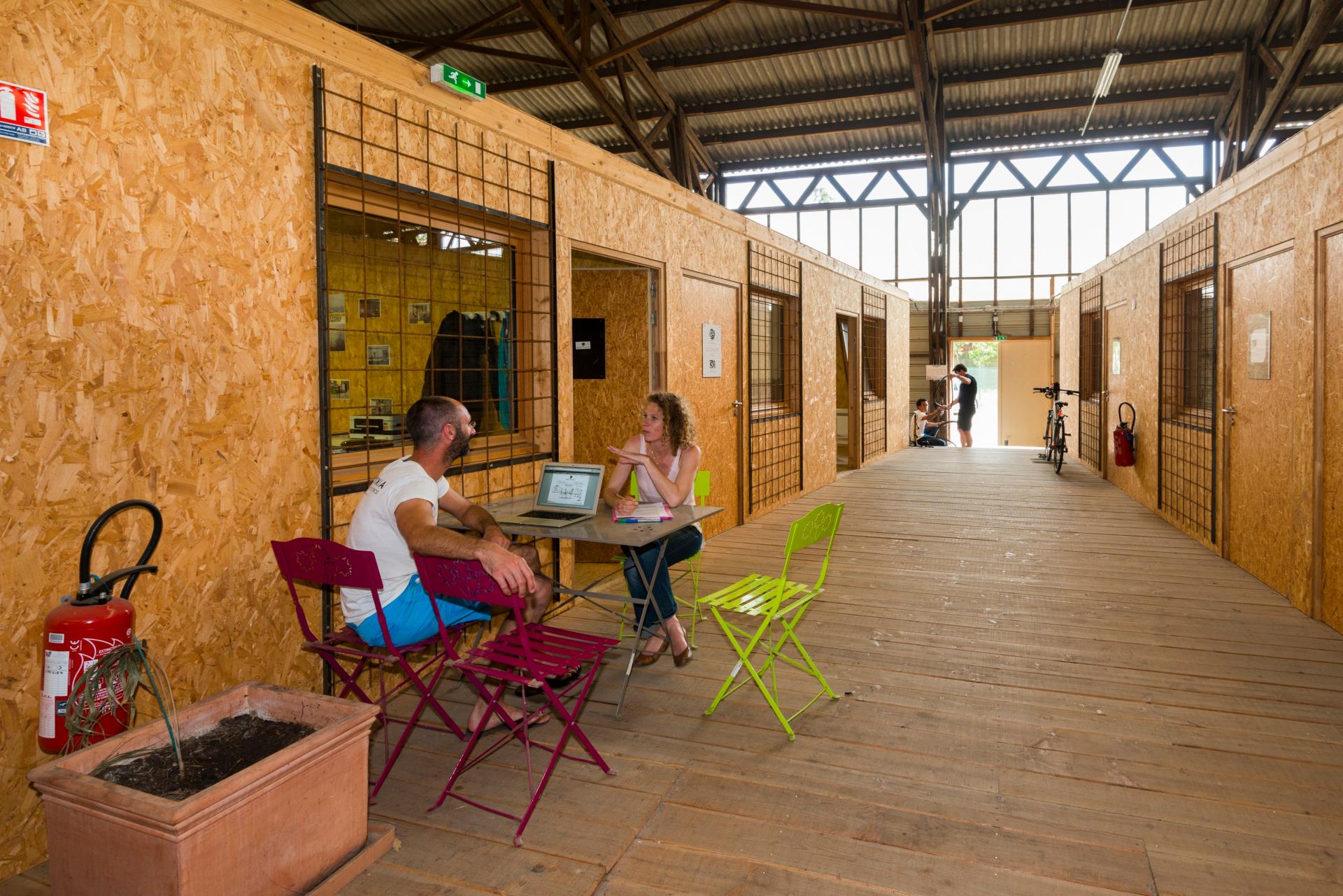
A wooden and modular office space prototype developed by Jean-Louis Berthomieu was conceptualized in KARTING as N.O.W – New Office Workshop. 12 NOW modules from 12 to 96m2 were installed and host around 150 jobs in the cultural and creative sectors.
Key objectives for sustainability
KARTING combines sustainability and controlled exit prices.
KARTING is part of the temporary use strategy that SAMOA has been developing for more than 20 years. Benefiting from a transitional period before the development of the final urban masterplan on the western point of the île de Nantes, SAMOA has established a sustainable and integrated management of industrial brownfields based on temporary use to reactivate abandoned areas and support the economic development of local creative ecosystems. This transition allows a temporary recycling of land, prevents unnecessary demolition or site security and allows for the testing of new city uses. It stands as a strong alternative to urban spread.
The applied method of light refurbishment guarantees a virtuous construction site in terms of energy sobriety. Minor but precise interventions were carried out on the building, openings in the cladding and a transparent envelope to filter natural light. The thick layer of moss on the roof was preserved to maintain a green roof.
Developed by the team Less is more, Essentiel, O&J and Axe 303, the modular office space concept, N.O.W – New Office Workshop, is based on a “minimal design”, providing a preliminary drawing as precise as possible to minimise intervention on construction materials and waste production. NOW was designed as an affordable solution to combine a response for vacant buildings waiting for new uses and affordable office space demand in the creative sectors. They are highly modular, perfectly insulated and can be easily dismantled and reassembled. The team enabled all construction materials for a NOW module to be entirely carried on a single semi-trailer truck, promoting high levels of rationality and sobriety.
The construction materials for the modular office boxes N.O.W were issued from a local distribution cycle, relying on proximity, the exploitation of the regional forests and supporting the local wood economic sector (via the Atlanbois association).
Key objectives for aesthetics and quality
The objectives of the project in terms of aesthetics and quality of experience were to combine design simplicity and reduced construction costs, while keeping high safety and comfort requirements.
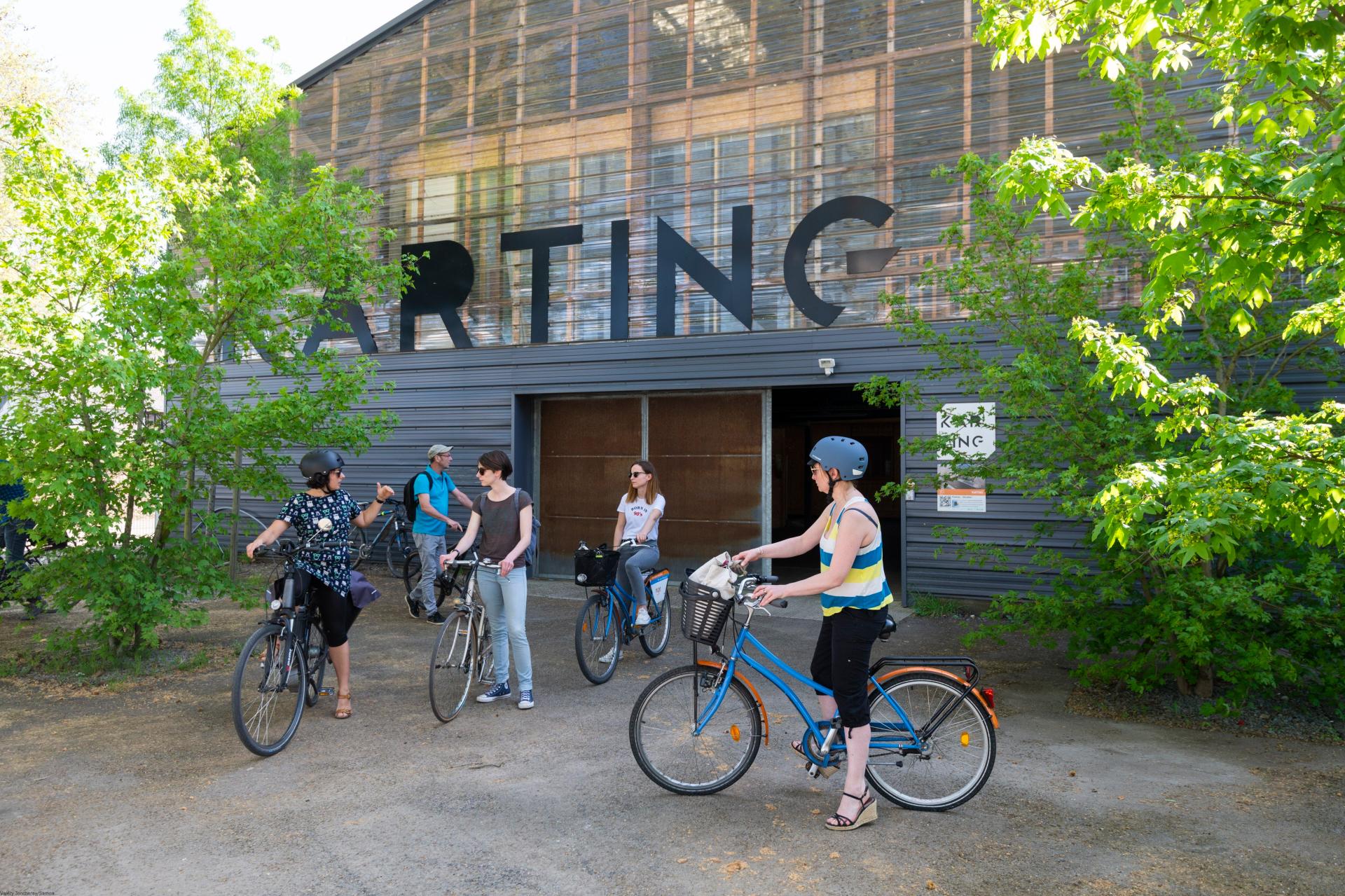
The general ensemble was largely preserved in its industrial aesthetics and the use of raw materials. This gives the KARTING project a specific visual identity and the memory of its prior affectation. It also gives a strong sense of belonging and a common label for the enterprises and collectives renting spaces.
The central modular aspect of the concept favours mutualisation of space and the evolution of the size of the enterprises along their economic growth. This adaptable and flexible vision of work inspired the design, aesthetics and quality of the office spaces.
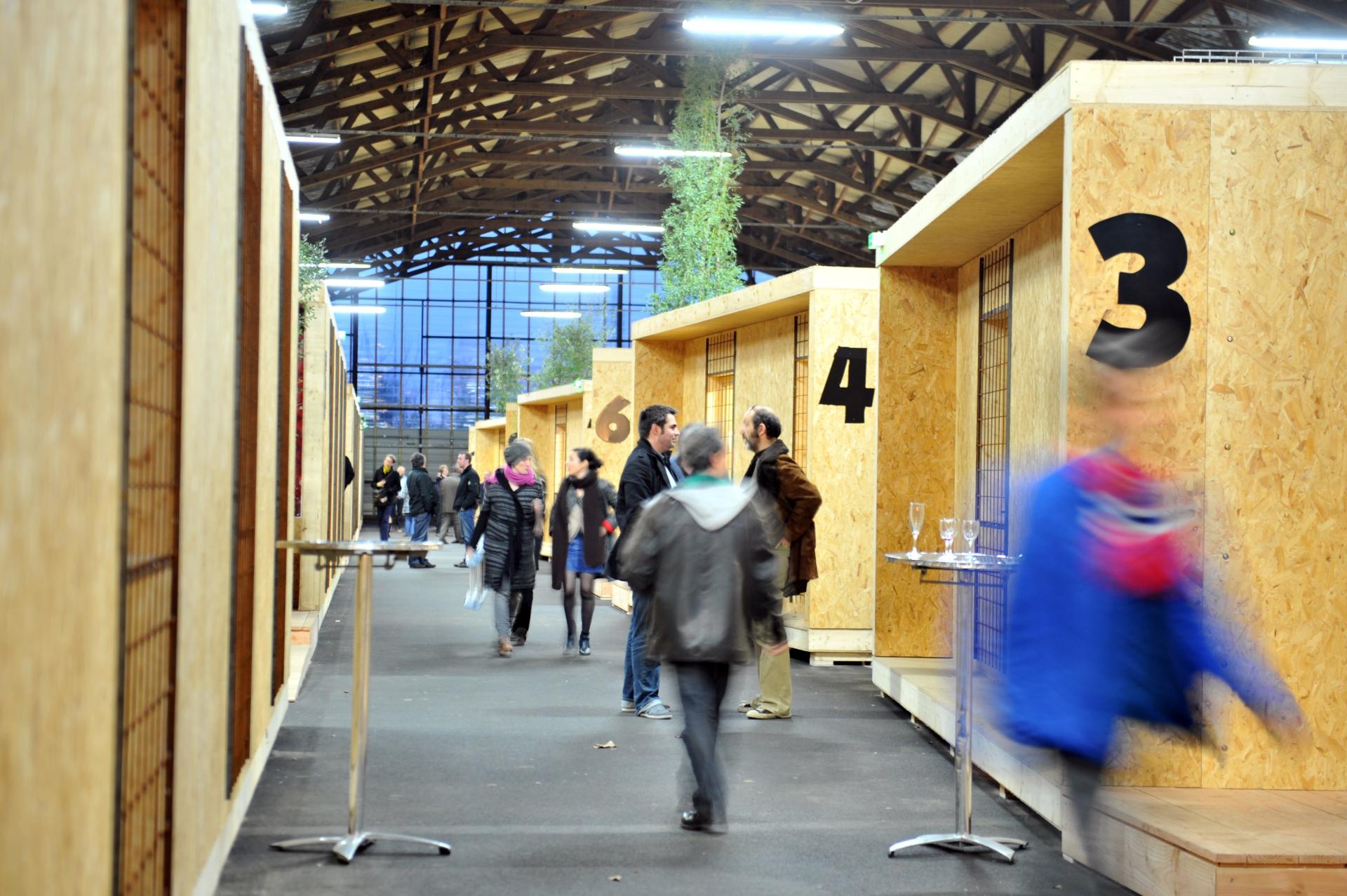
The implantation of the modules is organized exclusively on the ground-floor. It allows for lower costs, a sense of space and the development of larger sheltered spaces favouring interrelations between people. The modules were organized so as the have streets effect, with a sense of perspective inspired by Italian streets, allowing vis-à-vis and the view of all front doors. A well-thought signage highlights the effect. A second floor is available with 3 meeting rooms.
Beyond offering office space to the cultural and creative sectors, KARTING is organized around 3 main functions: working, interrelations, and the free use of unbuilt spaces for friendly and convivial moments. Anyone can freely use their office, the terrasses in between modules and the open areas can be invested (exhibition, professional meetings, cocktails). It can be qualified as a “third-place” space. KARTING also promotes a clustering effect allowing for the constitution of ecosystems and favouring creative friction. SAMOA provides animation to foster this clustering effect.
Key objectives for inclusion
The concept is based on the observation that many industrial brownfields are available in European cities and that there is a high demand for affordable small-scale office spaces. The SAMOA is able to provide a response through a real-estate offer below market price allowing hundreds of artists, NGOs and startups to access spaces suitable for their needs and resources. It specifically supports young creatives at the beginning of their entrepreneurial careers and artists that often struggle to find affordable creation spaces in city centres.
Through minimal intervention to rehabilitate brownfields, SAMOA is able to secure below-market price renting costs: 150€/m²/year all inclusive. This is usually one of the strongest barriers for young creative entrepreneurs to start their activities, so this proves a strong offer to help develop a strong cultural and creative ecosystem, as has been proved in the city of Nantes, fertile land for these sectors.
Temporary use of brownfields also helps to reactivate and dynamize deserted areas. Before the final masterplan is carried out for the long-term rehabilitation of the area, enterprises, civil society and citizens are driven to come back to such places, create and test new city uses, participate to events and rediscover the area. New uses based on temporary use practice are incorporated in the evolving masterplan of the urban project of the île de Nantes.
Results in relation to category
The strength of the project lies on the modular concept N.O.W – New Office Workshop and a minimal design development.
The modular concept provides:
- Surfaces evolving from 12 to 96m2, tailored to the needs of the renting innovative startups in the creative sector. The average turnover is around 3 years, with a few enterprises going from 12 to 96m2 before leaving for other market offer.
- A reduced project economy: construction costs (600€/m2 for the modules + 90€/m2 for the building)
- A rapid implementation of the project (fast to deploy with the prior production of precast modules)
Using assembling panels provided extremely economic and rational transport solutions: an entire module can be fully carried on a single semi-trailer truck.
The modules offer:
- An innovative assembling process guaranteeing, between panels, the continuity of the vapour sealing layer and rain screen
- The conception of modular organization of indoor partitioning and potential for outdoor extension
- To develop the local wood sector for the production of wall, floor and roof panels assembled on site. They guarantee perfect air-tightness to control energy consumption.
The simplicity of the building process and the minimum intervention on the existing structure guaranteed a rapid development of the operation. Since 2012, there is an annual 98% average occupancy rate and a permanent waiting list. Other temporary use sites have been developed since then and are still not in the capacity to accommodate all demands.
How Citizens benefit
As part of a temporary use strategy, the development of the KARTING project helped redynamize a deserted area in very close proximity to the city centre, previously home to industrial activities and turned into a vast brownfield since the 1990s. The development of a creative economy hub in this area helped citizens rediscover the neighbourhood and reactivate the space.
Since the development of KARTING, two other close neighbouring spaces were redeveloped in the same fashion: SOLILAB, a temporary use project for 150 social and solidarity economy enterprises and NGOs, and CHAPIDOCK, a centre for amateur and professional circus practices. This regrouping of new activities has turned this previously unsafe area into family-friendly, creative and vibrant spot with events attracting hundreds of visitors and workers.
These spaces were all developed with an intense participation of the end-users so as to be adapted to their needs. The people working in these spaces were also involved in the design of the public spaces in the area and the definition of the final urban masterplan. Several experimentations were tested on these sites dealing with a variety of topics and closely involving the workers on site: urban mobility (bike safety boxes, solar bike inflation station), energy (modular solar panels) or well-being.
Innovative character
Temporary use in now widely developed throughout Europe for the multiple benefits it allows but SAMOA has managed to organize an integrated offer based on the KARTING experience:
- Light rehabilitation of industrial or commercial brownfields
- Use of modular spaces as an answer for a need in small and flexible office spaces
- Integrated offer at fixed rates to support the development of young creative entrepreneurs
The NOW modules in themselves are highly innovative as they can be specifically and standardly used for brownfield reuse. They provide fast depreciation in investment and management costs.
They are adaptable and can answer the flexibility needs for innovative startups that start small and can grow rapidly. They can be developed for indoor or outdoor installation, for office space as well as housing spaces.
They can be easily transferrable and replicable in any urban environment and have the necessary technical requirement to be deployed in series production. They offer an economic and sustainable solution and help dynamize local wood sectors.