BEEHIVE: Smart modular monitoring system
Basic information
Project Title
Full project title
Category
Project Description
Beehive mission is to provide high-tech solutions to improve sustainability and safety in existing constructions while financing and collaborating with research for a continued enhancement of the built stock. Beehive offers modular wireless sensing networks that eliminate the problem of cables while caring about the aesthetics and affordability of the products, thus offering a solution that is adoptable by a wide range of clients, from private house-owners to managers of public infrastructures.
Project Region
EU Programme or fund
Description of the project
Summary
Structural Health Monitoring (SHM) and Indoor Environmental Monitoring (IEM) are emerging as useful new fields in civil engineering.
SHM aims to provide information on the health conditions and performance of structures (i.e., buildings and infrastructures) over time. It has gained popularity as a supporting tool in structural integrity management due to the increasing number of structures reaching their design life, the need to optimize the allocation of economic resources, and the increasing number and intensity of natural calamities related to climate change. On the other hand, IEM is employed to guarantee indoor comfort, safe conditions for users’ health, and an energy-efficient use of heating and air conditioning systems.
Although SHM and IEM are often performed at the same site, they are usually designed as separate systems, hindering data management and interpretation. Beehive is an innovative IoT system that integrates SHM and IEM, leveraging the possibilities offered by wireless communication and the flexibility of the data processing embedded computing module. Wireless technology eliminates the problems traditional cable set-ups entail and optimizes power by onboard data filtering and compression before transmission. What is more, Beehive provides the client with flexible real-time data monitoring through platform-independent web apps. Beehive is a modular solution, meaning that each node of the system is made of modular sensing components, thus offering tailored solutions for the client's specific needs.
Beehive's mission is to provide smart technology to enhance sustainability and safety in existing constructions while offering a solution that adds aesthetic value to architectural surfaces. Hence, differently from traditional solutions that are hidden, Beehive is designed to be shown.
Key objectives for sustainability
The building sector was identified in 2017 as the largest single energy consumer in Europe, with 40% of the total energy use. Given that 75% of the existing stock is energy inefficient and that a very small percentage (0.4-1.2%) of it is renovated each year, existing buildings offer vast potential for energy use reduction, which the EU is indeed heading to with the ‘renovation wave’ initiative introduced with the European Green Deal.
In this context, IEM helps to define which buildings are not offering comfortable indoor conditions and need to be refurbished; furthermore, it provides valuable data for helping an informed decision on the best interventions to adopt for thermal retrofits. Besides, it can be adopted in combination with smart heating and air conditioning systems to reduce energy consumption by adopting dynamic set-points and adaptive thermal comfort models.
What is more, beyond the opportunity for energy savings, an informed choice of the retrofit interventions, based on indoor environmental data, can improve indoor comfort while lowering operational costs, factors that are fundamental to ensure the continued use of existing constructions over time, and, with that, improving their preservation and durability. Moreover, keeping structures (buildings and infrastructures) monitored gives valuable information on the safety of constructions and the need to rehabilitate them, thus providing safe built spaces.
Overall, offering largely adaptable monitoring systems plays a crucial role in sustainable development. Indeed, it allows keeping controlled the built stock, indicating when retrofits are needed and helping designers to make correct choices to keep these buildings comfortable and safe. Consequently, it reduces the need for new constructions, with all the emissions that building them would entail.
Key objectives for aesthetics and quality
Most existing monitoring systems do not offer pleasant aesthetics and need cables that strongly impact the perception of spaces if not carefully hidden. The idea of Beehive is, first and foremost, to offer a new high-tech technology based on wireless communication that does eliminate the problem of cables. Also, great attention is given to the visual impact of the product and its parts, aiming at offering a solution that does not need to be hidden but, on the contrary, is designed to be shown because of the added aesthetic value it brings to architectural surfaces.
Beehive differentiates itself from other solutions because of the care given to the overall design and the attention put on offering a system with a moderate thickness. In this way, the system is suitable for being placed on walls like a decoration, creating a modern pattern that proposes itself as a contemporary high-tech canvas.
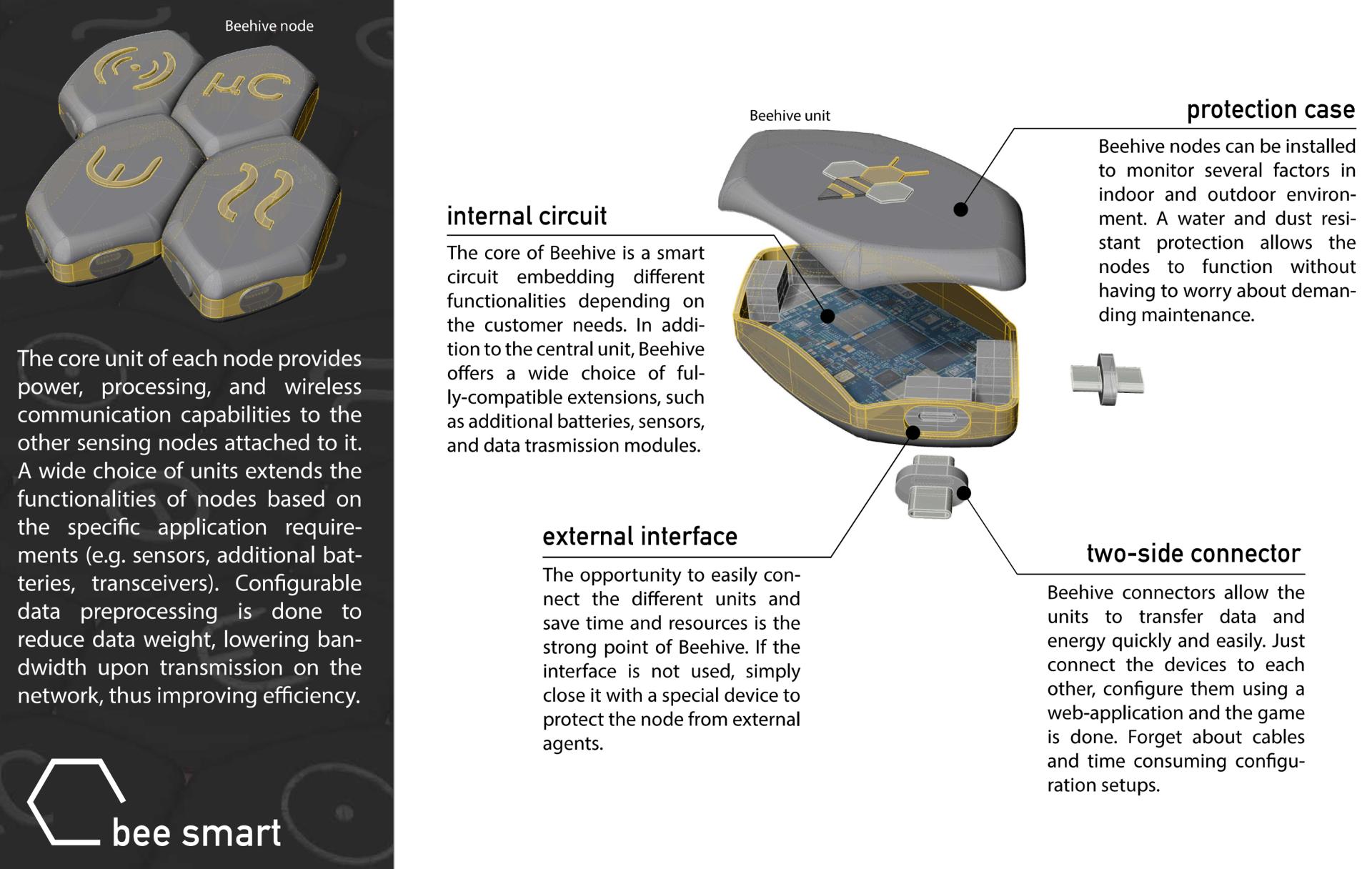
More in detail, Beehive sensing devices are made of modular hexagonal components, each containing a different electronic apparatus (namely, different types of sensors, the wireless transmission module, the battery module). In this way, solutions are very flexible and customizable according to clients' needs. Each module is studied in its material, texture, and dimensions, while the overall composition of elements aims at providing symmetry, balance, and unity based on the application architectural context. In this way, Beehive offers a pleasant addition to walls, catching the users' eyes and indicating that the space is healthy, safe, and monitored for their benefit.
The complexity of joining technological and visual design is researched along the whole project by collaborating with a heterogeneous team of architects, electronics and civil engineers.
Key objectives for inclusion
SHM and IEM are worldwide adopted for the management and maintenance of existing constructions. SHM systems are applied to different types of civil structures in the last decades, such as bridges, tunnels, dams, strategic buildings, and historical constructions. The information collected by SHM allows performing condition-based management of structures and supporting emergency operations in the aftermath of a damaging event. Whereas, IEM is employed in public and private sectors to reduce health-related hazards (air pollutants and smoke), lower down operational costs (optimized use of HVAC systems and correct design of retrofits), and guarantee indoor comfort (e.g., in offices, public buildings, houses, and hospitality industry).
Beehive combines the two monitoring systems in an aesthetically pleasing and much more affordable solution than traditional ones, thanks to the technology adopted and the modularity of the design. What is more, Beehive offers to its clients user-friendly apps that provide immediate understandability of the main results obtained in the monitoring process. Thanks to these characteristics, beehive aims to bring SHM and IEM in a large share of buildings, and not anymore only in infrastructures and monumental buildings, thus providing whole citizens with the opportunity to keep living-working-learning spaces safe and healthy.
Innovative character
Commercial solutions for SHM and IEM rely on wired devices and traditional batch algorithms. Due to the promising results of intensive research activities, innovative solutions are stepping into the market, providing wireless networks. Nonetheless, little space has been given to solutions that efficiently combine them, which is one of the innovations introduced by Beehive.
Also, commercial systems are mainly based on wireless adaptations of traditional technologies, thus preserving critical issues (e.g., design complexity, limited services). Indeed, traditional algorithms do not allow for network flexibility and allocate most resources on network design and support instrumentation. On the contrary, Beehive consists of a set of devices and services tailored to a wide palette of specific needs. The elements of the network (physical devices and operative algorithms) are modular and fully compatible with each other to provide specific solutions while minimizing the design effort. Embedded computing and wireless transmission enable decentralized processing of collected data, smoothing the process.
The system consists of groups of hexagonal units connected to form nodes with sensing capabilities. Different nodes of units communicate wirelessly (mesh/star network configuration), conveying heterogeneous data to a remote processing point. The core unit of each node provides power, processing, and wireless communication capabilities to the other sensing units attached to it. A wide choice of units extends the functionalities of the node based on the specific application requirements (e.g., sensors, additional batteries, transceivers). Configurable data preprocessing is performed to reduce data, lowering bandwidth upon transmission on the network, thus improving power figures. Data is taken to a central processing node that logs locally into a mass memory or transmits to a remote endpoint (IoT).