Color Replacement
Basic information
Project Title
Full project title
Category
Project Description
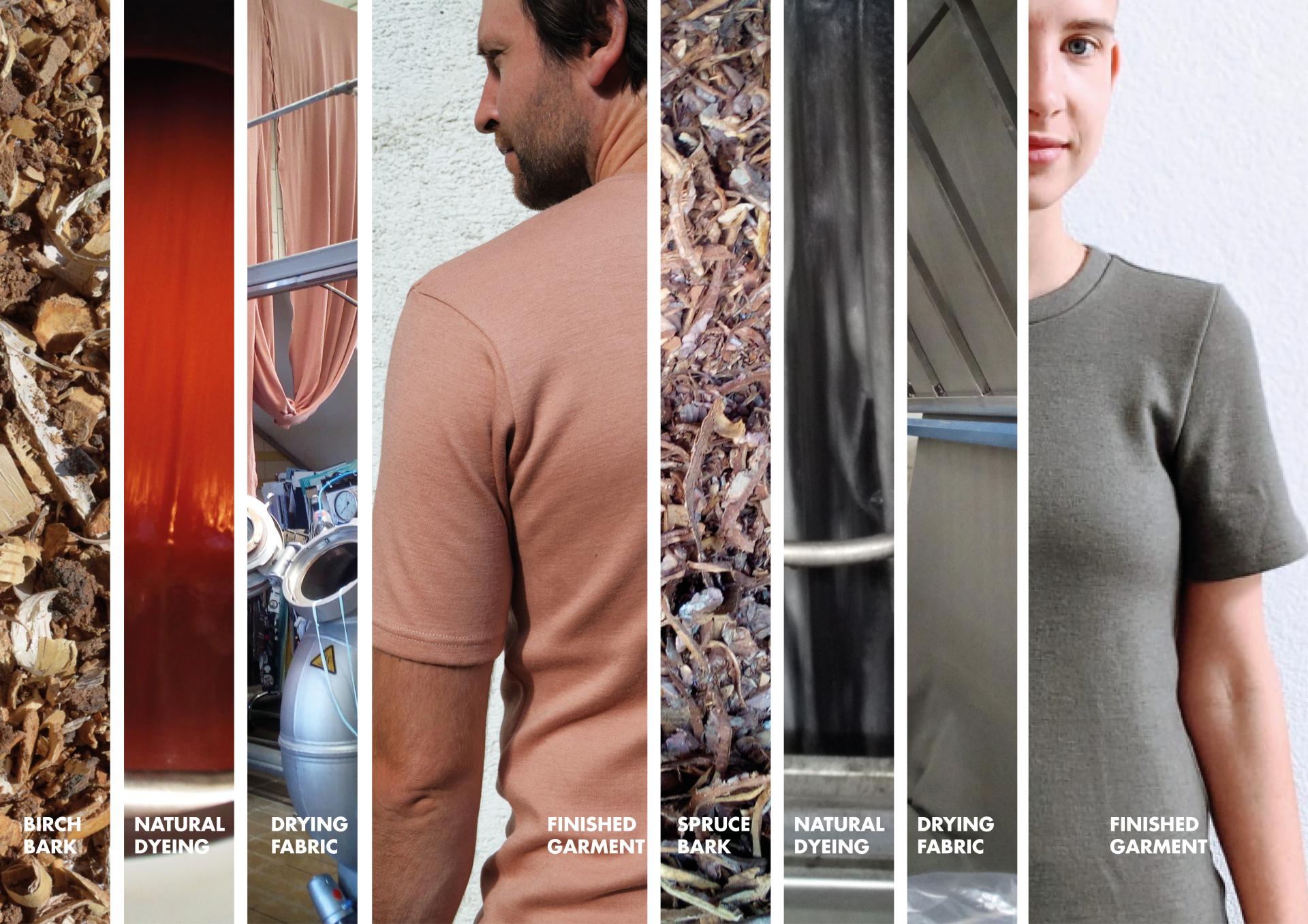
Let’s rethink fashion! An alternative dyeing method with native plants and a possible scalability for industry usage was explored within a small series of woolen T-shirts. Starting with the regional sourcing of dyeing materials, through the dyeing process in an industrial setting, to cutting and sewing actual garments. An attached user study guides participants to reflect on these natural-dyed garments through experiencing them on their own bodies.
Project Region
EU Programme or fund
Description of the project
Summary
Nature shows us the most beautiful colors every day. But how do we color the world of the clothes we wear directly on our skin? With the onset of industrialization and the advent of synthetic dyes, the traditional dyeing of textiles with plant dyes has slowly been forgotten and displaced in niches. Nowadays, scientists have reprocessed this knowledge of natural dyes so that it could also be applied within an industrial production chain. In the quest for more sustainable production, plant dyeing could thus become a potential alternative. Because the fashion world is currently trying to create exactly this image transfer towards more renewable and less environmentally harmful materials and production processes that are fair for both people and the planet. Nevertheless, there is still little or no natural dyeing done on an industrial level. Could this be only because companies think that plant-dyed textiles are unreasonable for their consumers?
According to these considerations, I have dyed about 50 m of fabric with local plant dyes and used them to produce exemplary garments for a user study. The central question was if test subjects get used to the alternatively dyed materials and recognize a greater value in this type of dyeing, even if it may change throughout use or the clothes may have to be cared for differently? Through a questionnaire I tried to find out how users get along with the given clothes, whether the knowledge about the sustainable production process has a positive effect on the appreciation of the clothes or how it generally feels to wear clothes dyed by plants.
Key objectives for sustainability
Reflecting on the terms of sustainability – let’s face it: the most environmentally friendly garment is NO additional garment at all. Nevertheless, we cannot completely stop the production of clothing forever, and we don’t want to give up the consumption of well-designed fashion. A focus in the future must therefore be on international regulations, durability in materiality, promoting a „new“ value of garments for their users and a reduction of the harmful environmental impact in the production process.
Dyeing and chemical finishing processes in clothing productions are still considered filthy. This problem is exacerbated by the lack of adequate wastewater treatment in the production countries, which has already destroyed more rivers and ecosystems. Therefore, this project focuses on testing an alternative dyeing process for its feasibility within industrial production settings. The central ecological focus is on the reduction and the transparent use of chemicals in dyeing with renewable plant materials. The use of native bark shows a successful example of recycling waste from timber industry.
Furthermore, all other design decisions were taken under ecological principles: The organic wool fabric was sourced from a local weaving mill, even though the raw material was not locally available. Wool in itself has the quality of being renewable, recyclable or putrescible. The test usage of alternative materials in order to replace the commonly excepted polyester sewing thread was surprisingly successful even though there is still room for improvement. The regional processing of the T-shirts reduced the generally long transport routes from production countries to the place they are sold. This project is just a step in the right direction demonstrating new approaches towards a more sustainable future of fashion. But we are still at the very beginning of transforming a global and growth-oriented system.
Key objectives for aesthetics and quality
During the design process, I decided for a purposeful, fairly simple and cautious piece where the focus in terms of aesthetic lies on the natural coloring, with no distractions of shape and design. I handed out a number of these T-shirts and people were invited to send me photographs wearing them. Seeing the garment come to life with each individual differently, demonstrated the beauty of various body-types and provided variety within one aesthetic.
The aim was to deconstruct a so-called "fashion classic": Reflecting on material, dyeing, sewing threads, trims and manufacturing instead of focusing on the form. It was essential to use high-quality and ecological materials, the unique coloring process should be in the focus. The color has its own qualities like satiation and changes slightly overtime as natural colors can be fixed but are not as steady as the common synthetic dyes.
The quality of the experience was tested with the help of a cultural probe. Users were reflecting on a given natural dyed T-Shirt extensively over a defined period of time. The test users were able to keep the T-shirt in order to see the long-term effect of usage. Most users were pleasantly surprised about a T-shirt made of wool rather than really noticing the natural dye at first. Wool has different physiological clothing qualities than the common cotton or synthetic materials. However, for some participants the wool jersey was sadly problematic as their skin was not used to the material. Most of the participants were fascinated by the color itself and its local origin. Many noticed that they were unusually chatty with others, explaining the story of this specific garment to their surroundings. A crucial element was determined by the cost of local-resourced and manufactured garments. Even though the majority is willing to pay more for a good quality piece the fact that fashion is largely associated with "cheapness" nowadays, is affecting each individual.
Key objectives for inclusion
The ambition for my thesis project was to include involved parties at various stages of the creation and consumption process.
Even though this project was developed during the pandemic and under social distancing regulations, it was still strongly inclusive. It connected different stakeholders from different countries (Austria, Germany, Italy): a design student, a farmer, a researcher of natural dyeing, a research institute and a handful of active consumers. All of them were somehow part of this sustainable, design-driven fashion experiment developed under my thesis project in Eco social Design at the University of Bolzano.
Personally, I think future-oriented design can’t sustain itself without being developed under a cooperation of experts of different fields. Therefore, student projects are an ideal base for "pilot testing": allowing ideas to be explored and implemented within protected settings. For the industry these trials can become "encouragers" and sources of inspiration to recognize alternatives and finally take them seriously.
As a designer I want to encourage reflection on products and convince people of environmentally friendly behavior. That’s why I wanted to be able to see behind every curtain and to share this view with my consumers. Normally we creators lose track of a piece of clothing when it passes into possession of the customer. With the user study I found myself suddenly included in the different life phases of an artifact that I developed. Through communication with my first users, I intended to not only get feedback on the product, but also to influence and raise questions to break their usual consumption patterns. Guided by the user study, some of the participants became intensively involved with a simple everyday product for the first time. For some of them, this reflection also extended to other areas of their lives. But moreover, I could gather a lot of knowledge which helps to improve my competence as a sustainable fashion designer
Innovative character
Just T-shirts!? Where is the innovation? The ecological innovation is to be found in the birch bark that turns the T-shirt into a lovely shade of pink and this almost without the use of chemicals.
I strongly believe that designers are innovative thinkers that influence the inner values of an everyday product, rather than just design the outlook. For example by drawing on traditional knowledge in search for sustainable approaches – such as plant-based dyeing as an alternative to common synthetic methods that can be very harmful to the environment.
My project builds up on existing research. The aim was to demonstrate physically and visually that plant dyeing is not only possible in the cooking pot but also on an industrial scale. For this purpose, I have made an exemplary series of 25 T-shirts from wool jersey. My family's forest provided the bark for the dye. The trees were debarked by hand using an old craft technique, chopped up, dried and finally boiled out for the natural dye. It was used to dye 50 m of fabric in a textile company and the labs of the Textile Institute in Dornbirn/Vorarlberg. In the future the bark for dyeing could come from sawmills where it is treated as a by-product of timber industry.
Another aspect of the innovative character of this concept is intensified in the conducted user study which was central part of the project. Since hardly anyone has had any experience with plant-dyed clothing, it was fundamental to see how individuals deal with these special clothes in daily use. The findings were documented with the help of a questionnaire and gathered different opinions and reflections. This user study in the form of a cultural probe allowed participants to act and try out the product and it helps me as a designer improving different facets of the product through the insights provided by the participants.