CIRERERS
Basic information
Project Title
Full project title
Category
Project Description
CIRERERS is a new housing proposal. Focused on people, designed, managed and executed as a bottom-up cooperative model. This project wants to create a space of shared coexistence under the sustainability’s premises in construction and inclusion oriented to the accessibility and affordability of housing. Cirerers is the tallest wooden building in Spain, with the most demanding parameters in energy efficiency and providing the city with 32 affordable housing units from non-speculative model.
Project Region
EU Programme or fund
Description of the project
Summary
The CIRERERS project is a new housing model, focused on people and adapted to the current and future needs of cities in terms of sustainability, aesthetics and inclusion, in line with the 2030 Agenda for Sustainable Development. It is a participatory and interdisciplinary initiative, in which, users and citizens, public and private entities from the third sector (Celobert-architectural part, Sostre Cívic-promotion and management and La Constructiva-construction project execution) have worked collaboratively to create a non-speculative housing supply model. The project does not end with its construction but extends to its subsequent use. The result is a proposal to facilitate a deep, collaborative and multidisciplinary social transformation of cities, with the next characteristics:
-Sustainability: Cirerers is an eight-storey wooden housing building located in Barcelona. It consists of 32 homes and community spaces. It is considered an energy efficient building, with net zero energy and reduced CO2 emissions, using natural-based materials that provide advantages in terms of comfort and circularity, with the minimal ecological footprint. The carbon emissions associated to the building’s energy demand are 72% lower than the NZEB Building Codes established.
-Quality of this experience: includes the aesthetics and design of the building and takes into account integration into the life of the neighbourhood, with the promotion of healthy and socially safety lifestyles.
-Inclusion focused on the accessibility and affordability of housing, values that are present throughout the project based on the dialogue between the participants to achieve a better living space and promoting a more inclusive economy, in which wealth is distributed and spaces are affordable.
The values of the project: affordable housing, non-speculative housing, self-management, participation and empowerment, social integration, sustainability and energy efficiency, mutual support and community living.
Key objectives for sustainability
The CIRERERS project aims to be a model of a sustainable cooperative housing building. The sustainability objectives are:
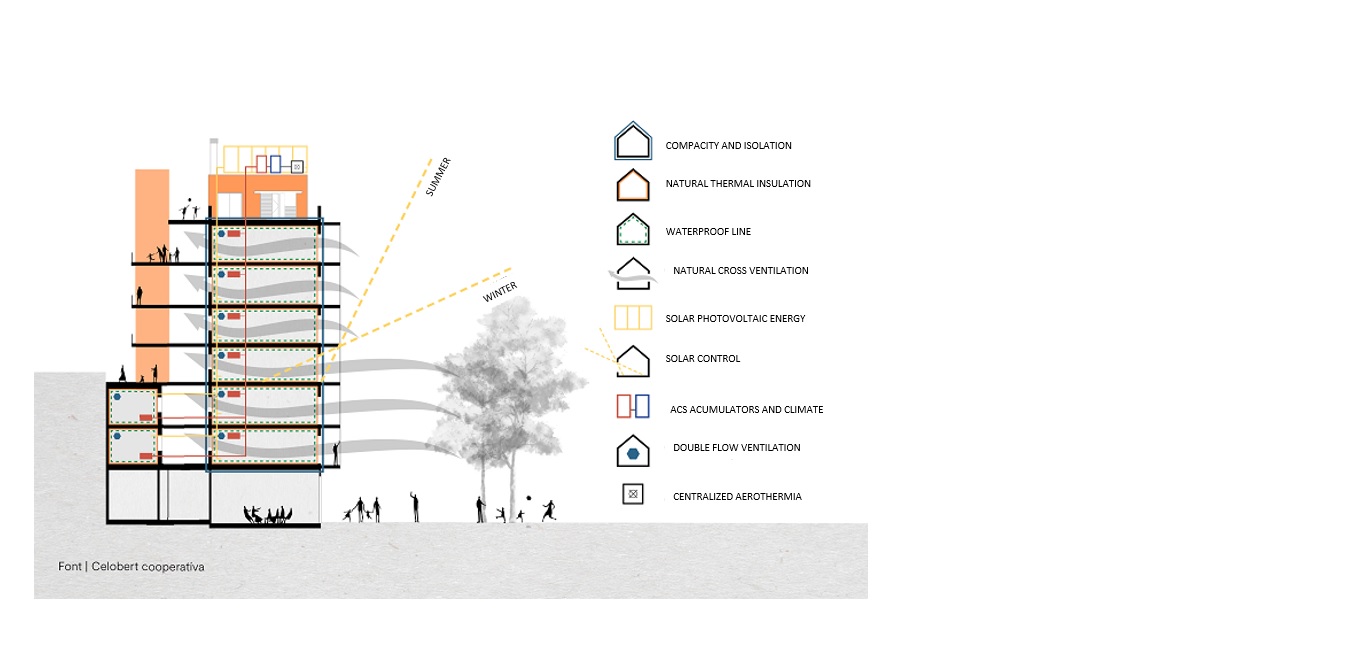
1.Very low energy demand. It is designed to minimize energy consumption throughout the year thanks to the building's architecture. It is created to ensure the level of efficiency of a passive building with near-zero consumption. The building has a non-renewable energy demand 78% lower than the nZEB code established.
2.Minimal ecological footprint and carbon negative. It is built to minimize the environmental cost of the construction process. It is constructed with natural-based materials, which require minimal energy and generate low CO2 emissions for their manufacture and transport and minimizes its environmental impact throughout its life cycle. The main construction materials used are cross-laminated timber, lime mortar (biodegradable, breathable, recyclable), gypsum fibre (obtained from paper recycling, without chemicals) and natural rock wool (recyclable). By using CLT as the main material, Cirerers not only avoids GHG emissions but also makes the carbon negative, because it acts as a natural carbon sink-storing 730 Tonnes of CO2 that’s taken from the air by the trees that are harvested and used to create timber. The whole building is built using dry techniques that reduce the volume of waste and facilitate the disassembly, recycling and reusing of materials.
3.Renewable and efficient facilities. All buildings need energy for heating water, cooking, lighting, electrical appliances and in some cases for improving indoor comfort. Facilities that provide this must be as efficient as possible and prioritize the use of renewable energy. To achieve this: All the flats have a controlled mechanical ventilation, which allows air to be constantly renewed in all the rooms minimizing thermal losses. The new building has a centralized aerothermal to produce cold and heat. There are photovoltaic solar panels to produce electricity for self-consumption.
Key objectives for aesthetics and quality
Beyond the environmental and functional benefits of the building, two main aspects of the architectural project are highlighted:
1. Urban integration, a patella building
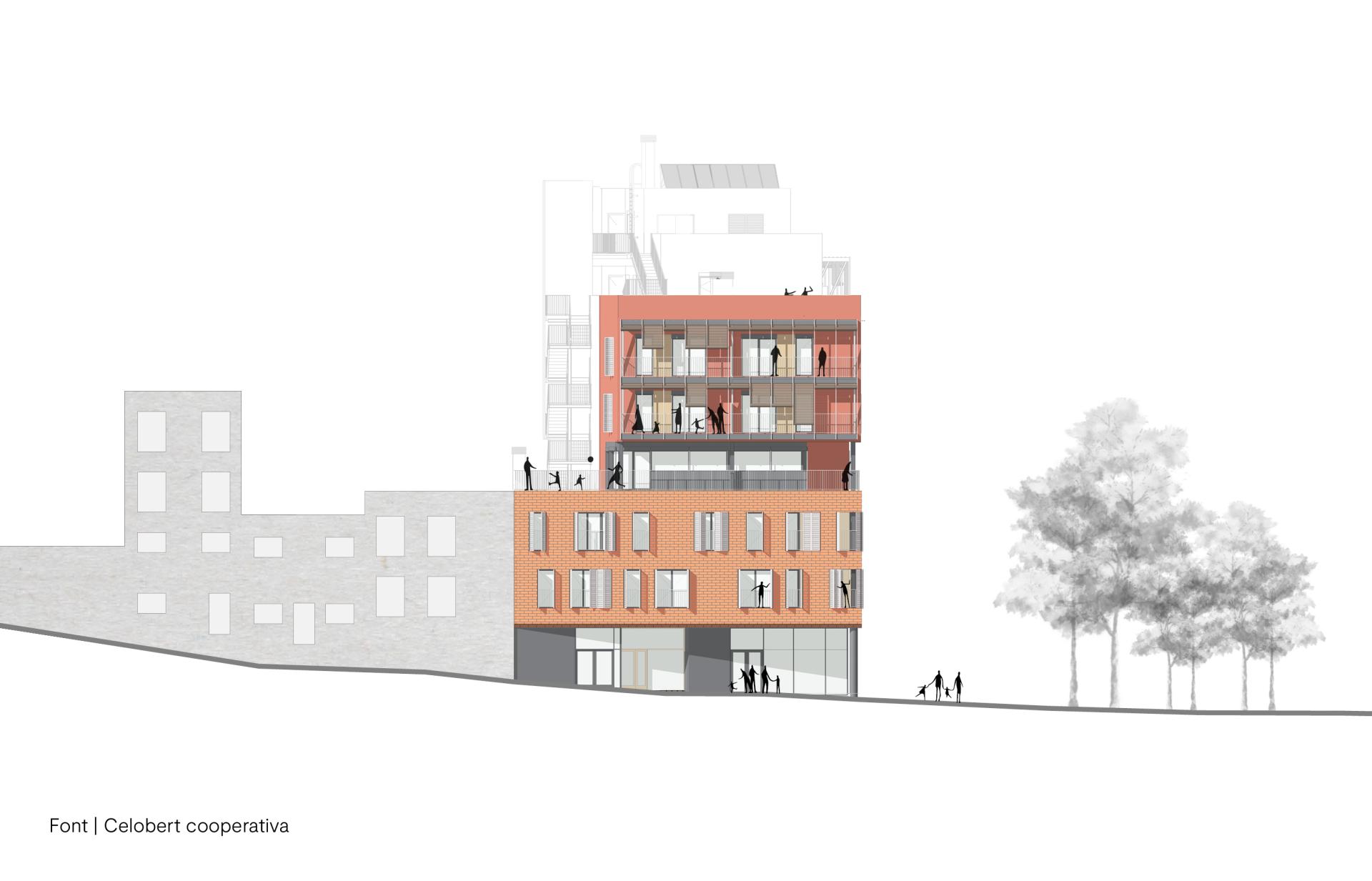
Cirerers is conceived as an urban structure that facilitates the articulation between a 2-3 storeys terraced family house urban fabric, built in the 1950’s, and located to the west of the plot, and a 5-7 storeys contemporary multifamily building urban fabric, located at the east. The project ensures that the 2-3 storey skyline is maintained along the entire façade of Pla dels Cirerers Street and solves the 5 storeys above it without any party wall.
2. Community integration, the house is the whole building
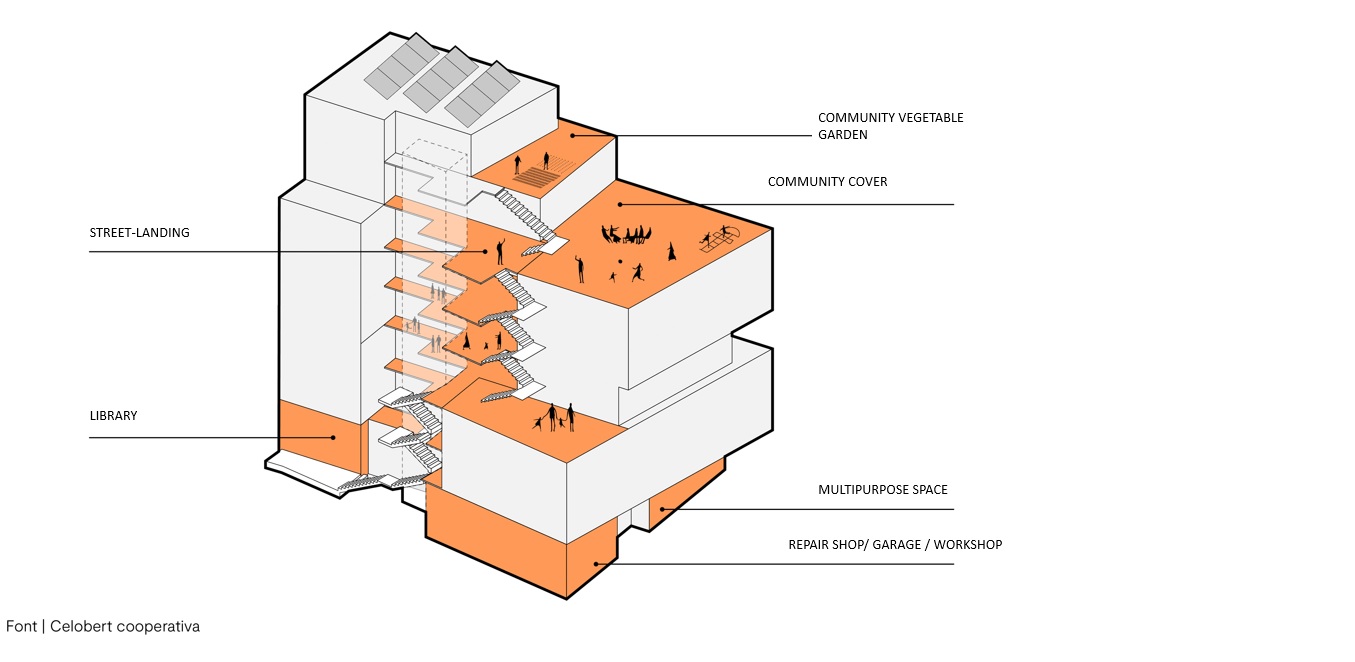
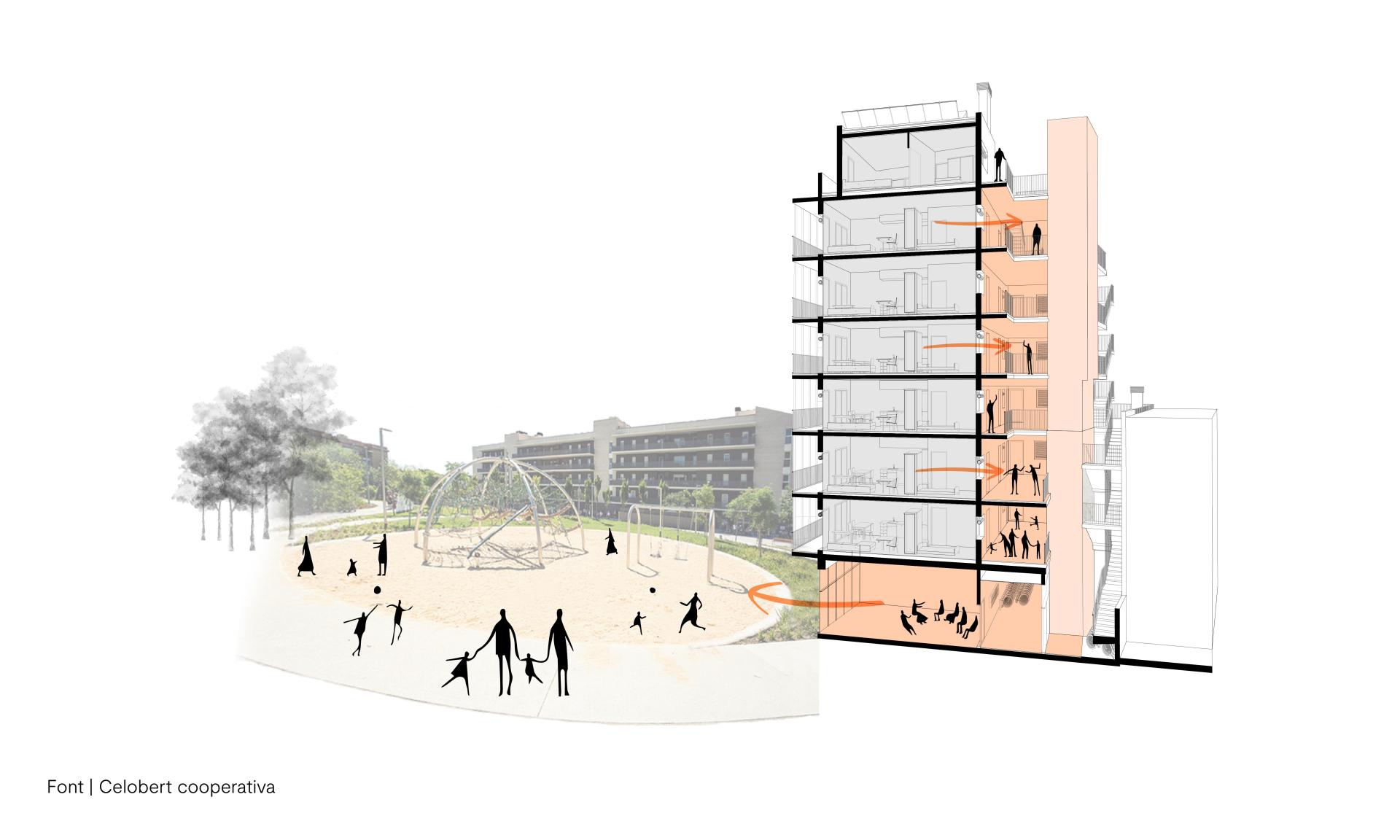
The spaces that structure the cooperative building are the collective spaces for the community use. They are open and visible from the public space and give the meaning and identity to the social project, becoming the central element of its architecture. It has 4 types of spaces, which are defined by their openness degree and with the community connections:
-Open spaces to the neighbourhood (close to the public square) this area is located on the ground floor, will be open to develop both commercial and leisure activities, linking Cirerers community with the neighbourhood.
-Community use areas: bicycle parking and lobby, repair shop and garage, working area and library located on the ground floor, multi-purpose room, conceived as a community space open to the public and outdoor multipurpose community spaces (community dining room, outdoor leisure activities and garden).
-Shared collective spaces: including shared laundry room for each floor of the building.
-Private use areas composed by 32 apartments (40 or 60 m2 loft flats).These spaces are for the exclusive use of each co-housing unit. Overall, residents enjoy a private home space of 40-60 m2, more than 180 m2 of ground floor communal spaces, and more than 170 m2 communal space on the rooftop.
Key objectives for inclusion
The CIRERERS project represents a boost to the economic and social transformation of the housing model, focused on cooperation and inclusion as basic principles, because:
- It focuses on a cooperative model, in which all the agents involved (future residents/citizens, architects, developers, builders and public sector) interact, generating dynamics of mutual support, with focus to a collective and non-speculative housing's model.
- All suppliers come mainly from the social and solidarity economy, thus supporting the growth of the social market in the territory through a new sustainable and responsible economic model.
- It creates links with the neighbourhood: CIRERERS is physically open to the surroundings and generates spaces for interaction with the larger community. It is placed in a vulnerable neighbourhood and will become a hub for social interaction.
- The project serves low-income residents who were on the waiting list for affordable housing, inviting them to participate in the design of the building and in the creation of the cooperative's governance schemes.
- This housing model moves away from speculative purchase or rental models, encouraging housing price stability and thus promoting affordability and accessibility. Housing becomes a space in which it is possible to live for 75 years without the need for large investments.
It is a model that will have a great impact at social level in terms of inclusion, transforming housing access in the city and the country and making it more democratic and community. However, the most important thing is that it is a replicable model and then its inclusion results can be exponentially multiplied.
Results in relation to category
The main results and impacts of this project are:
- To provide social housing and socially protected housing to the neighbourhood, which has been constructed on public land and co-operative promotion with a transfer of use model, ensuring its social use over several future generations.
- To offer a new building 100% committed with the environment, in order to fight against climate change through three main strategies: low energy demand, minimal ecological footprint and renewable and efficient installations. This building contributes to improve the criteria established by the technical construction code. In addition, it reduces drastically CO2 emissions associated with the all the life cycle of the building.
- To propose an architectural project solution with an urban project vocation based on the idea of acting as a hinge between urban fabrics.
- To involve future residents in the design and construction phase of the building.
- To transfer a new model of cession-of-use co housing building.
- To contribute to the sustainable development of the city.
- To propose new community spaces that foster social relations in the neighbourhood:
- It is a project created from a community logic, beyond satisfying individual housing needs. Therefore, this community vision requires spaces for common coexistence, with the objective of improving the quality of life of citizens and generating bonds of identification between them and the city. The objective is to improve the quality of life in our cities.
- To create new management models based on a cooperative and interdisciplinary participation, with the aim of generating synergies and providing advantages that drive our cities to implant new non-speculative models that democratize access to housing for all citizens.
- To create a model, designed from the outset to be transferable, as a pilot experience. Its innovative conception may be applied to new future projects guaranteeing its repeatability.
How Citizens benefit
The co-design process of a co-housing building involves a dialogue between the group of future users, the technical team that assists the architectural process and the regulatory requirements linked to the place where the project is built. A cooperative constructor has carried out the building's construction.
The Group has shared their own needs, the financial capacity to invest in resources and the priorities of the building: the amount of space for community use in relation with private use, the uses and disposition of community and collective spaces and the surface and private spaces’ characteristics (homes).
The Place establishes architectural conditions:
▪Urban planning establishes the maximum number of homes as well as the maximum built-up area, among other parameters.
▪The topography of the land and geotechnical aspects can have a strong impact on the project.
▪The climate, which conditions comfort.
▪Geobiology, which can affect our health.
▪Building regulations, which affect the construction or organizational requirements of the space.
Finally, all the technicians involved in the project have had a triple function:
▪to facilitate the process of identifying and prioritizing the group needs.
▪to find the best possible adjustments between group's priorities and site requirements.
▪to generate a building at the service of society, considering future generations: ecologically and energy efficient, healthy, affordable, flexible, comfortable, beautiful, tidy and well composed.
Consequently, the project has involved the participation of residents and citizens as well as entities. Thanks to the project, future residents will have a decent, collective and community housing and more space for social interaction.
But, the main impact of citizen participation in the project is that they are contributing to transform the model of housing access, making it more democratic and community-based, scalable and transferable.
Innovative character
Cirerers is an innovative project for the following features:
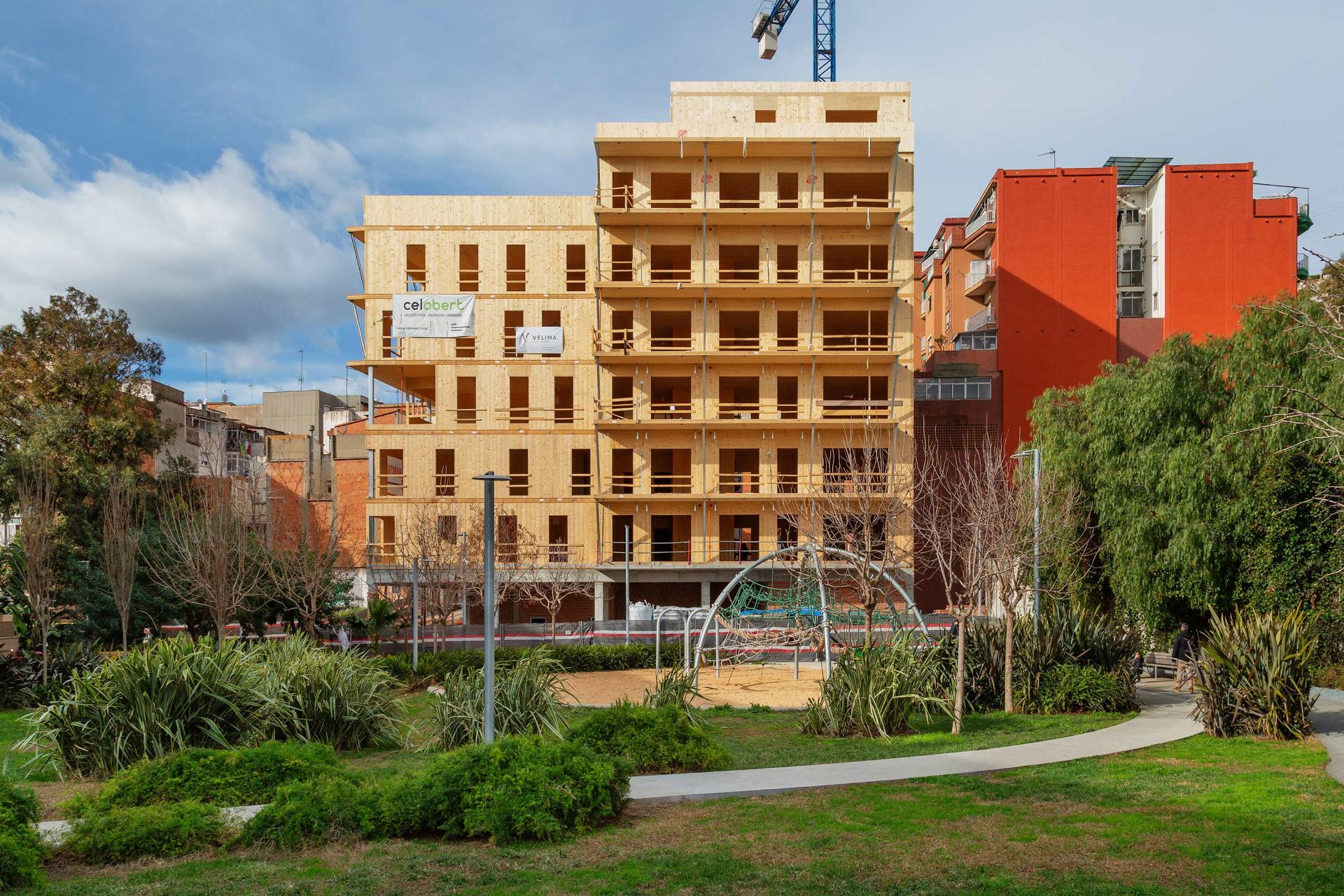
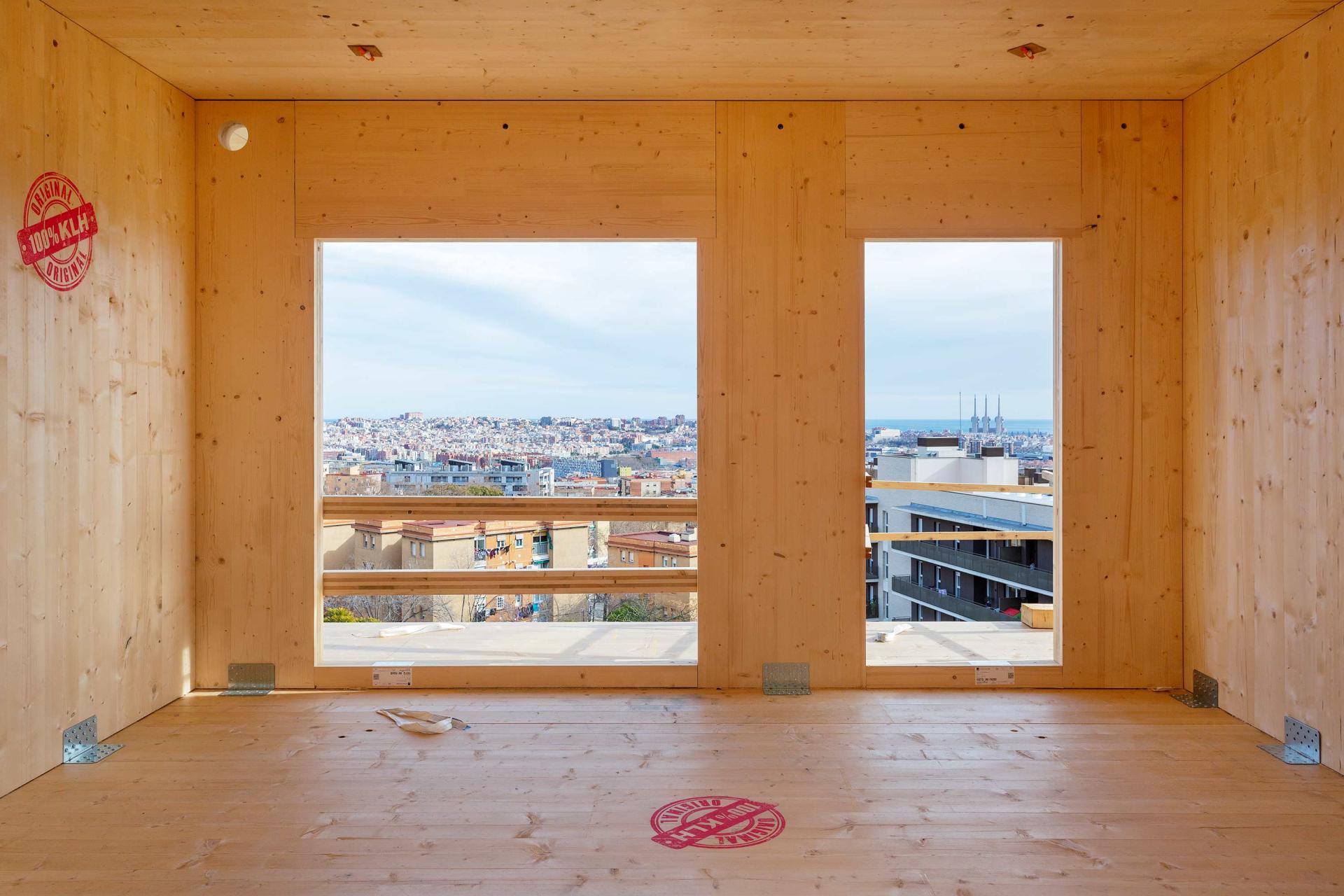
-Environmental innovation. The whole building is made of wood that provides a very fast construction, a high degree of thermal insulation and a great breathability. All these benefits improve the air quality and health inside the houses. This building has been built in dry construction method. This fact will facilitate its dismantling and recycling process at the end of its useful life. Cirerers is the tallest wooden building in Spain. Cirerers is a highly efficient construction thanks to the implementation of an innovative heating system with no thermal losses.
-Tenure Model. Cirerers is the result of a public tender process by Barcelona City Council to provide public land in a 75-year leasehold for the development of cession-of-use cooperative housing. Sostre Cívic, Celobert and La Constructiva are cooperatives formed by architects, an engineering team, co-operative housing and a property developer. It is a new concept of housing management, a community and cooperative project in which all actors have participated in all the decision-making process.
-Architectural level. It is an architectural building that offers community spaces, new ways of city living. Cirerers has communal and collective areas and private use spaces. The collective and communal zones gives the project its meaning and identity. These spaces have been the core element in the architectural co-design process. These different spaces are open areas to the neighbourhood (like cooking school), community use spaces (bicycle parking area, library) and community outdoor spaces (play areas, orchards), collective use spaces (shared laundry) and private areas (homes).
In addition, it is important to remark that all the agents involved in the building’s management are part of the social and solidarity economy. A new non-speculative model, a new way of relating to neighbours and other citizens thanks to community and private spaces.