Water in the city
Basic information
Project Title
Full project title
Category
Project Description
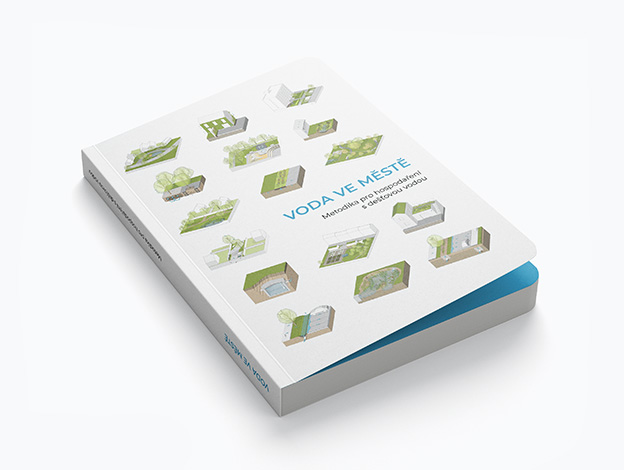
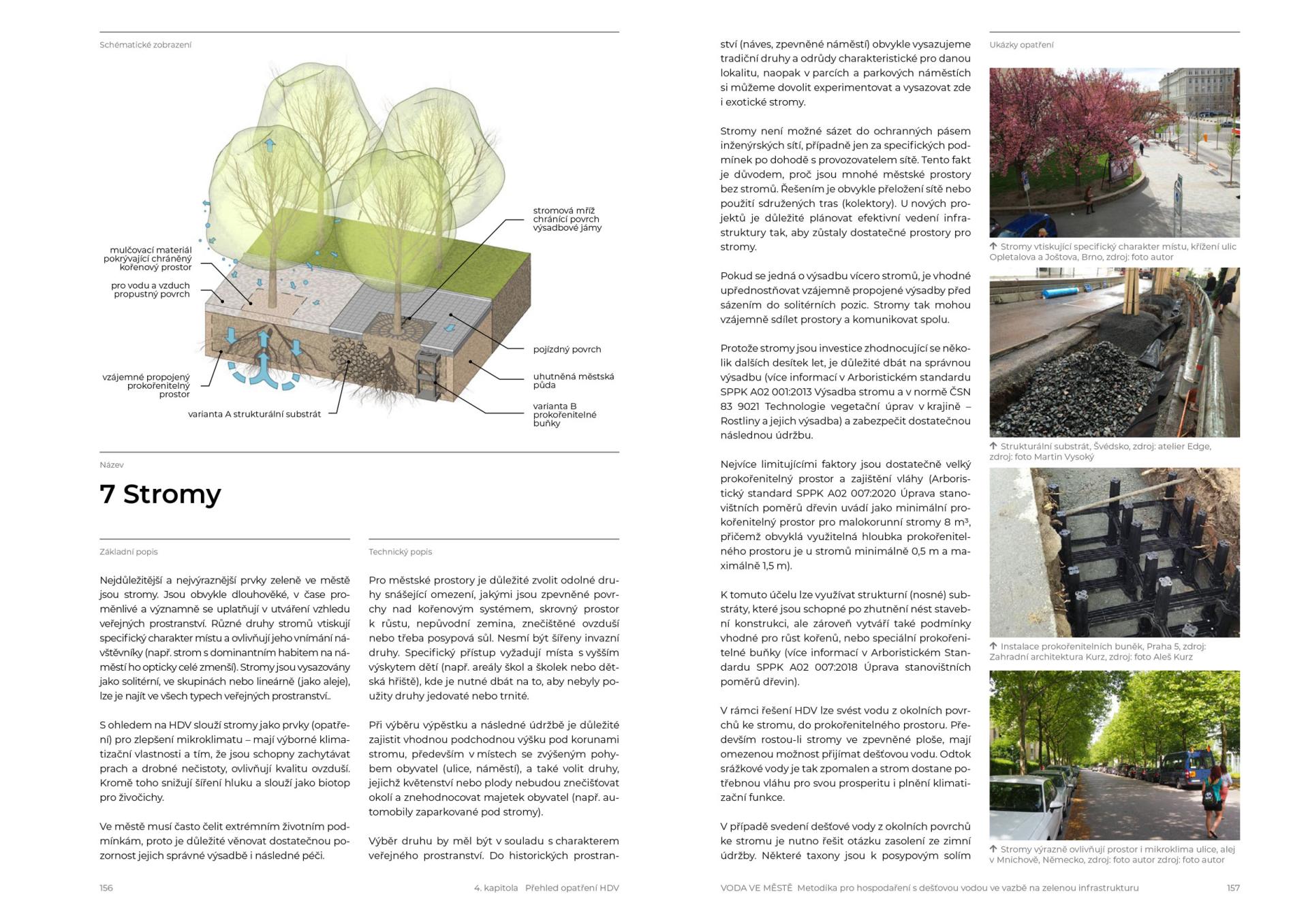
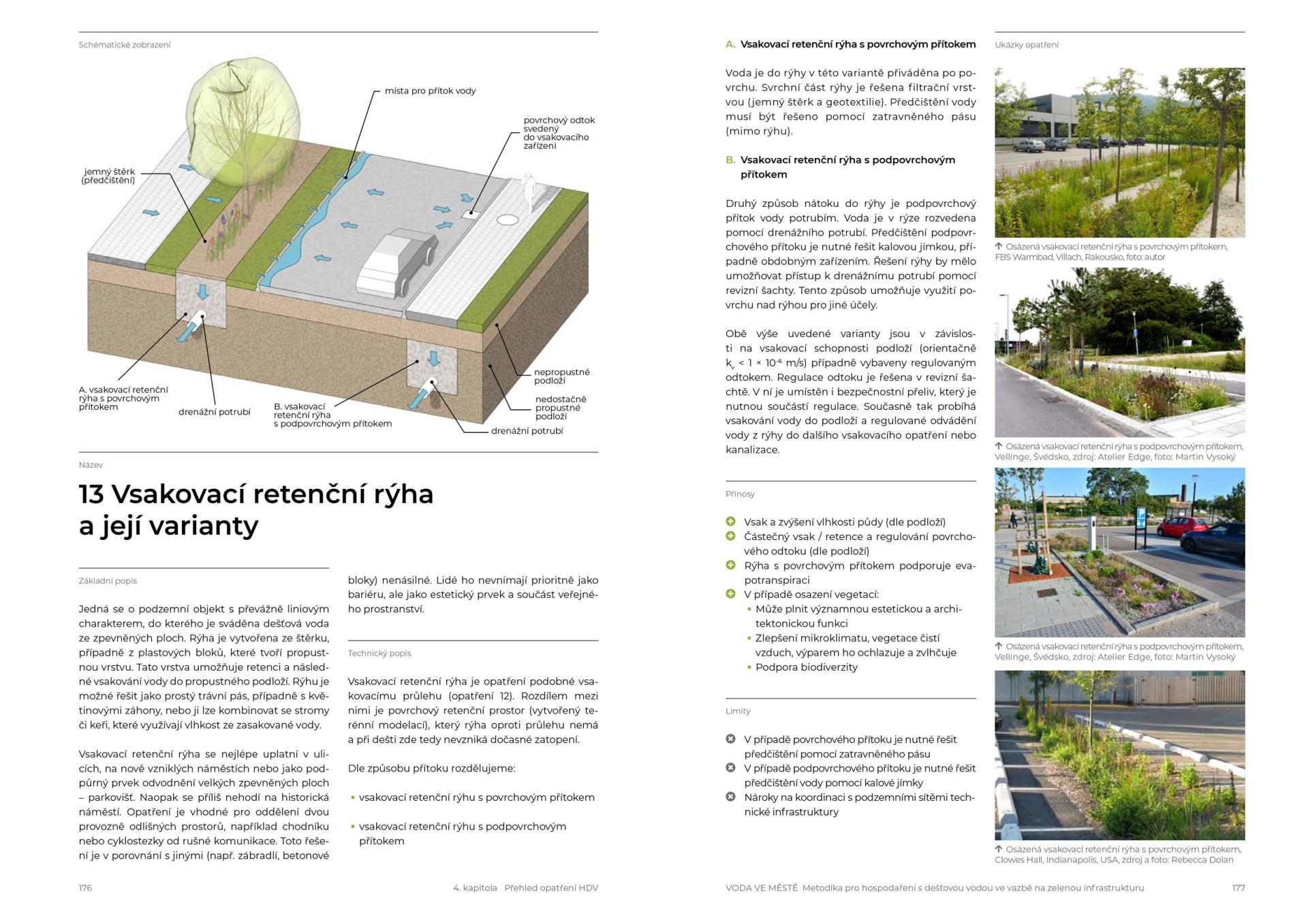
The aim is to create a methodology that will clarify and facilitate municipalities decision-making during planning and realization of nature-based solutions rainwater retaining system in the urbanized area. Further, particular examples of possible solutions in an urbanized area are provided, based on the character of the city and its surrounding. The final document is a tool that will simplify to formulate requirements and criteria for municipalities.
Project Region
EU Programme or fund
Description of the project
Summary
The Water in the City project is a collaboration between two academic institutions in the Czech Republic - the Czech Technical University in Prague and Jan Evangelista Purkyně University in Ústí nad Labem. The project was financially supported by Technology Agency of the Czech Republic (https://www.tacr.cz/en/) within the ZÉTA programme, which supports research of young researchers under 35 years of age.
The main objective of the project is to promote sustainable rainwater management in Czech cities, especially in public spaces. It is based on the current knowledge that rainwater in Czech cities is rather seen as a problem that needs to be drained from the area as quickly as possible to the sewerage system. Or one-sided solutions are created that do not fully exploit the potential benefits for the urban environment (ecosystem services). The Water in the City project looked for ways to functionally combine technical solutions and nature for the benefit of the quality of public spaces, the lives of residents and public budgets. The work aims to explain the intricate relationship between the city and stormwater in a comprehensible way. The need for a comprehensive view of stormwater management was reflected in the composition of the team. A water engineer, a landscape architect, an urban planner, a traffic engineer, a building conservation architect, as well as representatives from social science disciplines such as environmental economists and a sociologist contributed their knowledge and experience.
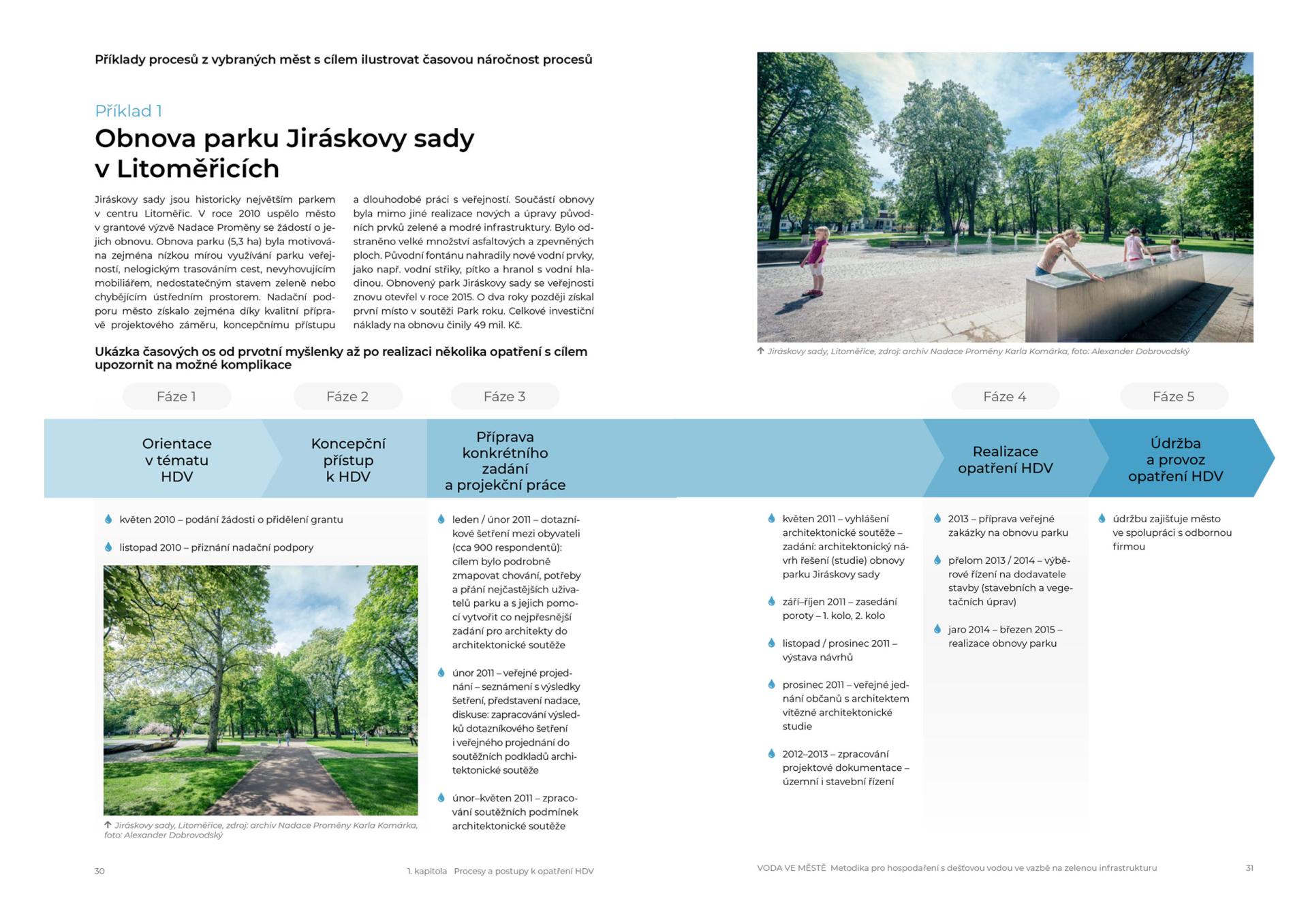
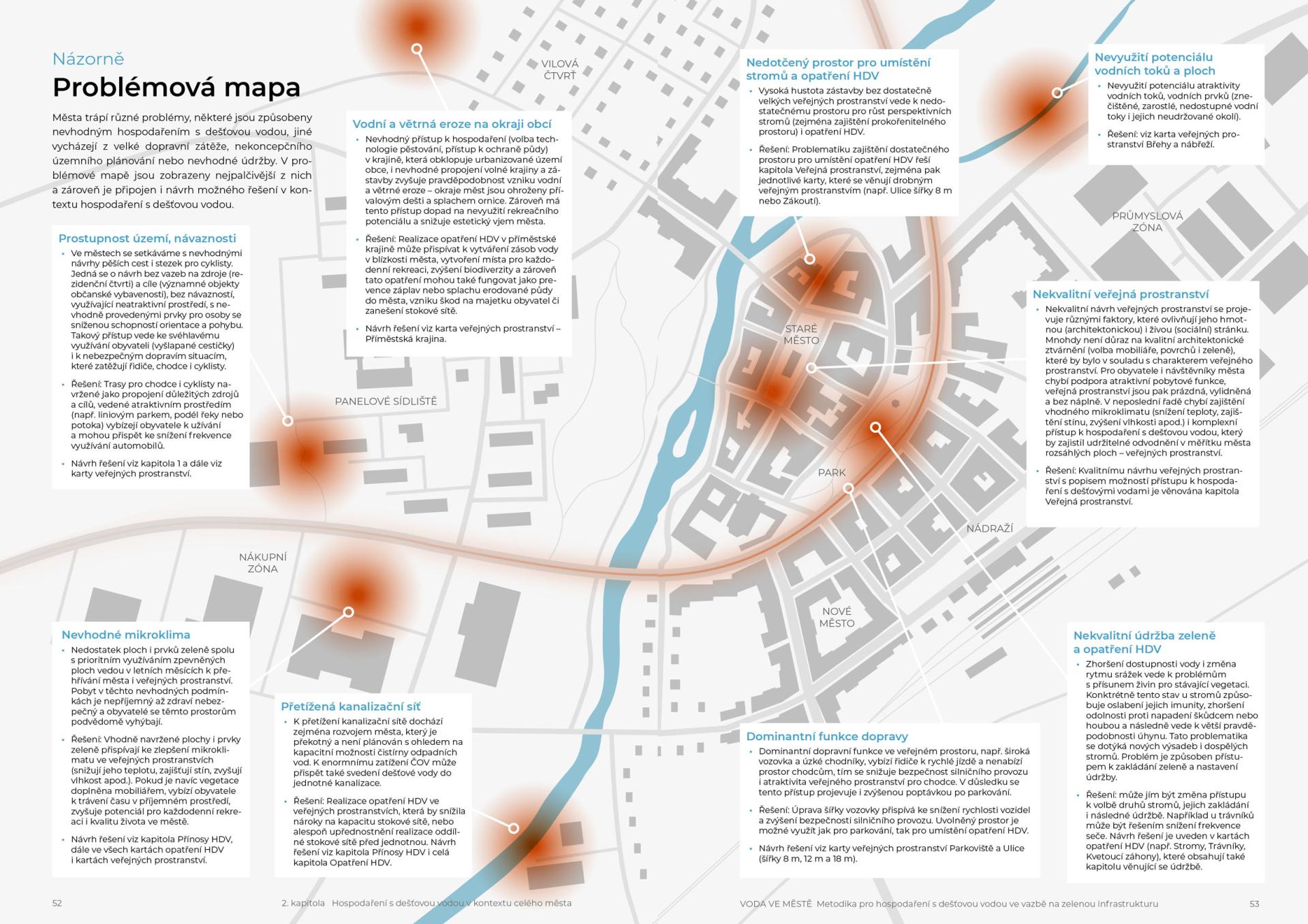
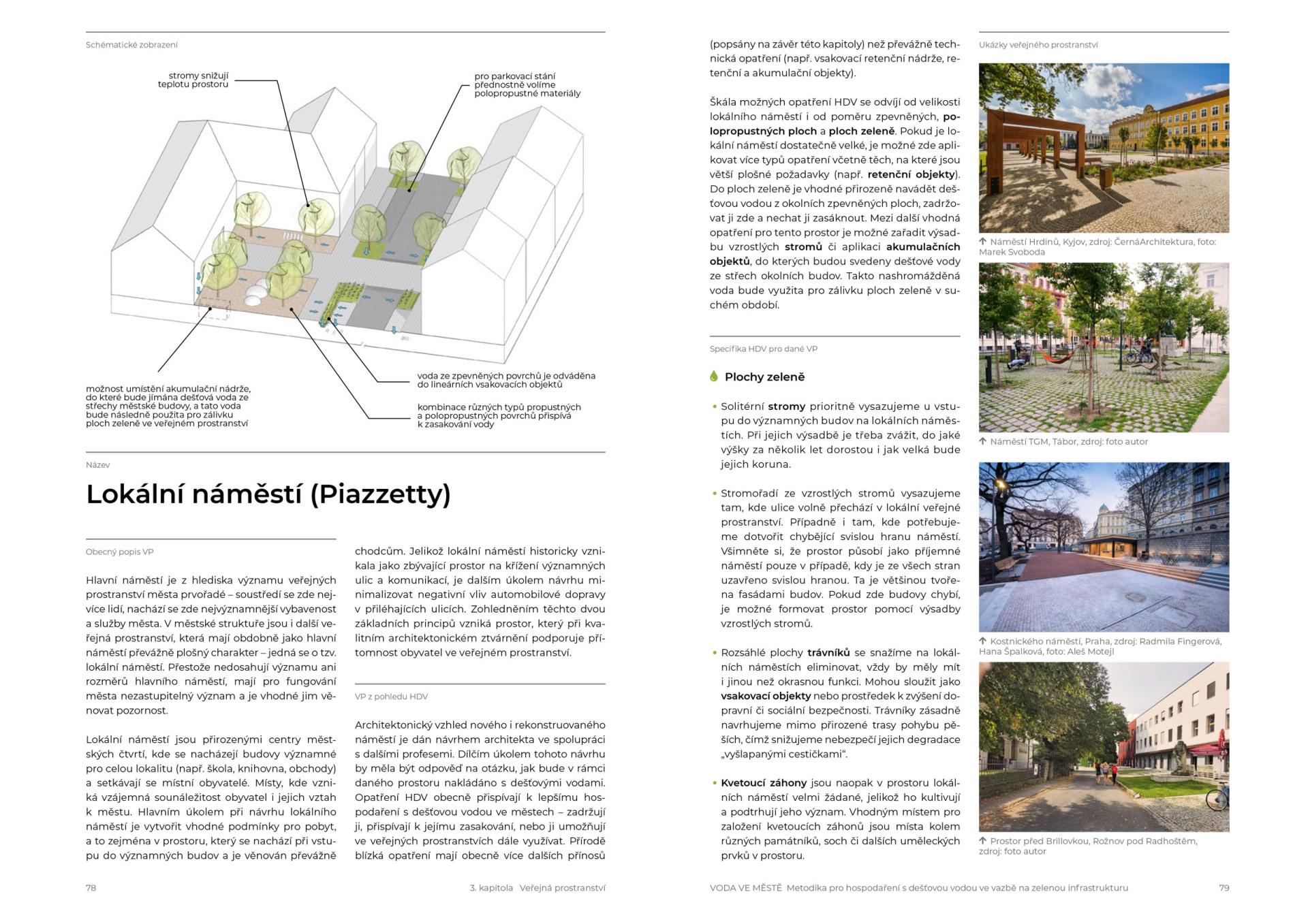
The clarity of the texts, supplementary schematic illustrations and concrete examples will help the target group of the methodology - especially mayors - to orient themselves in the given issue, to get an idea of who to involve in the process of preparation, implementation and maintenance and what their expectations are.
Key objectives for sustainability
The main objective of the project was a sustainable water management, which promotes the use of rainwater for irrigating vegetation or subsidizing groundwater by infiltrating rainwater at the site of impact. Sustainability can also be seen in the conservation of drinking water and the use of utility water - rainwater for irrigation of plants, street sprinkling in hot summer months or for flushing toilets, laundry etc. In the case of stormwater management, the authors of the project support the use of nature-friendly solutions (i.e. those involving blue and green infrastructure) over purely technical solutions. Thanks to this approach, various additional and often initially unexpected ecosystem services will be developed that will increase the quality of life in the city, such as increasing biodiversity, reducing the heat island effect, increasing the quality of public spaces and thus community cohesion, or even reducing the economic costs of operating and maintaining urban infrastructure).
An important part of the publication is the description of the whole process from the legislative point of view, but also from the point of view of the involvement of the population. If we want to achieve a truly high-quality and generally accepted result and long-term support from not only the representatives of the cities but also their inhabitants, we need to communicate with them about the importance of these measures and involve them in the whole process.
Key objectives for aesthetics and quality
Rainwater management is perceived as a technical discipline in the Czech context. Lack of time, lack of finances and especially lack of information about alternative solutions that can have a greater benefit for the quality of life in the city lead to the fact that a team that creates only technical solutions is in demand. However, this technical team represents only one component of the urban environment and does not see the potential that nature-based solutions offer. In particular, it is about improving the aesthetic and functional quality of public spaces.
The basic prerequisite for increasing the attractiveness of public spaces for urban dwellers is a sophisticated architectural design of public spaces with a sufficient range of activities for a diverse range of social groups as well as a suitable microclimate (temperature, weather conditions, dust, noise) that creates a favourable environment for their staying.
A multidisciplinary team (water engineer, landscape architect, traffic engineer, conservationist, urban planner, sociologist, environmental economist, biologist and environmentalist) worked on the Water in the City project. Such a team ensures that one-sided solutions are not preferred and that a wide range of urban environments (technical, cultural, natural, social and economic) are covered by their expertise. The aesthetic quality of the design was guaranteed by experts in landscape architecture, architecture, conservation and urban planning.
Key objectives for inclusion
The target group of the publication is representatives of cities with more than 10,000 inhabitants. On the one hand, this is the group that decides most about the future image of the city, especially through various strategic documents or decisions on spending funds, but on the other hand, it is not a group with expert knowledge or awareness of this topic. The publication is therefore accessible to the general public, summarises the knowledge of the multidisciplinary team, and describes the whole process from design to maintenance of the various measures. The publication is supplemented by illustrative examples of individual stormwater management measures and also includes inspiring examples already implemented.
The publication was printed and sent free of charge to all mayors of municipalities with more than 10,000 inhabitants. We assume that printing the publication will contribute to greater use than the digital form - the publication can easily be taken to meetings with other key stakeholders. The printed publication was also sent to regional and scientific libraries that expressed interest in it.
In addition, the methodology is available to others on the website www.vodavemeste.cz, where it is free for everyone to download. Within one month of its publication, the methodology has been downloaded by almost 1,800 people from the municipal and state administration, and another important group were also designers, professional students, as well as construction companies.
The publication also describes which stakeholders have an influence on the quality of design, implementation and maintenance and how to involve them in the whole process.
Results in relation to category
Approximately 1,800 people from different categories downloaded the methodology in one month. The largest group is the designers (about 36% of people - i.e. 648 people, 12% of people from local government - i.e. 216 people, 8% of people from public administration, 12% of people from students and the same number of people from the professional community). There are 129 cities with more than 10,000 inhabitants in the Czech Republic, so the 216 downloads of the methodology from local government were very pleasing. It is a sign that Czech cities are interested in the issue of stormwater management and that they are looking for guidance on how to approach this issue.
Information about the completion and the possibility of downloading the methodology has been published by professional Czech and Slovak servers (https://www.asb-portal.cz/aktualne/nova-publikace-radi-jak-nakladat-s-destovou-vodou, https://www.archinfo.sk/diskusia/blog/udrzatelna-architektura/publikacia-voda-ve-meste-metodika-pro-hospodareni-s-destovou-vodou-ve-vazbe-na-zelenou-infrastrukturu.html).
Thanks to this, the Water in the City methodology (which offers inspiring solutions on how to approach the design of the system and individual measures in cities and how to promote blue and green infrastructure, improve the quality of public spaces while developing a wide range of ecosystem services) is becoming known to the general and professional public, and especially to local and state administrations, which have the greatest influence on decision-making about the future of Czech cities.
How Citizens benefit
The creation of the publication was preceded by a year-long research, during which various participatory methods were used (e.g. semi-structured interviews with representatives of 5 Czech cities, as well as a questionnaire survey and the creation of feeling maps with residents. The main focus was on identifying the needs and preventions of the residents as well as identifying the current approach, visions and possible barriers to the implementation of stormwater management measures in the urban environment.
Information about the completion and downloadability of the methodology was also published by the most read web news portal www.seznam.cz (https://www.seznamzpravy.cz/clanek/cvut-nabizi-obcim-pruvodce-k-uprave-prostranstvi-i-nakladani-s-vodou-154086), bringing the news of the publication to the public's attention. The public can also download the methodology free of charge on the website and can influence their councillors from "bottom up" to implement the transformation of public spaces with an emphasis on the implementation of a sustainable approach to stormwater management. Last but not least, an important point addressed in the methodology is how to involve the public in the whole process, how to identify their needs and ideas and how to inform them.
Furthermore, a positive impact on the quality of life of the public is expected when the system and individual stormwater management measures are implemented in a realistic environment according to this publication. The publication emphasises the quality integration of stormwater management measures into public spaces in such a way that the solutions bring the greatest possible benefit to the locality - attractive and aesthetic public spaces with an emphasis on pleasant living conditions, activities for various social groups of the public, which will contribute, among other things, to community building in the locality.
Innovative character
With the right type of stormwater management measures and their appropriate application in public spaces, stormwater management measures have a significant potential to contribute to the attractiveness and architectural quality of the urban environment. This potential can be turned into reality if stormwater management measures are not only seen as elements of technical infrastructure that primarily fulfil their purpose. Instead, we will see them as valuable green spaces and water features, as a natural part of public spaces that contribute to the development of leisure and recreational activities in the area. A permanent stormwater retention basin may serve as a concrete example. This will become a popular place for children and adults to play in the summer, if it is supplemented with suitable furniture (rafts, water games, benches, jetties), and in the winter it will become a natural ice rink. The original water management function then takes on an additional dimension.
Such a high quality and generally functional solution will only be created by the joint effort of a multi-disciplinary team with a number of experts who focus not only on the material form of public spaces (specialists in water management, landscape architecture, traffic engineering, conservation, urban planning) but also on life, prosperity and ecology in cities (sociologists, environmental ecologists, biologists).
Innovation also lies in the focus of the publication on a specific target group - representatives of cities. This is also related to the clarity of the text, the information on the approximate costs for the creation and maintenance of individual measures and the graphic design of the publication, which contributes to the clarity of the text.
The photographs in the methodology are created by the authors within the methodology. We give the permission to publish and use the photographs for necessities of the New European Bauhaus Prizes.