Water Resilience for an urban Ecobalance
Basic information
Project Title
Full project title
Category
Project Description
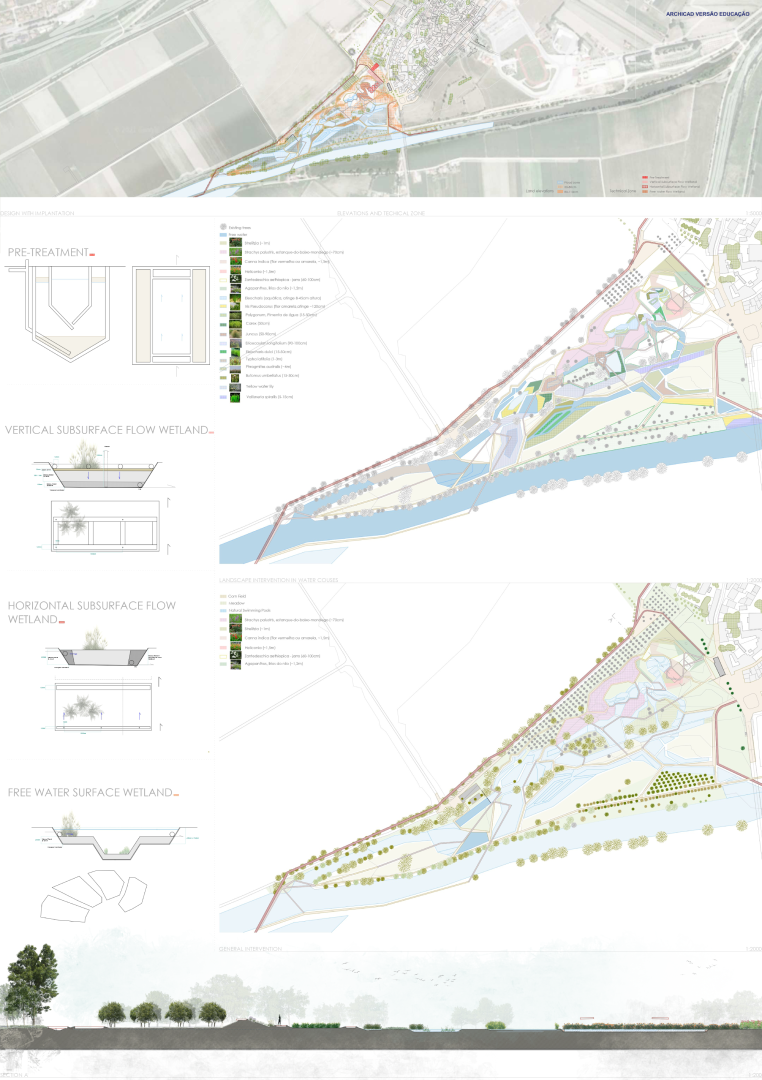
Renaturalization of a “non-place” in a fringe area between a river, and urban to rural landscape. The aim is to create a landscape that promotes local biodiversity, water resilience and follows the principles of circularity of resources and respects the local materials and techniques. The process designs a constructed wetland that includes an infrastructure capable of treating waste water by a natural efficient and phytosanitary method, and a social and ludic park with a natural swimming pool.
Project Region
EU Programme or fund
Description of the project
Summary
The idea is to construct knowledge by designing the process of renaturalization of an urban void, that constructs a wetland. This project aims to protect nature and improve biodiversity, with respect to cultural and social human needs. Aims to construct a new dialogue between nature and humans, where nature is completely integrated in urban spaces and a new Eco-balance is formed. In fact, investigates the way by which we can construct with nature, integrating the potential of natural materials, processes and resources in a truly sustainable and circular system. It rises from the responsibility of reconfigurating cultures. It is part of an urban network plan that aims to dynamize the Low Mondego region, in Portugal. Wants to prove that we can opt for natural solutions, and that this can be more effective, low-cost and overall sustainable. The project expands an existing public space in a terrain that is grey and forgotten into a usufruct area. At the same time, is a river waterfront, with maximum infiltration area, partially flooded when the main river protection dike system is not enough to sustain the force of the water. Most rivers in the world are strongly polluted. Most water treatment systems use several chemicals damaging to humans and ecosystems and freshwater is scarce. The designed and constructed wetland uses a phytosanitary treatment system, in an effort to protect and conserve the hydric resources. And goes further, opening the process to the public by integrating a park. This park, as public city space, renaturalizes the land, requalificates it, both for human and biodiversity reclamation. Investigating and choosing local and appropriate plant species for the treatment zone, water deep and throughout the landscape intervention as a all. The natural pool area and building accentuate this other sfere of the proposition, to look at the territory not only as a functional/productive lens, but through sensory aesthetic experience.
Key objectives for sustainability
Sustainability and its four pillars, economics, social, cultural and environmental are the base, structure and objective of the concept idea. The economical pillar is expressed in the low-cost and efficient way the phytosanitary constructed wetland treats and purifies wastewater and as an innovating infrastructure the power to attract attention and visitors to the region and even promote new jobs, in the technical area, the maintenance of vegetation and the pool and reception area. The social pillar, comes into action, in the way the intervention requalifies a non-space, giving it back to the city and its citizens, as a space of complentation of nature. The cultural sphere is directly impacted due to the project’s design, the way it searches for a relation between the local culture, identity, landscape and innovation, creating, as a park, a new cultural activities ground. The environmental element has water as the conductive theme and instrument. Water is present in all components and acknowledged throughout the entire process. The hydric resources and cycle place a big part in restoring and maintaining biodiversity and resilience. And here we also find an opportunity to produce energy, both hydric and solar. With small turbines throughout the lagooning and solar roof tiles in the building.
Key objectives for aesthetics and quality
The project wants not only to be functional and productive, but to grant an aesthetic and sensorial involvement as a way to enrich the experience and its value. The visual, plastic and material experiences that we want to enhance have the potential of creating a different type of knowledge. A knowledge founded in the sensorial experience of the landscape. We believe that a complete immersion in an experience of colors, scents, textures and sounds of nature can transform the way we relate to it, and create a new culture of dialogue and eco-balance urban areas. The concept intervention of the park aims to unite the identitary, cultural landscape and enhance it to a sensorial maximum, through the sounds of the running water, birds, and increasing biodiversity; the visual impact of local vegetation and its compositions alid with their own reflections in water ponds, and in the passing river; the refreshing by closeness to the elements; and, to summit all, the building, lurking from behind local stone wall and vegetation.
Key objectives for inclusion
Inclusion is a concept that can be easily defined and explained but that is difficult to implement depending on the dimension we want to promote. In fact, we can design spaces for inclusion that are not used for all, mainly by cultural identification impediments. These impediments could have an origin in the difficulty to create identity, a social and local identity that does not comprehend these spaces as theirs. By these, inclusion, in this specific project, is mainly manifested through public space as space of usufruct and education for all the residential community and visitors, where anyone and everyone is encouraged to come learn and participate. Not only as a passive participation but also to join in the efforts to maintain the landscape. The park is, also, expected to integrate spaces of agriculture, which itself represents social local values. Beyond all this, inclusion in the aspect of accessibility is present in all parts of the project. Thus the key objectives are the social inclusion of the resident population on the decisions, development and maintenance of the designed landscape, as the usufruct of the park and swimming pool. So the spaces are dimensioned and designed to compile and include special needs people, integrating them in a real experience of the landscape. At the same time, local identity could be recognized on the selection of local materials, techniques, plant species and agricultural crops. The construction site aims to invite the resident population to its natural experiences.
Innovative character
The innovative character of the idea is the extrapolation of intervention principles that are tested on a particular site, but that can be later applied on a global scale whenever an urban agglomeration meets a water course, and there is a necessity of despoluting water and soils. At the same time it is innovative by the way it “uses” nature resources and potential, constructing with nature and not against it. Forming a new eco-balance founded on a dialogue of respect for the natural clima, biodiversity and cycles of energy. The improved water resiliency of the renaturalized area can help to deal with flood problems. We trust nature and by this we follow the principle of minimum intervention defined on the Manifesto of the third landscape. The constructed wetland is innovative by itself, in this project we develop this even more by rethinking a low tech, vernacular technology and making it more efficient with contemporary technology. Associating to the process ways to process energy, like water turbines. All the construction site intends to have nearly zero energy incorporated and be self sustained. With special attention to materials, their cycle, the local techniques and once again combining those with high tech developments.
The overall intervention explores the theory, power and benefits of biophilic architecture and is thought to make the city that is integrated in more healthy, active, resilient, articulated and happy.