Re-Design It Green
Basic information
Project Title
Full project title
Category
Project Description
Re-Design It Green is a free research hub for students, researchers, and professionals of architecture, interior design, fashion, and industrial design. The main objective of the hub is to provide the necessary literature and equipment for developing innovative sustainable materials to be used in the corresponding fields. It is an organization that aims to fund and encourage the implementation of ideas for new materials with a low carbon footprint while creating an employment area for the region
Project Region
EU Programme or fund
Description of the project
Summary
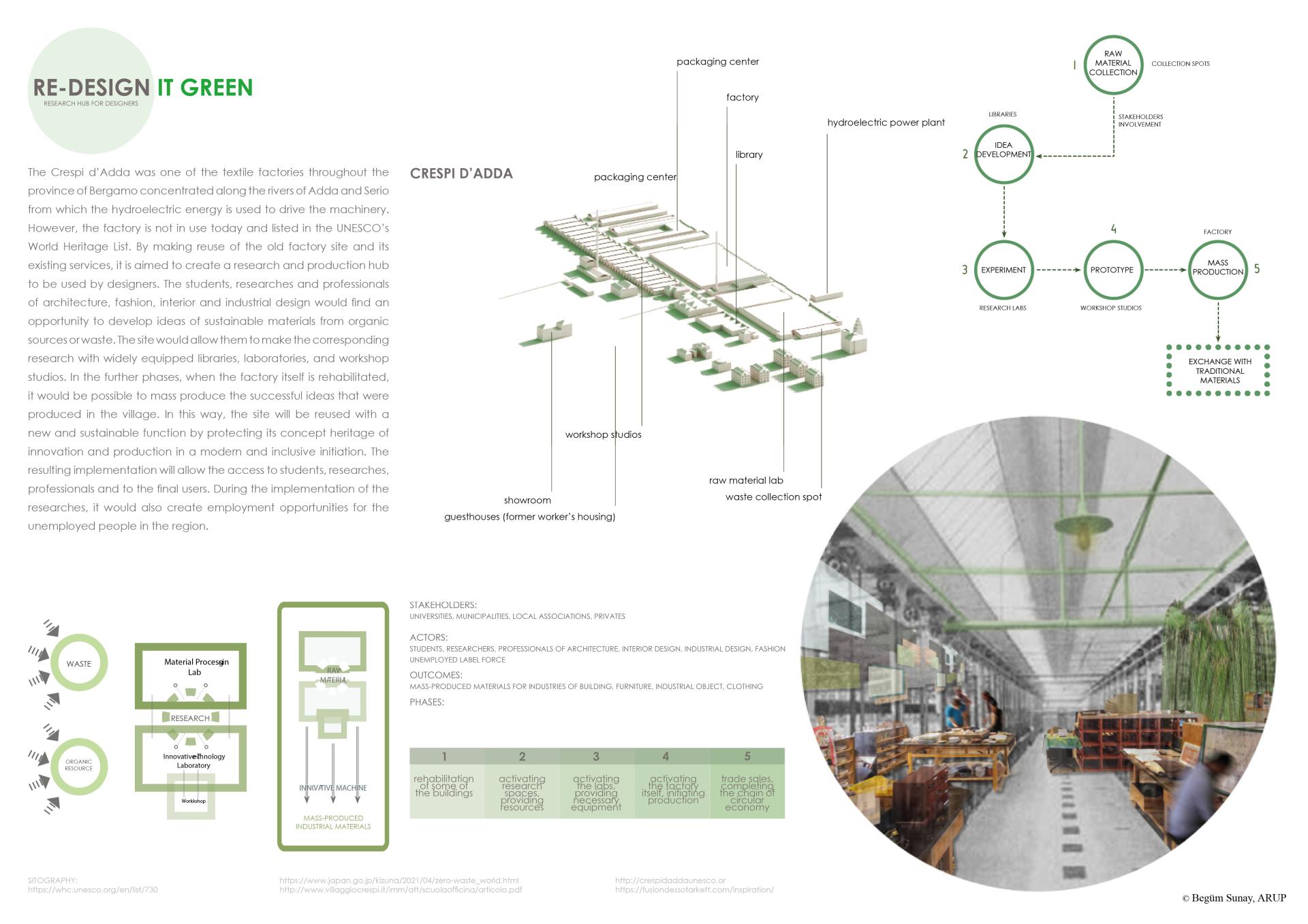
The Crespi d'Adda was one of the textile factories throughout the province of Bergamo concentrated along the rivers of Adda and Serio from which the hydroelectric energy is used to drive the machinery. However, the factory is not in use today and listed in the UNESCO's World Heritage List. By making reuse of the old factory site and its existing services, it is aimed to create a research and production hub to be used by designers. The students, researchers, and professionals of architecture, fashion, interior, and industrial design would find an opportunity to develop ideas of sustainable materials from organic sources or waste. The site would allow them to make the corresponding research with widely equipped libraries, laboratories, and workshop studios. In the further phases, when the factory itself is rehabilitated, it would be possible to mass-produce the successful ideas that were produced in the village. In this way, the site will be reused with a new and sustainable function by protecting its concept heritage of innovation and production in a modern and inclusive initiation. The resulting implementation will allow access to students, researchers, professionals, and the final users. During the implementation of the researches, it would also create employment opportunities for the unemployed people in the region.
Key objectives for sustainability
The materials that release high carbon are still widely in use in the construction field, clothing industry, and so on. The concept idea suggests that it is possible to provide sustainable alternatives to those of traditional materials. By offering the necessary fund and service to the researchers, it will start a circular economy which begins with just an idea. Later, the idea will be developed, experimented, implemented and finally added to public use. It will encourage the human resource of scientific development and create a label need for the unemployed. The resulting production will replace the traditional materials with ones with the low carbon footprint. The new materials will be developed from natural/organic resources and wastes. Infact, part of the factory site will be used as a collection spot for recyclable waste from all around the region. It is also suggested that the materials that are produced in the factory, could be collected again and recycled to be used when their life ended. In this was the chain of circular economy in the certain industries that use mass produced materials will be completed.
Key objectives for aesthetics and quality
In terms of aesthetics and the quality of experience, the factory will be an exemplary initiation for the future of all. The factory is completely abandoned and open only for touristic visitors although it is perfectly preserved. The existing extraordinary urban layout of the factory village will turn into a big hub or free research where the quality of experience not only remains as a heritage site but also as a reused space of design initiation. The existing buildings with various functions, will provide opportunity to create diversity of different uses in the site in order to achieve a complex and expressionist design.
Key objectives for inclusion
The idea points out the importance of the free research supply for all the students, researcher and professionals in the fields that use mass produced materials. The researchers with creative ideas of material generation from natural sources and/or wastes will be funded and provided with all the necessary equipment. In the process of idea generation, starting from the collection and recycling of sustainable raw materials to the production of resulting materials there will be a certain need of label. Therefore, the unemployed people around the site will find work opportunities. The funding will be provided by a diversity of stakeholders who care to leave a better world for the next generations. Those could be universities, municipalities, local associations, and privates.
Innovative character
The concept of creating a circular economy chain that urges the replacement of traditional materials with the sustainable ones in diverse industries would be a big step to evoke the interest in the research funds in the certain fields. It will be a movement that starts from just plain ideas. The factory village of Crespi d'Adda was one of the most innovative initiation of its time with its various urban layout and use of hydroelectric energy in the machinery. Therefore, as a cultural heritage site, its most important legacy is the concept of innovation in the textile industry. In this project, it is suggested to reflect that heritage into wider industries.