Kulturbahnhof Aalen
Basic information
Project Title
Full project title
Category
Project Description
Aalen’s industrial history and the architecture of the 21st century are brought together in the new cultural centre “Kulturbahnhof”. The town wanted a “beacon for culture and creativity” on the site known as the Stadtoval, which was previously occupied by railroad tracks and later used by a construction steel company. The Kulturbahnhof now plays a central role. It not only houses diverse cultural institutions and catering facilities, but also has a major radiant effect throughout the region.
Project Region
EU Programme or fund
Description of the project
Summary
Aalen’s industrial history and the architecture of the twenty-first century are brought together in the new cultural centre Kulturbahnhof Aalen. a+r Architekten have succeeded in integrating the historical building fragments on the “Stadtoval” into contemporary architecture with great sensitivity. The town of Aalen wanted a “beacon for culture and creativity” on the site now known as the Stadtoval, which was previously occupied by railroad tracks and later used by a construction steel company. Within the framework of this significant inner-city expansion, the Kulturbahnhof plays a central role: the building is not only intended to house the city’s diverse cultural institutions and catering facilities, but also to have a major radiant effect throughout the region. It accommodates a cinema, a theatre, the music school and high-quality function rooms for cultural events along with premises for catering.
Key objectives for sustainability
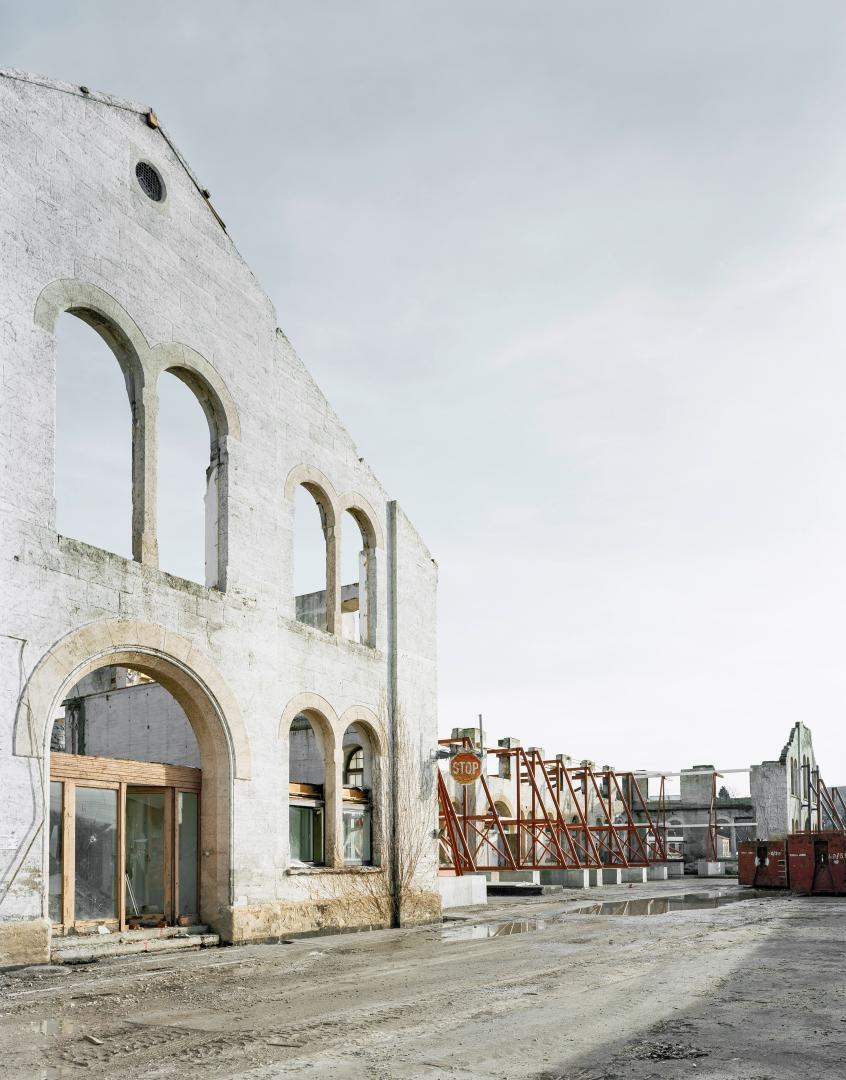
Following a fire in 2014, all a+r Architekten found were a number of historical groups of buildings, including the former railroad administration building and remains of the large hall of a former repair workshop. The existing industrial architecture constitutes an important structural document of railroad history in Aalen — these are the remains of typical local buildings with some striking characteristics, such as a sandstone façade and short side gables. The central idea was to carefully preserve this heritage and to further develop it into a forward-looking cultural centre for the twenty-first century. The preservation through conversion and further use of the existing building effectively avoids the creation of demolition materials and the amount of primary energy used. This approach contributes to a sustainable circular economy.
Key objectives for aesthetics and quality
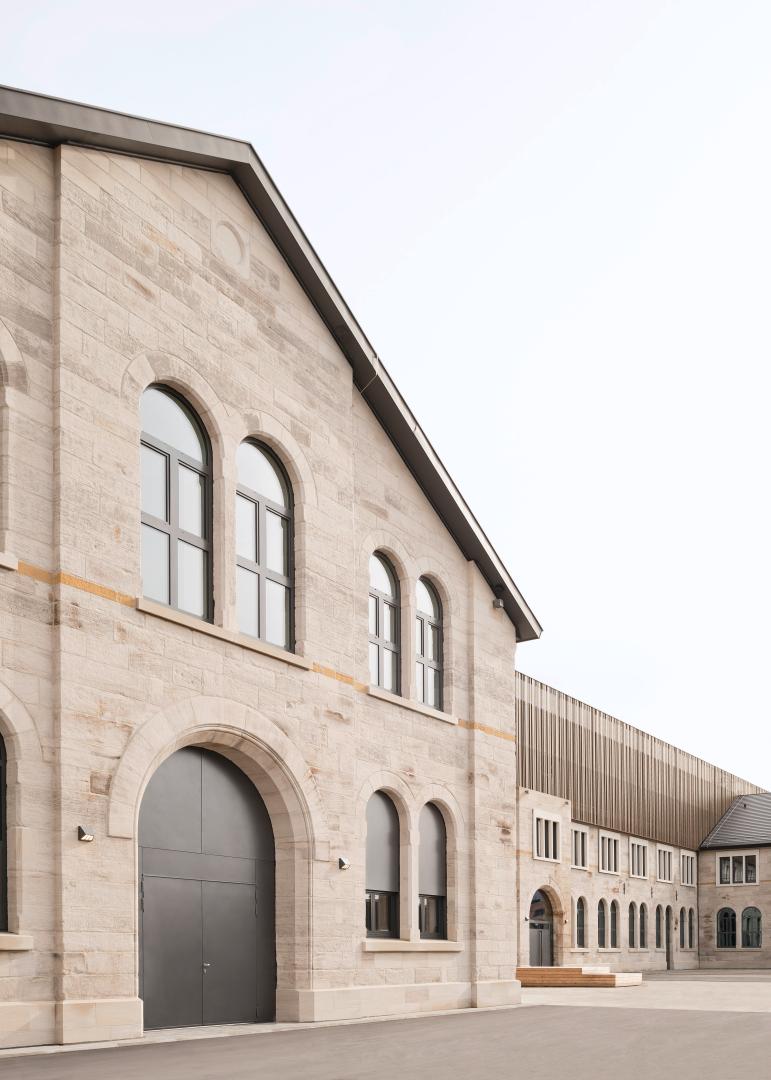
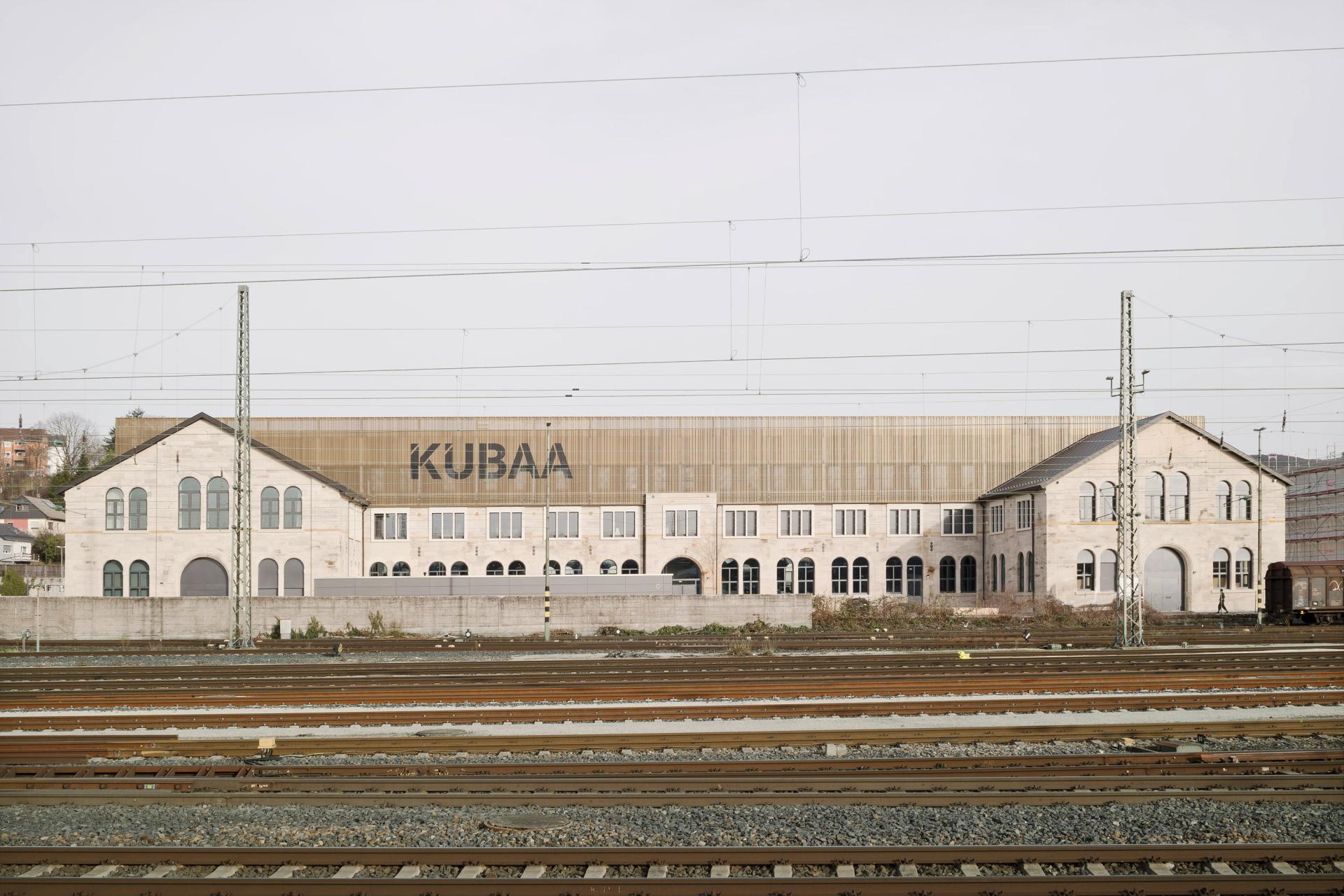
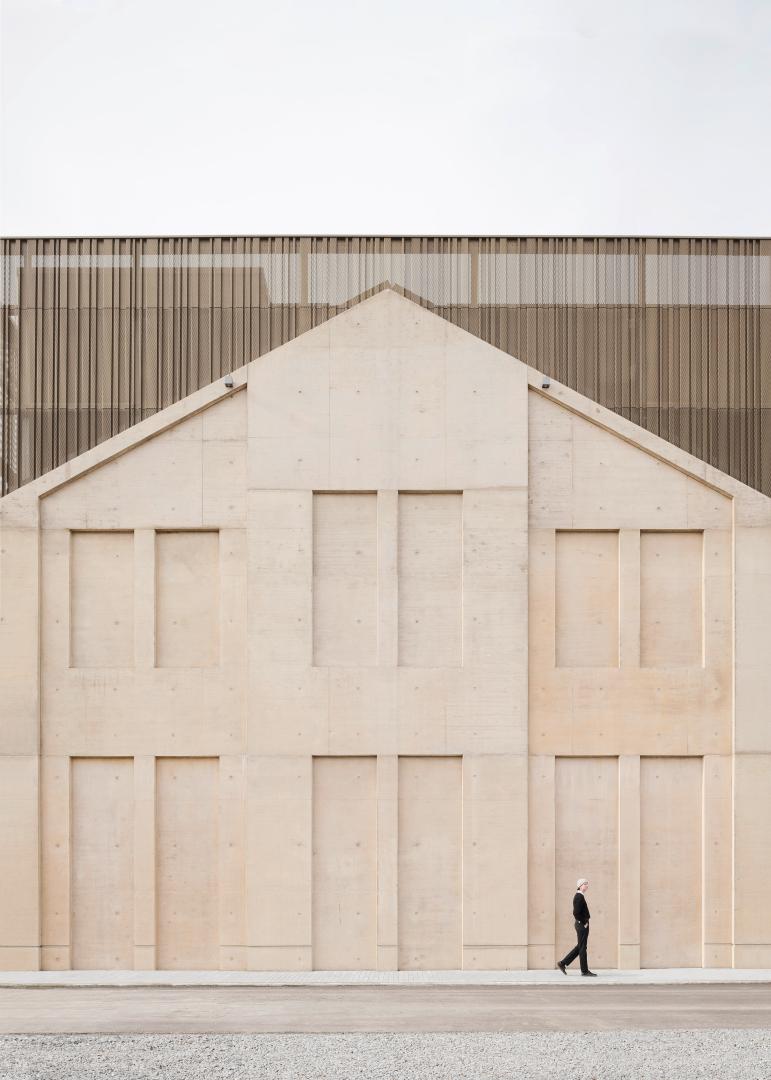
The extensively destroyed façade was replaced in a stylised way with coloured fair-faced concrete. Where possible, a+r Architekten sought to revive the historical character. For example, the sandstone façade was completed and repaired by stonemasons in the corresponding places. Due to the smoother surfaces of the new sandstone, the new components were deliberately left visible as such. The roofs of the short side gables were also rebuilt according to the historical design. The longitudinal gable, by contrast, was treated quite differently. It was replaced by an elongated, cuboid-shaped volume clad in folded perforated plate, thus creating a spatial reference to the urban edges of the neighbourhood bordering to the south. In contrast to the historical sandstone façade with its ornamental craftsmanship and massive appearance, the superimposed cuboid is plain and restrained. The semi-transparent perforated sheet façade allows the cuboid's volume to shine through, creating associations with a cloth-like curtain and contemporary industrial architecture.
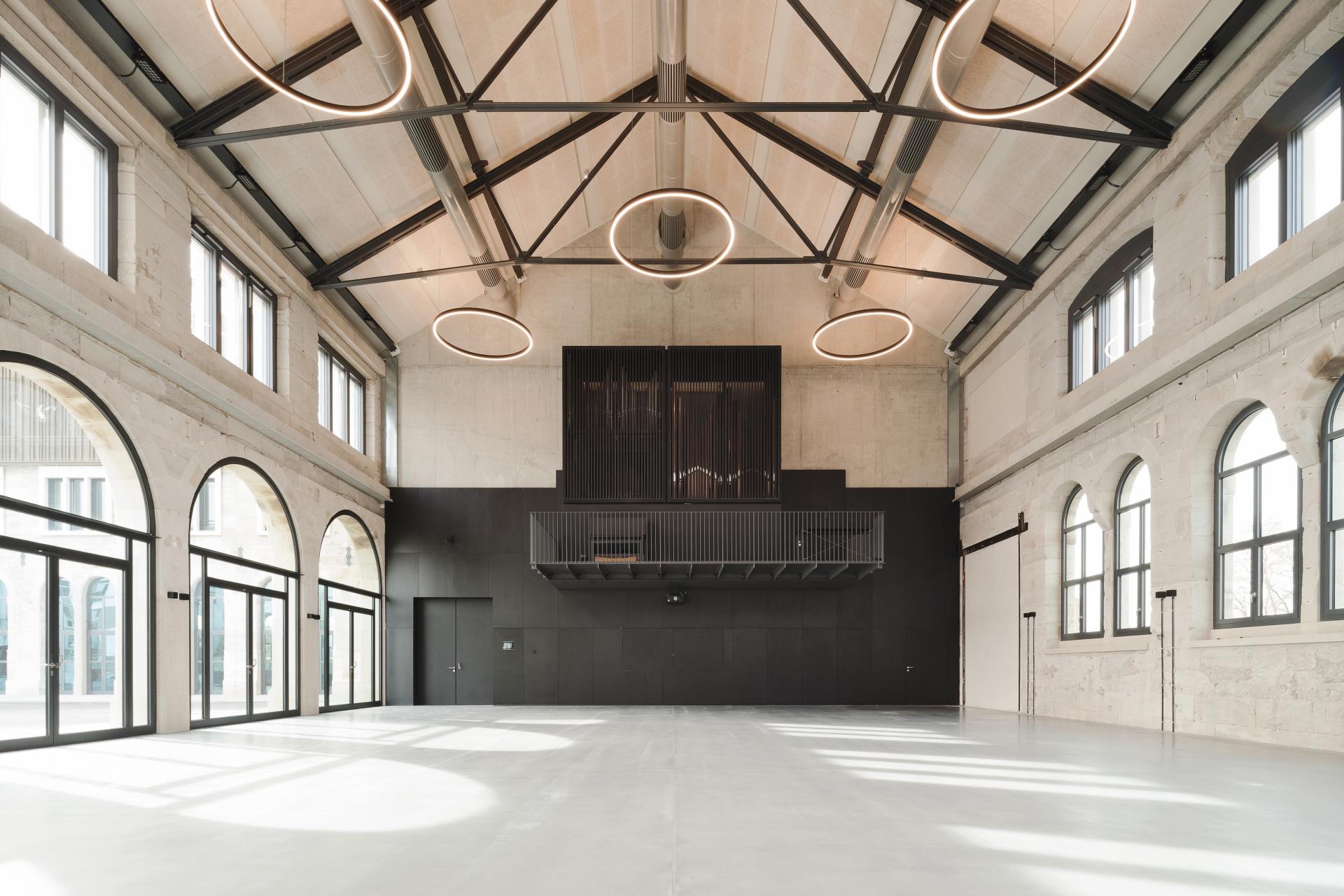
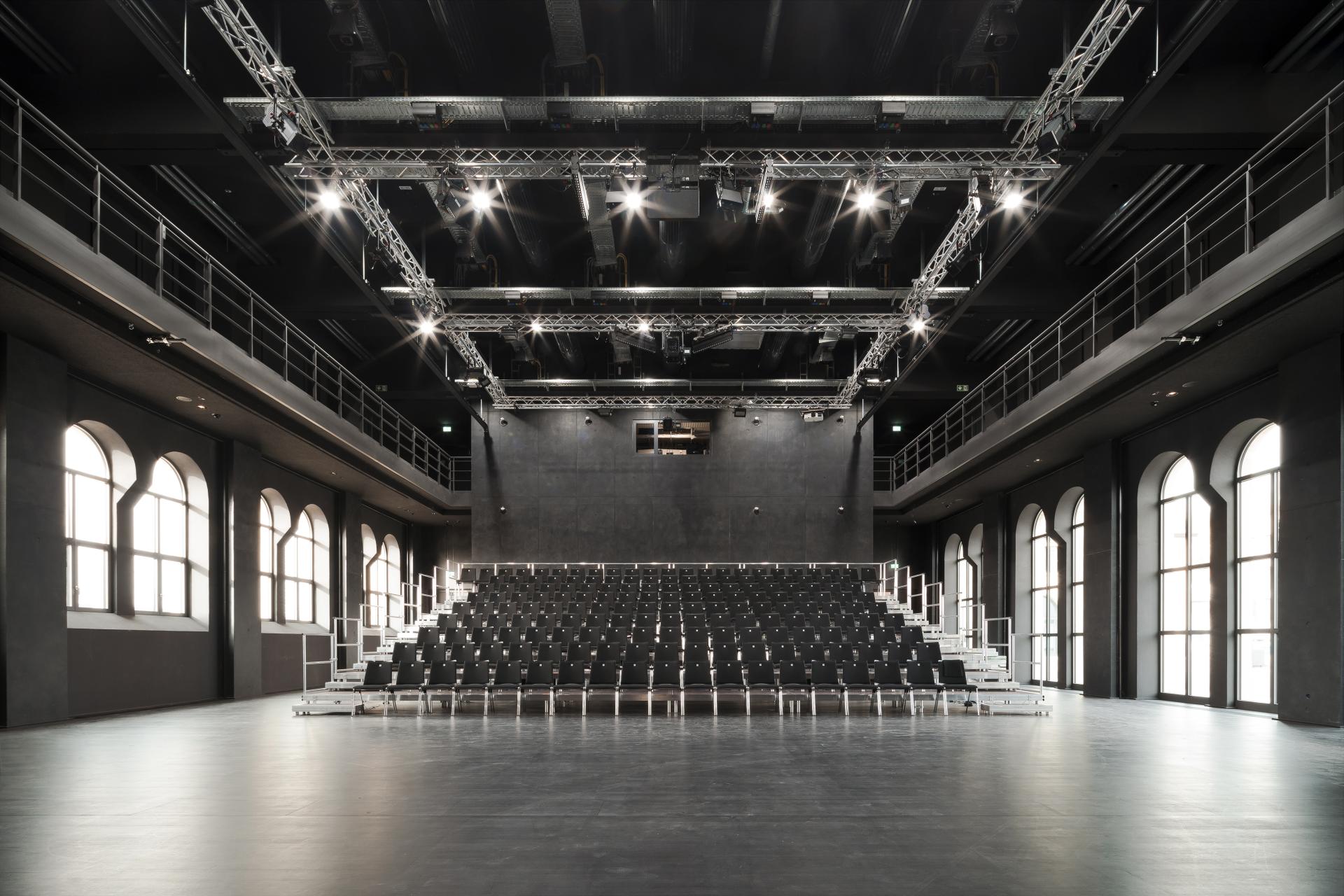
The historical façade provides the shell of a generous space. New boxes were placed inside this completely gutted space, zoning it for different uses. These boxes also support and stiffen the new load-bearing structure. The large halls and public uses are located in the old building. The music school and the theatre workshops are housed in the new, cuboid-shaped volume built on top. These rooms “serving” cultural production and education symbolically arch over the show stages for the culturally interested public.
Key objectives for inclusion
The building offers space for social discourse, free culture encounters and open exchange. It stands for the creative coexistence of people and is a meeting place for young and old. In addition, intensive discussions were held with the Advisory Board for People with Disabilities. It was very important to us that everyone benefits from the building and of course it is completely barrier-free.
Results in relation to category
The new Kulturbahnhof provides the opportunity to experience a variety of cultural events and a piece of railway history in a location close to the city center. It is a historically valuable building and was the heart of Aalen´s railway junction. Where locomotives have been repaired for almost 100 years the music school, cinema and theater of the city of Aalen now form a symbiosis with the conference and event industry. The shared building for the diverse cultural venues, which were previously spread across several locations, contributes to optimising resources, pooling synergies and ensuring cost savings in the long term. The building is a great example of urban development and, with around 3,400 m² of usable space, has become a cultural hub for Aalen and its region.
How Citizens benefit
Since the Kulturbahnhof is a building of public interest it was treated as such. Intensive discussions were held with all future users and the municipal council. There was a lot of need for coordination and an intensive dialogue with all cultural workers. These discussions enjoyed a very high level of participation and the realization of the functional and spatial allocation plan was tailored to the various needs.
Today the Kulturbahnhof provides a historical environment in which all citizens can enjoy performances, film shows, art exhibitions, concerts and other cultural events. With its very special, light-flooded architecture the building also serves as venue for company events such as conferences or anniversary celebrations.
Innovative character
The entire material and design concept is based on the idea of interrelating the industrial architectures of the nineteenth and twenty-first centuries in a variety of ways. a+r Architekten have succeeded in integrating the historical building fragments into contemporary architecture with great sensitivity and in creating a place with supra-regional appeal. By using historical components such as materials, windows and a visible roof construction it was possible to create an authentic and independent ambience for the different cultural venues. Although it was a challenge to create a harmonious whole from the existing building fragments and new elements, at the end a piece of city history could be saved which gives the new district in Aalen an identity.