Urban Degrowth Platform
Basic information
Project Title
Full project title
Category
Project Description
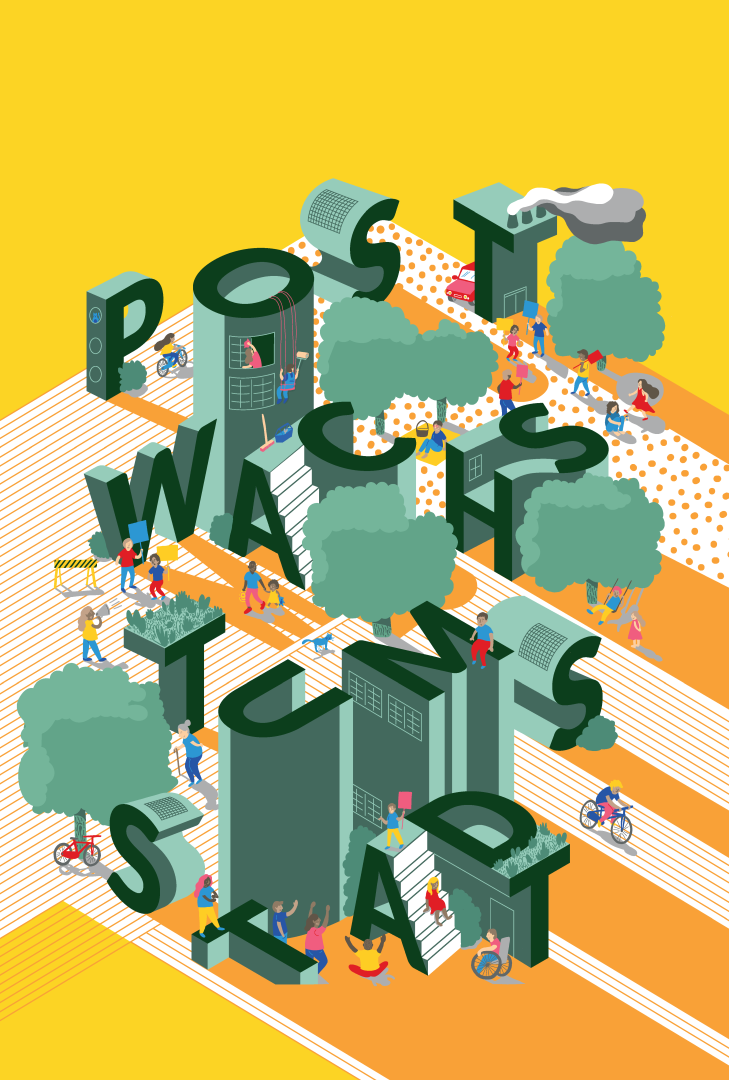
Another city is not only possible but also feasible: On the platform urban degrowth, a complete virtual miniature city becomes visible, through which one can wander. One can discover ideas for climate-just social housing, implementation examples for sufficient mobility, explanatory videos on alternatives to land consumption, and many more. To enable resilient urban design beyond growth, the platform accompanies the journey of innovative and transformative policies from one place to the next.
Project Region
EU Programme or fund
Description of the project
Summary
How can we convey new and attractive images of coexistence? How can the new European Bauhaus reach out to implementing actors with concrete tools for transformation? The proposal for an Urban Degrowth Platform (German: Postwachstumsstadt; cf. Brokow-Loga/Eckardt 2020) combines these two requirements. On the Urban Degrowth Platform, the social-ecological transformation of cities becomes visible. Forward-looking policies and feasible perspectives for the city of tomorrow are bundled and presented in an easily understandable way. The platform thus serves in particular to facilitate access and research transfer for the topics of urban sufficiency and resilience.
Basically, this platform consists of a website on which the 3D model of a virtual miniature city is displayed. Similar to the view of an urban planning simulation, one can zoom in or out of this model and rotate the perspective. Particular elements of this miniature city of tomorrow can be selected and provide further information, best practice projects, explanatory videos via a pop-up. This not only stimulates the imagination, but also provides innovative and tried-and-tested procedures and measures for municipal practice. For example, a "click" on the immediate surroundings of the city shows which instruments can be taken against further land sealing. A "click" on the four-lane arterial road shows which measures can be used to structurally promote sustainable mobility, etc.
Why is this platform needed? The concepts the new European Bauhaus stands for and that are so important for the transformation to a climate-friendly continent are being debated at length in academia and social movements. For these groups, the platform may be „nice to have“. But to accelerate and deepen change, a shift in structural policies is needed, especially at the regional and municipal level: Main target groups are therefore municipal and regional administrations, decision-makers from (municipal) enterprises and local politicians.
Key objectives for sustainability
After the realisation that a rigid focus on economic growth leads to irreparable damage to the entire ecosystem, new guiding principles are needed - especially for urban development and regional planning. Even though cities and municipalities were not officially parties to the Paris Climate Agreement, their actions are essential for achieving the goals agreed upon there. In terms of sustainability, the Platform emphasises the perspectives of a new European (Um-)Bauhaus: reducing the consumption of resources in society and closing cycles, avoiding the use of concrete and petroleum-based products as far as possible or not sealing any new areas. Instead, innovative solutions should be disseminated as widely as possible and decision-makers at the municipal level should be encouraged to convert and reuse existing infrastructures.
The platform serves these goals by acting as a bridging agent, taking up innovative sustainable ideas, illustrating them attractively and giving advice on how to implement them. The central mechanism of action of the platform aims at policy mobility and circulation of ideas. The topics covered include building and land policy, housing and mobility, economy and production, nutrition and urban-rural linkages. In order to present a truly comprehensive picture of a climate-neutral city of the future, attention is paid to the connection of individual elements: What synergies arise, for example, from the combination of the free offer of municipal e-load bikes and small-scale production and repair of consumer goods in urban areas? Where do community-oriented building land development and food policy go hand in hand? Various research projects and experts are involved in the development of this knowledge.
Key objectives for aesthetics and quality
When we ask our acquaintances today about the future of our coexistence in cities, half of them probably describe dystopian moments of climate catastrophe, the other half talk about a technology-optimised world in which there are more drones than people. Yet we need images of a successful city of tomorrow to motivate people and inspire them to change. Let's reclaim the Future: A real-utopian European Bauhaus demands the interpretation of images of the future. It is about inspiring our collective imagination, practising processes of creative exchange about desirable futures, gradually sharpening shared visions.
The concept achieves this goal of communicating a new, feasible vision for the organisation of cities through an appealing aesthetic presentation of the virtual miniature model. Because this is about a new "Gesamtkunstwerk Stadt" (total work of art), artists as well as computer scientists are involved in the (further) development of the 3D model. People have to be able to see change in order to understand it: The visibility and "walkability" of the model enables the individual conviction that a solidarity-based and climate-friendly way of life in our cities is not only theoretically possible, but can actually be realised.
Key objectives for inclusion
The post-growth city is either for everyone or it is not. Inclusion and participation are therefore central criteria for the success or failure of transformative policies - also and especially at the city level. Thematically, this is illustrated in particular by innovative approaches from participation, integration work and democratic culture.
The accessibility of the platform is in the foreground at every step of the conception and realisation. The service will be available to internet users completely free of charge. Easy access is made possible through barrier-free web design, the use of simple language, and combination with images and short video sequences. Hence, even in times of a pandemic, transfer of knowledge is enabled.
The beta version of the platform realises the real potential of trans-local online participation: own thoughts, projects and drafts can then be entered and published after examination by a scientific advisory board. Courage and motivation for fundamental change arise from the exchange of ideas, needs, wishes or fears: The platform stands precisely for such an attempt to dream together and develop feasible visions. In the third stage, gamification, i.e. further development as a mini-game or app, is envisaged in order to win completely new target groups for a social and ecological transformation.
Innovative character
Organising cities independently of growth - a vision hardly imaginable so far. But climate change, waste of resources, growing social inequalities and many other dangers for the future fundamentally call into question the current panacea of growth. How do we want to live together today and tomorrow? How do we design a good life for everyone in the city? While these questions are already being answered to some extent in niches and by specialists, there is still a lack of comprehensive designs and transformation approaches that outline a fundamentally different, solidary and climate-just city. The Degrowth City project ventures this attempt with the platform proposed here.
This platform has an innovative effect on three levels: Firstly, it makes a contribution to a climate-neutral turnaround by bringing together various findings from research and practice and conveying a holistic perspective on urban policy beyond profit and growth as concretely as possible. Secondly, it creates a potentially pan-European bridging agent for sensible policy approaches that can be "mobilised" and adapted translocally in other places in order to stay within the 1.5 degree target overall. Thirdly, the innovativeness is demonstrated by the fact that the intended research transfer aims to address the relevant target groups in a new way with visualisations and playful elements.
The platform asks and deals with pressing questions: How do other images, other wishes and desires enter the minds and hearts of today's people? How do we create strong utopias, without which a new European Bauhaus is at a loss? How do we mentally and structurally set the course for a turning point?
The character of this concept is fed by the hope that the history of cities as places to live for all people will find a third possible outcome between climate collapse and humanless smart city. The vision focuses on quality of life, a way of living in solidarity and the transformative role of municipal institutions.