Tracing the Roots
Basic information
Project Title
Full project title
Category
Project Description
The idea deals with perceiving the diverse narratives of productive landscapes, from them, selecting vital ones and then using the power of narratives to compress time and space, delineate them through sensitive design interventions to positively influence the organoleptic decision, by stimulating thoughts and sensations through inducing a different conception of landscape, which fully recovers its tangible and intangible value, leading to an added worth associated to the Colli Piacentini wine.
Project Region
EU Programme or fund
Description of the project
Summary
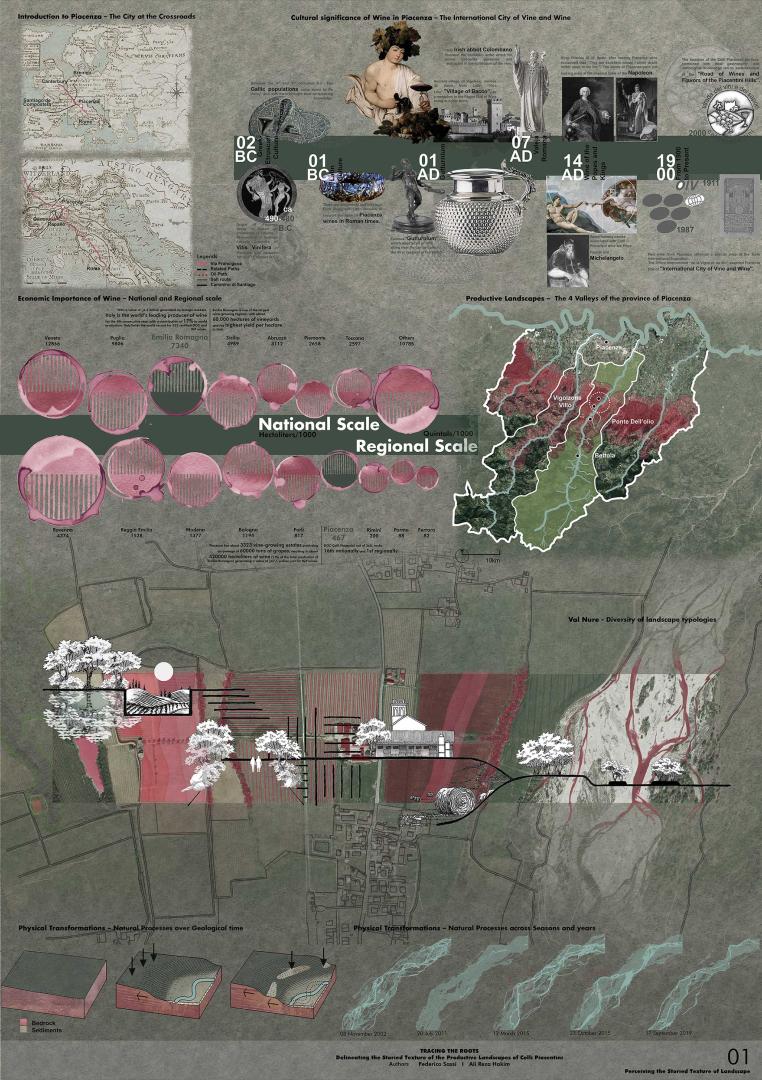
Landscape is a complex palimpsest composed not only of physical elements, but also of culture, history, traditions, and people and the productive landscapes of Piacenza are no exception with the earliest records of grape cultivation dating back to 2nd century B.C. The recent innovations in wine industry however have given rise to conflicting socio-environmental issues necessitating giving of poetry to utility of these functional landscapes.
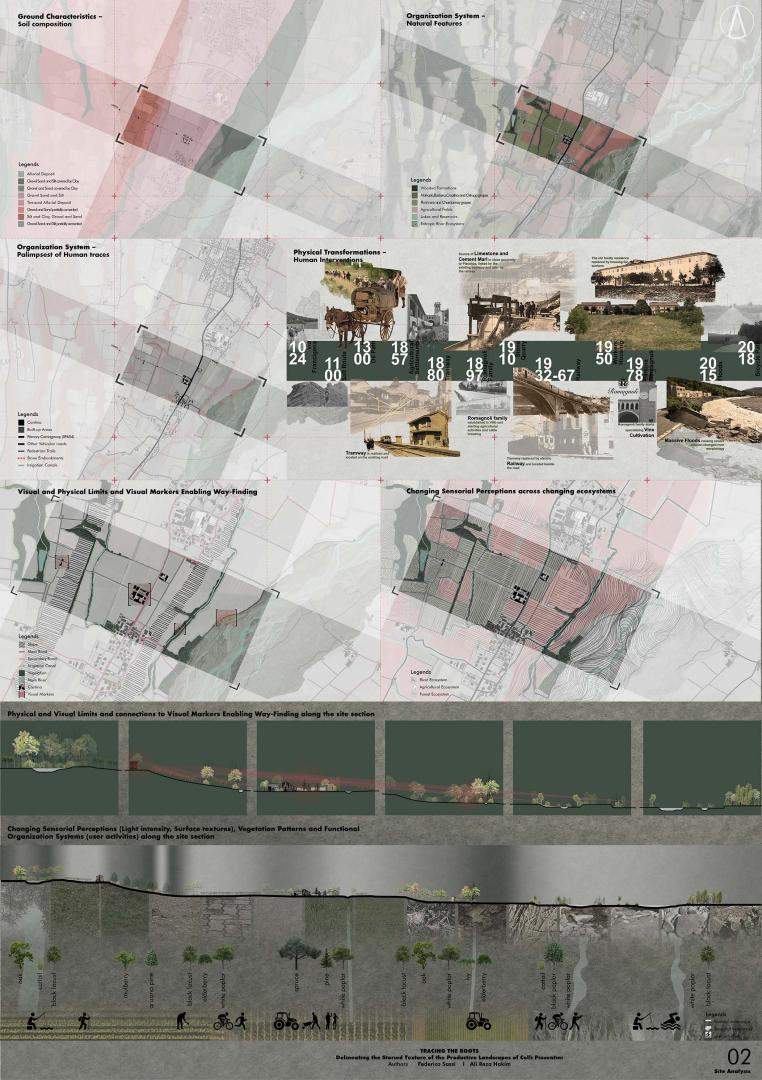
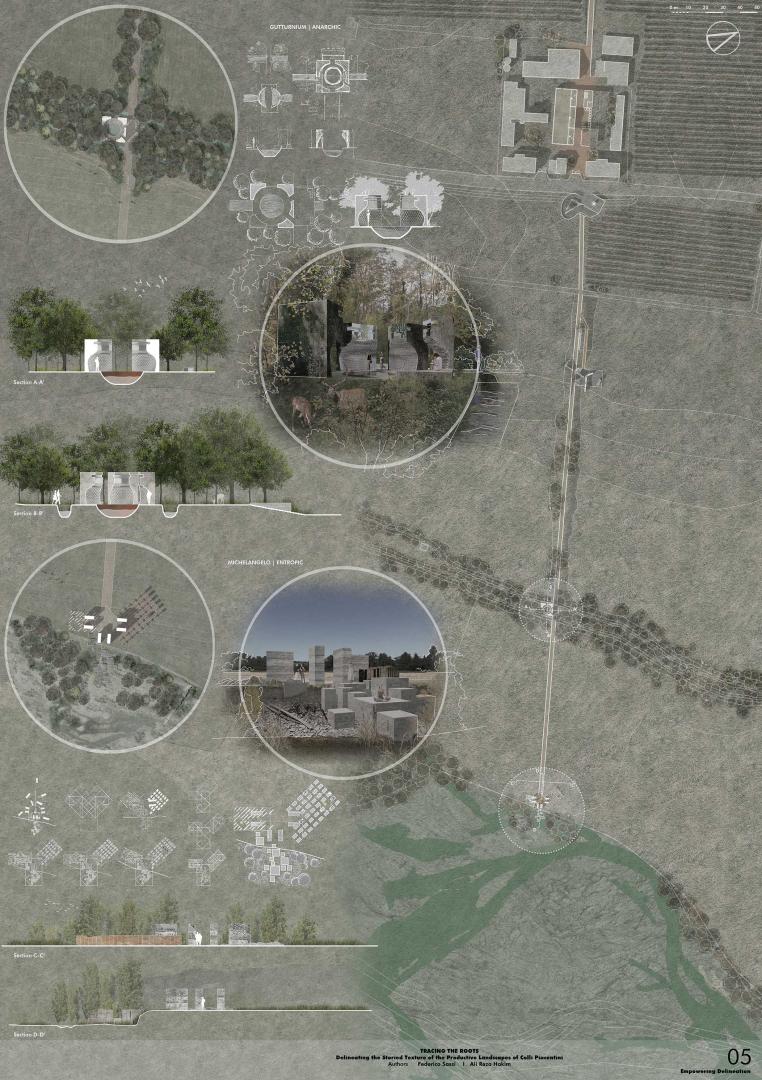
The idea specifically concerns the precinct of Cantine Romagnoli, on left bank of river Nure which is a complex mosaic comprising of an incessantly transforming landscape in which all the stages of beginning, climax, and annihilation can be seen at once. The research identifies the narratives of wine cultivation and production, cultural significance, and physical transformations on site in context of relation they have with the diverse landscape typologies which are determined by the changing soil composition. These stories are then narrated through architectural devices designed as art pieces, contributing to the site, a shared public realm. A plethora of narratives are evoked using tropes and abstraction of physical artefacts. All interventions represent efforts to gather and preserve the remnants of past within the context of evolving lived-in landscape.
The design aims to enhance the expressive potential of vineyards to positively influence the organoleptic decision by inducing a different conception of landscape, recovering its tangible and intangible value, adding to worth associated to Colli Piacentini wine.
Narrating the temporality of Colli Piacentini wine, could recreate economic opportunities in the region, spelling new life into its rich past. The idea has a potential to be adapted to diverse contexts. If we become aware and change the way we see and use our productive landscapes, an alternative future comes into view where we help biodiversity and promote the socio-cultural values we inherited.
Key objectives for sustainability
The general scope of the design concerns the possible role that landscape design can play in agricultural contexts, developing the opportunities offered by the integration between agriculture and architecture with a view to protecting and enhancing the environment and the landscape. More precisely, it aims at experimenting interpretative categories, methodologies and operational tools to recognize and enhance the specific identity values of the agricultural territories of the Colli Piacentini in relation both to wine production and to the urbanized and naturalistic systems that make up the complex territorial mosaic of the local Piacenza system, as identified by the "National Rural Network" promoted by the Ministry of Agricultural, Food and Forestry Policies.
The objectives that guide the research as essential elements for an effective project to enhance the landscape and the environment concern the sustainability of the interventions, the safeguard of biodiversity, the protection of soil and water (avoiding waste and practicing a sustainable use of fertilizers and pesticides), the mitigation of climate change through the reduction of emissions; objectives set out in the Common Agricultural Policy of the European Commission.
These objectives are addressed by implementing a design strategy manifested through interventions that essentially using locally available materials realize context specific architectural devices authorized within an ecological discourse for facilitating the delineation of the storied texture. Volumes, forms, and materiality become metaphors of time and transformations, providing significant spatial experiences at first followed by revelation of the other level of meanings. This apart from creating awareness, stimulates change in the commonly held discourses through an ecological (re) reading and design in nature.
Key objectives for aesthetics and quality
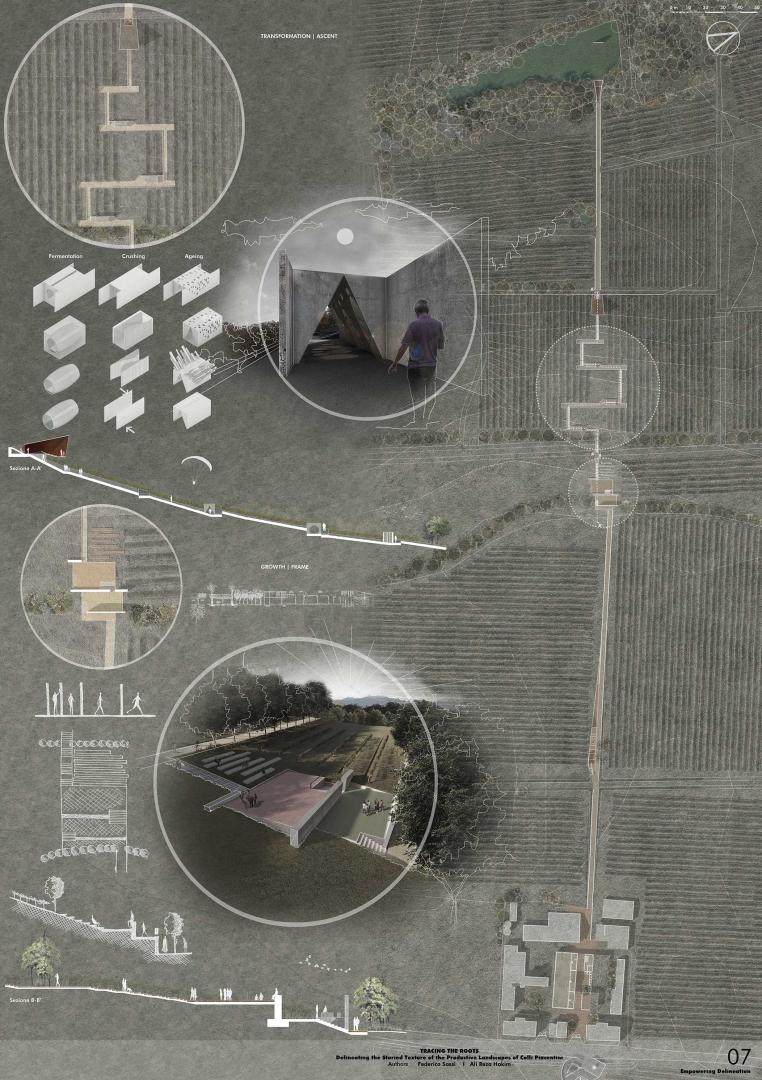
The landscape existing in layers on site, distorts and condenses time to create clear ideological constructs and associations between the various transformations that are constantly shaping new realities and can thus be perceived as a complex series of interrelated events that can be retold and organized into narratives. The design goal is to align these contingencies toward an overwhelmingly enriching experience and historical march by narrating these stories spanning across the actual geologic, ecological and human processes (story time) in the time it takes to walk across the site (time of narration). Natural sequences and processes, such as changing soil composition, lowland to highland, are some of the many devices used to structure narratives.
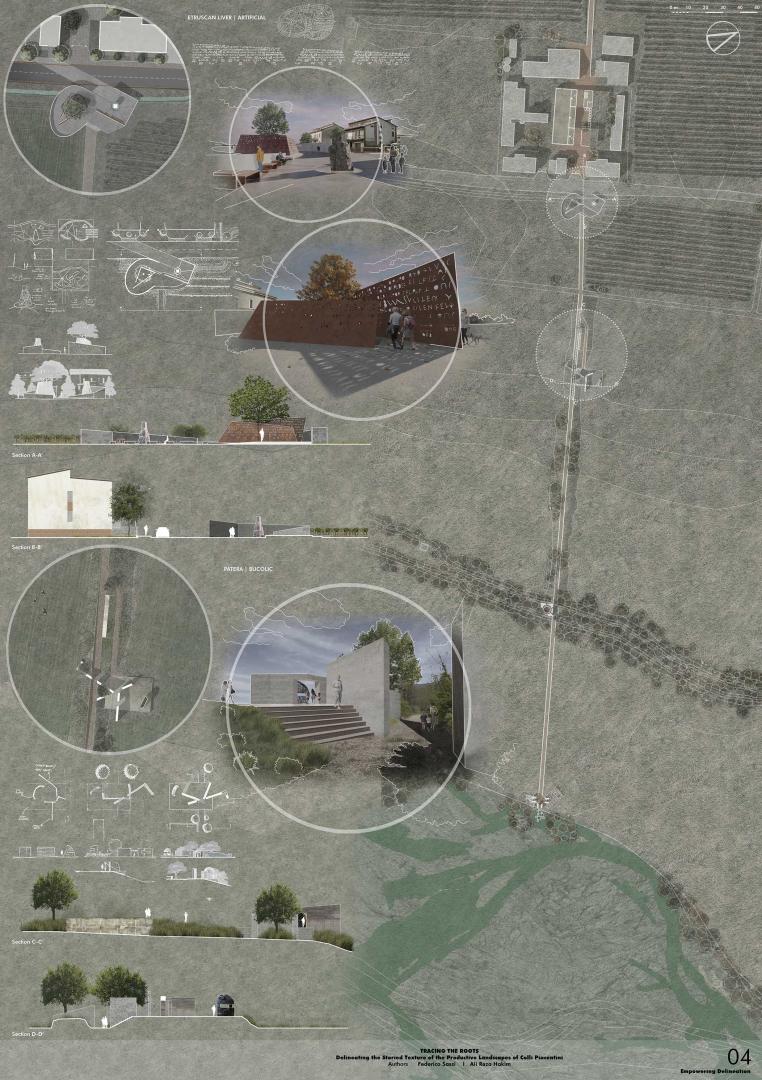
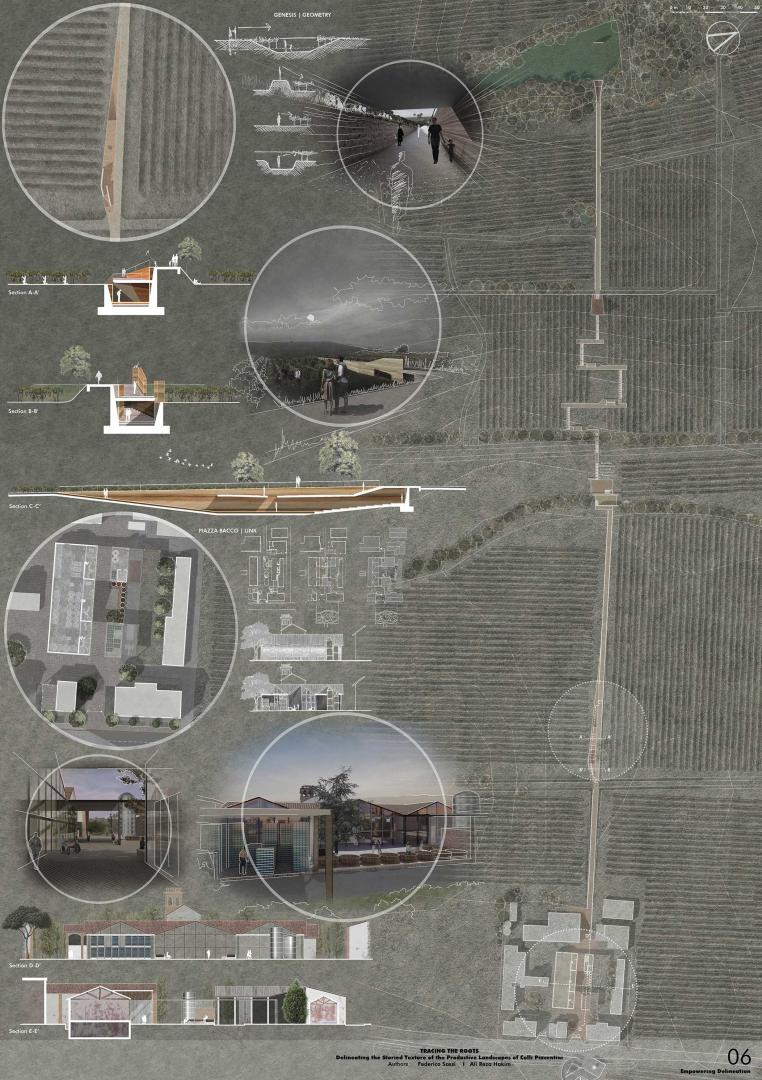
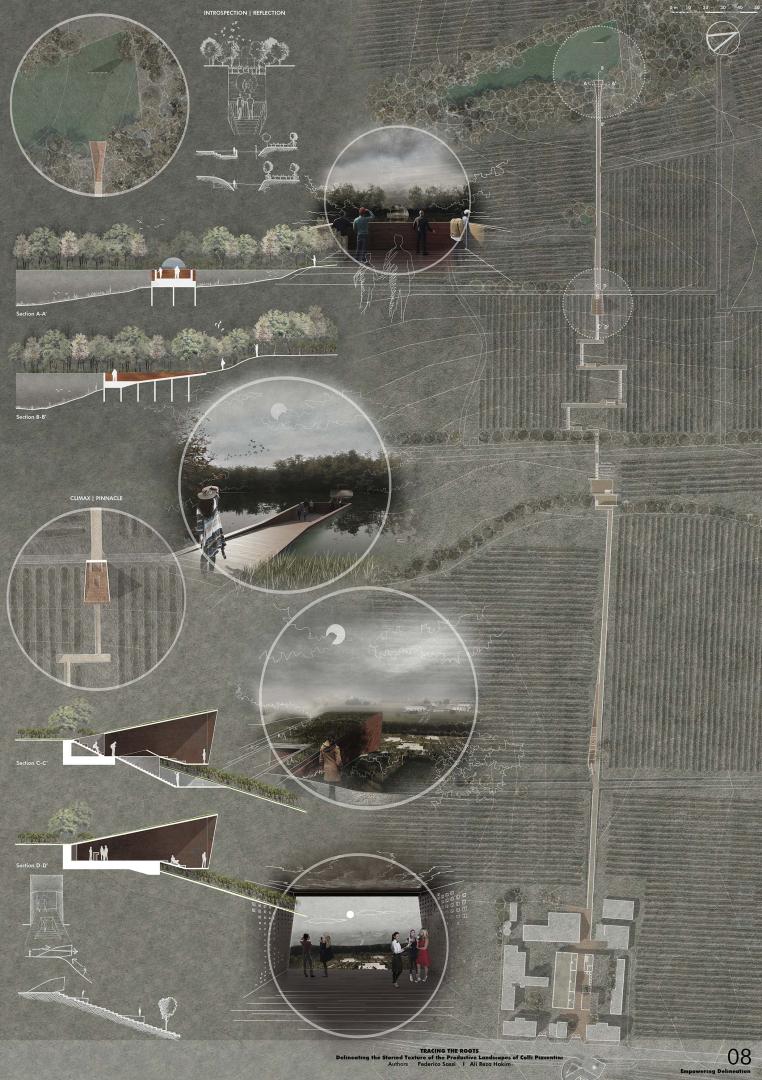
The design sets up the complex storied texture of the valley as a chronological socio-cultural history. It orchestrates a processional experience where visitors can feel, touch, hear and smell, and connect with a time that once was. The linear structure of proposed circulation becomes an ordering device for a sequential experience frequented by designed spaces from which to view the landscape. As one walks away from the river, one walks backward in time, crossing a sequence of increasingly older terraces. Ten pavilions empower the delineation of the narratives as distinct from an anonymous causality, all recounting how nature and humans play a key role in all of this. These spatial devices, designed not as objects but as an experience over time, by implementing visual narratives that have the power to compress time and space, materiality, and most important the play of textures work together to articulate this process.
The plot of the story creates a comparison between subjugation of the ancient terraces by contemporary productive landscapes, and that of the wild entropic river ecosystem of a more recent era. The design becomes an allegory asking the reader to interpret the actions of present in context of the past.
Key objectives for inclusion
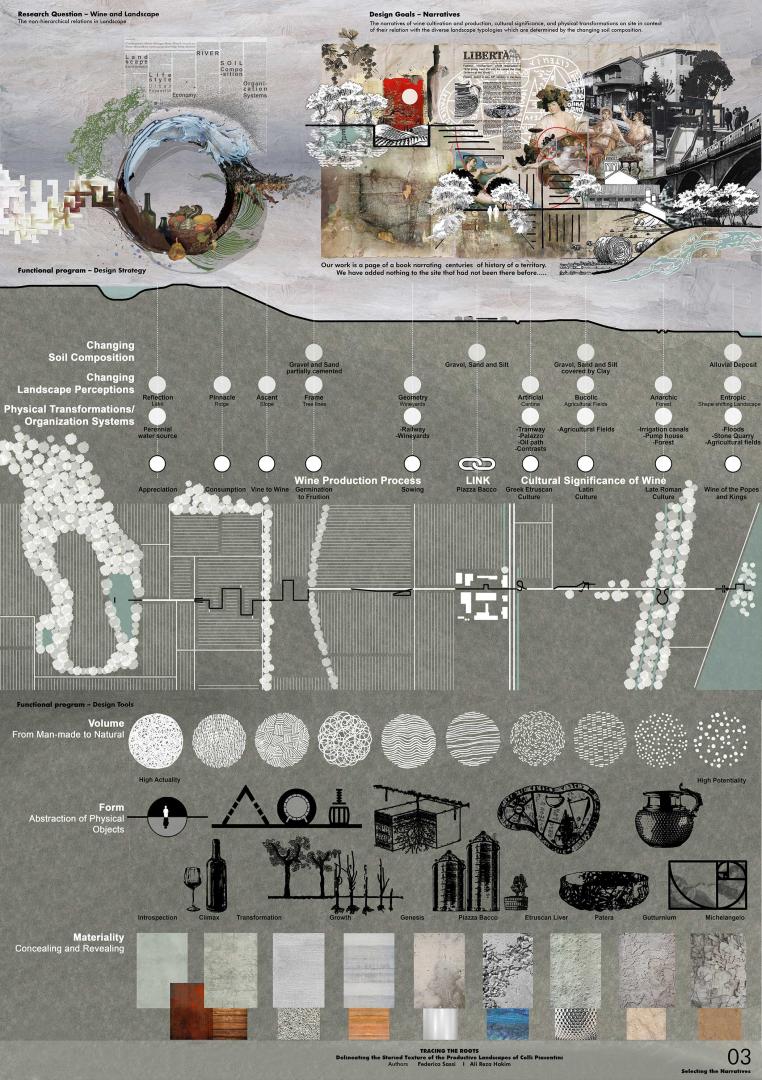
The design reading the existing ecological narrative, "lets the site reveal itself." Plant signatures become devices testifying how subtle changes occur along "changing soil composition". This is followed by overlapping the chosen narratives of changing landscape typologies, physical transformations, cultural significance of wine and its production process, through a complex matrix, thus identifying 10 strategic locations for design interventions. Each point employing sophisticated means of shaping the site to narrate transformative and cultural memory, thus has a plethora of information dealing with geological, visual, functional, technical, and cultural aspects of site, offering a tailored experience to a diverse audience.
The design enquiring the reciprocal interactions that are promoting a growing interest in the combination of wine and landscape defines a valorization strategy to ameliorate the quality of production as well as leisure along two "narrative" routes. The first, from the winery leads to the edge of the terrace through vineyards and works in a narrative dimension emphasizing various elements dictating the organization system of the landscape and its relation to vine cultivation and production through realization of some architectural devices. The second one, from the cellars, approaches the river and narrates the relationship between natural and cultural landscape that is at the basis of the wine-growing tradition of the Val Nure. Multiple sequences through the same Landscape are thus concocted, structuring different meanings depending on the direction the visitors choose to follow. All interventions represent efforts to gather and preserve the remnants of the past within the context of evolving lived-in landscape. People living and working in the landscape, become part of a dynamic history and ongoing narratives. Setting the site in motion the design thus engages both the visitor's movement through the site and the site's movement through time.
Innovative character
As narrative continues to be primary area of theoretical inquiry and practice in designing landscapes, several critical questions emerge. How can designers create intelligible narratives? Since there are many possible and often competing stories, how can one consider what traditions can be drawn upon? How open is the narrative to change, reinterpretation and participation? Addressing these issues, the research establishes the core metaphoric link between ecology and society highlighting the collective and non-hierarchical relation between the two. It eschews conventional, formalist design as capricious, emphasizing importance of authorization of all interventions within an ecological and cultural discourse.
The design analyses the site in a regional dimension identifying river Nure as the key protagonist actively carving the valley since eons into its existing form. The validity of such discourse is demonstrated through recurring phenomenon evident in landscapes characterized by rivers that define the soil composition which in turn determines various user activities and organization systems. The productive landscapes boost the economy thus benefiting the society and lifestyle manifested primarily through urban expansion. This influences the natural environment which impacts the river itself. Each element thus holds equal importance and changing one, sets off a chain reaction affecting all. These relations existing on site, concealed within the complex palimpsest of the constantly evolving landscape are delineated to create awareness and guide environmentally, socially, and economically sustainable decisions.
The interpretations of ecological landscape are presented in fast motion, making the otherwise unperceivable processes of nature visible. Further, being situated in an essentially productive landscape, the design exposing what was once concealed relates to the idea of integrating nature and culture, making people aware of their actions and use of resources.