Traces of freedom
Basic information
Project Title
Full project title
Category
Project Description
The “Little Red House", a pavilion on the issue of affectivity, and the "Pergola", a shady place to meet family, are the physical traces of an action-research that questions the living quality of Italian prisons.
Built between 2018 and 2019 in the Milan Bollate prison colloquium area, they witness the cooperation between the research group of the Department of Architecture and Urban Studies of Politecnico di Milano, inmates of Bollate, the Prison Administration and civil society associations.
Project Region
EU Programme or fund
Description of the project
Summary
The subject of the application are two small structures built in the outdoor meeting area at the Milan-Bollate prison:
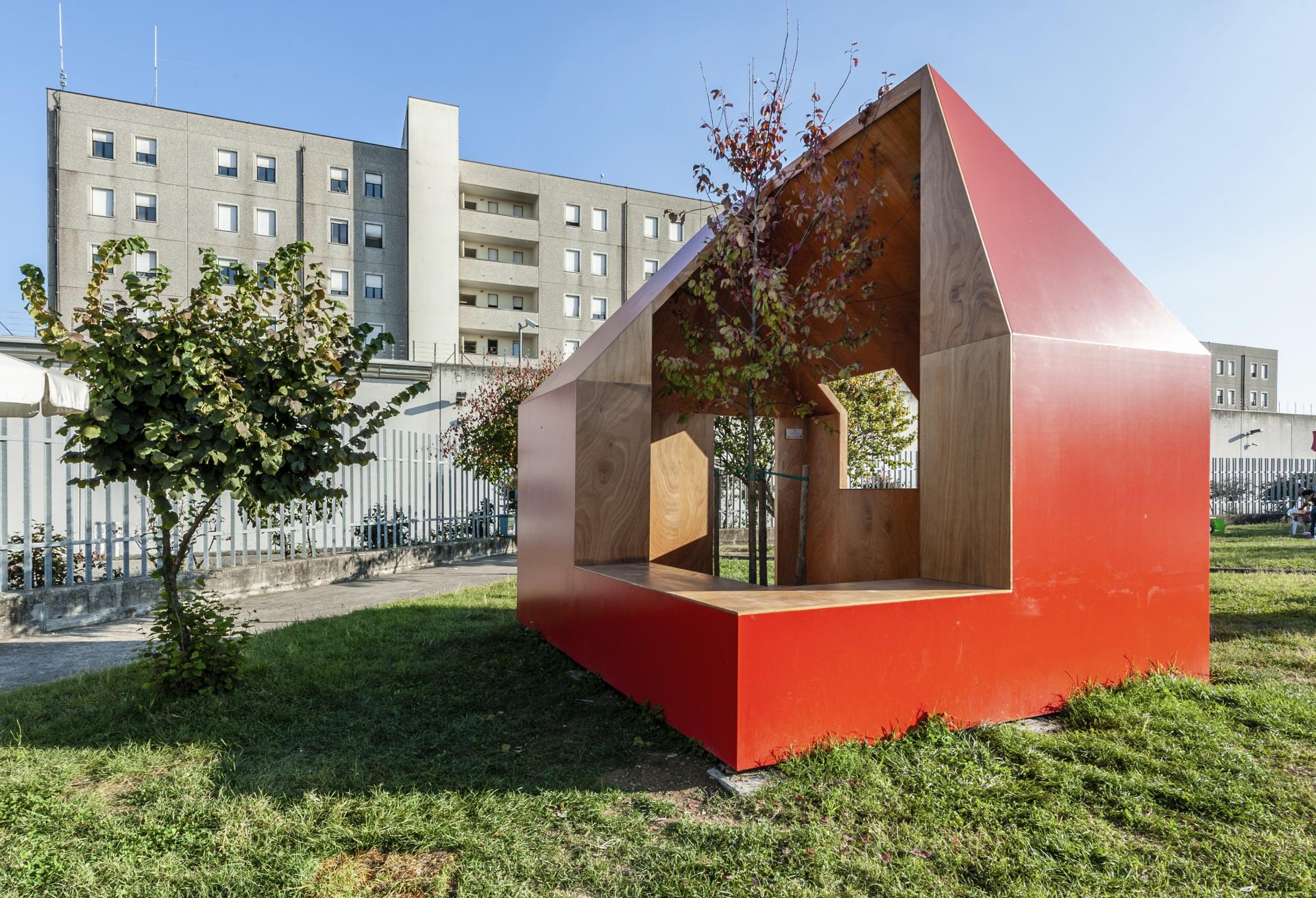
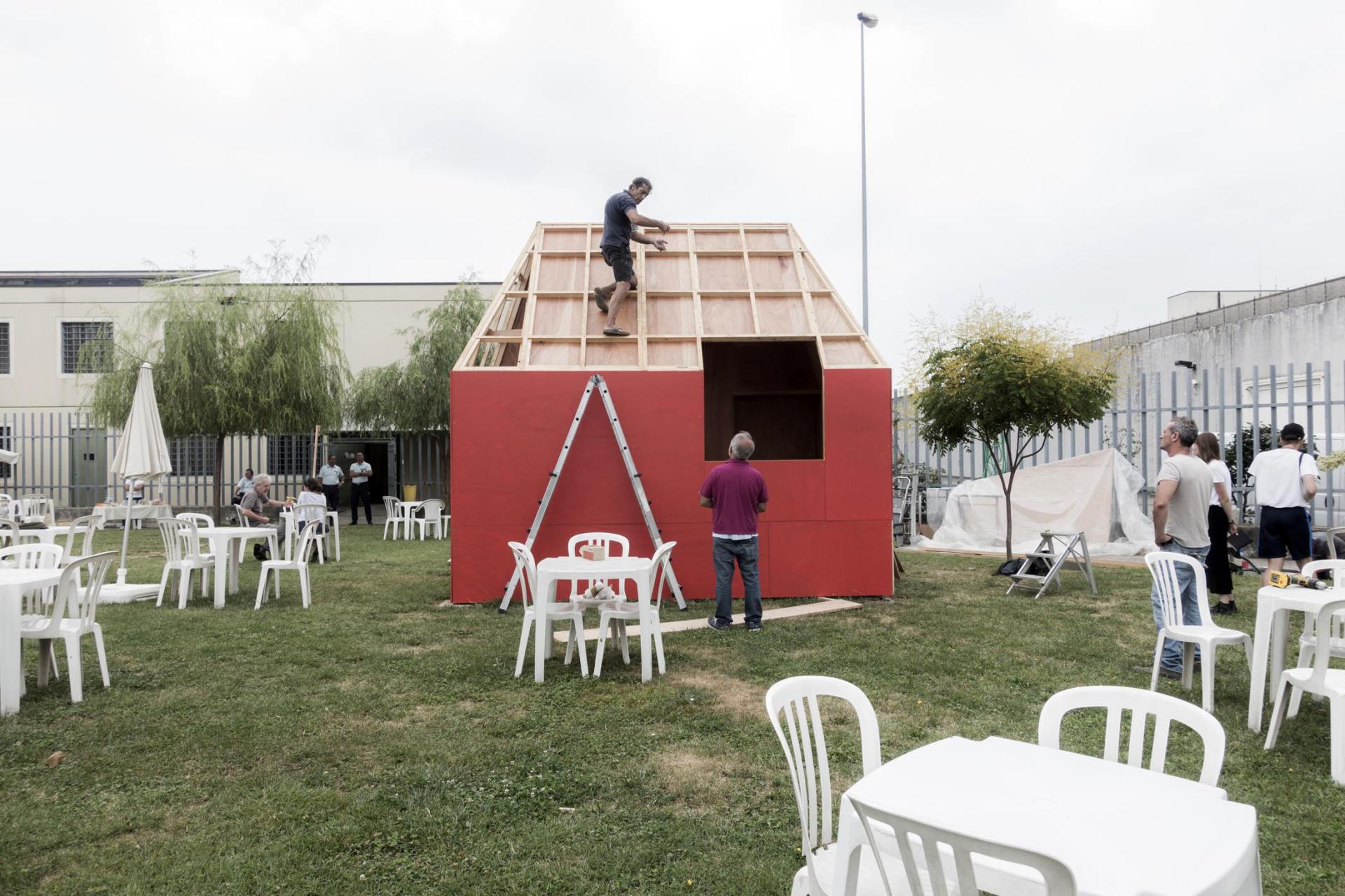
the "Little Red House", a wooden pavilion for parents who are in the prison to meet and to play with their children: it interprets the issue of affectivity. It was opened in 2018, after a two-year process of co-design and construction;
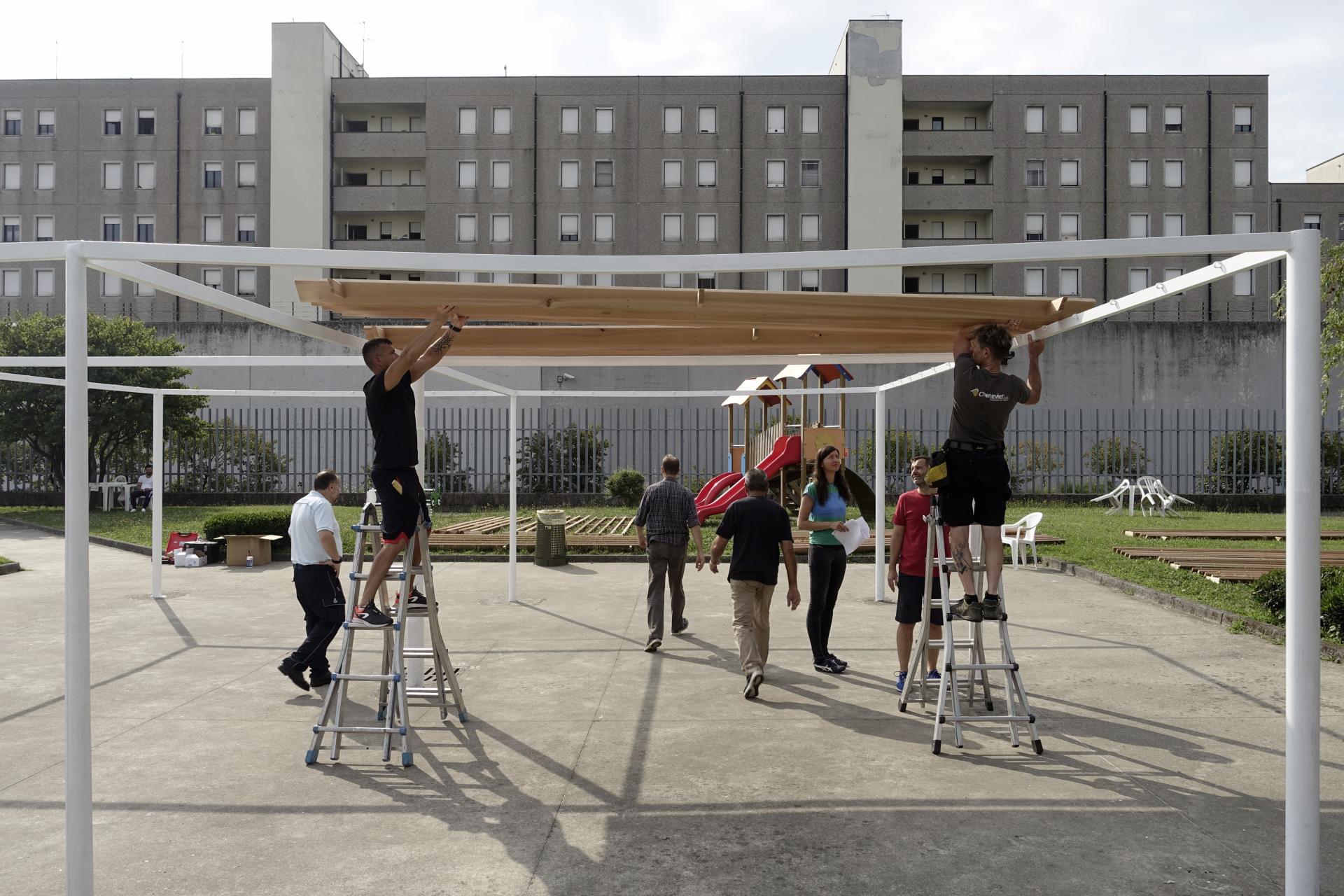
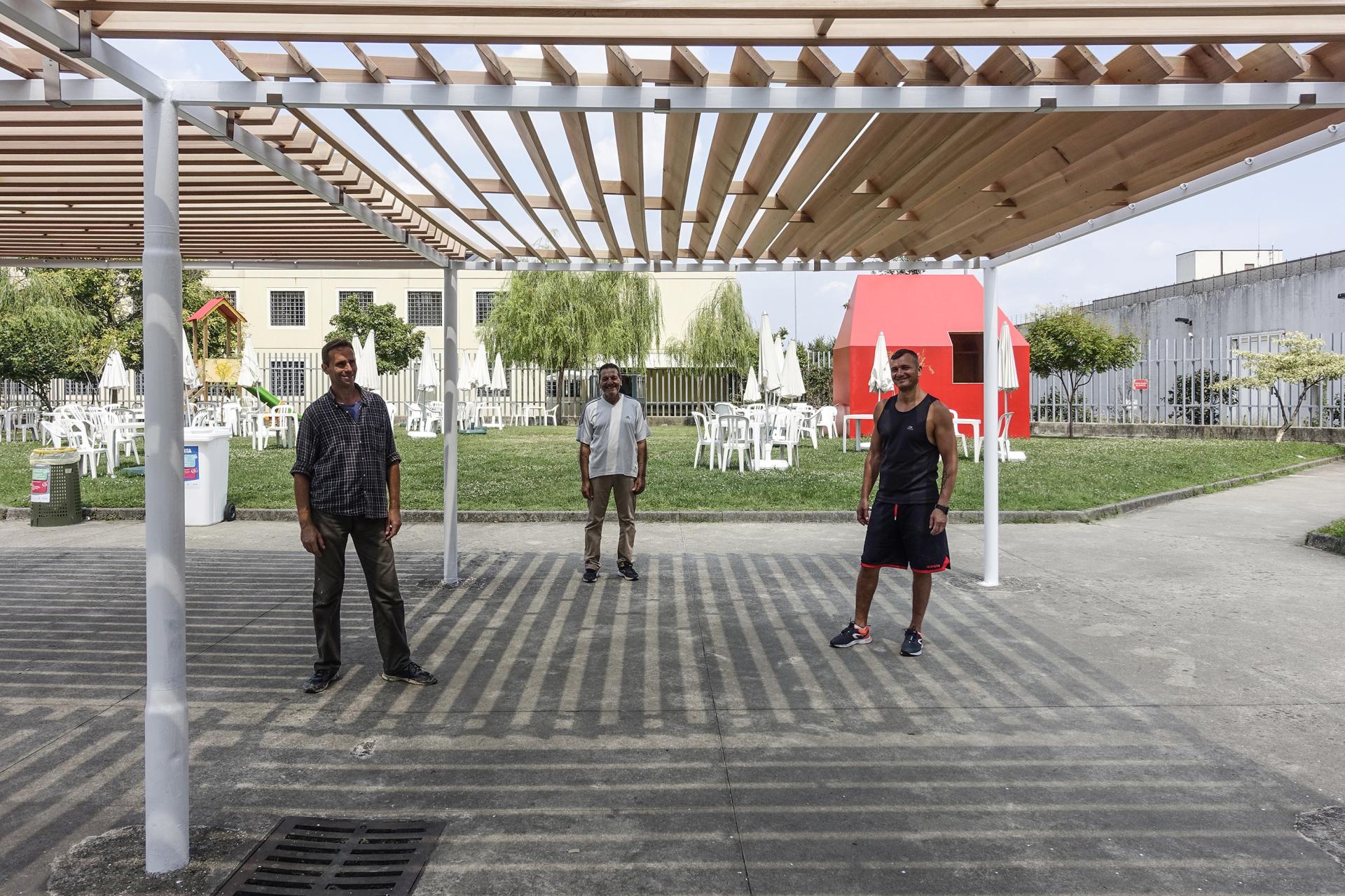
the "Pergola", a place for meeting and conversation. It was co-realized the following year 2019 by adapting an existing degraded structure.
The realizations are inquiry actions of academic research carried out from 2017 and funded by the basic research funds of the Department of Architecture and Urban Studies and supported by the Polisocial programme of the Politecnico di Milano. The Prison Administration and some civil organizations (Ass. Civicum, Italia Nostra Nord Milano, Coop. Rimaflow, Chenevier spa) support the research in terms of knowledge, economic resources and on-site work.
The work is based on the conviction expressed by Mauro Palma -National Guarantor of Rights of Persons deprived of personal liberty-about the role of the space in the inmates' lives: "space concretely conditions punishment in its development much more than many acute theoretical elaborations".
In Italy, we witness an obsolete and degraded building stock and the difficulty of carrying out a comprehensive redevelopment policy. The research uses the specificity of the cases studied (the Milanese prisons) and the projects drew to develop a national scale method. The method tries to frame the plurality of the opportunities that occur in time into an 'open' and 'long-term' strategic plan led by a design guesswork "from spaces of detention to places of relationship".
The value we assign to our work and to these minimal architectural experiments is to reveal the modifiability of the living quality of existing Italian prisons. The transformability of space aspects becomes a metaphor for a different vision of the idea of "punishment".
Key objectives for sustainability
The two projects aim to decline the sustainability theme according to different levels.
1. Optimize the resources available: economic, technical and human heritage. The issues of complexity that distinguish prisons tend to annihilate any concrete idea of project thinking. The research has tried to experiment and share a process that promotes the improvement of living conditions through the conception and sharing of a heterogeneous set of specific interventions - the Little Red House and the Pergola are two of these. The aim is to convey the idea that a change, even through small steps, is possible if co-designed as a process made by different punctual projects.
Each intervention is carried out in relation to the conditions and possibilities of the moment, minimizing the risk of failure. The individual artifacts aim to generate a lever effect to free up new resources and increase the value of each intervention in relation to the others.
Thus the limited investment renders the possible failure of the initiative more tolerable by not affecting the effectiveness of the broader process. Each initiative represents an example of what is appropriate by helping to build shared knowledge among the different actors involved.
2. Working in resource scarcity does not prevent the improvement of living conditions. The choices in terms of materials and technologies need to be precise. It is necessary to develop projects that use cheap, resistant and easily workable materials, enhancing the active contribution of prisoners in self-construction practices.
The personal involvement of 'inhabitants' represented an active value because to work is one of their most urgent need. In addition, the use of dry systems and materials such as wood and iron considers and allows the possibility of re-use and transformation: when the structure is no more suitable or needs to be changed it could be easily converted or dismantled.
Key objectives for aesthetics and quality
The two artefacts within the prison spaces could be seen as “negligible objects” from the material point of view, but they are relevant due to their symbolic value. They express and represent the traces of the possibility of a project that still survives inside the prison walls, in the hands and in the thoughts of its ‘inhabitants’, and associate to the project possibility the deepest nature of the freedom idea.
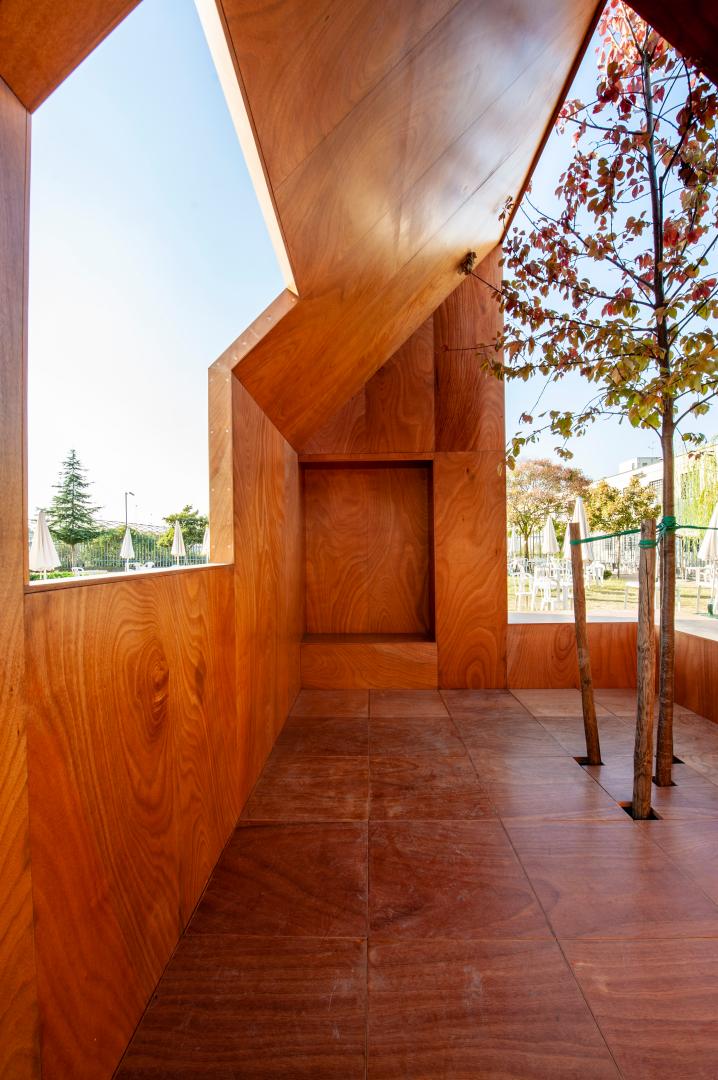
The Little Red House is a wooden structure that expresses the theme of affectivity. It is an open space enclosed by the idea of home and which in turn contains a tree that grows and blooms and needs constant care.
The Pergola is the reuse of a small iron structure by just adding a wooden sunshade on the roof. The warp of the wood on the roof determines a variable and suggestive landscape of light and shadows. It generates a small intimate square built with the inmates to host the meetings.
The space they dealt with is a generic one, homogeneous as a product of different modification without a project vision. Then the role of these small architecture is to reveal the specificity of the prison space and the design choices have been done with the idea to domesticate the space and trigger the imaginary of the inhabitants to stimulate new relational practices by:
- Using different materials, such as the introduction of wood, to recall the intimacy of the home.
- Introduction of unusual colors, as the red one of the Little Red House, to trigger new narration of the space by generating new appropriation practices.
- Introduction of natural situations, as the prunus tree held by the Little Red House, to trigger care practice as well as sensory comfort.
- Play of light and shadows, as the Pergola warp effect, to generate a continuous variation in an apparent static environment.
Thus the aesthetic strength of both could be directly associated with the capability to trigger new possibilities of experiencing the space of detention as a place of relationship.
Key objectives for inclusion
The action-research path is aimed at qualifying the idea of ‘freedom of space’ in prison by triggering the possibility of living the space through a project idea that gives meaning to the time of those who live or work there.
An open and inclusive path that recognizes the space modification as a necessary action both to improve the relational places and transform the design moment into a knowledge, sharing and personal growth situation.
The first action level concerns the physical dimension. There is a need to make the area more welcoming to transform visits into moments of ‘freedom’ by suspending the feeling of being in prison. The two artifacts are the first tangible signs of this possibility.
The second action level recognizes the architectural practice as part of a complex relational process triggering a network of stakeholders involved. In particular in prison the sense of participation is to return planning to those who have lost it or have never known it.
The participative method was practiced in different ways by adapting to the contingency of the moments:
- We have activated a network of stakeholders, giving voice and coordinating the questions and answers of the ‘inhabitants’, their relatives and prison workers. Over time, has been built up a community, composed by both promoters and beneficiaries.
- We activated two co-design workshops in Bollate institute which involved students and architecture professors, some ‘inhabitants’ and prison staff people that collaborated to make a proposal. Through an internal competition, the project to be build was selected (made by Buelli, Bucchi, Riccò, Rasile): the Little Red House.
- In both cases the projects were participatory. The different players actively collaborated for the self-construction; the prison administration, the civil society - Civicum Onlus financed the pavilion and Italia Nostra Milano Nord Onlus donated the tree - and the companies Rimaflow and Chenevier has provided the professional workers.
Results in relation to category
The process that led to the realization of the two interventions achieved both material and immaterial impact:
Material impacts - The first result is to have built structures that are used and improve (partially) the comfort conditions and the encounters between the prisoners and their families.
The Little Red Rouse is an intimate and child-friendly place, a ‘suspended place’ with respect to the surrounding context. It is a place where parents and children can have a family moment.
The Pergola is a comfortable and suggestive place to meet on sunny days due to the dynamic play of light and shadows generated by the wooden sheets.
These two artifacts have activated a design process that tries to qualify the outdoor meeting space by overcoming the standardization. They offer a differentiation of situations that satisfy the heterogeneous necessities of families meeting conditions. They are parts of a modification that is still ongoing, supported by new action-researches.
More broadly, the architectural achievements render tangible the possibility of improving the habitability of prisons through a process of small steps. Currently, within the same prison area, a multifunctional pavilion that expands the possibilities of meeting is being designed.
Immaterial impacts - The procedural nature of the projects has also produced effects of an intangible nature.
The first impact is to have recognized an active role for the ‘inhabitants’ in planning proposals for improving the housing conditions of the prison. Normally, they are generally passive beneficiaries of the projects they carried out in prisons.
The second is to have consolidated a planning community which, focused on Bollate prison, sees researchers, police officers, prison and university administration and third sector subjects collaborate on a trust basis. Construction of a network that took place together and which sees the group engaged in a new research program and the design of new interventions.
How Citizens benefit
The action-research path that led to the artifact’s realization is oriented towards an integrated and shared reflection on all project aspects. The approach employed considers architectural practice as part of a complex dialogue. The roles of designers and ‘inhabitants’ intersect on the basis of specific responsibilities.
Here more than anywhere else, the sense of participation is to generate the project possibility for those who have lost it or have never known it.
The process has provided many involvement actions:
- The activation of the dialogue between the didactic laboratory, the ‘transgression group’ (prisoners) and police officers.
- Communication of the project through various media, including the publication of the article in the newspaper which triggered the interest of the company Civicum which in turn triggered the involvement of Ri-Maflow and Italia Nostra Milano.
- The co-construction that represented a moment of opening by involving the agents, administrators, ‘inhabitants’ and family members.
- The relationship of trust with the prisoners that has favored the proposal and collaborated to create a new shading system for the existing structure supported by Chanevier spa.
The participatory activities activated a mutual communication: on the one hand, the students and the ‘external players’ involved in the project had the opportunity to get in touch and know the ‘prison world’, which is often stigmatized. On the other hand, the prisoners were able to come into contact with a fragment of external society by practicing a design practice to improve the prison condition. The different moments and collaboration plans have consolidated an enlarged group that still cooperates with variable geometry by participating in calls for funding and comparing each other for specific interventions. At the base of the cooperation there are the relationships of trust that have been consolidated through ‘doing together’. Cooperation in which the group is still engaged.
Innovative character
The innovative characters of the project are strictly related with the methodological approach, focused on the space modification, experimented through minimal realizations.
- The approach states the role of architecture as a ‘social practice’ and to be part of the swarm of social phenomena. The outcome of the architectural practice is not directly identified in the architectural achievements, but rather in the set of conflicts, and socio-technical negotiations that are necessary for the realization, and the recording of the relationships’ network activated. The success of the project depended on the quality of this relational structure. With the Little Red House the inmates become proposers and not passive beneficiaries, as it is usually. The inmates cooperate with the police officers and students, a first step that puts in relation the prison’s world with the outside society. The close relationship inside-outside activated is confirmed by the contribution by association and companies to realize the intervention. The Pergola is a clue of the activation of a designing community, it is born from the idea of some officers, a community that is still working together on new projects. The prison’s requalification becomes a project made by ‘tentative projects’.
- We can define these minimal architectures ‘tentative’, according to the procedural nature of the project. They take the form of an exploratory and interpretative activity of the situation that tries to solicit and experiment temporary forms of cohabitation, from multiple points of view. These temporary forms are to be understood as a constant rewriting of places in reaction to the agency of modified spaces. The design practice moves from problem solving activity to problem setting one.
- Each experience is told in a story. The collection of stories is not a list of best practices, but a catalogue of examples that produce new knowledge sharable. That’s why failures can also help in this reflective practice.