Ramón Latasa square in Sunbilla
Basic information
Project Title
Full project title
Category
Project Description
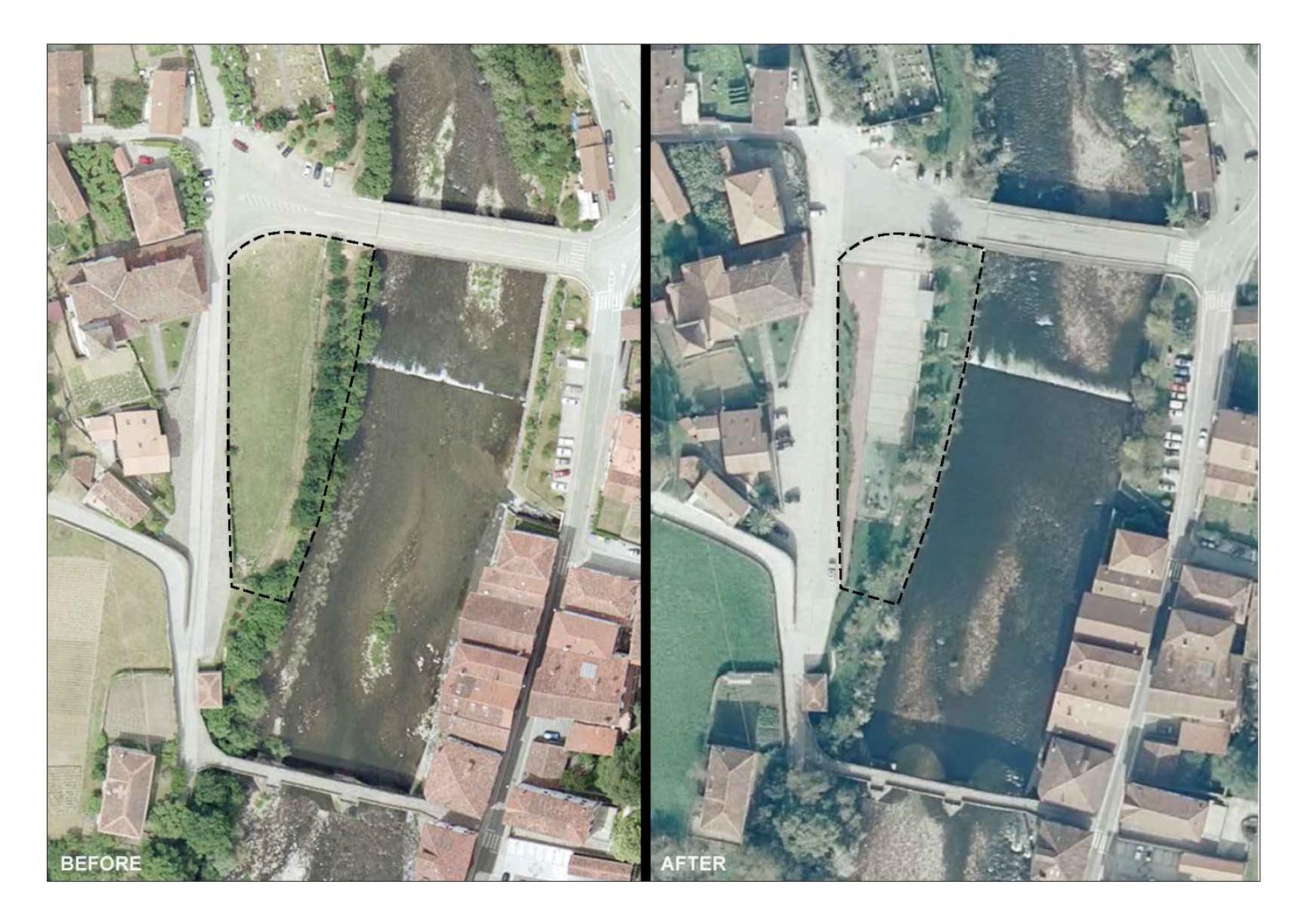
The project of the Ramón Latasa square located on the left bank of the Bidasoa river as it passes through the Navarran town of Sunbilla, has transformed and regenerated a disused central area of the town, providing residents with a significant, adequate, comfortable and pleasant space as a meeting and recreational environment.
The project has brought together citizens, local artists, rural athletes and the Sunbilla City Council around the figure of the local aizkolari (log cutter) Ramón Latasa
Project Region
EU Programme or fund
Description of the project
Summary
The square of Sunbilla (Navarre, Spain) built in 2007, was promoted by the town council, with the intention of benefiting relations between neighbors in a meeting and recreation space.
Sunbilla is a small town located in a narrow valley in a mountainous area in the northwest of Navarre. It is located in the valley of great natural beauty of the Bidasoa river surrounded by mountains with heights ranging between 100 and 1,000m.
The population of Sunbilla in the last 20 years has remained with small variations around 660-670 people, the current number of inhabitants being 665 people, of which a large part live in cottages.
Sunbilla sits on one of the few plains at the bottom of the valley. The Bidasoa river divides the town into two parts, to the east and west, linked by two bridges; a medieval stone bridge built in 1562 that has been rehabilitated several times and a new bridge built about 150m to the north.
Given the lack of an open-air square in Sunbilla, which serves as a meeting and recreation point for residents, a new square is designed and built on a surface area of 5,200m² in a degraded space. With this, a central space in Sunbilla located on the left bank of the Bidasoa river and close to the Church, the frontón, the two bridges and the two schools (nursery and primary) of the town is completed, transforming it for shared use by all the generations.
The square enriching the urban center and providing residents with a meeting space for leisure and coexistence between the river and the built-up area.
Between the square and the river, the bushes grow wild, forming a natural landscape that integrates the murmur of the water as another experience of the designed space.
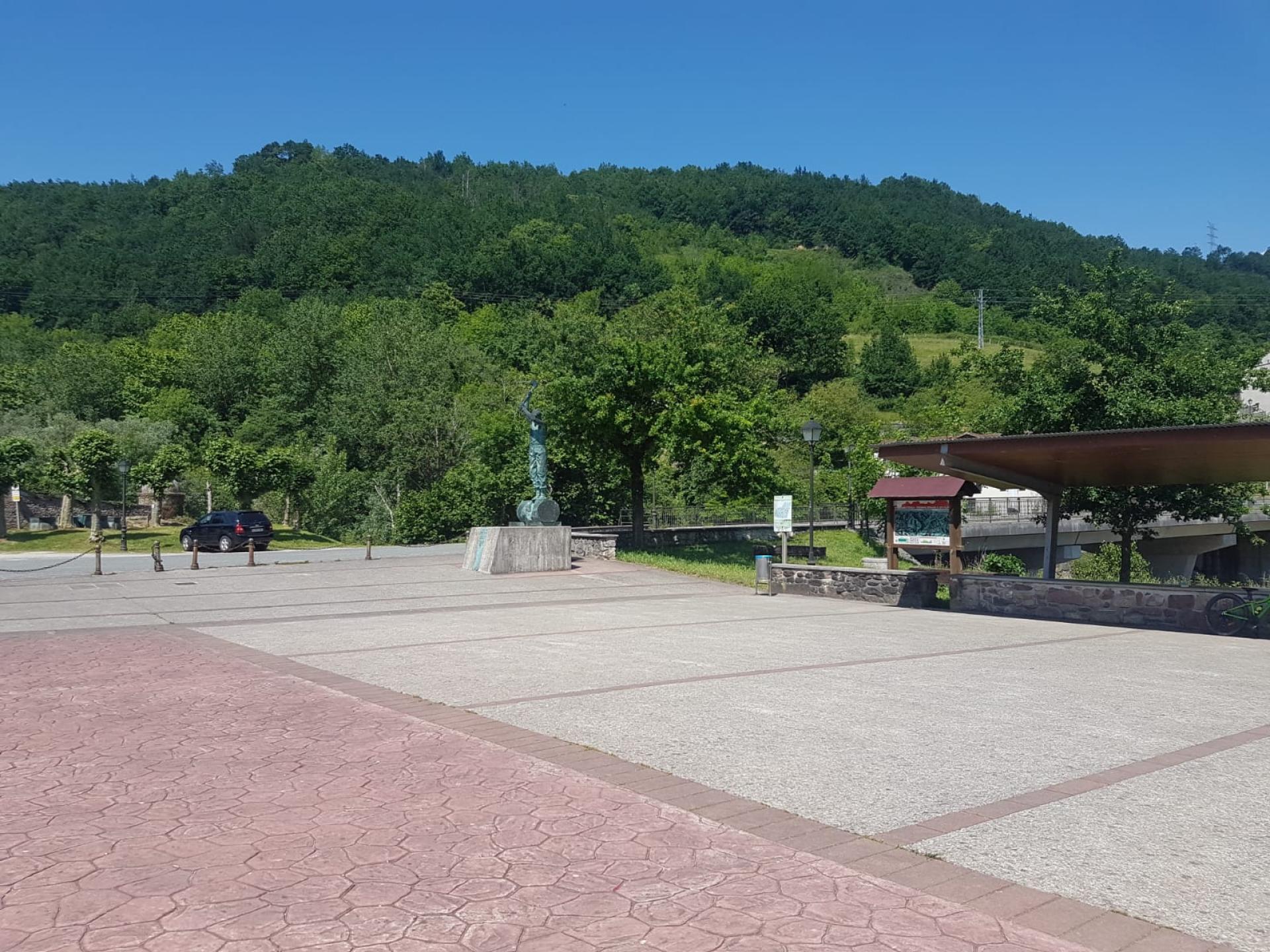
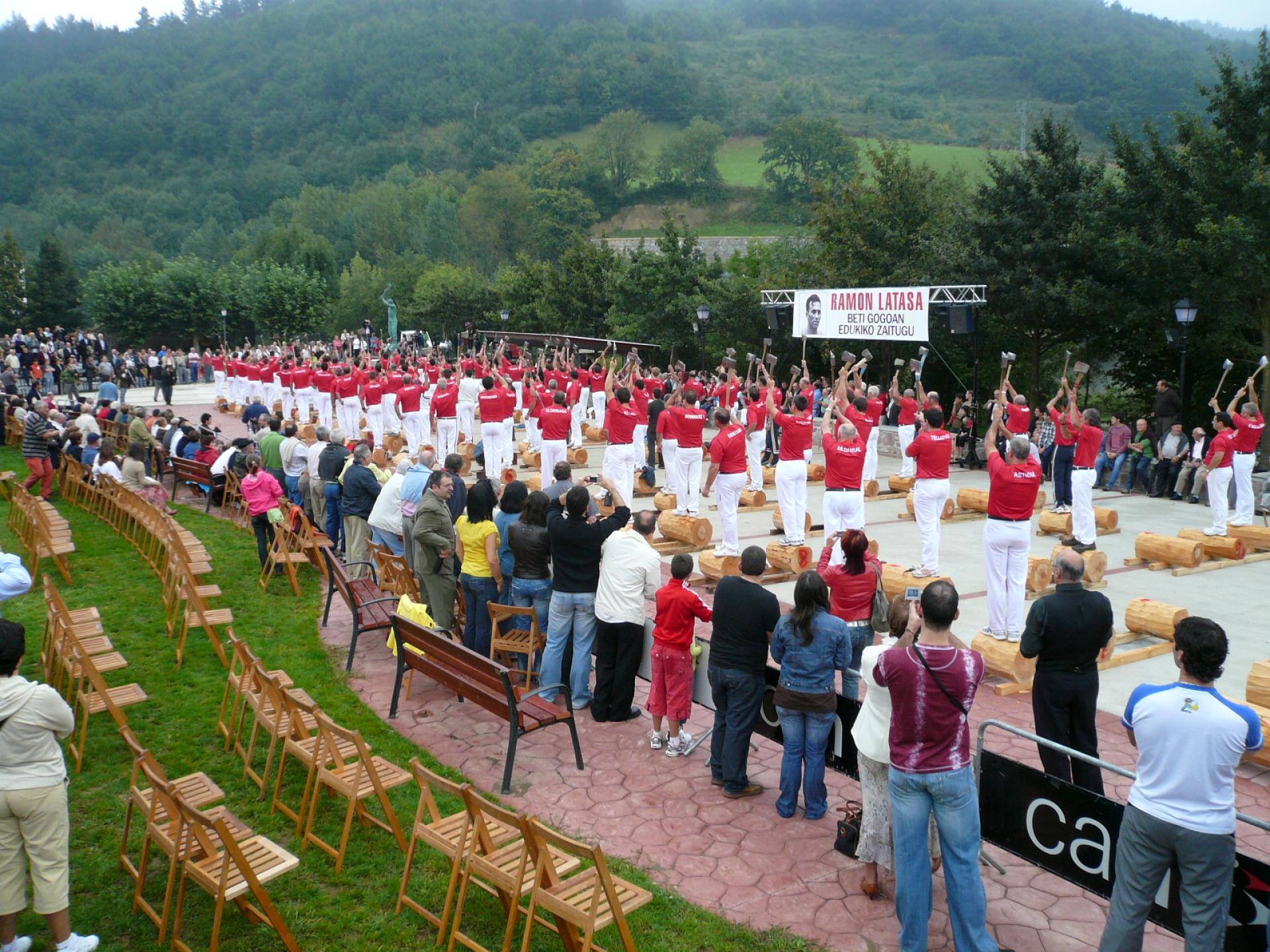
The square bears the name of the aizkolari (log cutter) Ramón Latasa, one of the best aizkolaris of all time and a benchmark in Basque rural sports. In the northern part of the square, a tribute sculpture to the aizkolari has been installed. It was inaugurated in 2007 by 150 aizkolari.
Key objectives for sustainability
The square built is compatible with the quality objectives of the Bidasoa river, a Cantabrian salmon-farming river, from which the riverside vegetation has been integrated into the green zone.
During the course of the works, the necessary environmental vigilance was exercised to avoid all types of discharges into the river, contamination by materials and damage to the rupicolous vegetation.
The paved areas respected the flood lines to keep a river free and alive with its integrated native flora and fauna.
Following the principles of sustainable urbanization, surface water is not collected, but natural gutters are left between paved cloths that allow the filtration of rainwater and the slope of the water from the rain to the river.
The design integrates the surface water evacuation system with a grid of gutters that define the waterproof paved areas, necessary for the use of the square throughout the year in a humid climate with frequent rainfall characteristic of the Cantabrian valleys. The children's play area was paved with permeable pavement.
In terms of economic sustainability, it is a small-scale project in which, through a design with simple lines, an abandoned space has been transformed, with an economically affordable and low-maintenance solution, affordable by the municipal entity. The work carried out had a budget of € 200,000 and was completed in 3 months. Part of the budget was covered by the sale of works of art by painters in the region.
Since its completion it has not required repair work, given the resistance of the materials used and the way they are used. There are no surfaces susceptible to misuse that lead to another use that results in deterioration, so they remain in the same state as when it was finished.
The square is culturally sustainable by using references from the culture of the territory (Basque rural sports) and the landscape linked to the Bidasoa River, as a sign of the historical identity of the town of Sunbilla.
Key objectives for aesthetics and quality
The key objective in terms of aesthetics is the construction of a square that harmonizes with the landscape characteristics within the small urban area of Sunbilla.
In a picturesque setting with the church and traditional stone houses, forms have been sought that harmonize with the past and highlight the natural treasure that is the river that runs through the center of the town.
It has been tried to integrate the noise of the vegetation and the water in the scene, avoiding walls and closures. An old wall has been rebuilt as a bench on its east side and on the west the slope has been integrated with a smooth and slightly sloping stone masonry wall similar to the walls that support the nearest roads and streets.
A fully contemporary aesthetic has been sought, fleeing from historicisms, seeking that in the forms the past can be recognized by creating a space that links us with the origins of the square as a space for Basque rural sports.
By aesthetically solving the covered spaces necessary for the climate of frequent rains, the extreme simplicity of the traditional “aterpe” (porch), with a gable roof, has been sought, recreating it in metal industrial materials manufactured in the industry of the area.
Since its inauguration in 2007, the square has been used by children and adults in a respectful way, having been integrated into the space of daily collective use, without the citizens requiring any more traditional aesthetic intervention. Therefore, in view of the elapsed time, it can be concluded that the aesthetic resolution has been successful.
The simplicity and simplicity of the aesthetic solution allows the space to be versatile for the celebration of parties, markets and competitions and is perceived by the inhabitants as a space that has arisen naturally in which the limits are blurred between the built space and the Bidasoa river nature.
Key objectives for inclusion
The square of Sunbilla has been designed as a meeting place, accessible and adapted for people of different ages that includes playgrounds for children, walks, stays, green areas, etc. and that has been equipped with lighting elements, fountains, benches, canopy, etc., thus generating a pleasant, safe and comfortable space next to the Bidasoa river. The benches inside and outside the canopies, allow its use throughout the year in a territory of rain and temperate temperatures.
Its location in a space between the two parts of the urban center of Sunbilla on both banks and between the two bridges over the river, favors the meeting and coexistence between the residents of both centers.
It is a space that is easily accessible from different points of the town and that has a sensibly flat topography. The square is accessible to people with reduced mobility from the north. To the south, a staircase has been designed for direct access from the bridge and a passage accessible from the outside.
The walls that delimit the square to the west and east, protect it from the traffic of the adjoining street and the Bidasoa river respectively, creating a safe space for all people and especially for children who have a place to run and play protected with a run bench that draws the boundary between the green area and the paved area. It is a space with wide views and that has night lighting for greater security.
The involvement of the City Council as a promoter of the action, promoting the creation of this space and the placement of a sculpture tribute to the aizkolari (log cutter) Latasa and the municipal coat of arms on the pavement as a reference to Sunbilla, has helped residents have recognized the square as their own space with which they identify and use.
It is a meeting space for everyday life but also a space for extraordinary activities: parties, markets, shows, etc. that allows its use as a stage thanks to the slight existing slope.
Results in relation to category
It is a small-scale action but one that represents a great benefit for a town of 665 inhabitants that lacked a public space for relationships and that now has a square in which to meet and celebrate all kinds of events. The services offered by the town of Sunbilla to its neighbors have been increased and improved.
For this reason, the impact of the project is twofold: on the one hand, the residents have a square in the urban center near the fronton, the schools, the church, etc. and, on the other hand, municipal services and facilities have been improved, helping a greater interaction between the population.
The Bidasoa river is fundamentally part of the character of the town and of its urban historical structure. Therefore, the relationship of the place with the river is one of the important pillars in the design of the project. Located in a privileged position next to the Bidasoa river, the square replaces a degraded area in its environmental and naturalistic aspect, releasing the views towards the landscape of great beauty with a harmonious solution with the environment that combines aesthetics and functionality, creating a place that connects with the river and that invites you to relax listening to the sound of its waters.
The reconversion of this space has transformed the landscape of the environment in which it is integrated and its view from the right bank of the Bidasoa river and from the bridges that cross it, from where you can enjoy the picturesque landscape created by the river, the buildings of the town among which the church and the mountains stand out as a backdrop; a landscape typical of a painting.
More than 10 years have passed since the construction of the square was completed and we can see that it has maintained its image and functionality and that it is a reference space in the social life of the inhabitants of Sunbilla; where they meet, play, socialize, coexist, etc.
How Citizens benefit
The project for the square involved the city council and the residents and artists of the Bidasoa river area to finance the installation of a sculpture by the aizkolari (log cutter) Ramón Latasa.
The artists of the area donated paintings to defray the costs of the sculpture of the aizkolari that was installed in the north area of the square that bears his name. An exhibition and sale of the paintings was organized in the Sunbilla Town Hall, which was visited by many citizens and in which all the paintings that were exhibited were sold.
The Plaza Ramón Latasa de Sunbilla was inaugurated in 2007 with a festive act of rural sports in which the deceased local aizkolari was honored. The event, which was attended by the residents of Sunbilla and the surrounding towns, brought together 150 Aizkolaris.
In 2016, coinciding with the 25th anniversary of the death of Ramón Latasa, the residents of Sunbilla remembered the figure of the aizkolari in a new posthumous tribute held in the square that bears his name.The local press echoed this tribute, underlining the symbolic character of the place; "The choice of the location for its celebration denotes the special nature of the event."
It is a project that has brought together society, culture and sports around the figure of Ramón Latasa and a place; the Sunbilla square.
The neighbors who were aware of the project, and were part of the initiative for the sale of paintings and the organization of the opening event that included a meal for the entire population in the covered frontón of the town.
Thanks to the involvement of the citizens and the symbolic nature of the performance, the residents of all ages have recognized the square as their own space with which they identify.
Innovative character
The innovative nature of the new plaza project in Sunbilla is derived from the aesthetic solution of the project for a small urban center with traditional architecture. The innovative character of the performance resides in the final aspect of the square, which is aesthetically recognized as 21st century based on the Basque tradition of the square for rural sports.
Also, it manifests its innovative character in its geometry away from the traditional canons without built fronts, and in the recovery of the river as a substantial part of the collective image of Sunbilla.
The square is innovative due to the sustainability integrated into the design and the naturalness with which the built part approaches the natural part of the Bidasoa River. It is separated from the riverbed, respecting its domain area and its riverside vegetation and protecting itself from the flooding of the river.
The square also innovates in sustainable construction solutions and the use of simple materials, low cost, and good durability that is novel in this traditional architecture environment. Concrete and steel have been chosen instead of stone and wood without reducing integration.
Budgetary limitations constituted a challenge to the project, which led to imaginative solutions in terms of economic contributions through the sale of works of art donated by their authors. The innovative character derived from the collaboration between the City Council, neighbors and artists to achieve a public space for the inhabitants and pay tribute to Basque rural sports in the figure of the aizkolari Ramon Latasa.
The popular character of the decision to build the square, led by the city council, has contributed to the acceptance of the space with contemporary characteristics by the inhabitants and to its daily use by the entire population.