GO[A]T WASTE?
Basic information
Project Title
Full project title
Category
Project Description
The GO[A]T WASTE? project explores in a playful way the possibilities for reuse and circular economy in the building field in Latvia. Three prefabricated stands from construction waste were used as base for an educational workshop for children in which they could take part in decorating them while at the same time learning about reuse and recycling. After the workshop the stands were moved to a nearby mini zoo and joined into a single pavilion which from now on is used as a playground for goats.
Project Region
EU Programme or fund
Description of the project
Summary
The GO[A]T WASTE? project explores in a playful way the possibilities for reuse and circular economy in the Latvian building field. It started with the request of the owner of a mini zoo to design and build stands for a workshop with children. Instead of creating a temporary structure for two days which would be trashed after the event, we suggested a different approach - one could avoid material waste and transform the structure for further use as a goat playground in the mini zoo.
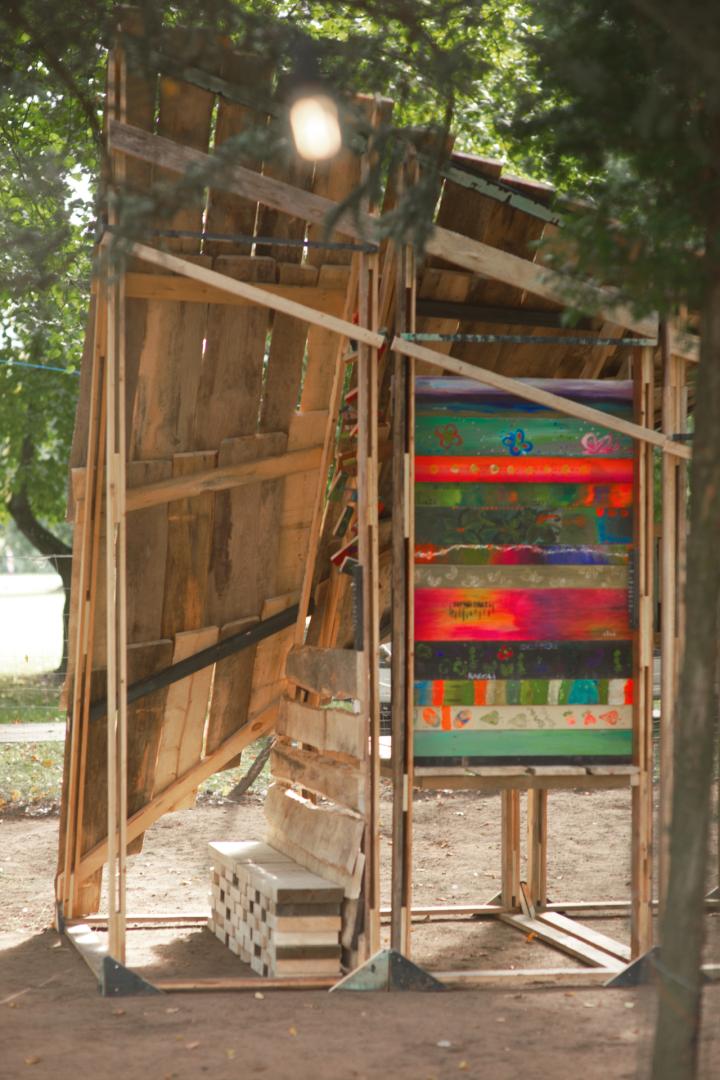
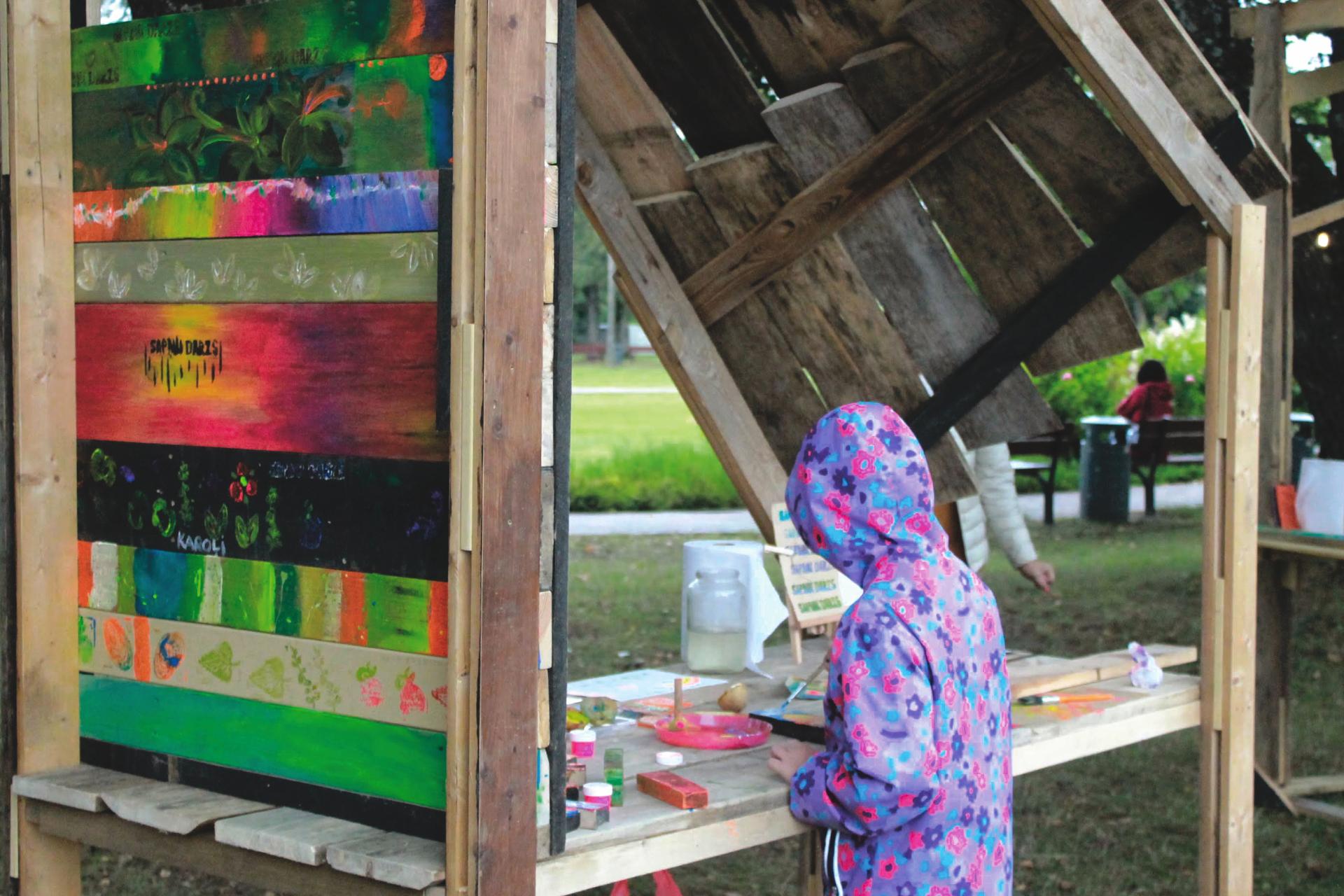
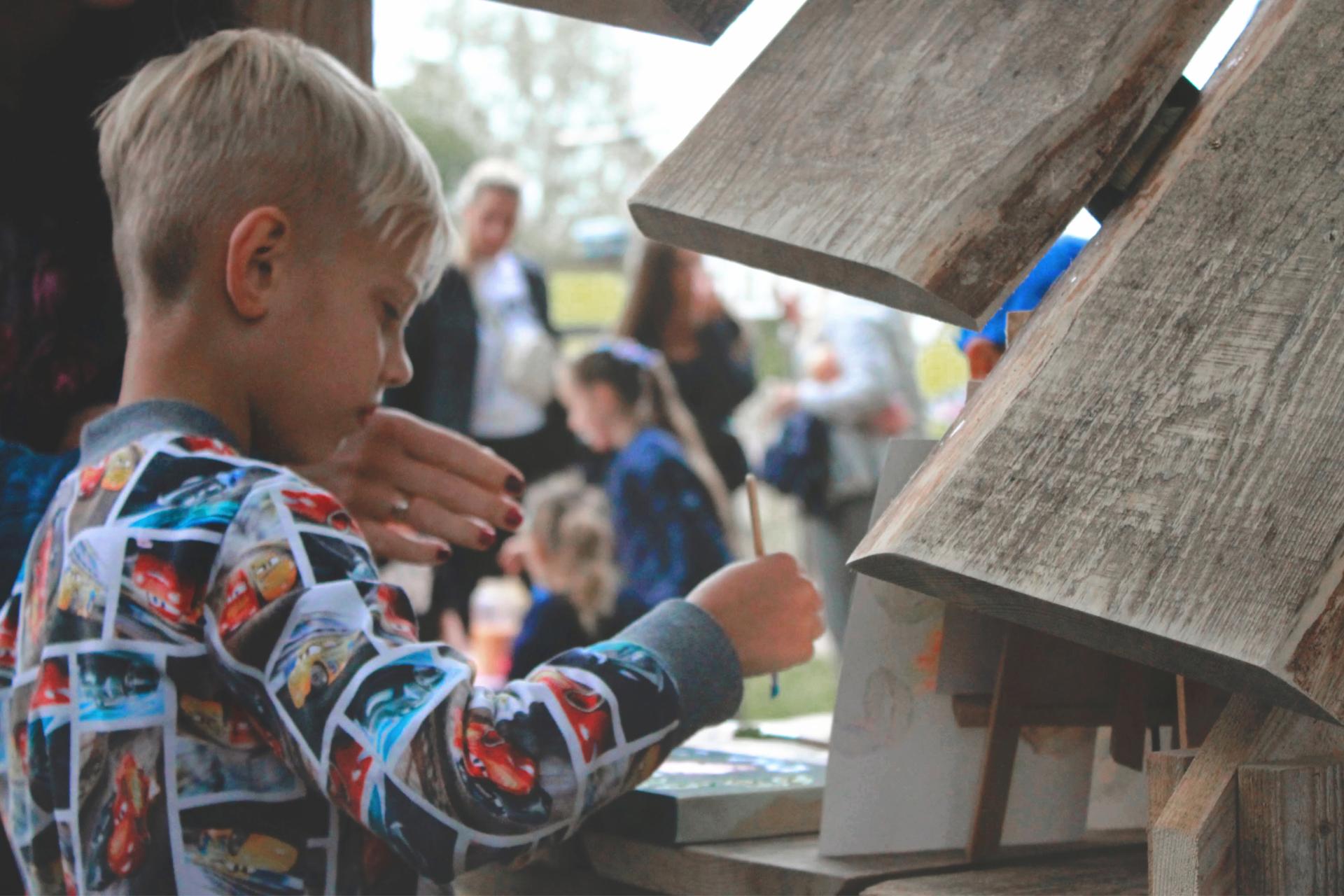
Therefore, we collected wooden waste from nearby construction works, renovations and demolitions for constructing three roofed workshop stands. During the event children could take part in decorating the future goat playground in various ways. One stand was adorned with garlands created from the smallest wooden cut-offs, another one with standard facade cladding and the third had a facade constructed based on design for disassembly principles. This participatory design helped to engage children and their families in the topic of reuse and gave them a playful and age appropriate way to participate in creating public space.
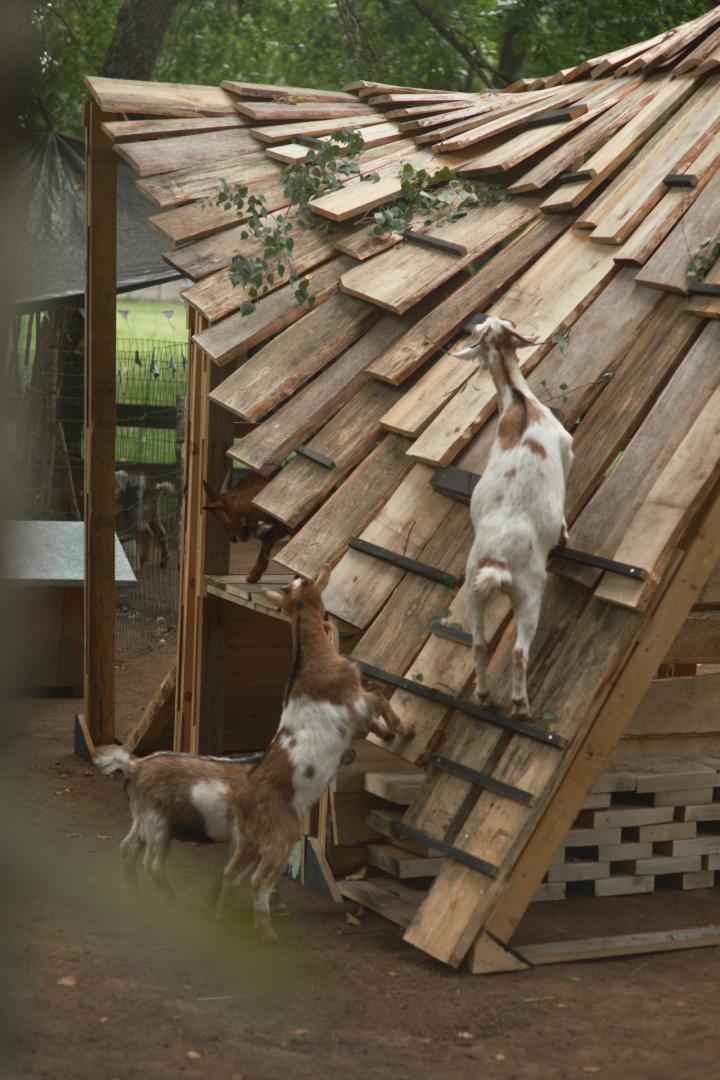
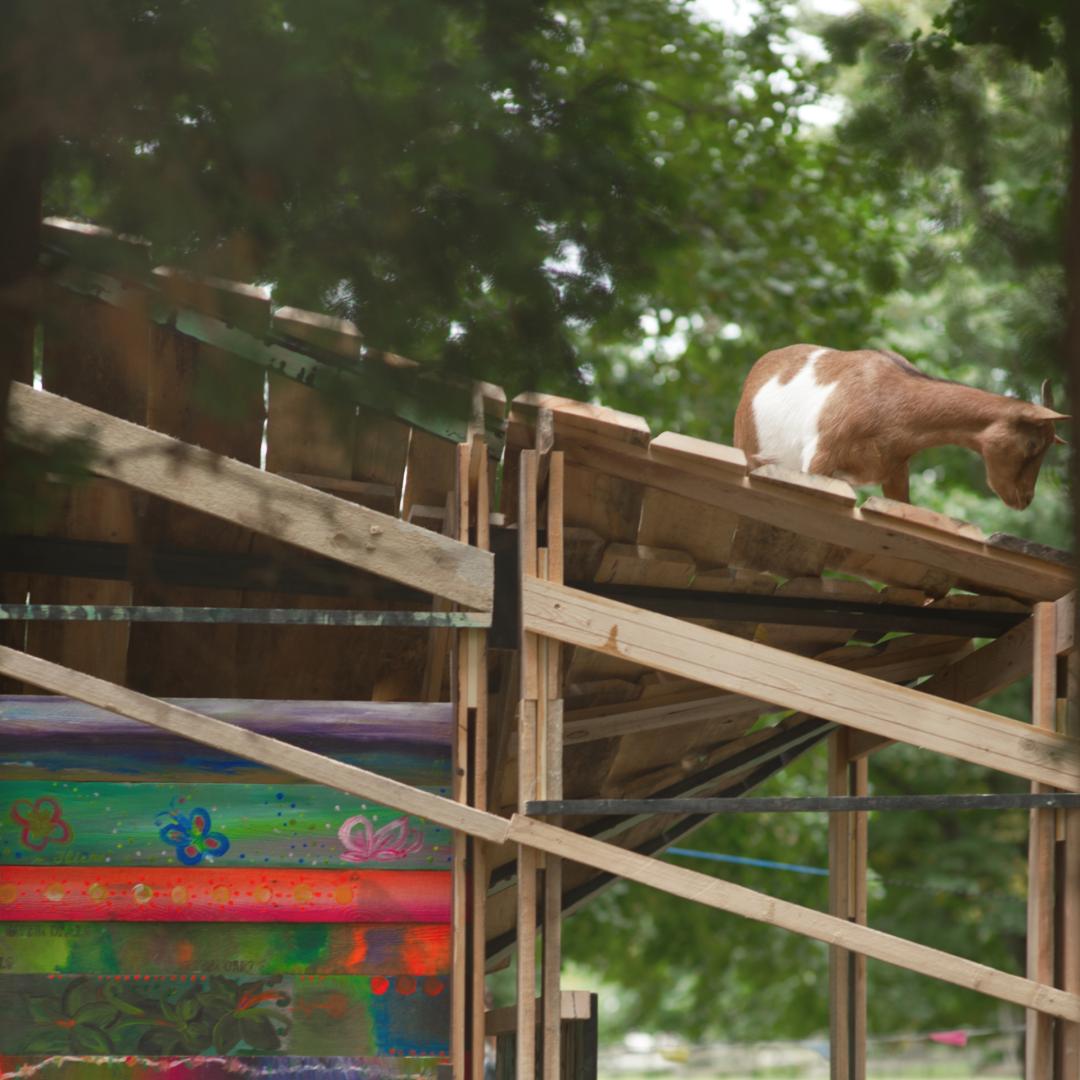
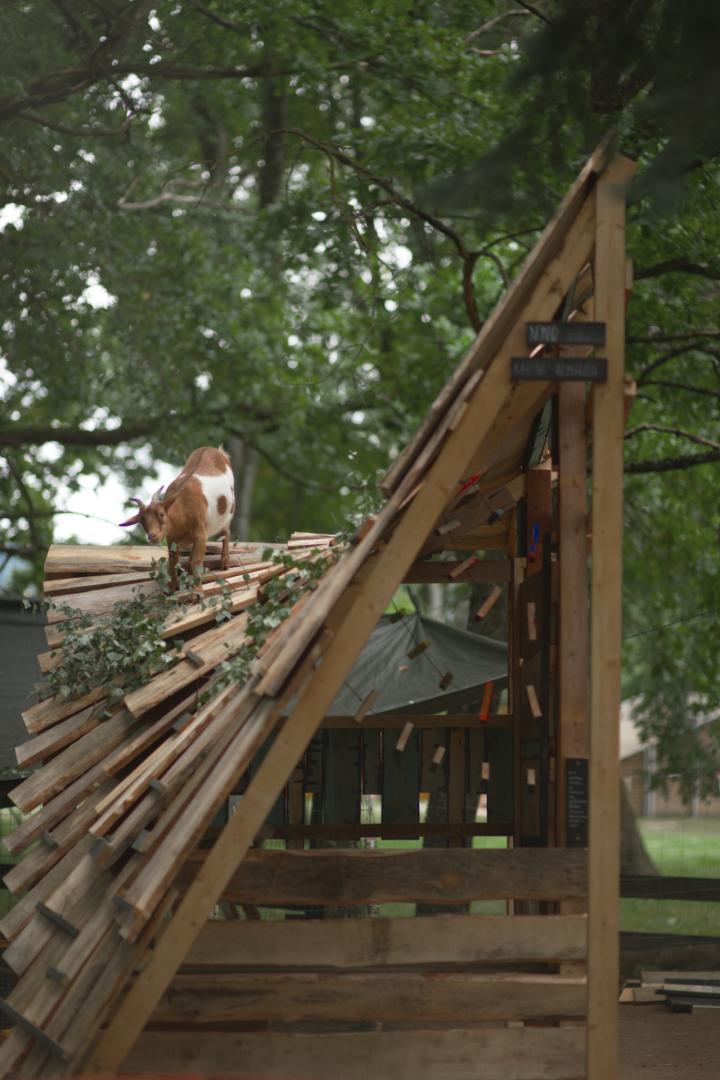
After the workshop, the structures were joined into a single pavilion that functions as a goat playground for the minizoo. The previously used tables of the workshop were reassembled as platform and slide for the animals, the wooden garland and bench as items for goats to rub and scratch on, and lastly, the large organic shaped roof acts as a climbing surface.
Through the process we could identify two major problems for reuse in Latvia. Firstly, most buildings are not constructed with design for disassembly principles. During material collection from the demolition sites, much of the material had to be discarded because of too high damage. Secondly, material libraries for urban mining or a simple marketplace for reused material are missing. This makes it difficult to use reused materials in larger projects, as planning time, costs and risks get very unpredictable.
Key objectives for sustainability
The project had two key objectives. Firstly, we wanted to address the problem of enormous waste generation and lack of circularity in the building sector in an illustrative and easy understandable way for the general public. Secondly, we wished to use this project as a practical test to identify the obstacles one faces when wanting to give materials for reuse or recycling or wanting to use such materials in a building project.
The project met both key objectives. We could get in contact with numerous locals. Many had no idea about the amount of waste the building sector produces and wanted to improve their way of dealing with or avoiding waste. As a result, the approached locals give a second thought to the materials before discarding them. Regional groups on social media are mostly used for reselling or giving away material. We also encouraged the people we got materials from to improve their way of showcasing them online, to improve the chances of reuse.
For us the importance of design for disassembly became clear. During material collection from the demolition site, much of the material had to be discarded because of too high damage in the demolition process. This was due to the use of glue and excessive amounts of nails which limit the disassembly process. It was also hard to predict for us what materials we will find on the building sites. This means the planning process has to stay very flexible in order to adapt to the found materials. While this functions well with small scale projects such as pavilions, to integrate reuse in large buildings, certain potential material libraries have to be created that identify the types, dimensions and amounts of material available to avoid the increase of building costs due to longer planning time. Another way would be simply providing a kind of marketplace for the reused materials. The latter was a commonly asked question from the locals of Adaži if such a facility could be introduced in the local community.
Key objectives for aesthetics and quality
It was important for us that we preserve the original, often also used look of the reused material. Visitors of the minizoo who have not participated or heard of the project should be able to immediately recognize that the GO[A]T WASTE? pavilion is constructed from reused materials to get easier engaged in the topic.
However, as we got numerous different materials for construction it was important to give the pavilion a coherent appearance during its time as separate workshop stands, as well as after as an animal playground in the mini zoo. The twisted roof is hereby the aesthetically most contributing element even if its shape is foremost a result of the function as rain protection and the compromise to provide access for the goats to the roof without highlighting to the young visitors of the zoo the access due to safety reasons.
The open side of the pavilion with the decorated and painted elements from the workshop is facing towards the entrance and center of the mini-zoo. This colorful little exhibit in combination with the climbing goats is very liked by the visiting children as well as adults.
Key objectives for inclusion
One of the two goals of the project was to inform and educate the general public about the enormous waste generation and lack of circularity in the building sector. As the workshop took place next to the mini-zoo it was to be expected that many children would participate, which are usually accompanied by parents or grandparents. Therefore, it was important that the information we provided is understandable for everyone regardless of age or foreknowledge.
In order to not exclude anyone the entry for the workshop was free. This we could achieve with the help of a few donations from local businesses from which we could provide the joinery for the pavilion and paints and tools for the workshop. All other building materials were reused building waste we obtained for free ourselves.
The entry to the mini-zoo, in which the GO[A]T WASTE? pavilion stands now, is donation based. Therefore, the pavilion can be experienced by everyone. Little information signs on the columns inform shortly about recycling, reuse and principles of design for disassembly. An integrated bench gives space to rest, insofar no animal has occupied it.
Results in relation to category
The project brought many people of different ages and professions together to speak and learn about more sustainable material use - from building field professionals to the users and their families.
Possibly the most important aspect of the project was the general idea of introducing reuse and circularity to children. As such, from early days on they will have been introduced to more sustainable practices and hopefully preserve the interest and even dive deeper in the field as years pass. Furthermore, the playful engagement of children which incorporated for them already known crafts such as painting together with new knowledge of building and circularity gave them early but important insights in participatory design and community engagement in the local city scape. At the same time we hope that through this participation it also fueled a certain shared ownership feeling to the public space of the city.
Circularity in the building field can also strengthen a community itself. The general understanding that a certain leftover material from building is not waste but a potential resource to one's neighbour also helps to establish a different kind of communication in the local area. We could already observe this in a simplified manner in the local facebook group where posts of sorted building waste appeared, offering to give away the materials to anyone who might find use.
How Citizens benefit
The project was affecting many people during its different stages. Firstly, during the material collection from nearby building sites we could get in contact with builders and building owners, discussing the issue of building waste and their wishes to improve the framework for material reuse and recycling. As well, we were able to give feedback on how left-over building material and building waste could be advertised better to people who search for such.
Secondly, we built the stands together with Karina Armanda who is a young architect, too. This was our first experience building with reused material. We had to solve the logistics - how we transport the material, where we can store it and how we clean it if needed. We also realized that we ourselves create cut-offs and therefore construction waste while building. Samuels Rozentals, a teenager living next to our building site, was glad to take the left-over wood to construct a small wood storage for himself.
During the workshop the GO[A]T WASTE? project addressed local families, sensibilizing them in an playful and easy understandable way for the benefits of reuse. Children enjoyed the hands-on experience, while many parents and grandparents were motivated to speak with us. Often we were able to provide some interesting facts and gained at the same time feedback about what could easen the reuse of material. Many also found the time to read the little information signs on the workshop stands about the importance of recycling and reuse and the principles of design for disassembly.
Now, the GO[A]T WASTE? Pavilion stands in the mini zoo. The information signs are still attached and can in best case enhance the interest of visitors in sustainable building.
Lastly, since the GO[A]T WASTE? project was nominated for the Lativan architecture awards it is also widely discussed among building professionals and during several lectures, including Wood Days, we could share our experience and fuel a productive discussion.
Innovative character
The GO[A]T WASTE? project is the first social project in Latvia which communicates the importance of circularity in architecture. Its ability to bring together construction professionals and architectural users to share insights and knowledge is probably the most valuable part of the project. Thereby not the design but the topic of circularity and the issue of waste generation stands in focus, which helps to fuel a productive discussion.