Passive retrofit in Pessonada
Basic information
Project Title
Full project title
Category
Project Description
In this project an old house was converted in a passive house thanks to the big south façade where was installed a passive solution that allows to reach the comfort with the support of a biomass heater for the cloudy days.
Project Region
EU Programme or fund
Description of the project
Summary
In this project an old house was converted in a passive house thanks to the big south façade where was installed a passive solution that allows to reach the comfort with the support of a biomass heater for the cloudy days.
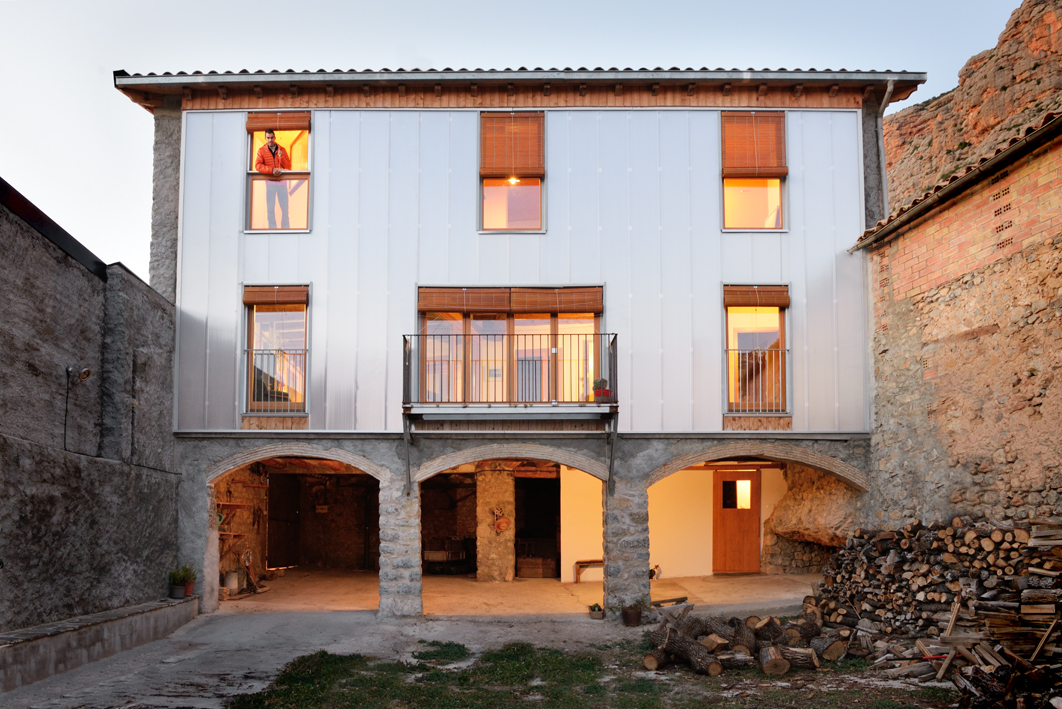
We have transformed a house in northeast Catalonia into a low-energy building by adding a new policarbonate plastic facade
A 19th century building with a limited thermal behavior becomes an energy-capturing building.
Inside, the house comprises a large open-plan living and dining area, and three bedrooms, two of which are accessed by a generous landing space on the uppermost floor of the three-storey property.
The middle floor features one room that can be exposed to the elements, which acts as a transition between the interior and the exterior when open in the summer months, and acts as a greenhouse when closed in the winter
https://www.architektur-online.com/magazin/altes-haus-mit-neuer-haut
Key objectives for sustainability
The south façade is covered with a transparent U insulation of less than 0.9W / m2K and captures more than 3kWh / m2 per day. An enclosure that provides energy inside, and this building in the Pyrenees at an altitude of 800m almost never needs to provide interior heat. That when necessary is with local biomass.
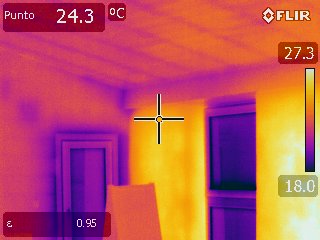
The radiant wall is maintained at about 30º throughout the winter and by increasing the thermal inertia of the existing structural walls, the temperature inside the house is very mild and does not cause condensation.
The idea of the project is to keep the whole existing structure in good condition and repair the part of the building that needs it. The existing construction is maintained and dignified giving it a new impetus and enhancing its intrinsic constructive characteristics. It is important for us to know traditional building systems and know how to work to implement rehabilitations that enhance and improve these building systems.
This strategy allows us to devote more effort to the south façade of the building which is the main project.
It is a low-tech and economical solution that does not require external energy to operate beyond solar energy. It is a robust and resilient solution. Easy to build and without complicated mechanisms that make the construction system delicate ensuring that it does not deteriorate or be damaged.
To reach the optimus temperatures to comfort, new windows were made on the south façade and panels of polycarbonate of 8 layers were installed outside the existent wall that has turned it into a big heater. The interior temperature on the wall remains between 28 and 30ºC being a very comfortable radiating wall. In summer the night free cooling is enough to be comfortable during the day together whit the solar protection.
In order to avoid the overheating of the polycarbonate in summer, it has been designed a solution of sliding shutters made of canes, with low weight, that will protect the façade depending on the needs.
Key objectives for aesthetics and quality
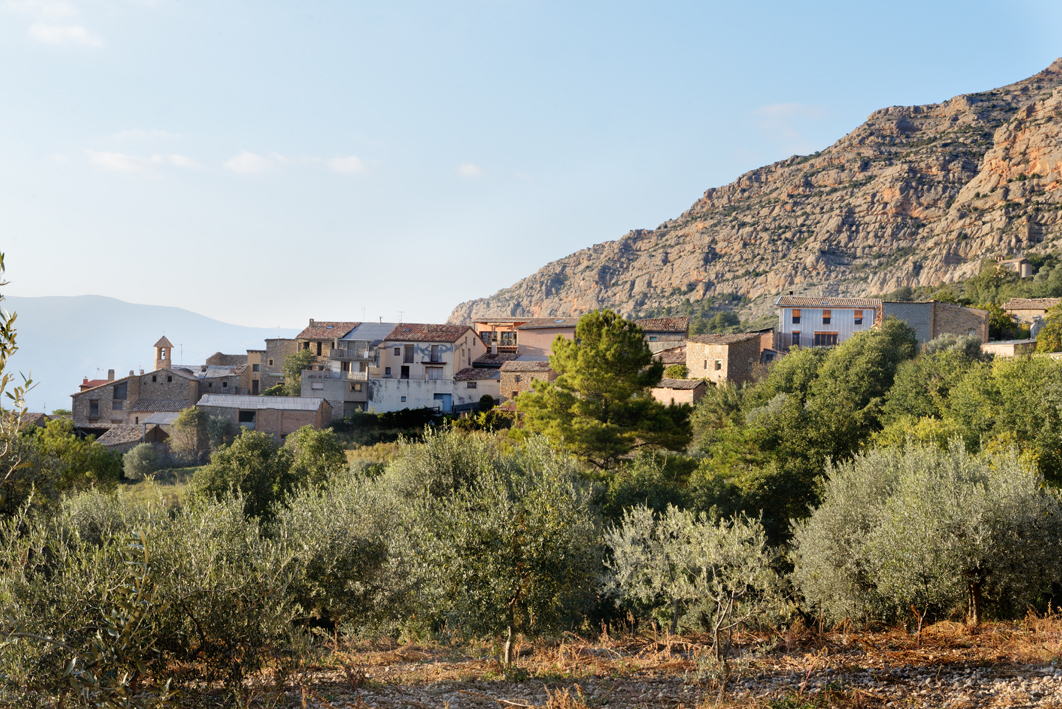
The new facade gives the building a completely different appearance. But – because it retains many of its original features – the house remains sympathetic to the traditional aesthetic of its neighbours, which cascade down a hill to the south of the Spanish Pyrenees.
Balconies added to the first floor for drying clothes echo those originally on the house, while a traditional choice of solar shading – external blinds – were also installed to allow residents to maximise natural ventilation.
Due to the naturally sloping topography of the site, a large space open-air is located below the house on the south side.
Accessed through three arches, this space was once used to keep horses, but is now used by residents for various domestic activities.
Key objectives for inclusion
Accessible routes have been designed for people with wheelchairs.
Both common spaces and private spaces have been designed to be accessible.
Results in relation to category
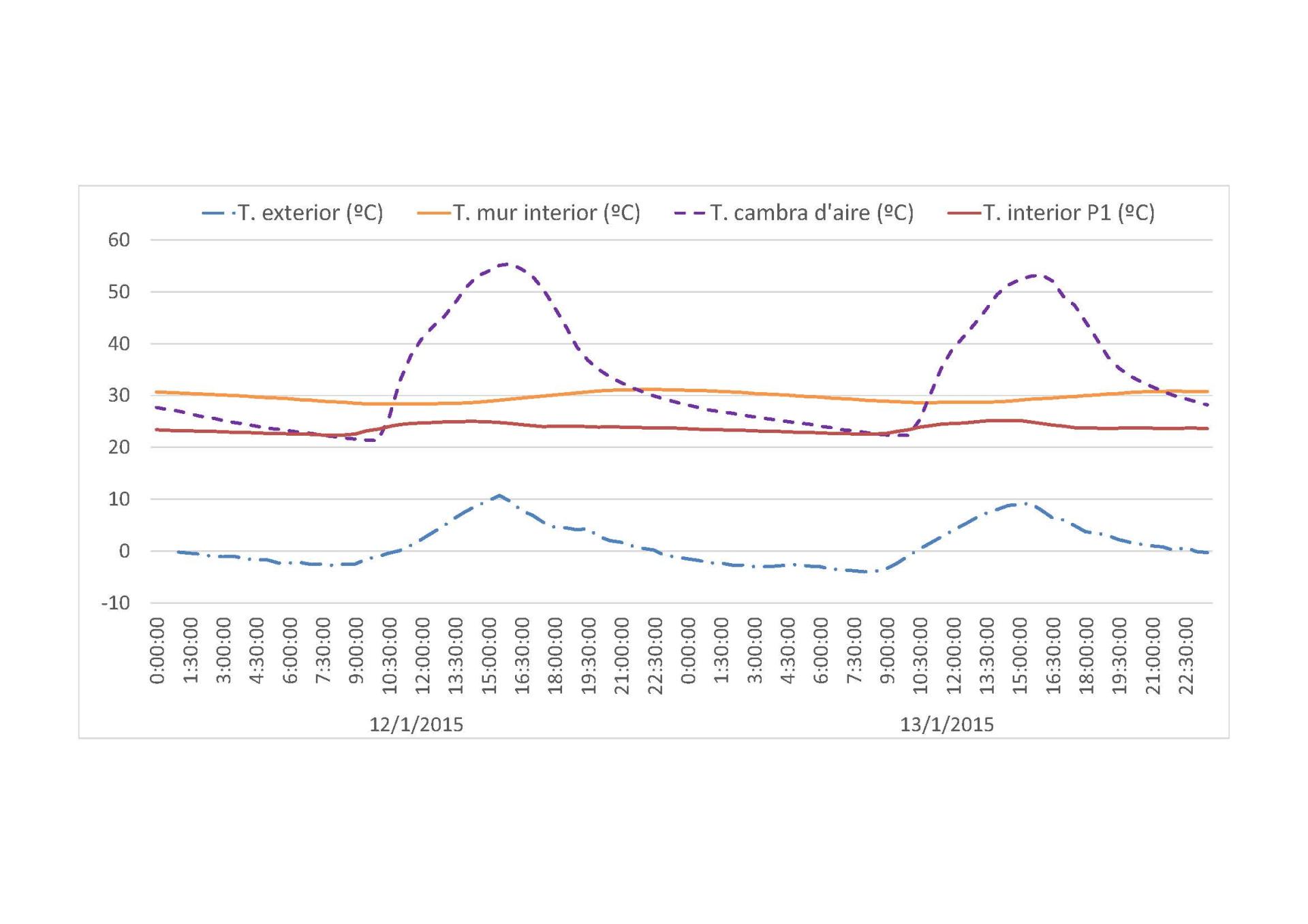
The results of the intervention can be clearly seen in the graph attached. This has been extracted from the temperature sensors that have been installed at different points on the south façade.
The temperature graph shows how the temperature in the winter months is stable between 22 and 28º while the winter outdoor temperature is between 0 and 5º.
The graph also shows how the air chamber between the polycarbonate and the existing stone wall behaves. It has a very high temperature that gradually penetrates inwards and offers a stable and comfortable temperature at night.
Thanks to the trajectory of the sun, the system works perfectly in summer and winter. In summer, the sun has a higher position and the overhang protects the polycarbonate, and in winter, the façade receives a greater amount of sun, minimizing the need for additional energy when temperatures falls down in night.
How Citizens benefit
The main beneficiaries of the intervention are the clients, who have been able to carry out a rehabilitation of high energy performance at a price comparable to that of conventional construction in the region.
At the same time, the city council also welcomes the way in which the project was proposed as it sees the opportunity to capture the interest of new future citizens through such interventions.
Offering a good quality of life to the rural world can be one of the motivations that attract visitors and new inhabitants to the region.
Innovative character
The innovative nature of the project is undoubtedly the treatment of the south façade that captures solar energy.
With a non-energy resource, clients can live throughout the winter with very little annual electricity consumption.
As we said before, the south façade is covered with a transparent U insulation of less than 0.9W / m2K and captures more than 3kWh / m2 per day. An enclosure that provides energy to the interior, and this building in the Pyrenees at an altitude of 800m almost never needs internal heat supply. That when necessary is with local biomass.