Smart Multi-Energydistrict Nieuwe Dokken
Basic information
Project Title
Full project title
Category
Project Description
Environmentally conscious building is an important anchor point for the City of Ghent and sogent in the redevelopment of the Ghent old dockyards. The cooperative DuCoop was created to exploit & set-up new circular concepts. By using innovative technologies to close the loops of energy, water and resources, the carbon footprint is drastically decreased. Residents were engaged early on to participate in DuCoop, creating transparency, ownership & social equity in the neighbourhood.
Project Region
EU Programme or fund
Which funds
Other Funds
Horizon2020:
Run4Life- no 730285 (Applicant: CEIP)
Interconnect- no 857237 (Applicant: DuCoop)
Renergetic- no 957845 (Applicant: CEIP)
Bright- no 957816 (Applicant: DuCoop)
Interreg 2Seas:
NEREUS: New energy and resources from urban sanitation (Applicant: DuCoop)
EFRO: Dockside renovation Old Docks (Applicant: City of Ghent)
Description of the project
Summary
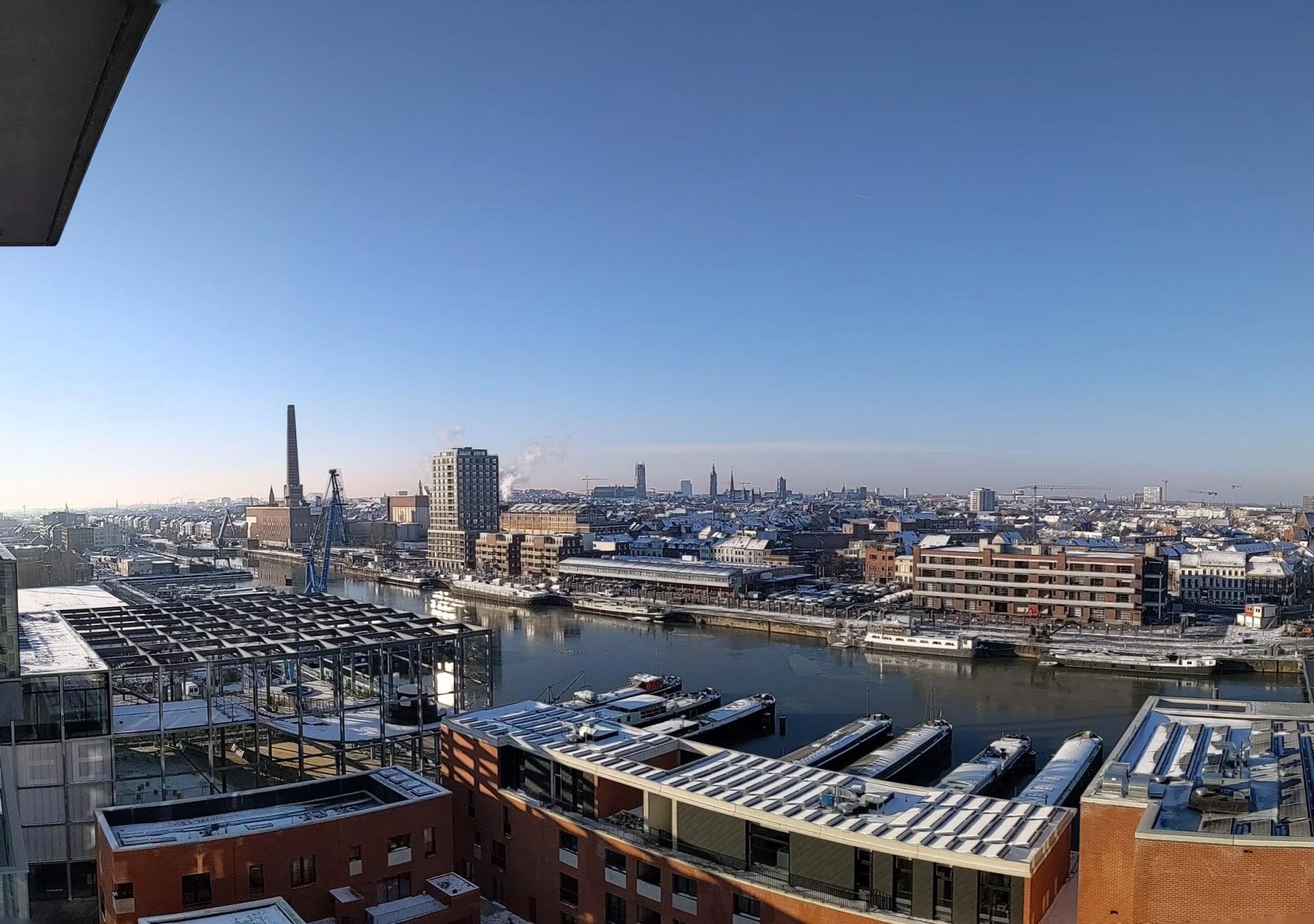
The integration of DuCoop’s innovations in the initial competition design of the ‘ Nieuwe Dokken’ proved to be crucial in the evaluation of the sustainability ambitions by the City of Ghent. Like many larger cities in Europe (and worldwide), Ghent is challenged by international initiatives (e.g. Covenant of Mayors (COM), Sustainable Development Goals (SDG’s), …) to reduce emissions of greenhouse gases and reduce its population’s footprint on the planetary ecosystem. Because of the energetic inefficiency of the historic building stock, there is a high need to stimulate energy-efficiency and renewable energy production in the newly built areas. The city considered the redevelopment of the old harbour site as an opportunity to create a leap-frogging towards more futureproof designs for the urban environment. This was adopted in a strategy for the development of the broader area and extended to every aspect of urban planning: from the clearing of the historic pollution in the brown fields, through thoughtful planning of the public space, parks and green areas, building density, mobility impact, effects on exhaust emissions, etc. This process of urban transformation will take decades to unfold. From different partners in the cities network (aware citizens, University of Ghent, different administrations) ideas emerged on how the old harbour site could be used as a living lab for innovative technologies and new ways of living .
Key objectives for sustainability
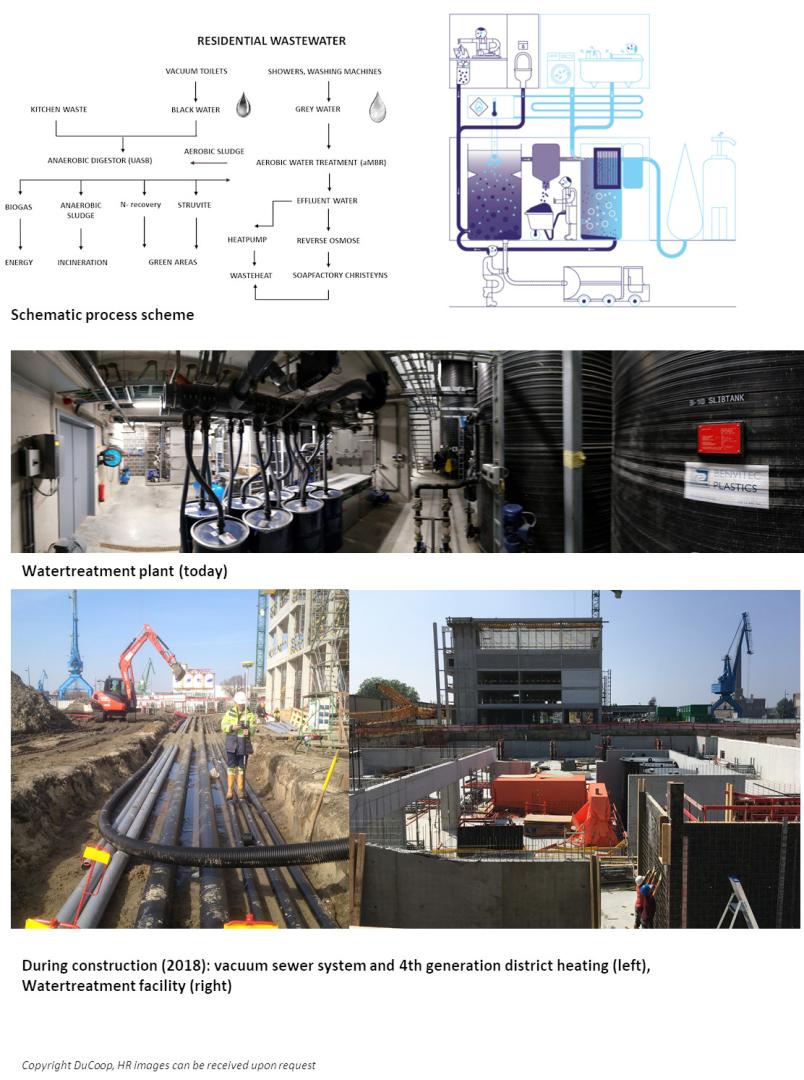
The main purpose of the project is to demonstrate economically viable business models for decentralized treatment of residential wastewater with integration of other sustainable technologies, like low-temperature district heating, resource- and water recovery and smart energy control systems. Use of the different systems of DuCoop in the ‘Nieuwe Dokken’ district will reduce the emission of greenhouse gasses with 2/3 (over 500 tons of CO2 -eq per year) compared to any other newly built reference project In Ghent. At full deployment (400 housing units by 2024), the district will be an example of circular economy, with yearly re-use of over 30.000m³ of freshwater (>90% of the total consumption), recovery of over 750MWhs of waste heat and the production of 1.500kg of phosphate- and nitrogen rich crystals (struvite), which could be used as a renewable fertilizer in a local urban agriculture project. The site will be a test site for the application of novel technologies, like decentral wastewater treatment- and vacuum sewer systems, local energy communities (direct private powerlines), virtual private grids, ICT-infrastructure, home automation- and smart energy management systems, 4th generation (low temperature) district heating networks, local production, storage and flexibility management of renewable energy sources (RES). From the Ghent project, a lot of valuable experience will be gained with cooperative business-models for local energy systems, end-user acceptance of novel sanitation systems to develop the market for new innovative, circular and sustainable urban systems in the near future.
Key objectives for aesthetics and quality
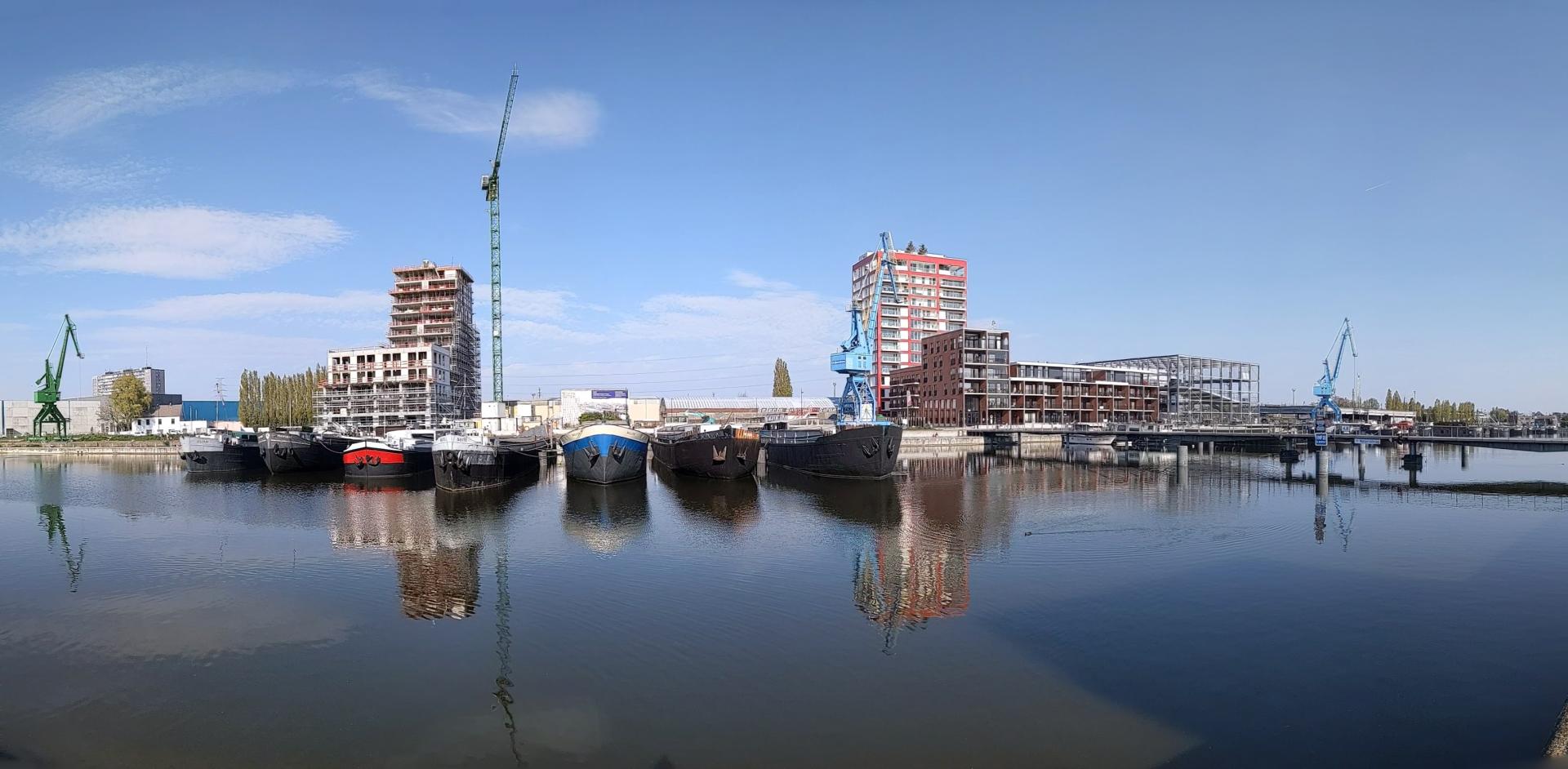
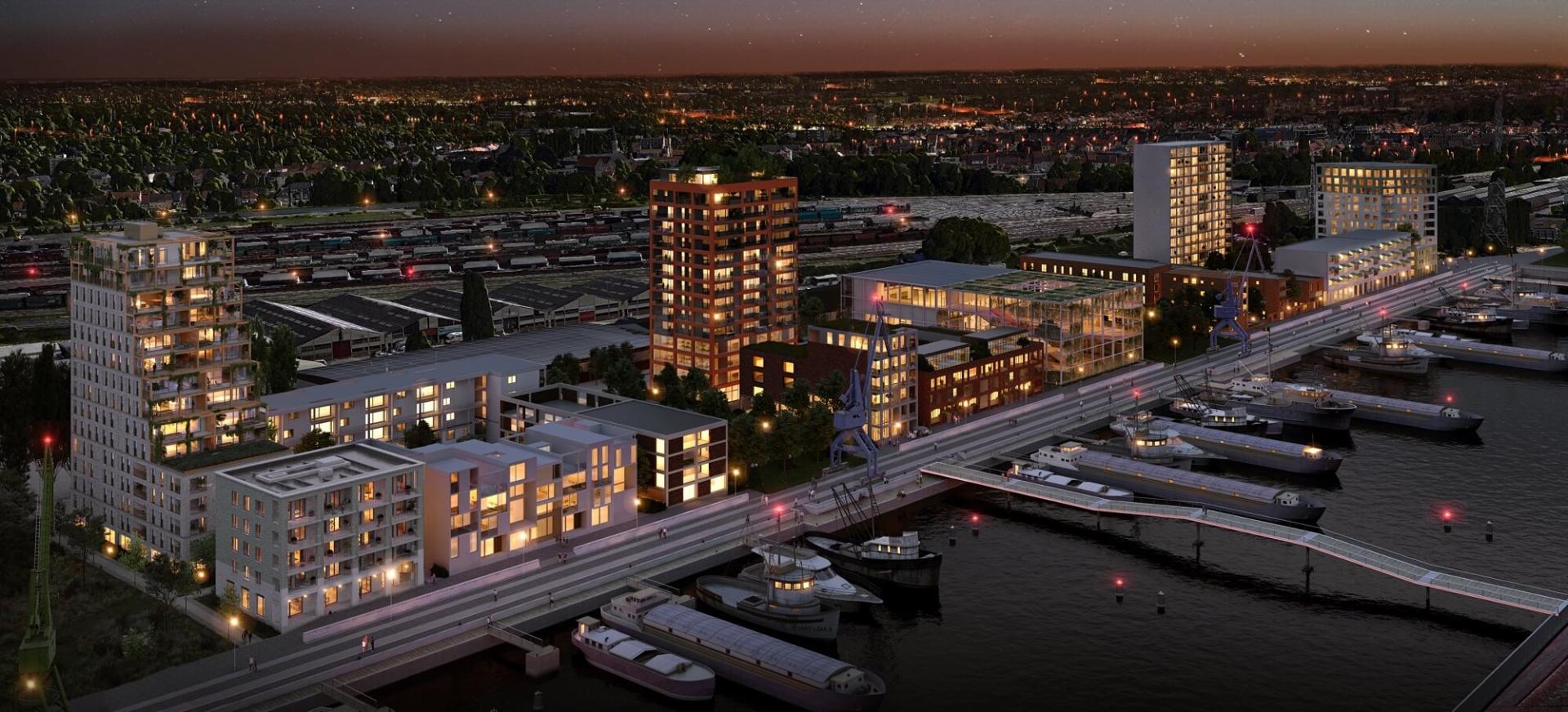
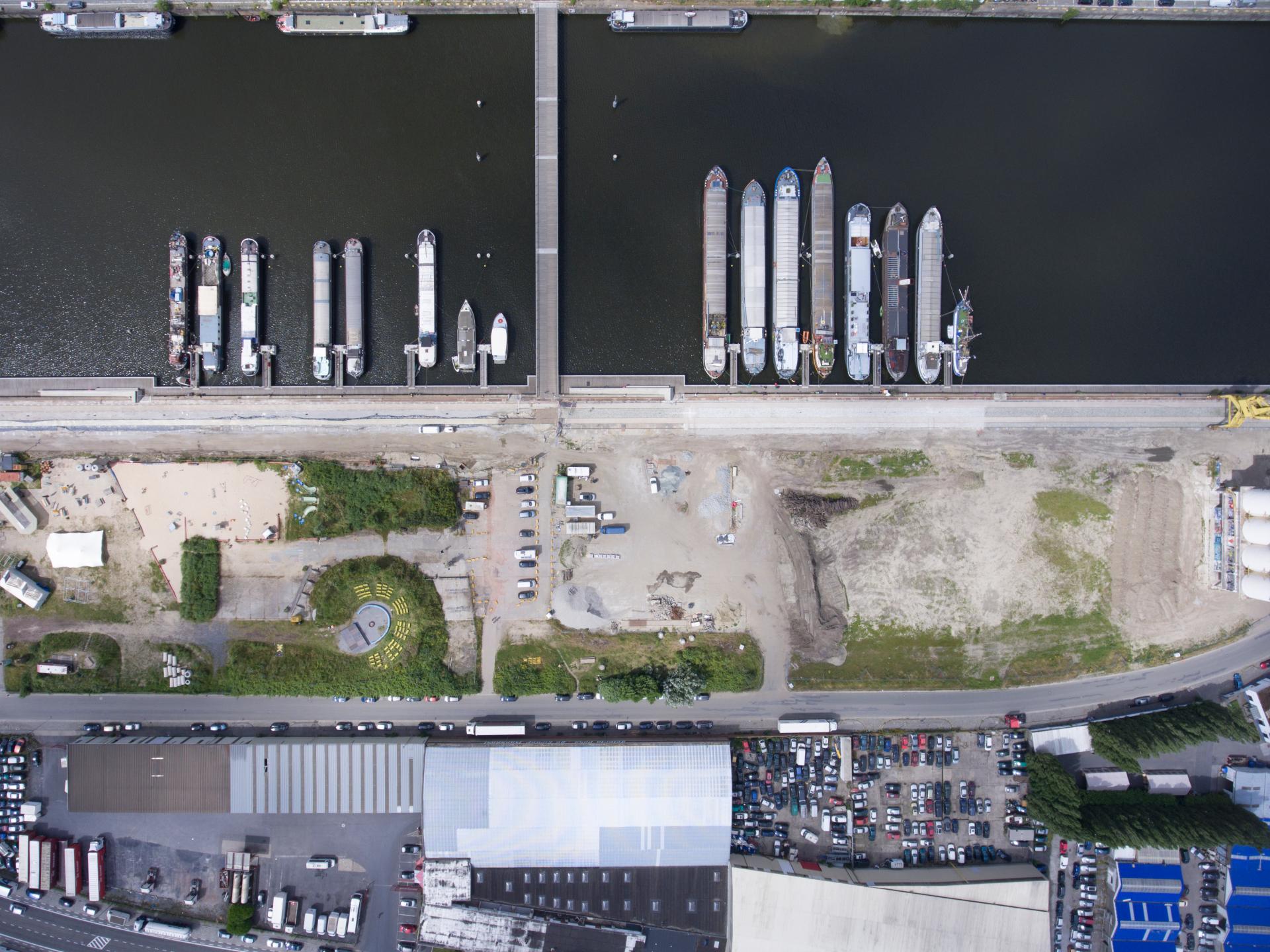
The ‘Nieuwe Dokken’ are part of a large scale urban renovation programme for an old industrial harbour site in the north of Ghent (‘old docklands’), which will house more than 3000 families. Previous industrial activities caused a lot of pollution and by the end of the 20th century the old docks became an unattractive area close to the city centre. In 2004 the Ghent Development Authority sogent launched an urban development competition which was won by the Dutch office O.M.A. It proposed a very simple ‘chopstick’ urbanplan in which green public spaces alternate with buildings along the quays. These areas are extended at both sides of the canal, to stretch the horizon. Old industrial elements (cranes, silos, etc.) were recreated to restore the authentic atmosphere of the dock area. These projects are supported by the European infrastructural fund (EFRO). As the new vibrant city quarter also needed an innovative design, the 'Nieuwe Dokken' is a result of competition turned into a Public Private Partnership coordinated by sogent. To qualify the tender proposals on different parameters the city of Ghent implemented the ‘Sustainability barometer’, assessing the proposals on their expected impact on the use of energy, water, natural environment, mobility, project integration, design, resources and products, socio-economics and liveability of the project. The integration of DuCoop’s innovations in the proposal proved to be crucial in the evaluation by the City of Ghent. However, these innovations posed the developers with problems of their own kind: integrating vacuum toilets, sewer lines and an advanced water treatment facility in the underground premises of the project required a thorough design, skilled construction workers and a well-managed project planning; taking into account possible risks and perceptions on noise impact (vacuum suction), odour nuisance, public acceptance (reuse of nutrients and water) and in individual behaviour of the residents.
Key objectives for inclusion
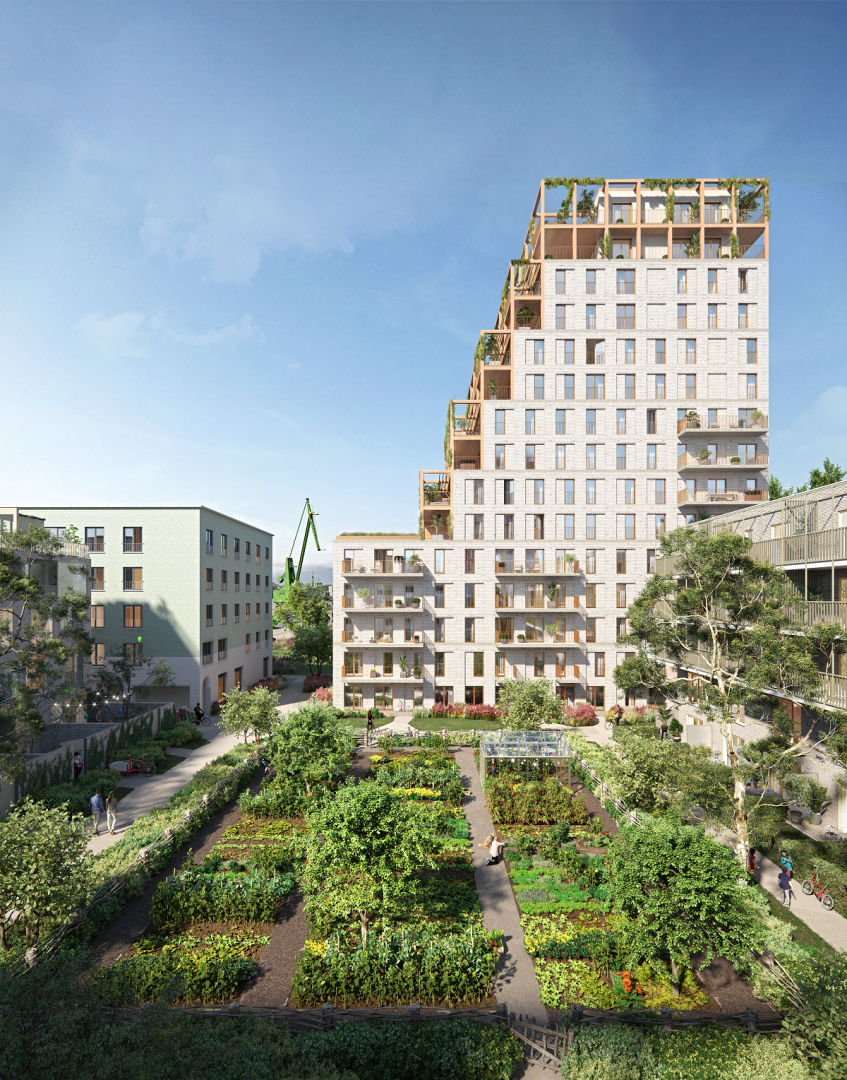
To stimulate inclusion and cocreation, the project developer also integrated an urban farming project within the projects boundaries. This common garden will become a place where residents can rest and grow plants together. The district also houses a multifunctional building ‘Melopee’, which hosts a daycare, primary school and city sports complex in one venue. The outdoor playground of the school has a compounded structure of slides, an urban farming plot, a basketball court and several other playing areas on different levels. The different buildings and meeting venues in the neighbourhood will be connected by a pedestrian corridor to revitalize the sense of community, while maintaining personal space and privacy. As one of the measures to give people from all strata a chance to live in the district, the Autonomous Municipal Ghent Development Authority sogent integrated a minimal share of 20% of social housing and 20% ‘affordable housing’ (aimed at maintaining property housing affordable to young families, one parent families or singles) within the project tender. As part of the agreement, DuCoop adopted the BATNEEC (Best Available Technology, not Entangling Excessive Extra Costs)-principle in its tariffing structure. In this way, the cost structure of sustainability services is transparent, and socially vulnerable users are not impacted by higher costs of innovative technologies. Technology costs were shared between the project developer and DuCoop, which looked for extra investment subsidies to cover the eventual negative margin of implementing novel technologies. As all residents of the ‘Nieuwe Dokken’ become shareholders of DuCoop, public participation in the management of sustainable services is guaranteed through general assemblies and representatives from the residents in the board meetings of the company.
Results in relation to category
DuCoop innovates with a radical reorganization of municipal utility services in a decentralized manner. DuCoop deploys proven innovative technologies from the water and energy sector in an integrated fashion for the first time on this district-scale (1200 IE). A local circular economy is created with recovery of waste heat, water and resources like fertilizers. An overlying smart utility management system is developed to optimize the overall efficiency. By integrating sustainability on practically all levels of public utility services (power, heat, freshwater, mobility, garbage collection, etc) and by organizing this within a financially viable and cooperative business model it has reset the standards for sustainable residential development projects in the 21st century. The integrative design of all these novel techniques into the development of the residential housing project became a painstaking endeavor to bring a range of expertise (architecture, construction works, water sanitation, renewable energy, ICT, public administrations) together and drive the project to realization. DuCoop has learnt a lot along the way and is ready to expand its knowledge to other demonstration sites and housing projects.
How Citizens benefit
Involvement throughout the realization of the project is done by the establishment of the local sustainability cooperation DuCoop, that works together with the residents to organize sustainability services in the neighbourhood. Together with the consulting company Rebel, a financial (cashflow)model was elaborated, which calculated the overall profitability of the activities that DuCoop will organize at ‘De Nieuwe Dokken’. Revenues will come from renumerations for supplying district heating, water sanitation, management of kitchen waste, charging of electric vehicles (EV’s) and selling renewable electricity and flexibility to the grid system. DuCoop will manage a portfolio of over 5 million EURs of investments in sustainable infrastructure with a maximized IRR of 6% over 30 years. Future home-owners and tenants will be involved through a citizen cooperation: They adhere to the annual general assembly meeting and can financially participate in the company’s capital and/or they can be involved in the cooperative’s governance. This invites end-users to be more engaged, better understand what the goals and mission of DuCoop as a service company mean for them, and thus, use the system more appropriately. DuCoop also has frequent interaction with the inhabitants through newsletters, social media, focus groups, questionnaires and face-to-face interactions.
Innovative character
With the ‘Nieuwe Dokken’-project, DuCoop has realized innovative milestones on a national and international level: It has integrated the first vacuum sewer system in Belgium and is operating the largest (design capacity: 1200+ PE) decentralized wastewater treatment plant based on the New Alternative sanitation system principles (https://webshop.dwa.de/de/new-alternative-sanitation-systems-2016.html). Next to this, it has also worked on heat recovery using aquathermics on wastewater treatment effluent and nearby low-temperature waste heat sources (<60°C), providing heat to the district with a 4th generation district heating network. Local renewable energy is being produced with rooftop photovoltaics and shared in a local energy community, to operate the technical processes and charge electric sharing vehicles. In 2020, DuCoop put one the first district battery systems (244 kWh) into operation in Flanders. It has created an integrated data-network to monitor all services and measure the energy flows in the district. Based on an energy management system (EMS) the flows of heat and electricity can be controlled, based on energy saving-, grid balancing- or carbon reducing algorithms. The existing infrastructure and data network is being used as a living lab in several European research collaboration projects that are funded by the Horizon 2020 programme (Run4Life- no 730285, Interconnect- no 857237, Renergetic- no 957845 and Bright- no 957816) or Interreg fund (NEREUS). Some of these projects will boost research and implementation of other innovations like building integrated photovoltaics (BIPV), bidirectional car charging, energy positive districts, legal aspects of energy communities, digital twin models for local energy systems and P2P/blockchain trading of local RES. The innovation of the project is also realized by combining all these new technologies within a cooperatively funded sustainability company (SusCo).