Nice-Tech Community Game
Basic information
Project Title
Full project title
Category
Project Description
Nice-Tech is a community game that allows people from any kind of community to gather, explore, discuss and challenge the state of contemporary technologies, fostering informed choices and a change of lifestyle.
It is also the starting point of a much bigger project: a simple platform open to co-design and customization, but also the foundation for a network of groups working in parallel, finding financial support and making the real effects of their actions visible.
Project Region
EU Programme or fund
Description of the project
Summary
Technology is everywhere. We are surrounded by an endless number of interconnected devices, and as new technologies become more advanced, they also become more invisible, letting us perceive only their façade (interfaces, screens, buttons). We are not able to clearly see the impact they have on our environment and society, and therefore cannot change our behaviour accordingly.
There is a new need for visibility, to maximize the value that technology can offer.
It is well known that transforming complicated issues into a game, especially a game where information is made visible and easy to understand, may be a good system to engage people.
We propose here a further step, developing a community game as a starting point of a bigger project, which includes a platform open to co-design and customization, and the creation of groups working in parallel and making the real effects of their activities visible within the communities and the cities.
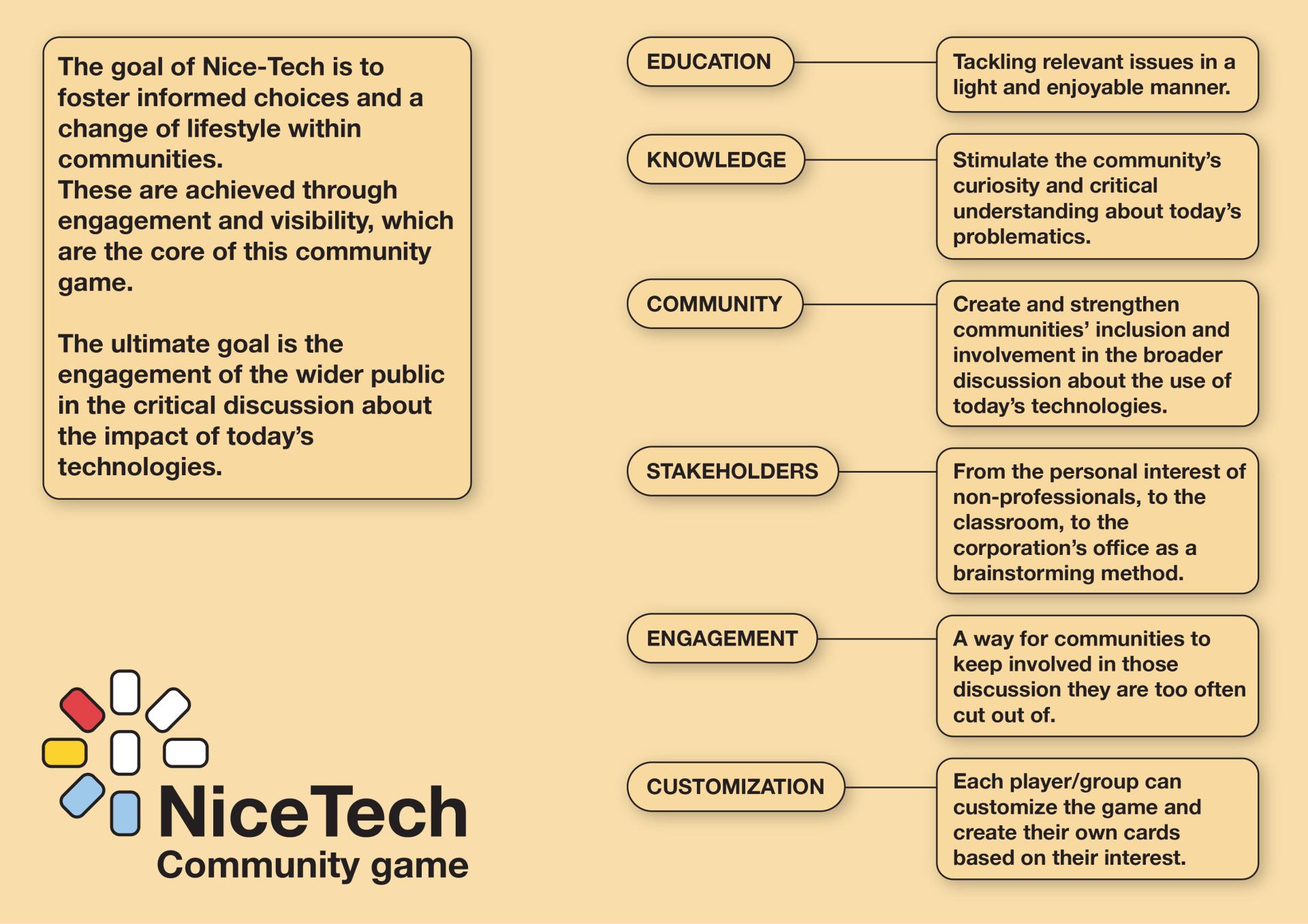
Nice-Tech aims to be a tool for visibility in the form of a card game, which allows people from any kind of community to gather, explore, discuss and challenge the state of contemporary technologies, fostering informed choices and a change of lifestyle.
Engagement depends on how much we can take into account everyone’s set of priorities and needs. We must help people to identify which aspects of technologies may affect their lives and in which way, and what people can do to maximize the positive effects and minimize the negative ones.
The game will provide:
- easy access
- fun
- feedback about the actions taken
- a reward for the most active community.
We make reference to the concept of RRI (Responsible Research and Innovation) to develop a model of dialogue and cooperation among the community’s stakeholders; from a better visibility of technology and its impact on our lives can arise a set of responsible answers (actions) that will move the communities towards a more sustainable future.
Key objectives for sustainability
Nice-Tech as a product itself, which consists of a card game and its added features (website, app, digital platform), can be produced in an eco-friendly manner, using recycled paper both for the cards and the box. In addition, it employs a format that can be easily replicated by individuals: a printer and some thick sheets of paper are sufficient to get the game started.
Looking at the bigger picture, Nice-Tech is developed keeping in mind two different kinds of sustainability: internal and external.
Contributing to the sustainability and growth of our communities, through a better understanding of technology and a shared effort towards a better use of it, is the first objective of this project.
Sustainability is related to change at individual level, as citizens not only can push decision-makers to adopt better policies, but should also take action modifying their habits and promoting more responsible approaches in their families/communities.
Nice-Tech’s internal sustainability, on the other hand, is focused on promoting a cultural change within our communities. This takes time, as well as human and financial resources to get attention, promote the activities, and keep people involved and motivated. The project plan is also to launch the initiative in at least 3 different territories and social contexts, which implies a significant effort in terms of networking and dialogue with the local stakeholders.
To support all this a fundraising contest activity can be developed, as explained below, to guarantee financial sustainability to the project.
Impact cards are subdivided in different categories: Environment, Health, Social life, Money, Time, Work-study and Home. This way, players can identify their own specific priorities, keeping a more sustainable and healthy lifestyle as a general goal.
Fostering positive change and informed choices is the end result of the game, as players are encouraged not only to get informed on a certain topic, but also to act upon it.
Key objectives for aesthetics and quality
Nice-Tech takes the form of a relatively simple and well-known mechanism, a card game, and adds a broader meaning to it. Embracing simplicity in the first place allows a bigger audience to be engaged in the discussion about new technologies, which remains too often an object of interest for only researchers and professionals.
Card games represent a “language” that is spoken by the majority of the population, from the elderly to teenagers and kids. This way, Nice-Tech can be a fun and enjoyable experience, but it also offers an intelligible point of access to broader thematics.
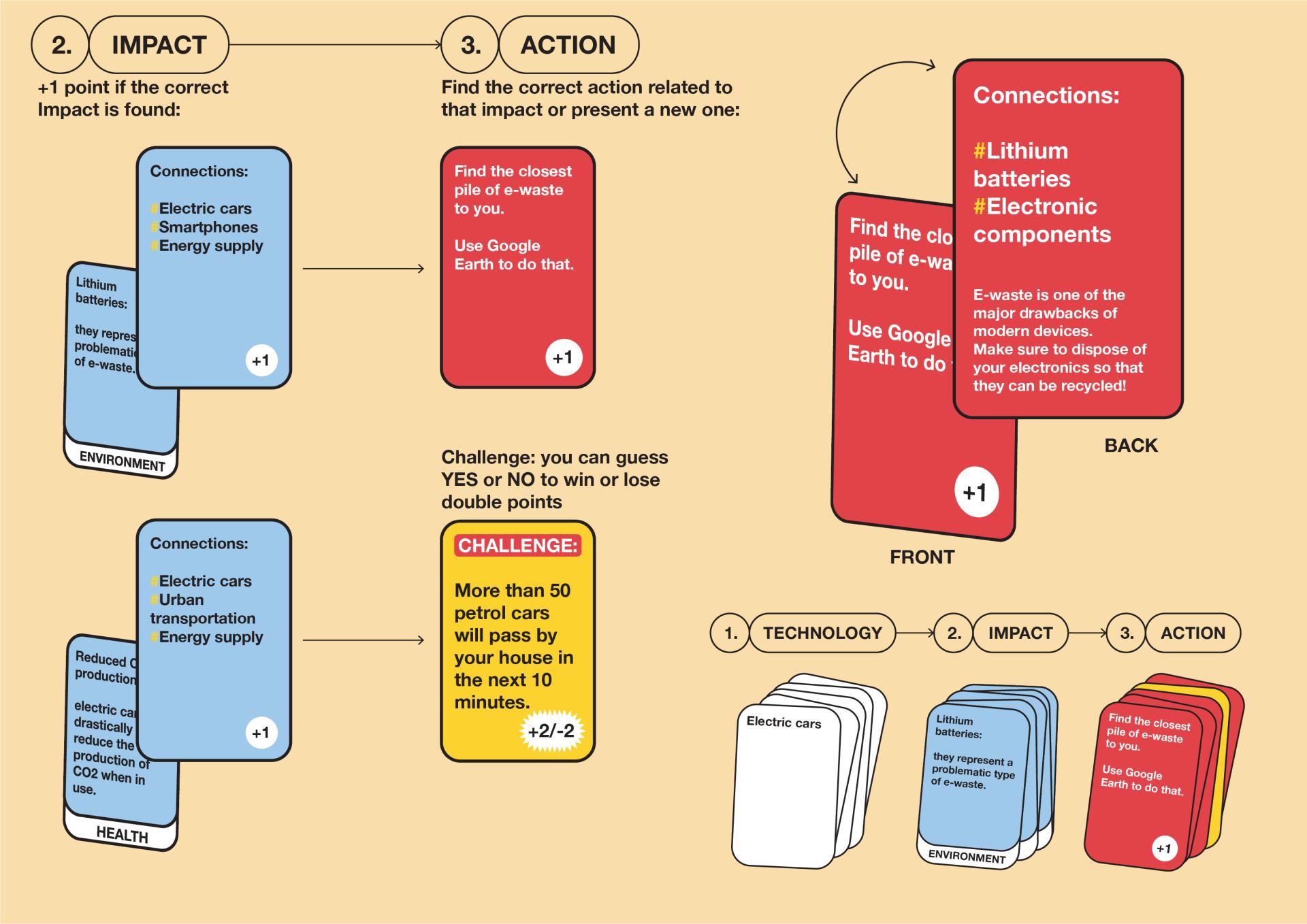
The sheer functionality of the game is based on teams competing against each other, using three different types of cards: Technology, Impact and Action. They are consequential steps within the game, and represent its core.
One (or more) Technology has various Impacts associated with it, and one (or more) Impact is linked to different Actions.
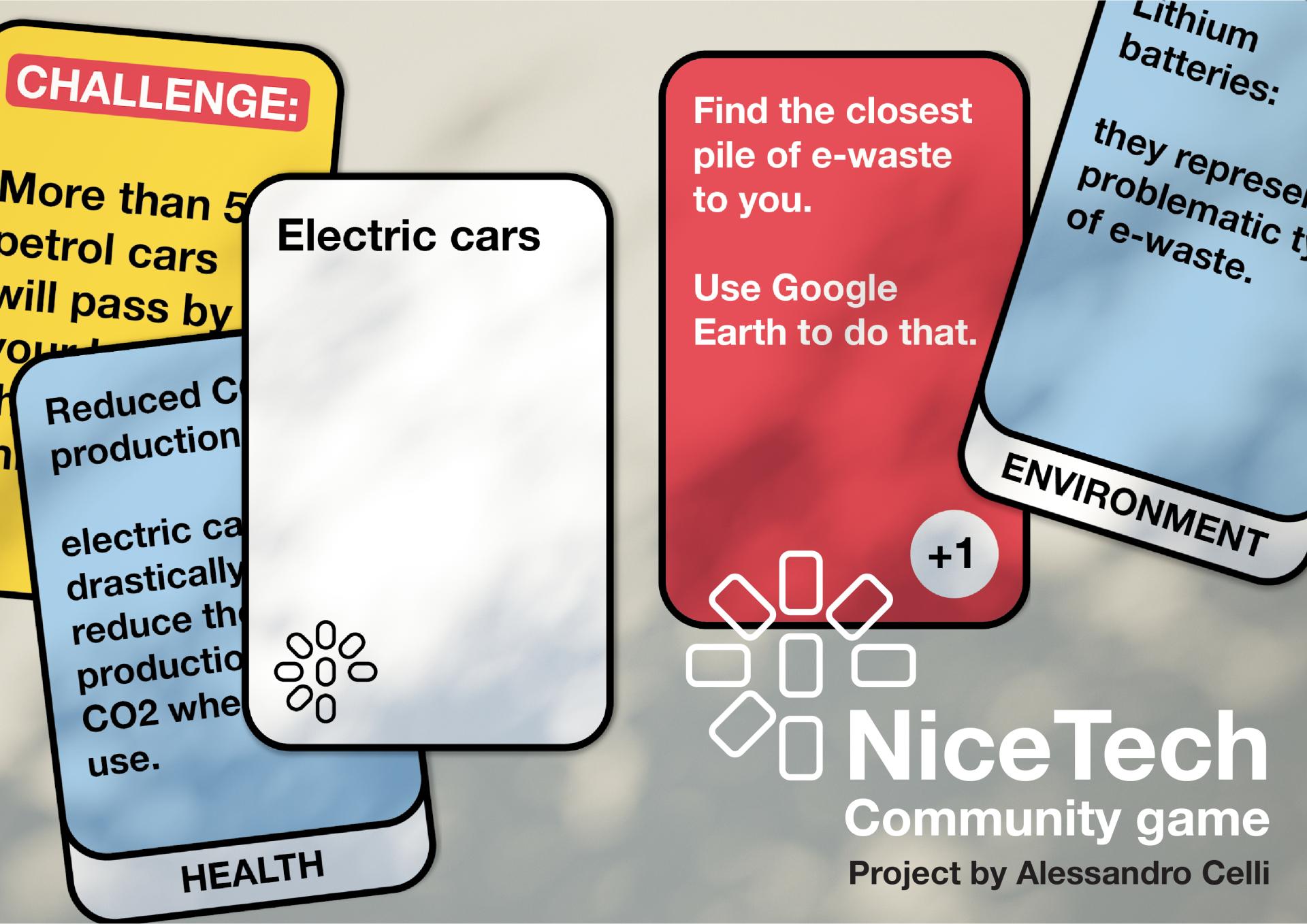
Each team can choose one Technology as the starting point, and is then challenged to find the correct Impacts that relate to it, to gain points. For instance, if the chosen Technology is ‘Electric cars’, its related Impact cards could be ‘Lithium batteries’, ‘Reduced CO2 production’, ‘Electric engine’, and so on. In the same way, once the correct Impact is linked to the chosen Technology, the team can then choose the correct Actions that relate to it, to gain other points.
At the end of this chain, each Action card suggests a real action that can be performed to improve the team’s score, as well as a suggestion to improve one’s behaviour in real life. Following the same example, an Action connected to ‘Lithium batteries’ could be ‘Find the closest pile of e-waste to you. Use Google Maps to do that’. The group can then collectively put an effort in getting informed about e-waste landfills and find one, while getting conscious of the fact that it is important to gain knowledge about recycling electronics.
Key objectives for inclusion
As a tool for curiosity, exploration, visibility and knowledge, Nice-tech aims at empowering existing communities and creating new discussion groups, starting from individuals.
Its versatility is based on simplicity, given that there are only a few rules to follow to be able to participate actively. In fact, its modes of use can vary depending on the groups participating, as well as leaving room for everyone to customize it and come up with new scenarios. Families, students, researchers and professionals could all benefit from a different usage of the game, as it can be a source of knowledge, a starting point for brainstorming and debates, as well as an inspiration for developing new ideas.
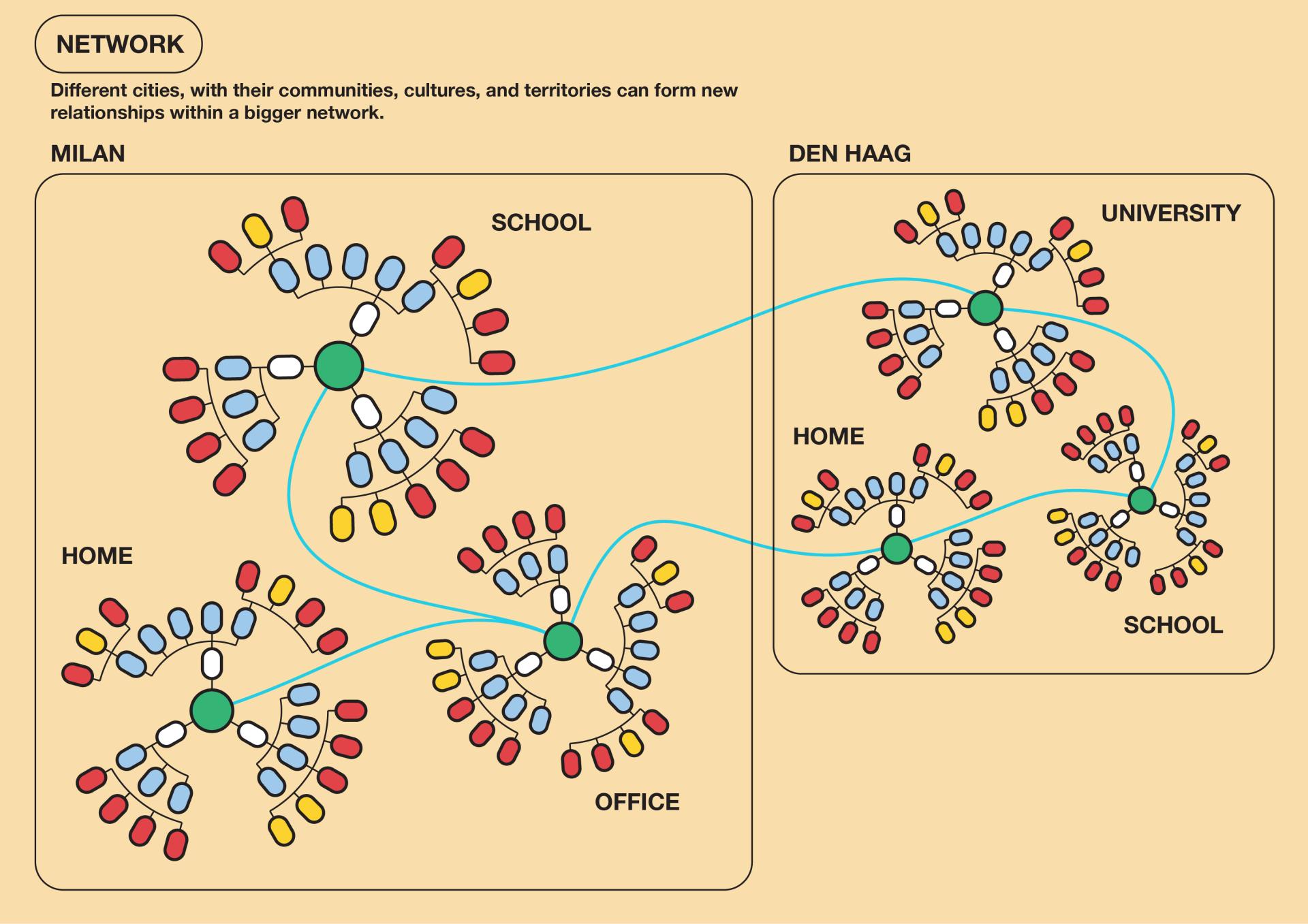
In the long term, the goal is to create new communities, engaging a more diverse audience to the discourse about new technologies and their implications on our planet. As more and more groups of people get involved in the game, they are encouraged to interact with other communities around their city, country, or world.
To achieve this, a contest can be created to set a healthy competition between different communities, with rewards provided by sponsors to keep the engagement alive.
The key concept for inclusion are:
- Customization, as the game's content will change depending on the users and the context. The elderly population, for instance, often find it difficult to understand new technologies and make the right choices. Also, the format in which the game will be proposed will vary depending on the specific needs of the users: from a small-scale board game for individual or family use, to bigger versions for schools and companies, to an urban size one to be played in open spaces.
- Easy access: starting to play will be extremely easy. People can begin and continue to play for a reasonably long period of time, as the type of actions envisioned are not quick-fix, but true changes of mind.
- Specific versions of the game for children and disabled people will be developed.
Innovative character
Games dealing with technology and its impact are already available in many different formats and versions, but very few seem to be really engaging, and the number of people involved is not significant.
In our case several innovations are introduced to make the game as popular and useful as possible. In short:
- A plan for network-building and game diffusion will be developed together with the game itself, launching a test-project in 3 different locations, which will compete with each other.
- The game works as a basis for further co-design and implementation by the users. It is presented to the users as an open template which they can expand with their own perspectives.
- Simplicity is regarded as a priority and a key-factor for success
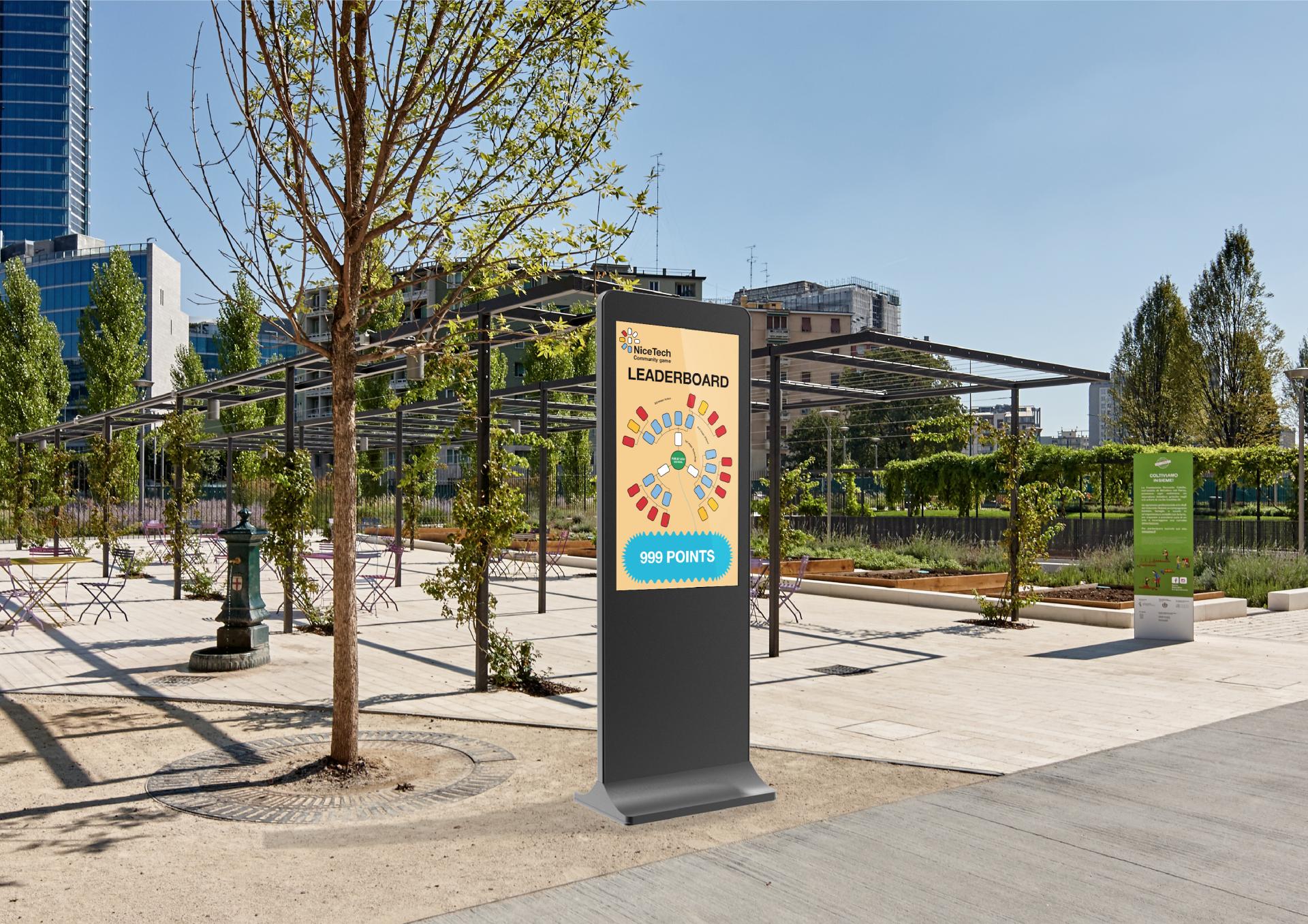
- Visibility of results and impacts obtained: particular attention will be devoted to making the technology impact visible, as well as the level of engagement and the impacts of the actions taken by citizens, over a period of time not shorter than 1 year. This means developing a system of displays in private and public spaces, continuously enriched and updated, showing the progress of the game, the widening of the scenario and the number and quality of actions made. This will also motivate more and more people to join.
- Financial sustainability is one of the key-points. The project will be submitted to territory stakeholder wishing to support the initiative (foundation, local government, companies, private citizen), so that thanks to a fundraising action financial resources will become available to cover costs and make a prize available.
- The game will be made available, step-by step, in various formats, to make it usable in all environments and by the entirety of the population.