Social innovation
Basic information
Project Title
Full project title
Category
Project Description
The project addresses the issue of social and spatial exclusion of large housing estates and their place in the ecological transition. We ask how can the circular economy help disadvantaged communities? Our strategy foresees the insertion of a parallel local economy based on a system of exchange as a springboard to their integration into urban dynamics. The project redevelops excess spaces of an urban derelict, enhances its community dimension and aims at an inclusive "zero waste" model.
Project Region
EU Programme or fund
Description of the project
Summary
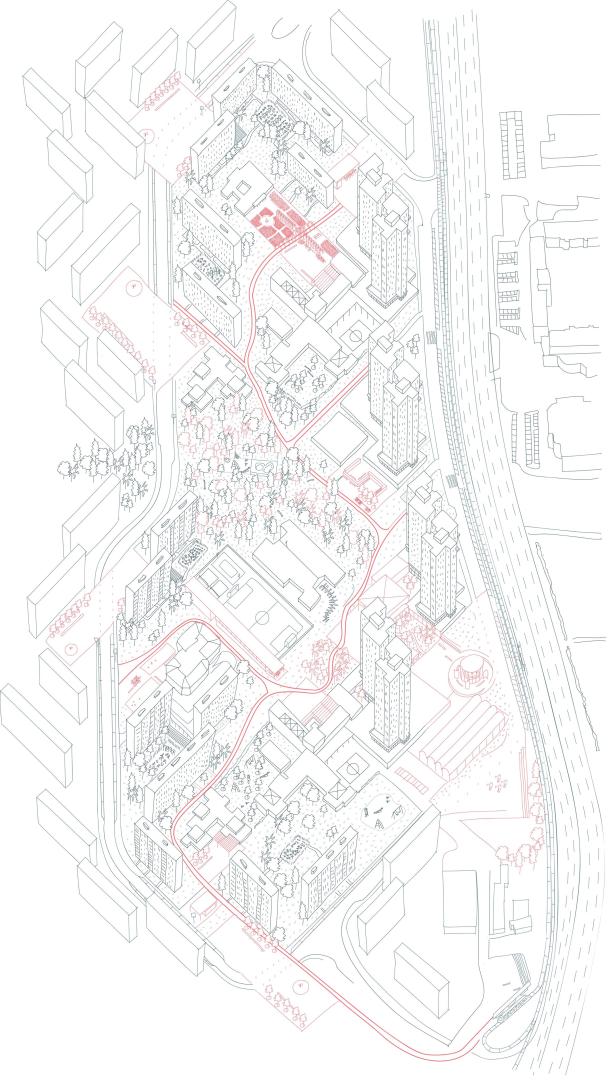
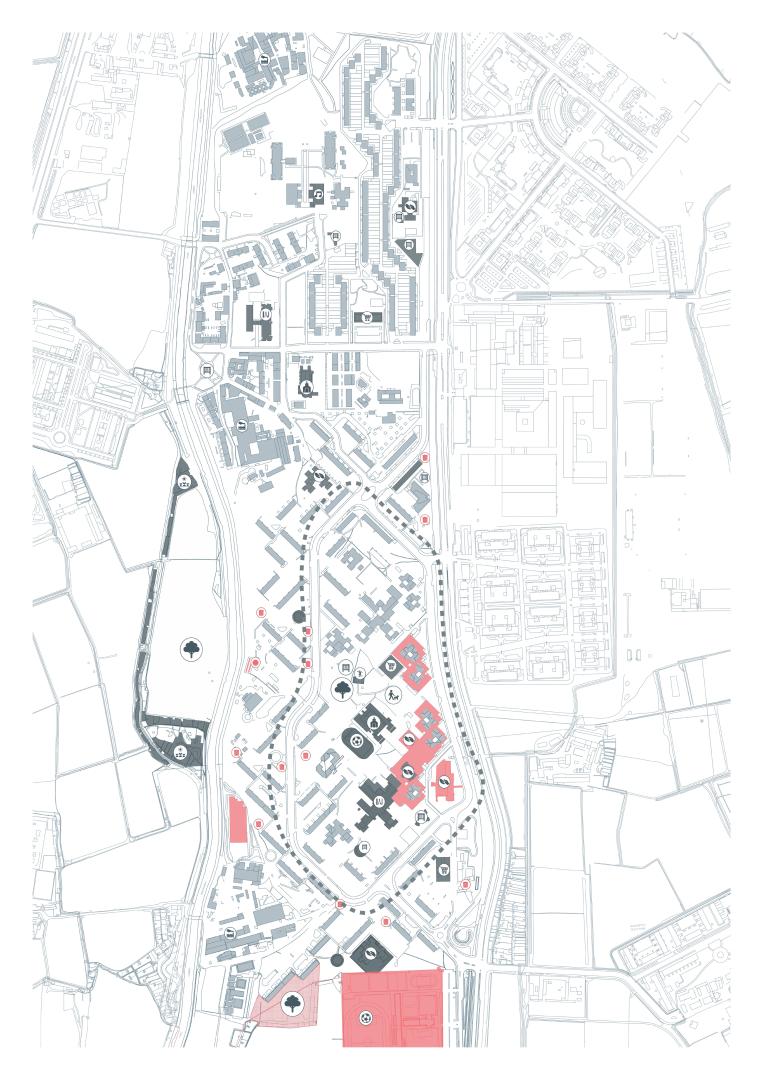
In the north of Milan, the Gratosoglio "grand ensemble" is a post-war architecture, made up of bars and towers of social housing. The project addresses the social issues of the modernist neighbourhood built by BBPR.
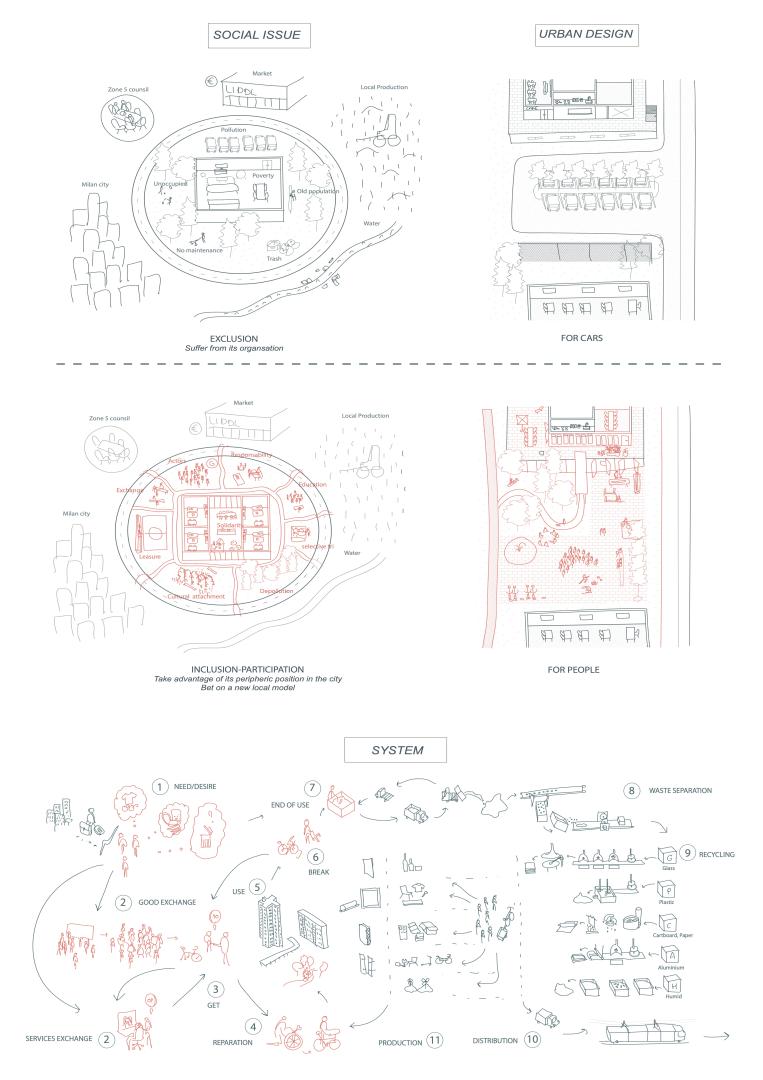
We propose to implement a new economic system of local currency based on the exchange of goods, services and the recycling of materials, where the inhabitants are generators of the system.
This economy, at a neighbourhood scale, does not pretend to be in competition with the current capitalist system and constitutes a springboard for the integration of newcomers into society.
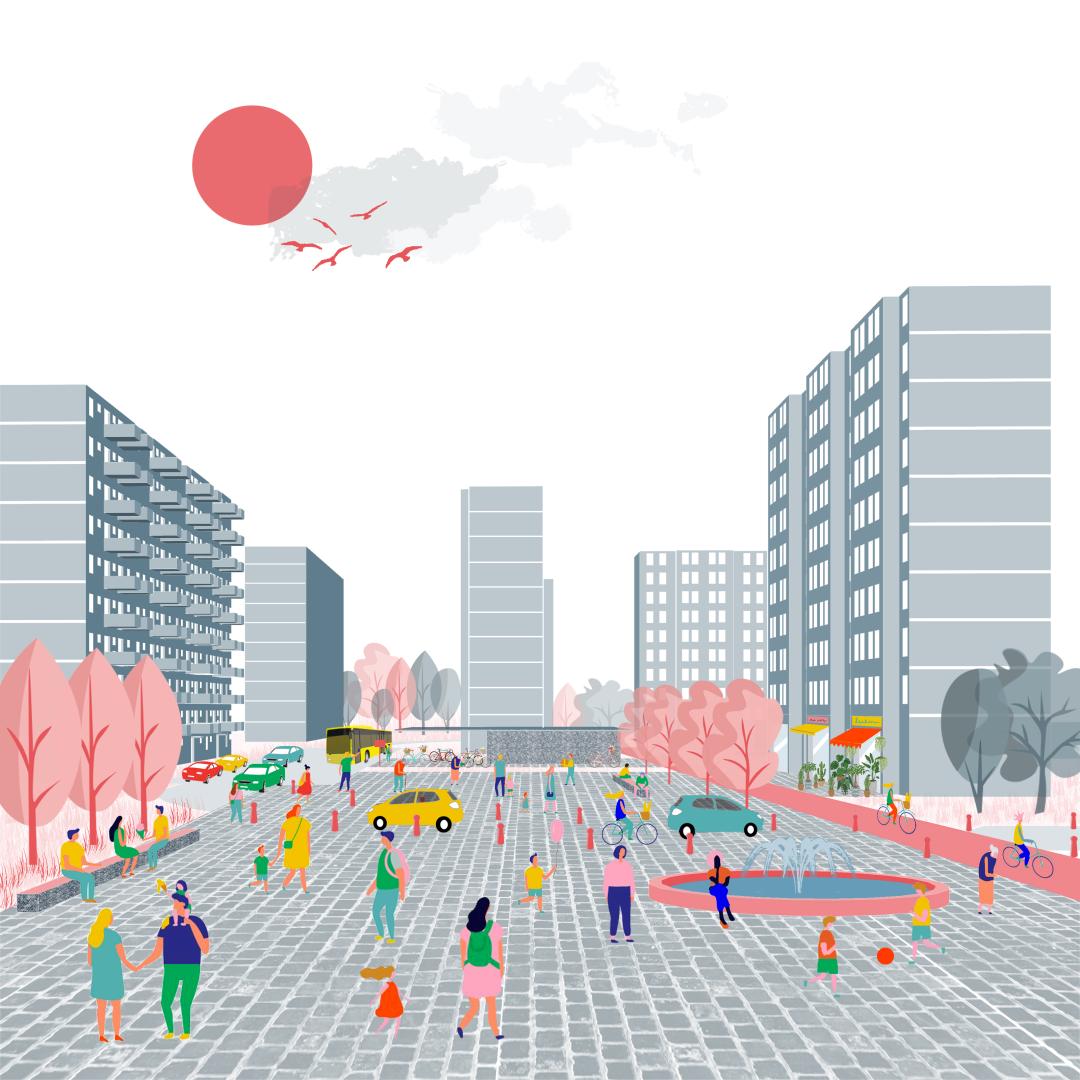
The challenge is therefore to allow the inhabitants to reappropriate the area by redefining the place of the car, reinvesting green spaces, and creating new common places for knowledge exchange, capable of recreating synergies within the communities.
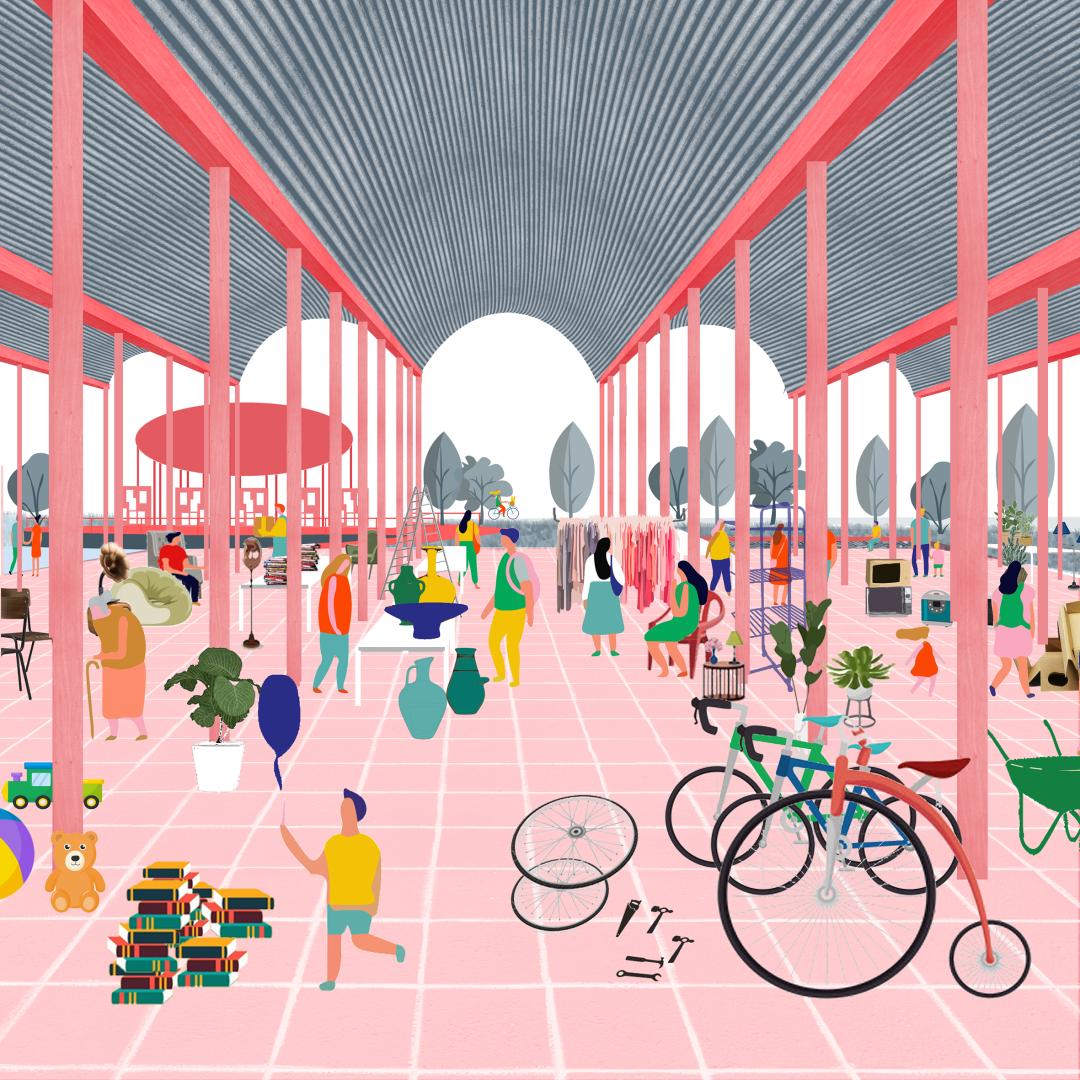
"A man arrives in the neighbourhood, he has nothing, but he knows how to tinker, so he repairs a washing machine at a resident's house and gets 50 "Grat'coins", he can then use this exchange currency to go to the new market square and buy the bicycle repaired by another resident that he needs to get around. "
The programme generated helps to re-qualify public spaces that stand out as unmanaged, subdivided, oversized, unsuitable and therefore residual.
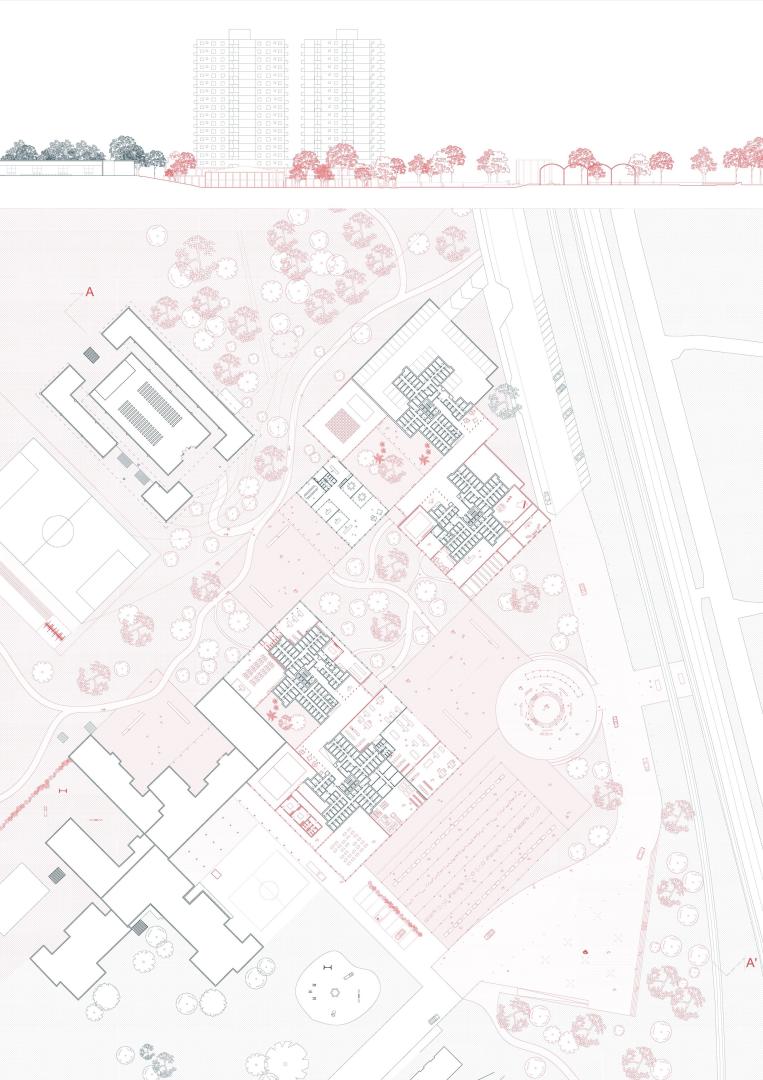
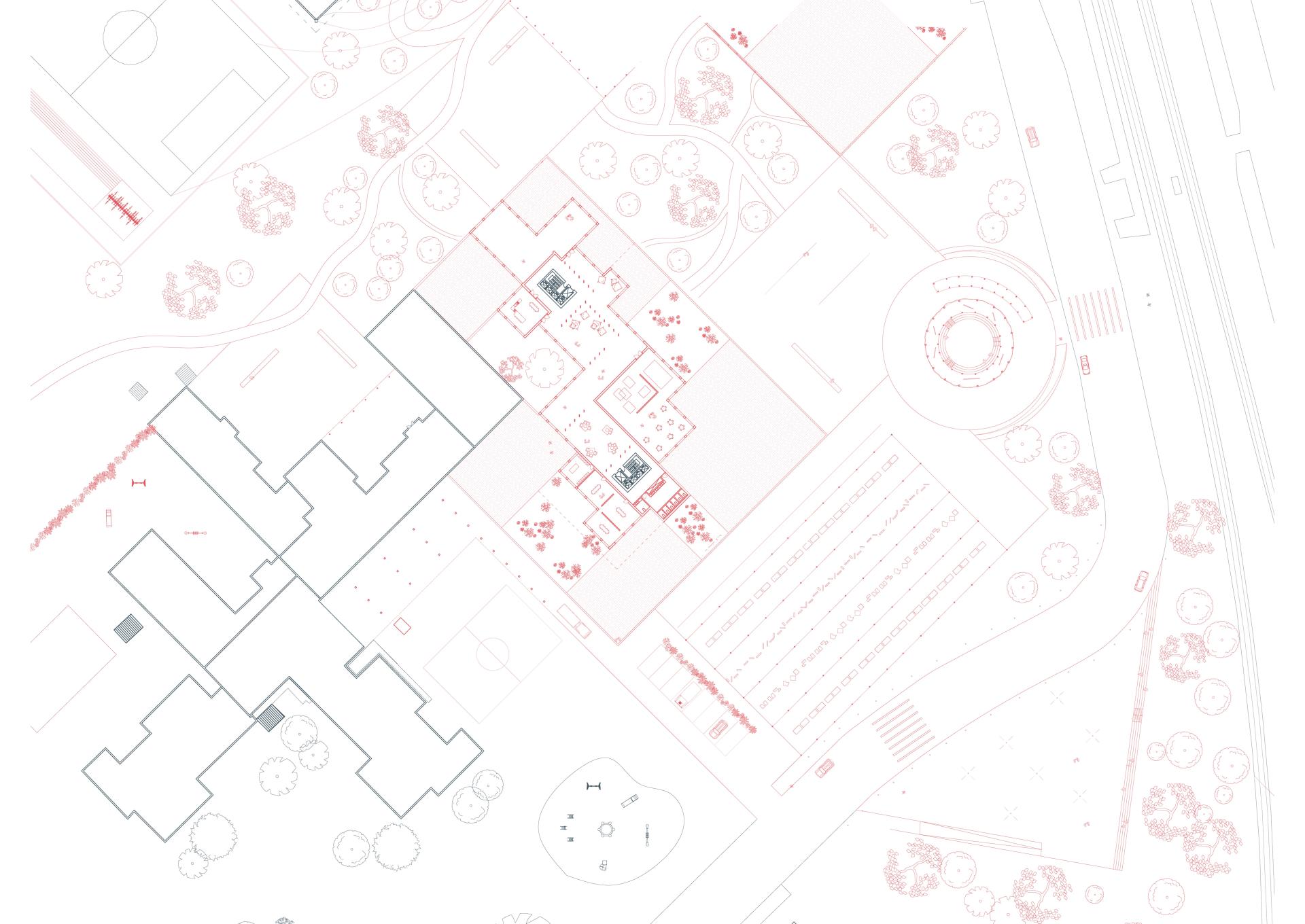
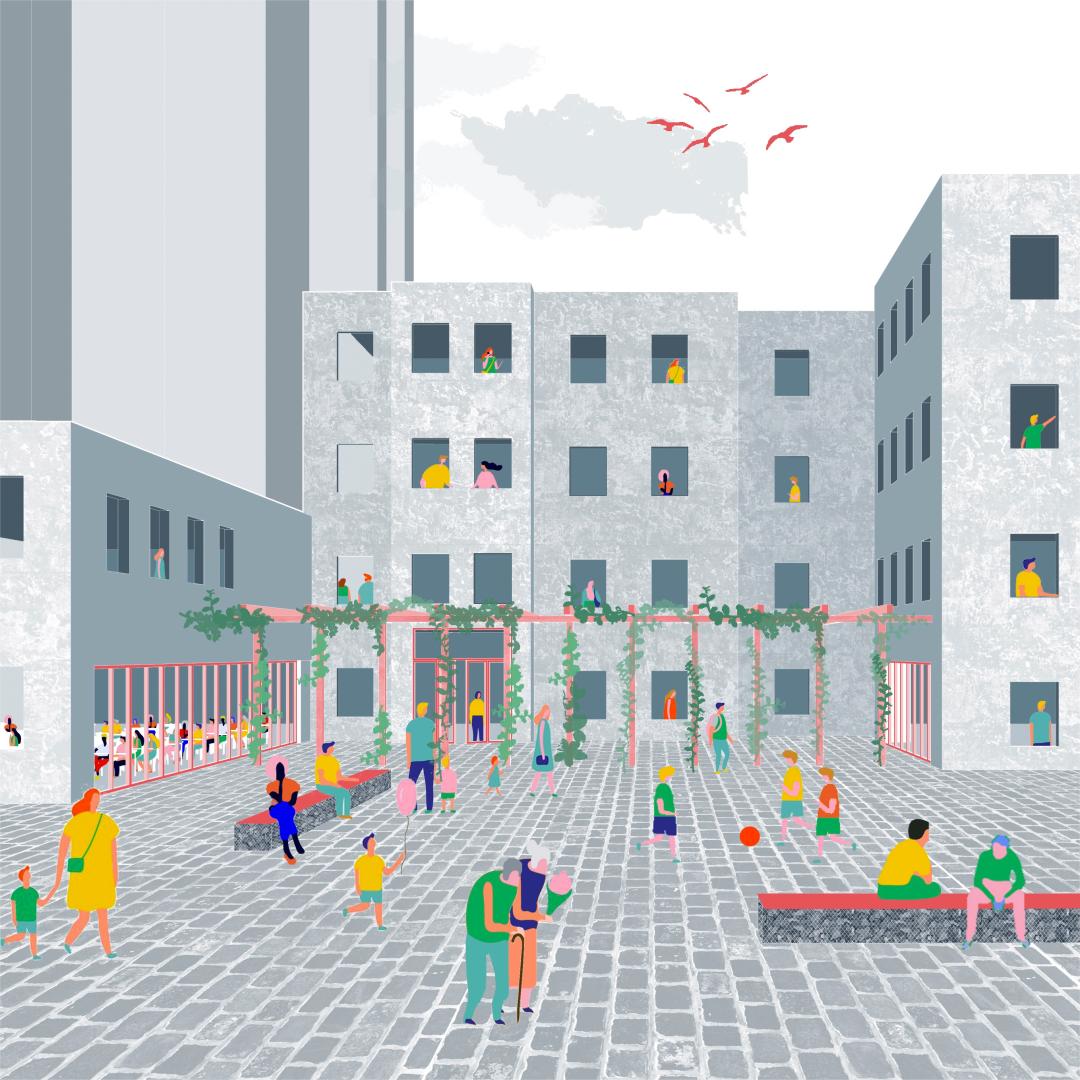
By partially demolishing the parking-system dominating the ground floor we act on the creation of social infrastructures and collective facilities. All architectural interventions are built from the reuse of site materials.
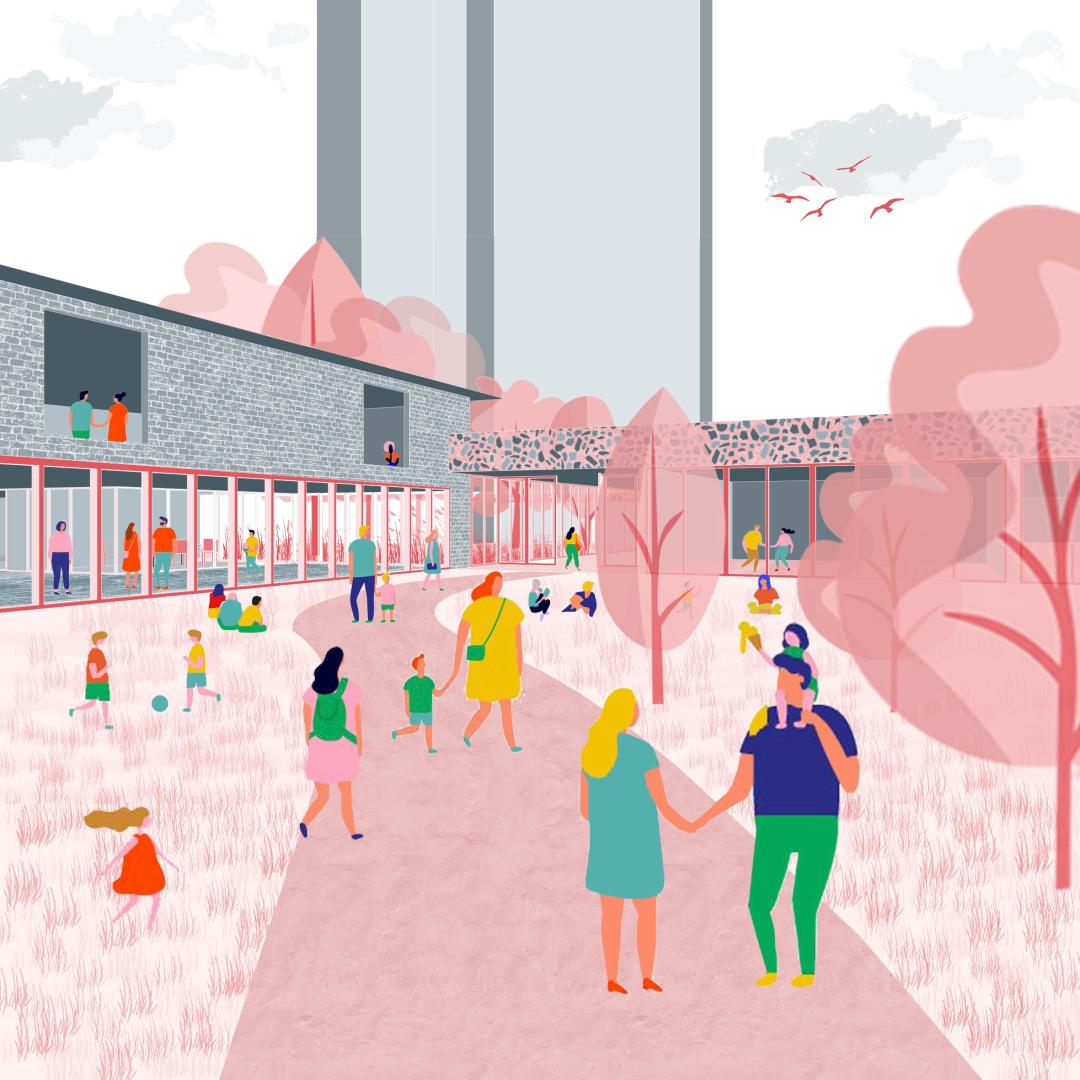
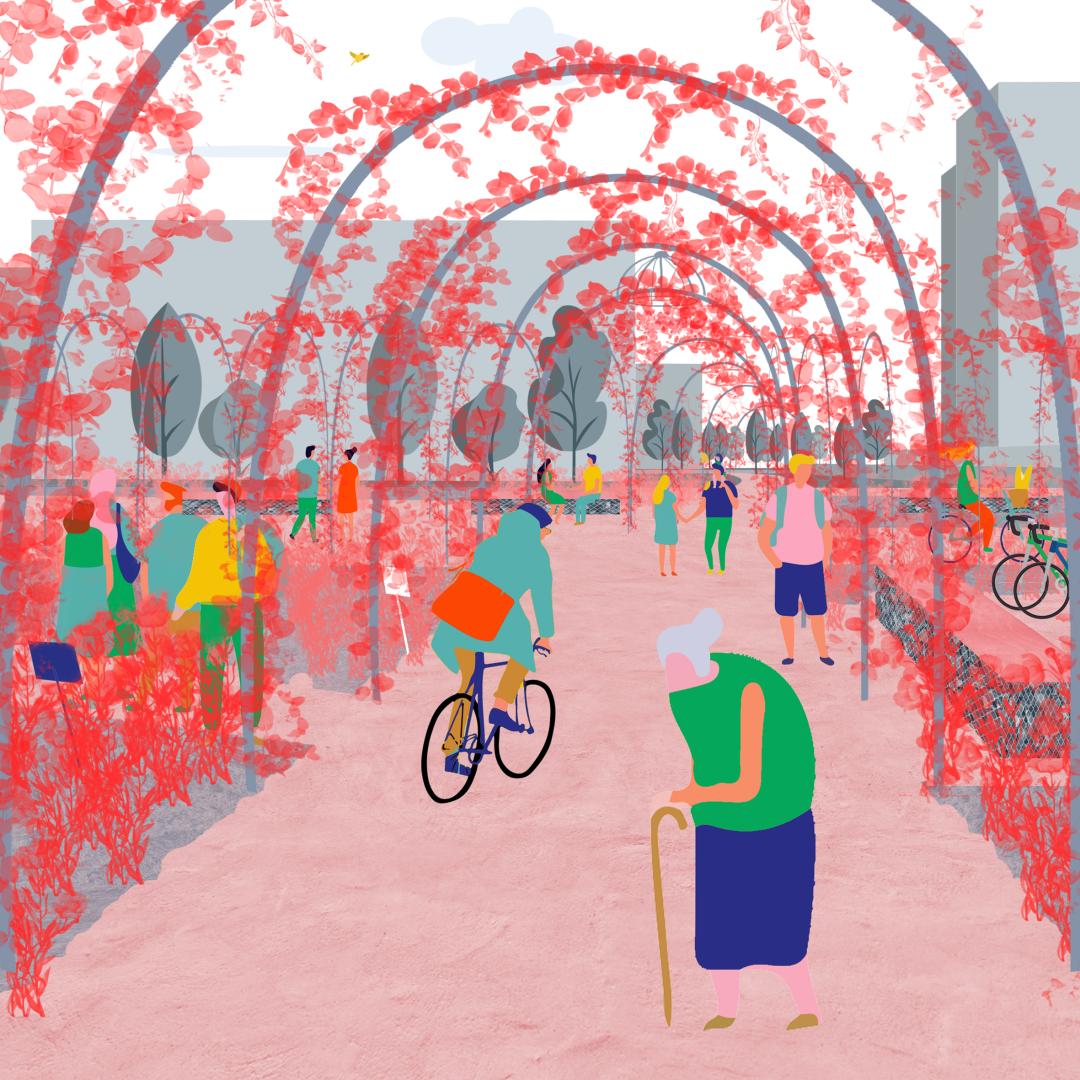
Thus a network of social infrastructures is connected by a soft mobility promenade. These public spaces enliven the path by providing new intergenerational uses.
The tools established affirm the autonomy of the system, through this circularity leading to a "zero waste" concept.
Key objectives for sustainability
All the interventions done remain modest, with a view to achieving a low carbon footprint both in the implementation and in the future use of the site.
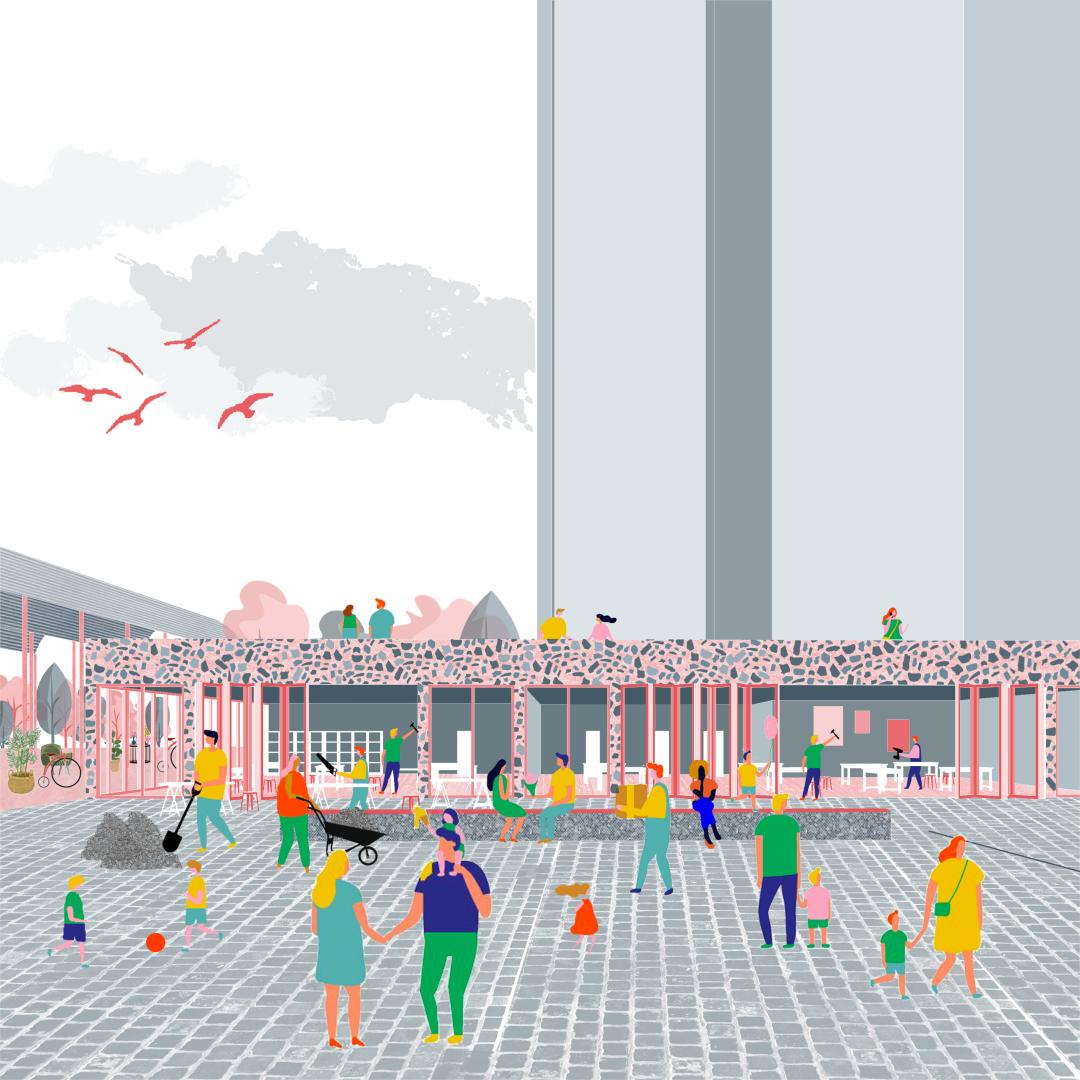
Several levels of action have been developed in order to ensure that the project aspires to be sustainable. The first axis focuses on the reuse of materials recovered during the demineralisation and partial demolition of the car park slabs. Short circuit materials are directly transformed on site and reused. For example, pieces of concrete can be used as filler to make up the urban furniture of the main square in gabions.
The second axis focuses on energy saving in the housing blocks and towers through more responsible water management, for example by placing rainwater harvesting devices on the roofs which can be used directly to supply the washing machines of the collective laundries installed in the common areas of the buildings. Shared vegetable gardens are installed at the foot of the housing areas. A double skin system prevents overheating in the flats due to excessive sunlight on the upper floors of the towers.
The third and final axis restructures an ecosystemic public space. Access to the site is rethought: tram stops and public car parks are optimised and strategically positioned to support the transition to soft mobility and improve accessibility to the site. A cycle track crosses the entire site to allow the inhabitants a smooth and clean circulation. The public spaces are written with the green infrastructure in order to preserve the links of refuge and to bring a natural infiltration of water in the ground. To ensure the permanent maintenance of these meadows, sheep are made available to graze the grass allowing for uninterrupted mowing.
Key objectives for aesthetics and quality
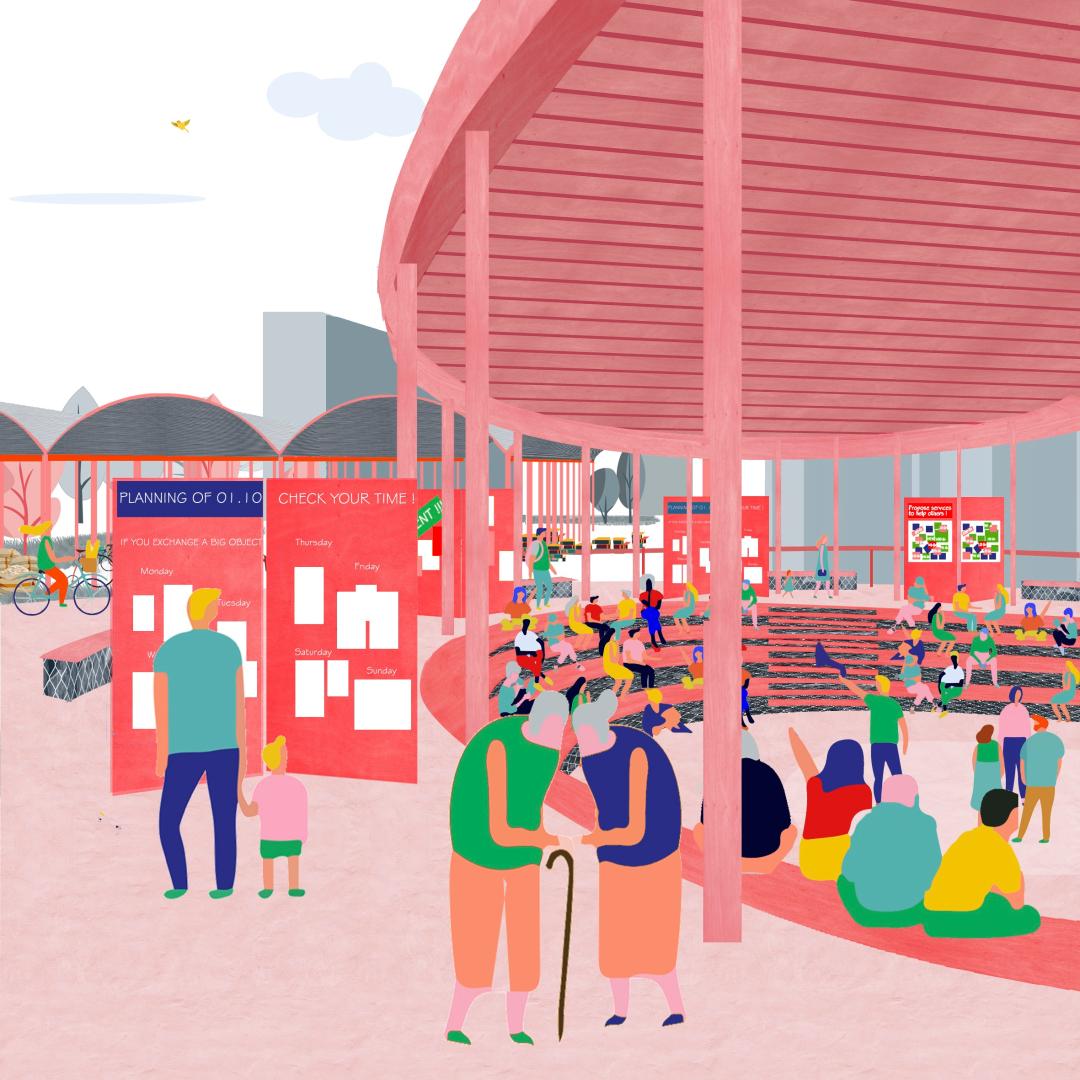
The intervention falls within the aesthetic character of the site's industrial emergency. It composes its architecture with a set of functional architecture like a cultural heritage to be revealed. The reuse of materials from the site in new constructions offers new possibilities of assembly and gives a second life to the "useless". The means mobilized remain sober, economical, experimental and do not claim to want to gentrify the district. The architecture, in contrast to the current massive constructions, is wired, transparent, open and reflects the integration of social infrastructures. For example, in the market square, materials recovered from the car parks, such as concrete reinforcement rods, are used as a framework for the canopy covering the space, benches form concrete gabions, plinths are composed of architectural fragments.
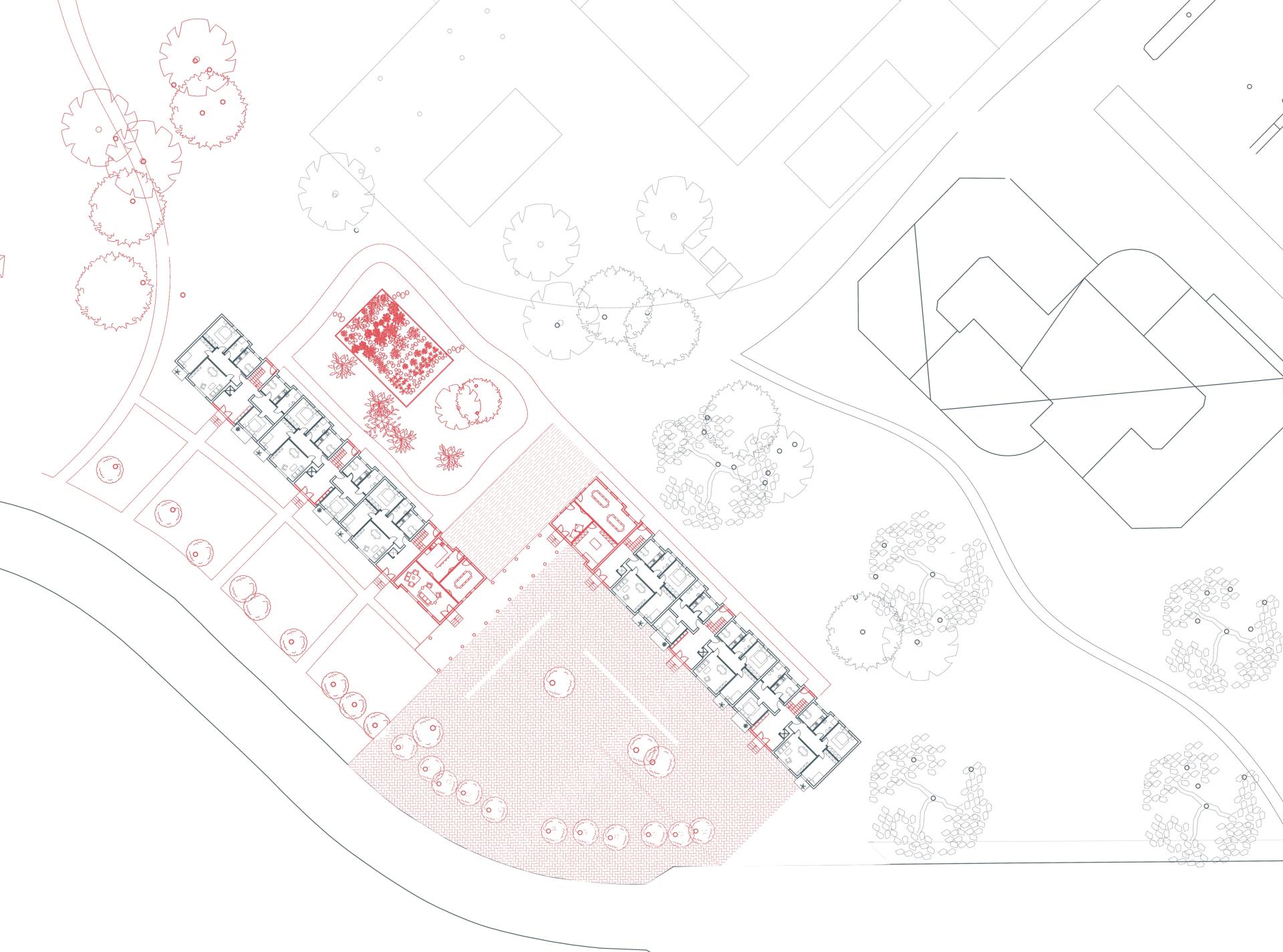
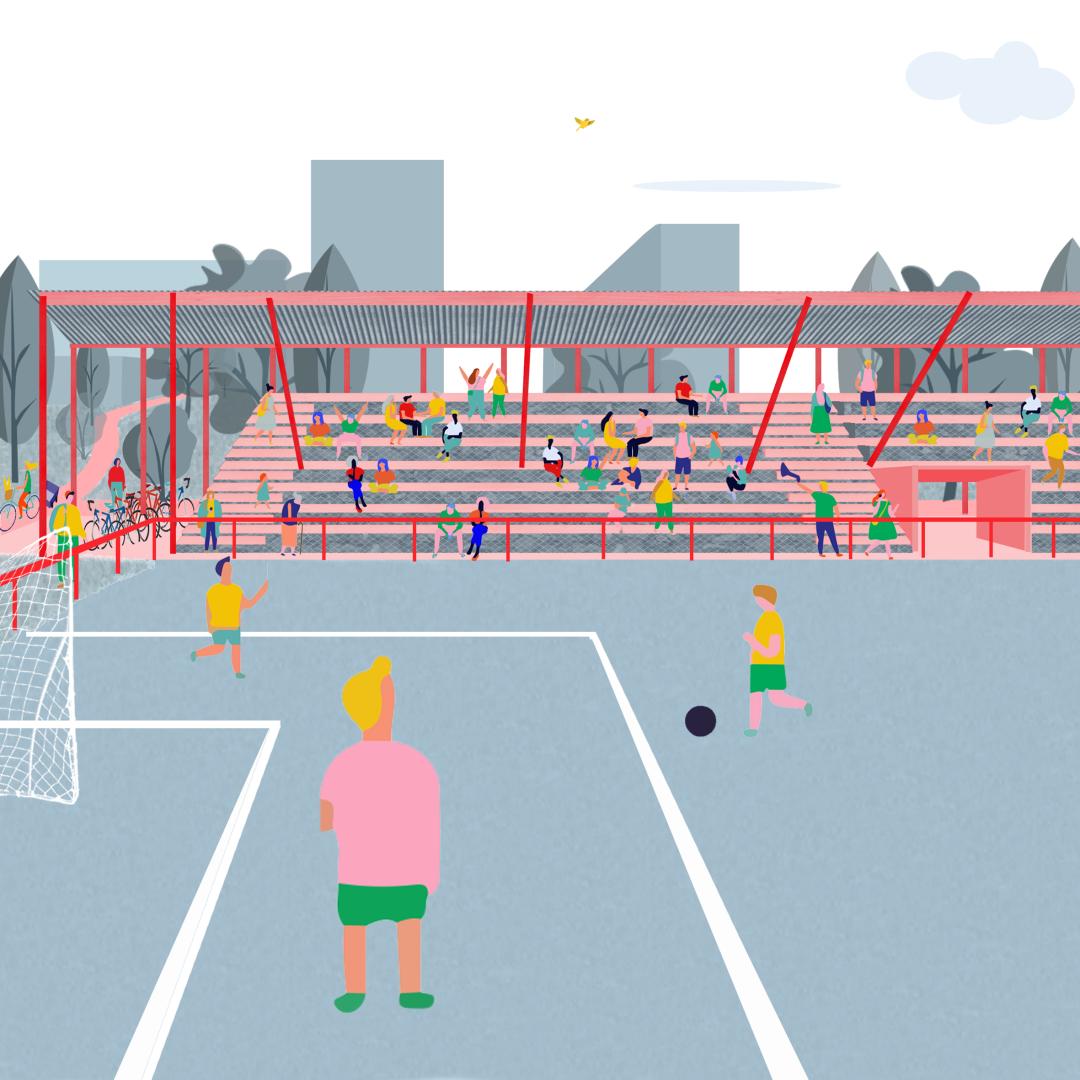
The attachment and memory of the inhabitants are also solicited. The idea is to rediscover a sense of belonging and to enhance the identity of the site. The cycle path links specific public spaces: a rose garden, a reading garden, a children's park, a forest area, a picnic area with a modular bench where its height varies and it becomes a seat or a work surface. The furniture is flexible and playful to encourage appropriation. Public spaces are conceived as mineral mats on which tactical artistic interventions are free to take place and be interchanged.
Key objectives for inclusion
Project's ambitions are to create synergies between the neighbourhood's inhabitants by encouraging them to become involved in this new exchange system and to make them responsible for being part of this loop of circularity and solidarity.
Citizens participate in the system in order to introduce a dynamic of sharing and social cohesion where they are the main actors. Each week, the market is organised in a management centre, accessible to all, where everyone can make their voice heard. Then, they help to organise neighbourhood events and the market, a new landmark in the neighbourhood, in order to sell their objects, which they have repaired and renovated beforehand in the new workshops set up in place of the old car parks on the ground floor. Inhabitants are also being asked to participate in workshops and workshops to help build street furniture using reused materials, while at the same time raising their awareness of the subject.
Associations already present in the district have a reinforced place and are gathered as close as possible to this new market place and the management centre, they are included in this dynamic, attractive and exchange centre.
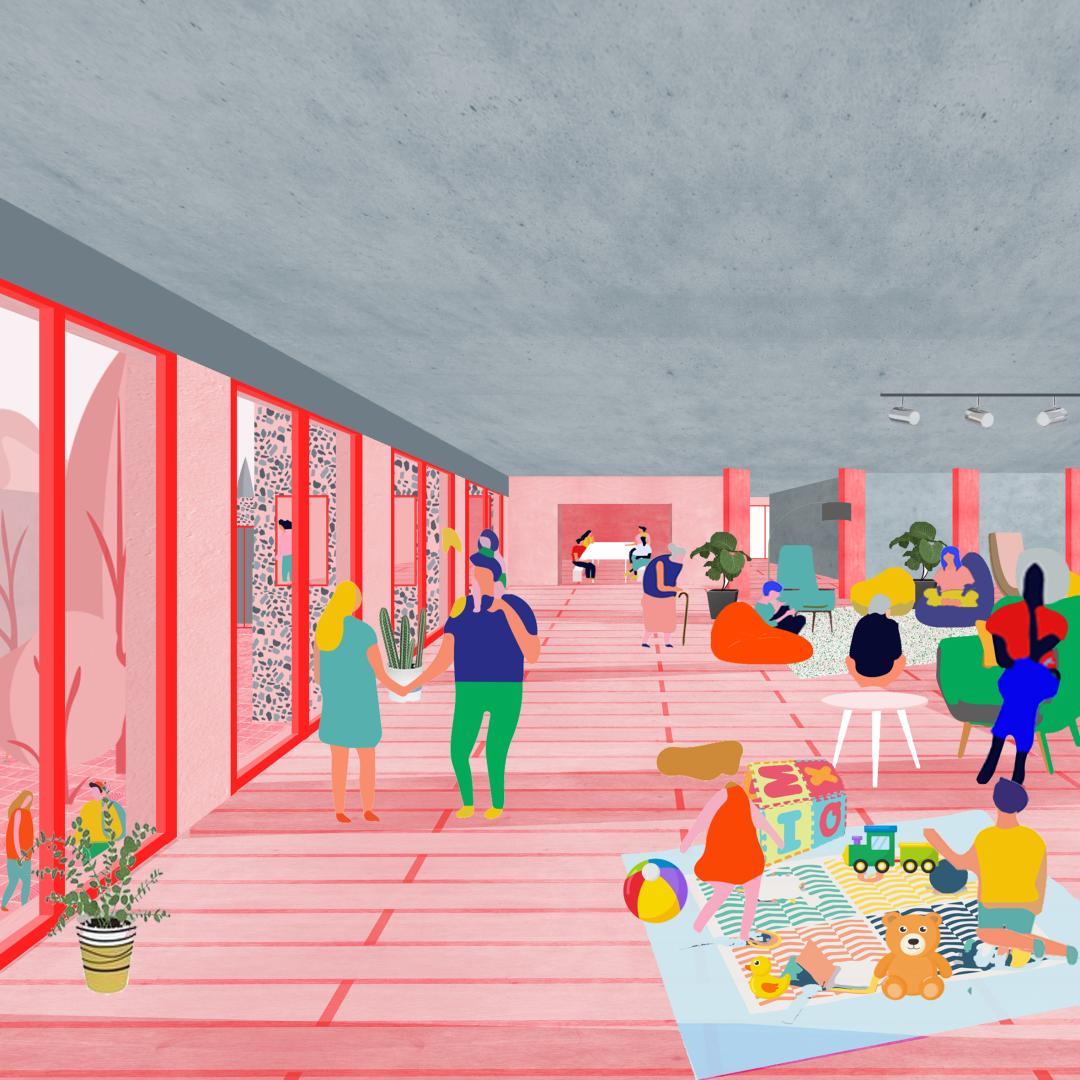
New communal living spaces are set up on the ground floor of the bars and apartment towers (day care centre, multi-purpose room, communal laundries, etc.), but also in the external public spaces (common outdoor kitchen, playground, vegetable gardens), leaving room for meetings and sharing.
Finally, in addition to their monetary insertion thanks to the system of exchange of goods and services, a real ecosystem of solidarity and involvement is created inviting the residents to participate in the community life of the neighbourhood. Residents are the central actors of the concept, a spirit of belonging emerges from these actions aiming at rebuilding solid social links within the neighbourhood.
Innovative character
This new local economic system is based on the circulation of a currency: the Grat'coins, and the belief that everyone has a hidden talent that gives them a place in the community. It is based on their goods and abilities which they share by offering their services. As soon as a good or service is exchanged, money is generated and this money allows them to access other goods or services. This method not only encourages encounters and the exchange of "good practices", but also involves inhabitants in a self-managed economic system.
"Mrs. Grabila is looking for help with her cleaning, Mr. Armato offers his help and in exchange for the Grat'coins that Mrs. Grabila gives him, he can buy the fabric he wanted for his new curtains on the new market square.”
In order to perpetuate these community exchanges, workshops are available to inhabitants to repair any object in order to exchange it on the market square or to teach their neighbour, to pass on their knowledge so that they in turn can provide a service. This new ecosystem is part of a dynamic of circularity and sharing, of particular attention to education to promote better integration of the most disadvantaged populations (newcomers, the elderly, students, etc.) where a contemporary society such as ours is not always inclined to integrate them.