Dvelas Reusail Proyect
Basic information
Project Title
Full project title
Category
Project Description
DVELAS reuses sails and transforms them into beautiful products using contemporary designs.
Sails that travelled for years on boats all around the world are now transformed into useful objects with a maritime past. The idea came up as a creative reaction to finding a new use for discarded boat sails.
This fabric has excellent durability and resistance and develas has found a way to upcycle these sails.
Project Region
EU Programme or fund
Description of the project
Summary
Dvelas designs creative products and services for recycling boat sails. At the end of their useful life sailboat sails are put into storage as until now there has been no available process for restoring them and bring them back to life. Our project focuses on finding these retired sails and taking full advantage of the technology that has been invested in them. We do this not only because we can take full advantage of their strength and durable qualities but also because we think they have enormous, unexplored, aesthetic potential.
The project focuses the activity in four areas
1.Design and tailor-made solutions for sun protection
We create shading solutions, using recycled sails within a framework of traditional systems that already exist in the nautical world or which can be adapted to our needs. We work with new applications such as photo catalytic treatments that clean the air, LED lighting systems incorporated into the fabric, nebulization systems that cool the air and fireproof fabrics.
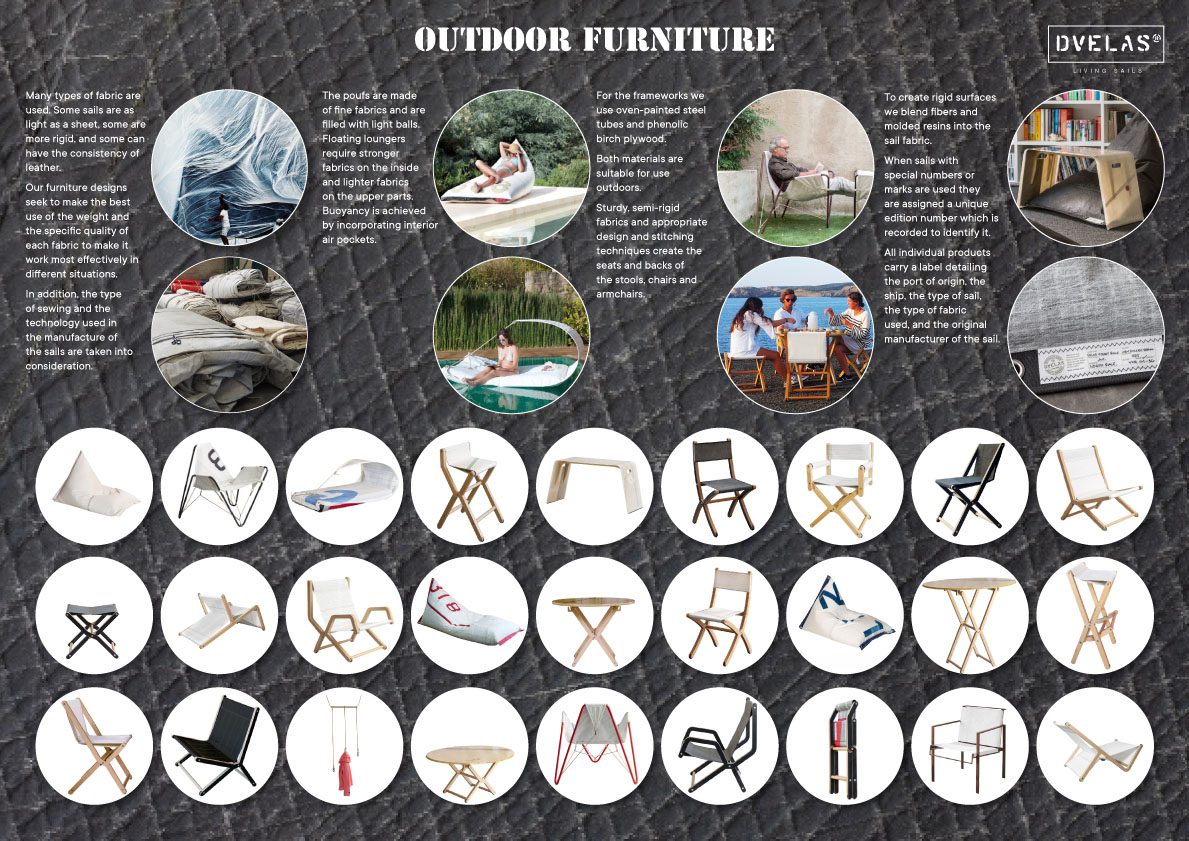
2.Design and manufacture of outdoor furniture
Our furniture designs take advantage of the qualities of the various sail fabrics along with other materials such as metal or wooden frames, tensioned rope, foam, resin, and fibers or light balls.
3.Design and production of lighting systems
The different sail fabrics create special effects when held against the light, a feature which makes them good light diffusers.
We have created a series of unique lamps that take advantage of these effects as well as the varying fabric textures.
4.Tailored supply service of raw materials and consultancy for its use in architecture.
We can supply architects and designers with raw materials in made-to-measure dimensions for specific architectural projects along with specialized advice on the materials and appropriate installation systems.
www.dvelas.com
Key objectives for sustainability
The most characteristic part of the project is locating the retired sails, recovering them and reusing them as raw material and thus taking advantage of the high technology that has been invested in them. A material that is no longer suitable for sailing, for which there is no recycling channel has excellent qualities of durability and resistance. This process allows us not only to give useful life to a discarded material but at the same time provides a solution to the recycling of this material. The sail material used on Maxi Yachts are excellent for sun protection due to their mechanical resistance, their waterproof qualities, and good performance against UVA rays.
Furthermore, these fabrics are usually interwoven with fibers that create pleasing effects when seen against the light. Despite being a high-tech, resistant material, its appearance resembles a heathered or reeded texture. The different sail fabrics, a feature which makes them good light diffusers.
In terms of sustainability, it is worth highlighting the development, in collaboration with a center specializing in nanotechnology, developing "photo catalytic sails"
A nano chemical preparation has been developed to ensure perfect surface adherence on the sails where, when in sunlight, it produces a chemical reaction capable of eliminating dirt and toxic particles in suspension. This process of photocatalysis eliminates CO2 to generate organic matter and oxygen. It also eliminates common pollutants in the atmosphere such as Sox, VOCs, or NOx, through this sunlight-activated process. It is estimated that 4 m2 of this type of fabric can have an effect equivalent to removing a car from circulation for a whole year.
All sails treated with this process are identified with an information label and date of application.
Key objectives for aesthetics and quality
The project began in 2009, since which we have been in a continuous process of design and improvement of the products to ensure that we offer optimum quality. Not only have the designs been improved, but our production techniques have also been perfected. We now have a network of local suppliers that not only helps to reduce emissions but also ensures that we receive the quality we are looking for.
Since Dvelas’ beginnings, we have also been improving our designs to increase the usefulness, comfort and resistance of the products, offering more durable products.
We are currently developing our own awning systems, as well as several furniture and lighting collections with bold and original designs, as well as a raw material supply service with worldwide sales, all of which are in line with Dvelas’ aesthetics and design which are the hallmark of the company.
Our raw material of ‘recycled sails’ carries with it a history of its own. Each sail has its labels, seams, eyelets or windbreaks, giving each sail an origin feel which adds a very personal aesthetic and emotional added value. Aesthetics are fused with functionality to create products that combine design, comfort, beauty and emotion.
Key objectives for inclusion
From its beginnings, Dvelas has maintained a spirit of social responsibility and has worked towards the inclusion of different groups.
The majority of the Dvelas team is made up of women with jobs in all areas, both management, design and workshops.
From the very beginning, one of our larger objectives was to generate quality employment to promote the integration of people with disabilities. And for this reason, we work with various local social entities with Special Needs Employment Centers such as Aspace or Animet.
Another angel of our collaboration with the social entities is with Universities and educational centers. We offer internship positions to students studying architecture, engineering and design. They are offered prior training in inner workings of Dvelas, but we also ensure that they learn different aspects of business so that their work experience is meaningful and beneficial to their career in the future.
We frequently collaborate with the University of Navarra, more specifically with their Architecture and Engineering departments, the Engineering department of the University of Deusto or the Creanavarra Higher Design Center.
Results in relation to category
The current Dvelas furniture Catalogue has more than 100 interior and exterior references that include chairs, tables, stools, sun loungers, coat racks, poufs and lamps. In 2013, the furniture collection received an award by the Basque Navarro Official College of Architects.
Dvelas’ current distribution is worldwide. Our main markets reside in Europe, the United States, Australia and Japan.
In recent years the company has attended different trade fairs in Stockholm, Milan, New York, Hamburg, Paris and Valencia. During the 2017 ICFF Fair in New York, the furniture collection was awarded the Editors Awards for the best outdoor furniture of the fair.
The growing need for outdoor furniture has augmented the demand in shading systems. Due to this, we have grown notably, which has led us to focus on developing both the design of the sails and their tension systems as well as incorporating new applications.
The incorporation of lighting in the sails give shade during the day and serves as a lamp at night, the photocatalytic treatment of the fabrics give the sails the ability to behave as decontaminants and oxygen generators. The incorporation of pressurized water nebulizers to lower the temperature or the incorporation of solar panels (now in process) make our product attractive and competitive in different ways and sectors. The beauty of a stretched fabric while at the same time fulfills the functions of shading, illuminating, decontaminating, or cooling spaces.
The raw material supply and consulting service for its use in architecture has aroused interest in different projects, the most representative being the shading of all the central areas of the La Mer Shopping Center in Dubai, contributing most especially to reducing heat islands in the mall.
How Citizens benefit
The Dvelas business model can serve as exemplary for society. Starting from a waste product that generates a problem, we solve the problem, and create raw material that we offer to third parties and use ourselves to design and produce beautiful and functional products. The company has generated 9 full time jobs inhouse and another 15 jobs indirectly through collaborations with local companies that form part of the production processes.
We collaborate with the Lurederra technology center, a technology center that carries out research and applied technological development in the fields of nanotechnology, new materials and advanced environment at the service of companies and economic agents both nationally and internationally, including the subsequent implementation of the innovations developed in the industrial production centers of their own.
We are part of the Wood Office And Contract Habitat Sector Cluster Association (HABIC), which was created to activiate and propel the businesses in the habitat industry and serves to facilitates contacts between companies and other agents in the sector. It allows us to be in contact with companies and agents of the cluster, and others, with whom we can exchange knowledge and obtain business opportunities.We also collaborate with AIN (Navarra Industry Association), a private association that specializes in management and technology, encourages collaboration and competitiveness in the industry and the environment. Through AIN, our company was incorporated into the catalogue of oustanding companies in circular economy in Navarra. Collaboration with research centers, the cluster and AIN has given us the opportunity to offer talks at different events in which we have been able to promote ourselves and teach our way of working. In 2018 we were Sustainability partners of the Turn the Tide on Plastic team of the Volvo Ocean Race. We were also invited to participate in the Sustainability presentations at the Volvo Ocean Race Summit.
Innovative character
Dvelas emerged as a creative reaction to finding a solution to certain sails that were no longer useful for sailing and were simply stored away taking up a lot of space. At the beginning of the project, we contacted several Spanish sailing companies and they all had the same problem of not knowing how to get rid of the sails. We realized that no company offered a withdrawal service because they just didn't know what to do with them. In the first phase, we began designing furniture like poufs or loungers that did not need a frame. Later, new designs were incorporated where we used wood and metal frames, resins and fibers. All the designs are original and have the a common denominator of being novel and original design inspired by the sea and the nautical world.
For the use of the sails as shade, we adopt the type of stitching and the nautical hardware and rigging used in professional sailing, however we have developed our own products such as the design of an aluminum extrusion to generate a mast with four rails with variable height in order to hold several sails on the same mast and adjust their height at any time.
DVELAS has developed in collaboration with a center specializing in nanotechnology a nano chemical preparation has been developed. This preparation has perfect surface adherence on the sails where, when in sunlight, it produces a chemical reaction capable of eliminating dirt and toxic particles in suspension. This process of photocatalysis eliminates CO2 to generate organic matter and oxygen. It also eliminates common pollutants in the atmosphere such as Sox, VOCs, or NOx, through this sunlight-activated process.
We are working on the development of textile solar panels to incorporate in the shade sails, converting the energy provided by the sun into electricity. These plates are characterized by their thin thickness, flexibility and lightness. We obtain shade sails with light powered by solar energy.