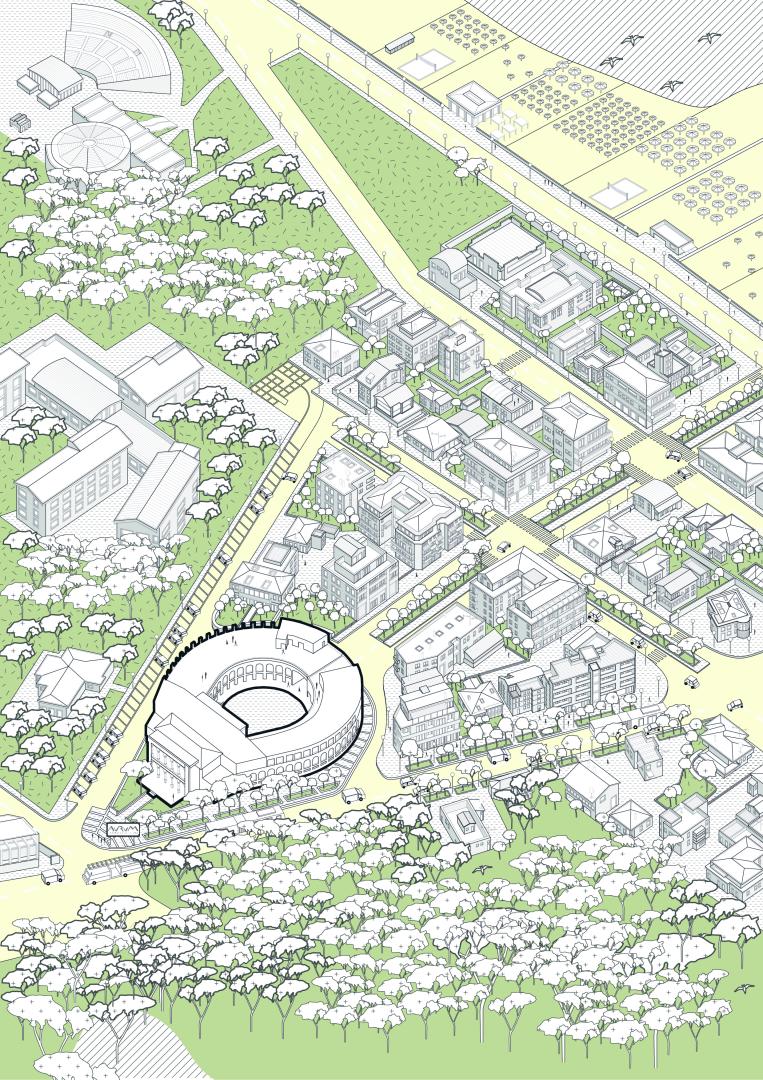
Urban complexity
Basic information
Project Title
Full project title
Category
Project Description
Cities require the easy movement of people, called their mobility. The ways that people move around a city depend on what is perceived to be the easiest, which results from a complex mixture of socio-environmental, socio-demographic, and socio-psychological factors. . This research focuses on walking in the street space as a form of mobility and its role as a public space critical for social exchange and urban development.
Project Region
EU Programme or fund
Description of the project
Summary
Cities require the easy movement of people, called their mobility. The ways that people move around a city depend on what is perceived to be the easiest, which results from a complex mixture of socio-environmental, socio-demographic, and socio-psychological factors. As the use of cars is reduced to combat climate change, walking becomes even more important. This research focuses on walking in the street space as a form of mobility and its role as a public space critical for social exchange and urban development. Recognizing that at the base of the success of cities, there is a high consideration of the importance of urban space: the adequate design of these spaces makes cities more productive and significantly affects the increase in the quality of life and environmental and social prosperity and economic. Cities that re-evaluate and promote widespread access to urban commons also increase social cohesion, civic identity and the quality of life of all citizens.
About the approach.
Integrative: combining multiple disciplines;
Sustainable: incorporating economic, social and environmental values, taking a multimodal perspective to understand the fundamental relationship between transport and the built environment;
Multi-scale: planning, designing and developing interventions for neighborhoods, cities, regions;
Innovative and Practical: deriving new ideas from fundamental theory to generate transportation solutions and ideas for the needs of today and tomorrow.
About goals.
1. Improving our understanding of the dynamic relationships between human behavior and the built, social, and natural environments;
2. Developing new tools and techniques to improve urban mobility planning; like as developing urban simulation tools, testing how new planning methods might change underlying institutional relations among stakeholders;
3. dentifying viable policies, programs and initiatives to effectuate real change towards better urban mobility systems.
Key objectives for sustainability
In 2014, Un-Habitat (the UN agency that deals with human settlements and in particular with the monitoring of the implementation of the Habitat Agenda) organized an Expert Group Meeting in Rome on the issues of public space and the Global Agenda for sustainable development.
The contributions of experts, professionals, administrators and researchers from different disciplines, cultures and geographical areas were collected for the drafting of a Global Toolkit on Public Space, a manual that defines the pivotal role of public space understood as the flag of civilization, generator of income, common good and promoter of equity and social inclusion.
The main objective of the research is to integrate sustainability skills with the technical abilities required by specific functions, through transdisciplinary training for the acquisition of new skills for the environmental, economic and social aspects of sustainable development in line with the sDGS of the UN 2030 agenda.
1.Climate, Energy and Urban System
Focused on education, on the basic knowledge of climate change and increasing pollution and on the research of their impacts on ecosystems and on the territory. Other fields of research are energy transition, decarbonisation of the economy, smart cities and urban planning and finally on mitigation and adaptation to climate and environmental changes.
2.Circular Economy
Focused on training to accelerate transition to the circular economy through the innovation of production models of goods and services of companies, businesses and local authorities and awareness of responsible consumption.
3.Health Social Inclusion
Focused on training on the impact of climate, environmental, urban and economy changes on human health, migration, community inclusion.
Key objectives for aesthetics and quality
In the belief that the spaces of the city need not be exhausted in morphological issues, nor in questions of purely urban-architectural regeneration practices and form-function dialectics, we must recognize the need to formulate practices capable of reading micro reality, considering the great potential of public spaces, beyond conventional behaviors, in search of an urban vitality from which to start in order to trigger regeneration mechanisms. The latter intervene on the urban form; Since the 1960s, Kevin Lynch's studies show how the intervention on the built environment does not concern only the physical arrangement but represents a sign capable of modifying the perception of a place by citizens, intervening - for better or for worse - also on social and economic behavior.
The form influences the function and the links between different spaces support the functions thus influencing the use and performance of the environmental system. For this reason, the relationship between urban form and sustainable development should be emphasized.
It is assumed that we look with great interest at the ways in which outdoor spaces are conceived within a system of integrating factors: social and environmental.
Key objectives for inclusion
For an individual who belongs to a community, feeling good means being able to share places and events of sociality, leisure, travel, as well as the possibility of experiencing something that can continuously renew the feeling of belonging to a specific place. Feeling good, in these terms, is a need that can be satisfied in the urban space. In this regard, cities need liveable, welcoming and interconnected urban spaces. The urban regeneration of a city in a sustainable key must pass through the redevelopment of its spaces and in recent years we have witnessed a rediscovery of the role of public space by Bodies, from local administrations up to the European Union which increasingly encourages renewal of cities starting from its public spaces, recognized as key elements for the liveability of cities and a pretext for implementing interventions aimed at improving environmental quality.
Innovative character
The specific objective will be to provide guiding answers through a toolkit; a manual of principles, practices, operational tools and case studies; a guide and self-assessment tool. It is not a question of designing using models but of studying methods, flexible design tools that allow continuous adaptation; recognizing that the problem is to be found not so much in collective definitions of actions and strategies as in shared ethical visions in an attempt to provide answers:
- How to arrive at the definition of a system of strategies, good practices and actions in favor of an approach that recognizes urban space as a device capable of triggering mechanisms, creative processes from below; open to the unexpected, interposed in the dialectic between multidisciplinary project and community?
- How to arrive at a multidisciplinary vision that is able to raise the public space to the resolving role with respect to the issues set out, favoring a combination of different fields of study?
- A multi-scalar, multi-technical and multi-cultural path that manages to restore new perspectives and new scenarios of sustainable development. To what extent would this attitude imply a revision of traditional methodological tools?
Observing successful public spaces asking ourselves what makes them so usable, livable and welcoming to arrive at the conclusion that there is no single and mono-disciplinary formula but that, on the contrary, the answer is to be found in a set of factors. Not a linear system of only inputs but an adaptive system of coherent objectives, enhancing the value of everything: human capital for a creative community, natural resources, environmental sustainability, development of anthropic space in harmony with biotechnologies.