Positive energy building in Barcelona
Basic information
Project Title
Full project title
Category
Project Description
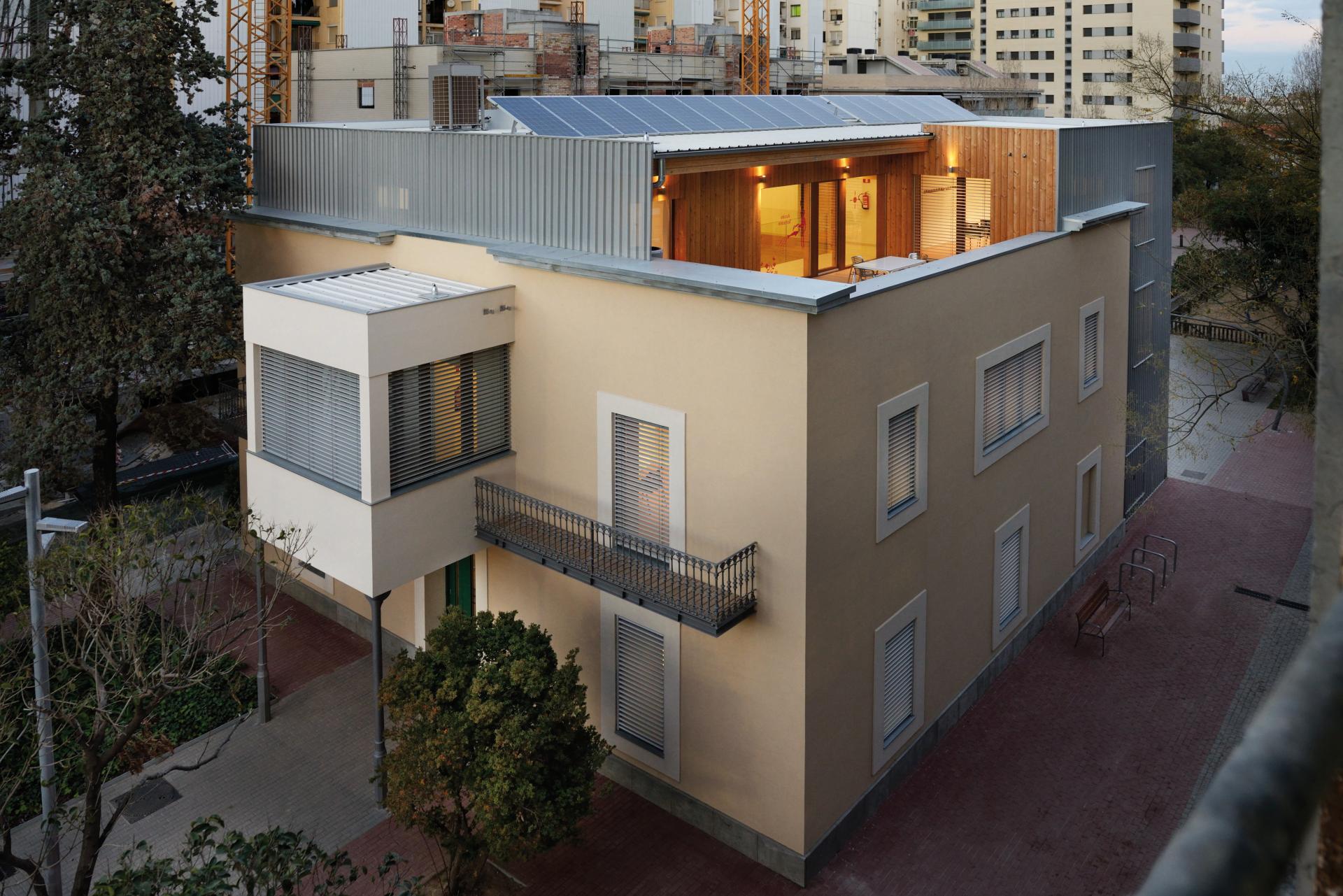
The retrofit and extension of Can Portabella, a public community centre in Barcelona, it is the first “Positive” public building in Catalonia. With a negative CO2 balance, it generates more energy than it needs during the year, keeping the standard budget. In 2016 it generated 12.179 kWh and it consumed 11.052kWh.
Project Region
EU Programme or fund
Description of the project
Summary
The project is based on a retrofit and extension of a public community centre for the Barcelona city Council.
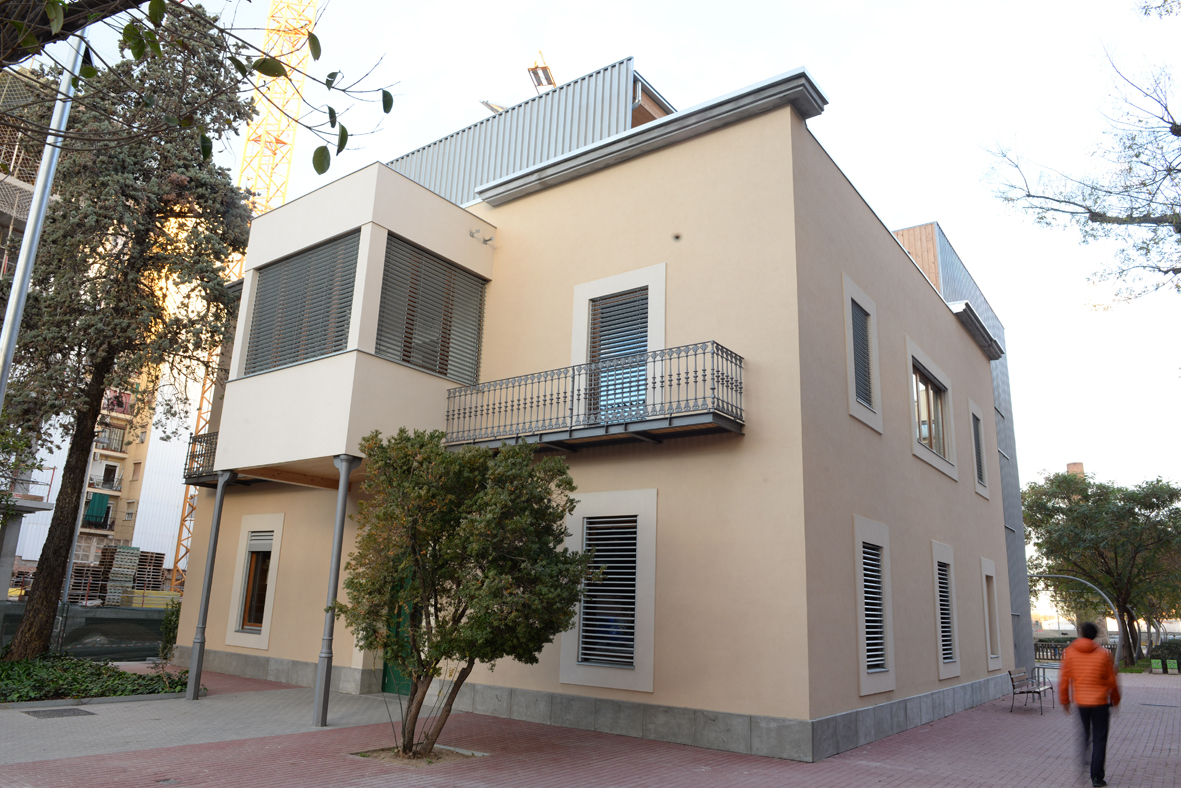
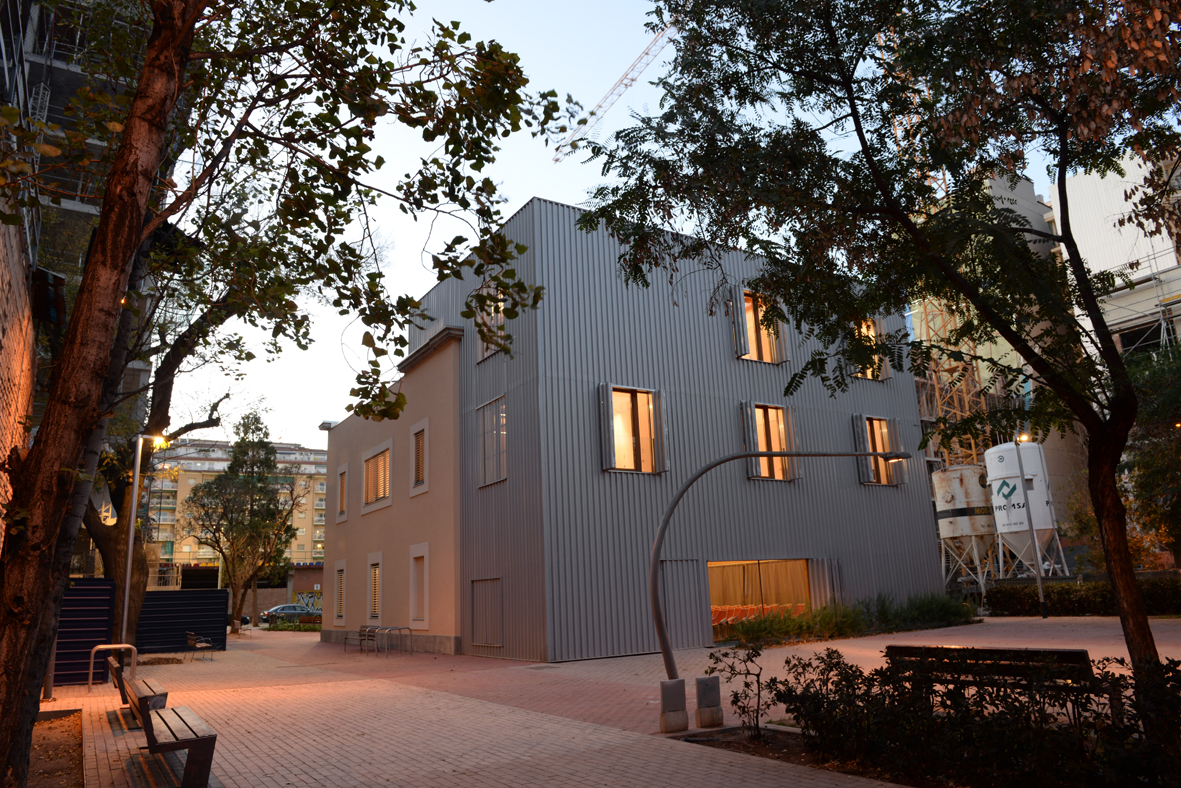
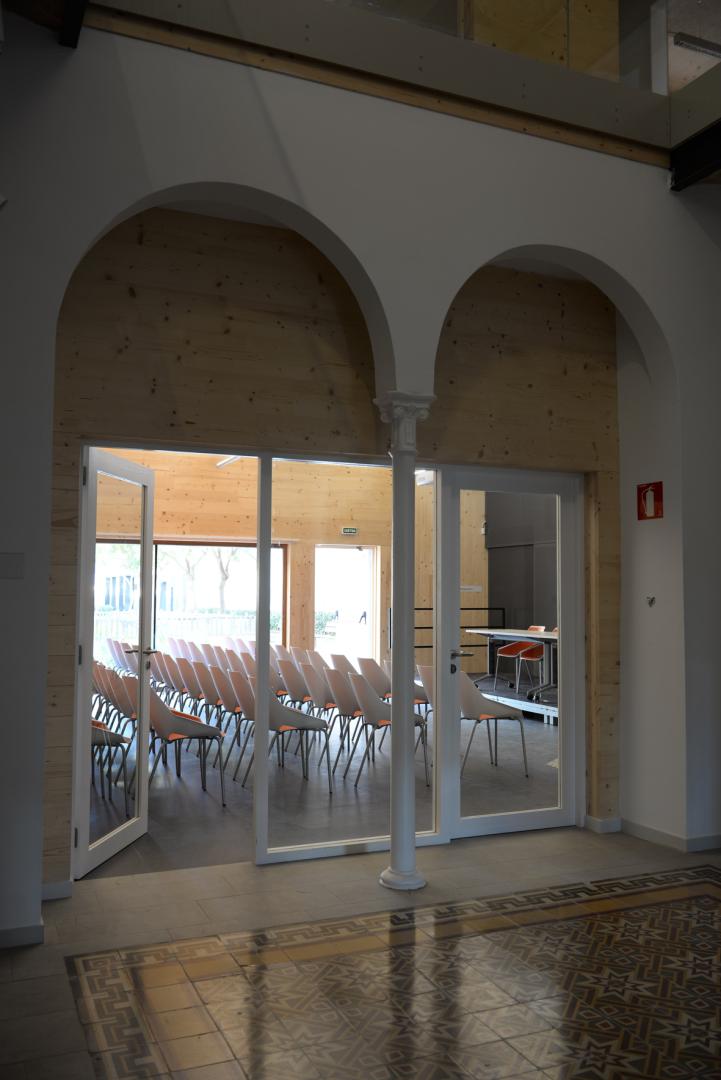
The building, called Can Portabella is placed in the district of Sant Andreu and was the factory owner’s residence in the XIX Century. Nowadays the city Council uses it for social activities but it was obsolete in terms of systems, space flexibility and durability. Therefore, the building is extended through one of its facades and the rest is totally refurbished, preserving all the other facades and the first floor.
The criteria followed on this improvement are based on the use of low environmental impact materials and the reduction of resource’s consumption, reduction on the energetic demand of the building and improvint the efficiency of the installations.
Key objectives for sustainability
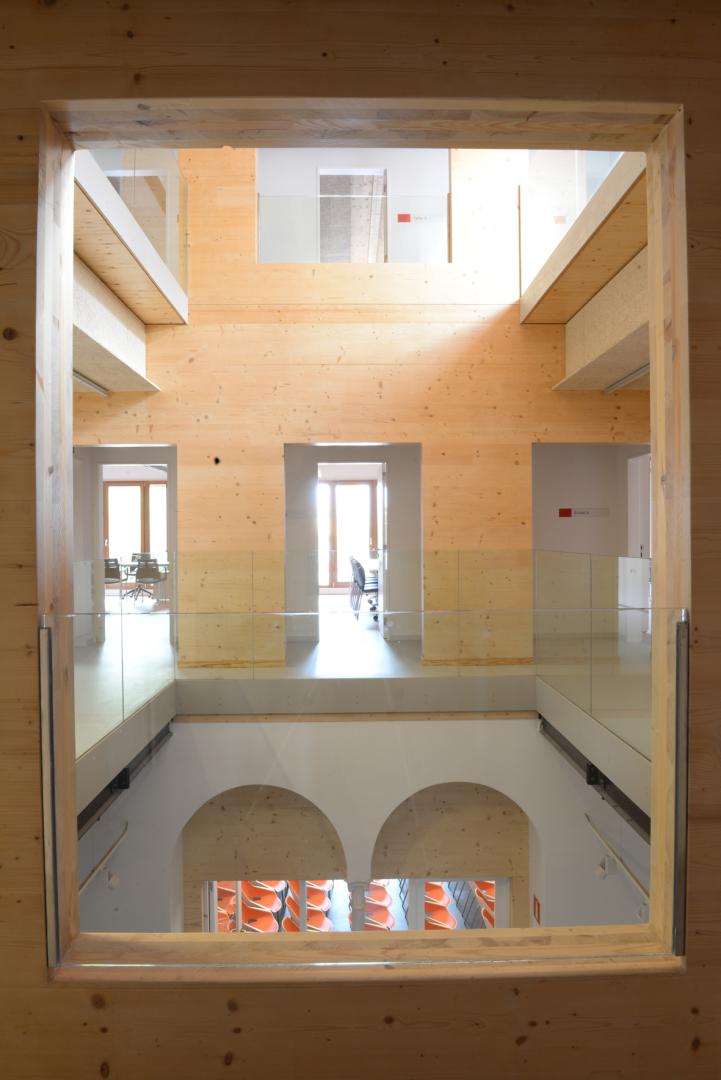
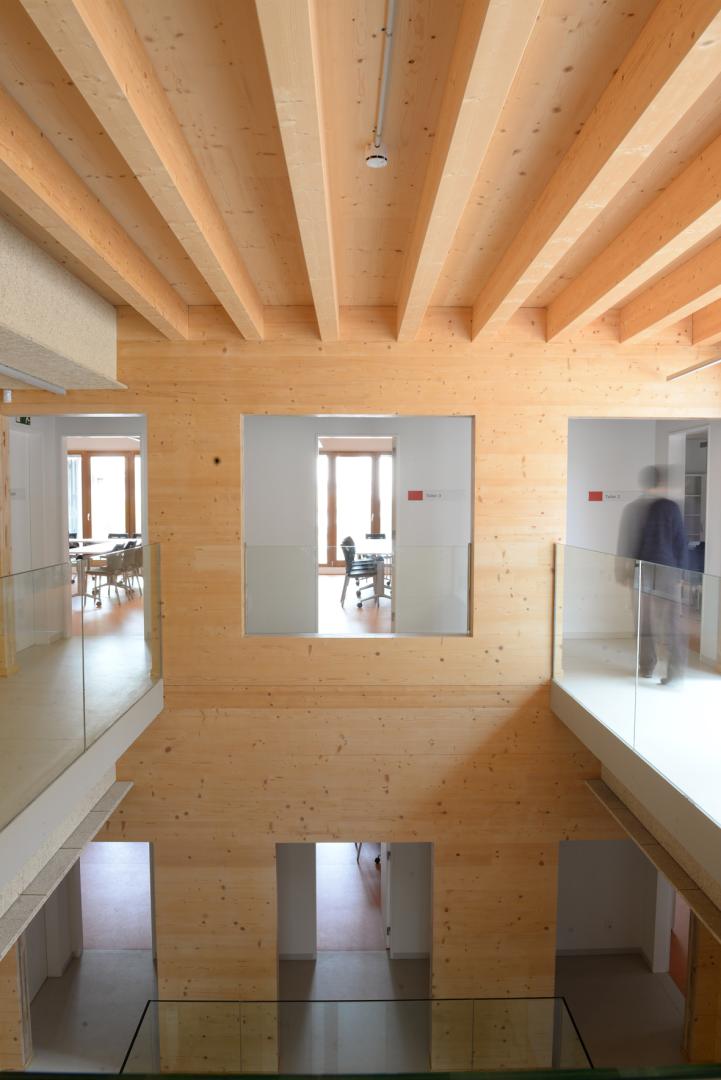
The extension is built with a wooden balloon frame structure with 16cm of natural insulation for the facades, X-lam for the new floors and the intern load bearing walls and a ventilated roof of wood frame and 24cm of recycled cotton insulation.
The existent façade stone walls of 45cm are externally insulated with 12cm of wood fibre and finished with breathable mortar, which guarantees a thermal stability day-night. New wood windows are created and and new mobile solar protections are installed in all of them. A new big opening on the southern façade allows the sun to go through the internal atrium and the circulation space.
The systems are planned with the same criteria, considering that the building has a passive performance and its goal is to produce more PV energy than it consumes during the year. The 40m2 of photovoltaic panels installed on the roof provide more than 12.000kWh/year, exceeding the building demand estimation. During this first year, the electrical consumption has been less than 8.500kWh.
The climate system installed is a heat pump with fan-coils in each room. These are the smallest fan-coil of the market, with approximately 1.600W.
The ventilation system with a heat recovery system is installed in two sectors independently; one in the conference room and the second covering the rest of the building. A bypass is prepared on the system in order to free-cooling the building during the summer nights.
Key objectives for aesthetics and quality
The aim of the renovation in terms of the quality of the experience is to convert a XIXth century building into a building with the necessary features of the XXIst century. We can reach this goal by marrying the existing with the new, endowing the building with contemporary features without losing the original reference. The aim is to take on the limitations of an obsolete building and give it a new life, with a contemporary language.
The aim of the intervention is also to mark the difference between the existing and the new, making evident the tension between the two constructive moments.
Without an overly protectionist and conservative aesthetic strategy, the aim is to read the building and its surroundings as a positive evolution, where the neighbours recognize the building and at the same time value its rehabilitation.
Key objectives for inclusion
One of the main goals of the building is universal accessibility. It is a public building and therefore accessible to everyone, it could not be considered otherwise.
Accessible routes have been designed for people with wheelchairs. Both public spaces and private spaces are accessible.
A universally accessible signage system has also been devised. This system is designed for blind or partially sighted people, with Braille translation posters, embossed posters and bright colors.
Results in relation to category
Besides, a simplified manual of use of the building, specific for each room, has been prepared to explain which bioclimatic strategies they have to apply in order to reach the indoor comfort.
Three temperature sensors have been installed in the building in order to have the data and the graphics that will show its behaviour allover the year.
The PHPP results for heating and cooling demand are 13,1 kWh/m2.year and 12,8 kWh/m2.year respectively.
With this built example for the city council of Barcelona, we demonstrate that the transformation of an existing building in a negative CO2 balance one, thanks to using a lot of wood during the construction which diminishes the CO2 emissions and generating more energy than it needs during the year is a reality also with a standard budget.
ANNUAL CONSUMPTION NET
2016 8.631kWh
2017 12,051 kWh
2018 11.803kWh
PHOTOVOLTAIC GENERATION
2016 12.033kWh
2017 13.051kWh
2018 12.667kWh
How Citizens benefit
In the first place, during the process of designing the building, meetings were held with the neighbourhood associations in order to land the project and validate the architectural proposal. Especially with regard to the program, the associations were able to make their contributions which were collected and incorporated into the project programme.
Neighbors' concerns mainly were about of the daily use of public space around the building and problems arising from urban pests (cats, rats, etc.) and the rooms intended for the neighbourhood to hold meetings and workshops: number of rooms, versatility, square meters, etc.
Also, the neighbourhood has gained a building of high architectural quality and it has a larger building to develop and enhance the public and political life of the neighbourhood. In addition, it is a building that consumes very little and this has an obvious energy benefit to society. We know that much of the energy a building consumes is spent using the building. A building designed with bioclimatic criteria and high energy efficiency also involves a minimum economic cost related to its maintenance and use.
Today, Can Portabella offers courses of all kinds, workshops, weekly meetings of neighborhood associations, ceremonies, conferences, concerts, conferences, etc.
Finally, It is also important to publish this type of project in order to create or expand a benchmark of a sustainable nature for future generations of architects. We need benchmarks in this discipline to serve as examples of good practice. At the same time, people who are not directly related to the world of construction must also become accustomed to a new aesthetic paradigm where sustainability and energy efficiency are at the heart of the world of construction.
Innovative character
The main elements of reflection that have guided the project are: reducing the physical and carbon footprint of the building and reducing the energy demand of the building, using materials with little accumulated energy and industrializing all processes.
An attempt has been made to maintain the structure of the existing building which was in good condition. The affected part of the structure has been repaired and an attempt has been made to minimize the extension of the new construction structure, which is the most expensive part and where more energy is allocated to the project.
Local and low-impact materials: The vast majority of building materials have been used in local materials, which require little energy to be transformed and with little gray (accumulated) energy.
In this sense, wood has been used in all its expressions. Structural wood has been used for both vertical and horizontal structure. Wood has also been used as an insulating material, with blocks of compacted wood fiber, both for thermal and acoustic insulation, both inside and outside. Wood has also been used to make windows and doors throughout the building.
At the same time, wood is a material that allows the industrialization of most construction processes and thus speed up the work of the building, shorten and plan deadlines.