Architekturwettbewerb.at
Basic information
Project Title
Full project title
Category
Project Description
www.architekturwettbewerb.at
Architectural Design Competitions are efficient participatory procedures that directly involve a high number of citizens in order to reach optimized solutions for the built environment. The Platform “Architekturwettbewerb.at” is an electronic database offering support to architects and public and private clients with the aim to enhance the use of ADC as a tool to support design and co-creation for more sustainable building and planning processes.
Project Region
EU Programme or fund
Description of the project
Summary
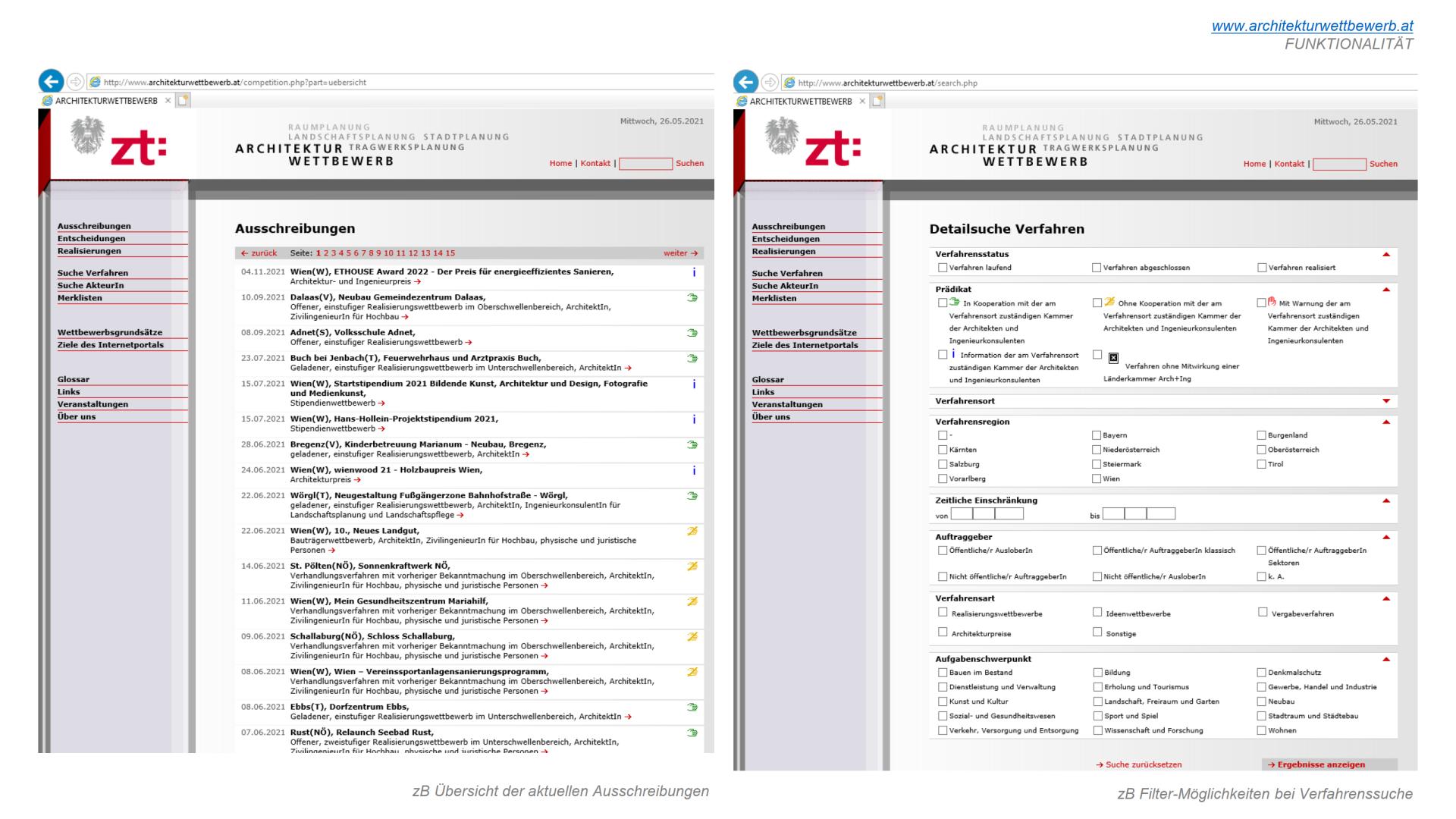
The “Architekturwettbewerb.at” platform is a supporting tool for architects and public and private clients with the aim of simplifying, improving and thus enhancing the use of Architectural Design Competitions as an efficient way to support design and co-creation for more sustainable building and planning processes. Thus, it is an important instrument for enhancing sustainable architectural quality.
It provides an up-to-date overview of upcoming and ongoing proceedings, offers full transparency and provides all information - including the minutes of the jury - to the public. The regionally competent Chambers of Architects and Chartered Engineers with their specialized Competition Committees evaluate the legal and quality assurance standards of the procurement documents. These evaluations lead to the award of different categories of procedural quality (red, yellow and green hand) and help public and private clients to improve - based on the evaluation feedback - their procedures in order to get the best possible results for their projects. They also provide orientation for participating architects and help them to decide about risks and benefits of a participation. The evaluation is based on the “Competition Standard for Architecture” published by the Bundeskammer der ZiviltechnikerInnen.
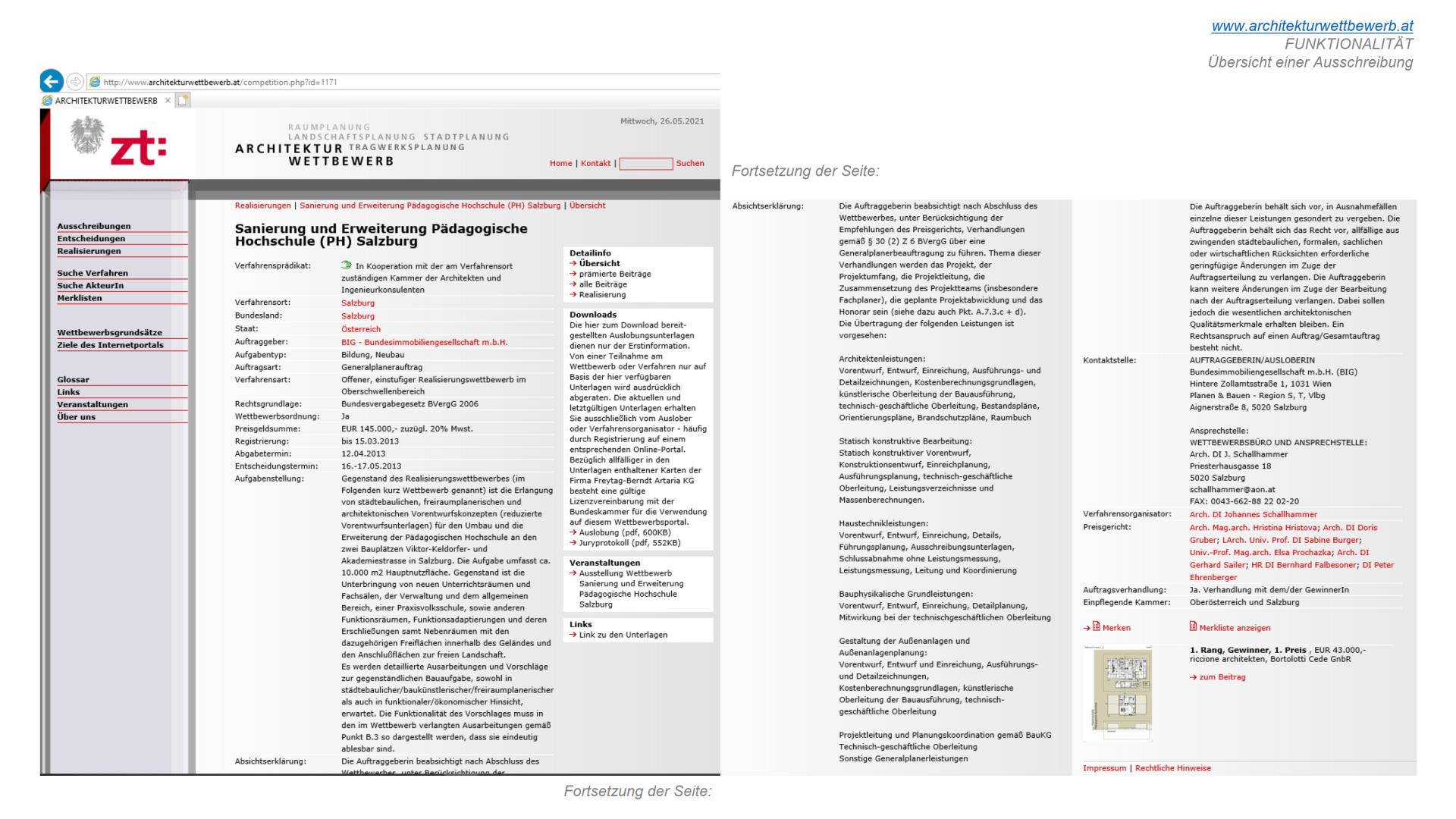
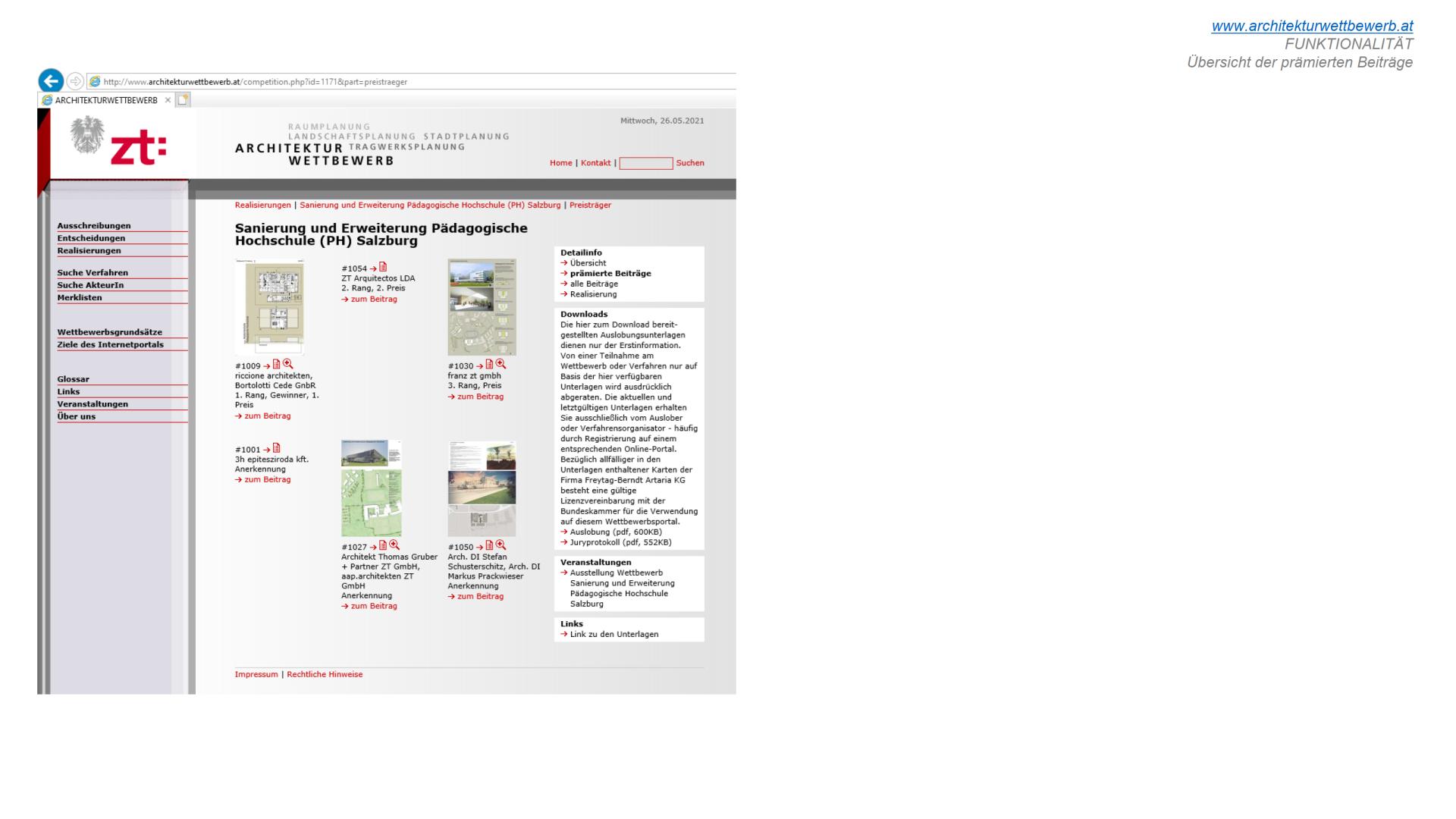
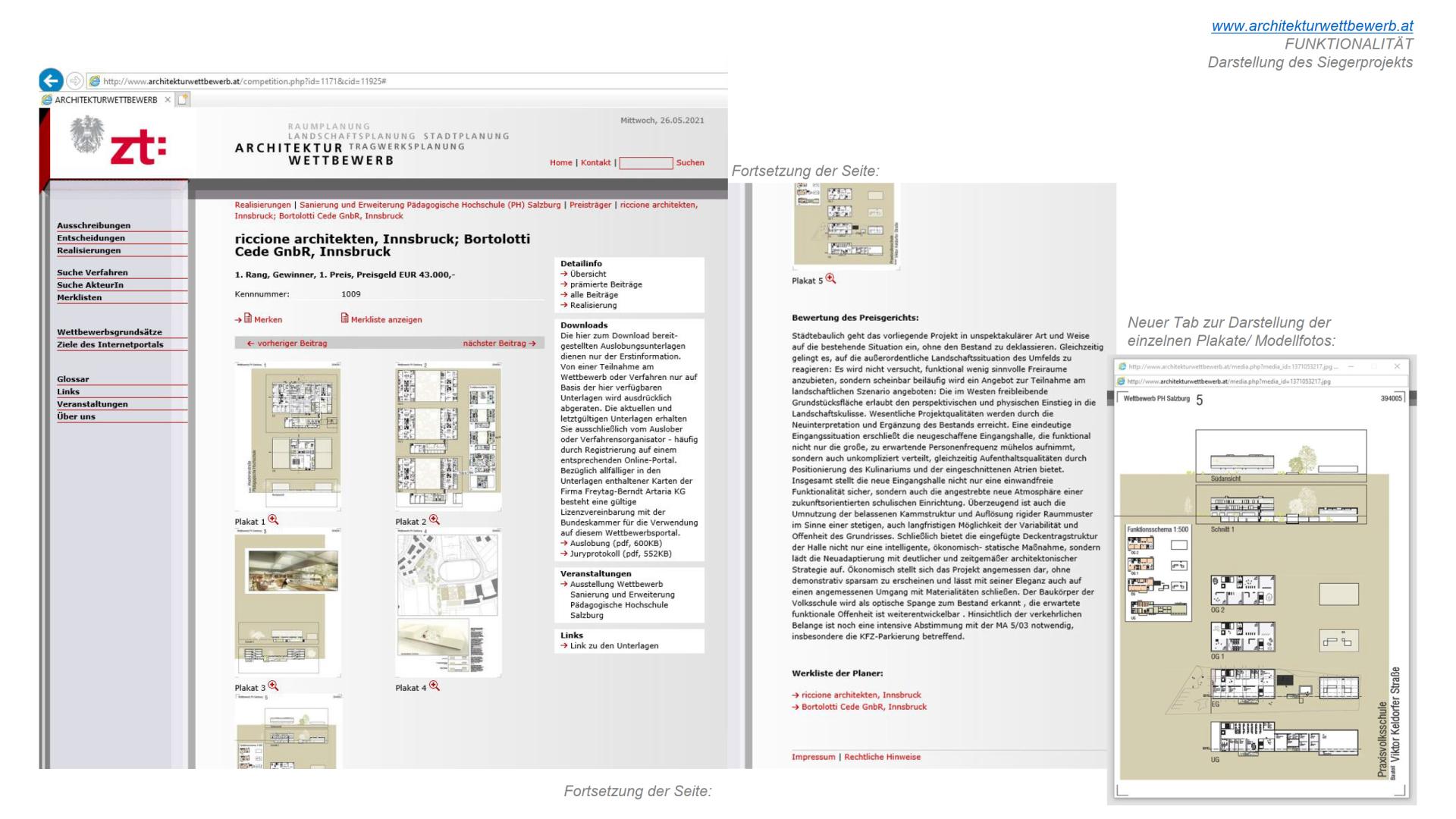
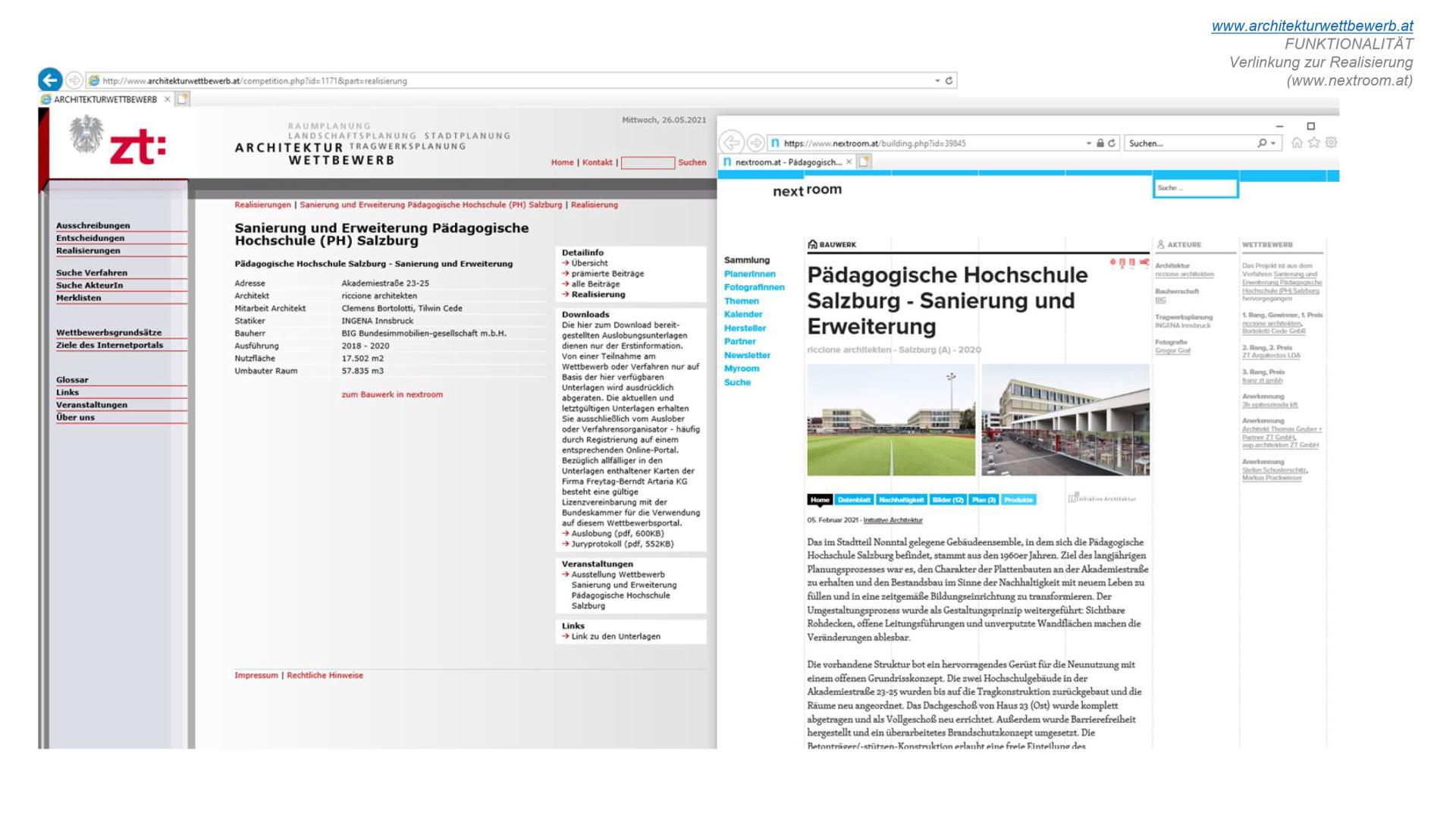
Every single competition is documented with all submitted projects including the winning schemes and the realisation of the winning project and is added to an archive dating back to 2005.The documentation of the realisations is provided in cooperation with https://www.nextroom.at/.
All documented procedures are statistically analysed and published. As this has proved to be an efficient tool to gather information and also detect undesirable developments the current relaunch of the Website is also focusing on optimizing the statistical outcomes.
In addition, the platform is offering communication tools for all involved players in the competition process and for the pu
Key objectives for sustainability
Architectural Design Competitions have a focus on holistic solutions. Combining sustainability with aesthetics and inclusion is therefore the common approach in Architectural Design Competitions. It has to be stressed that reaching the aims of the New European Bauhaus and the European Green Deal will very much depend on adequate and qualitative procurement procedures. Only on such a basis it will be possible to gather innovative and holistic solutions in regard to sustainability, aesthetics and inclusion on a broader basis. Architectural Design Competitions offer the most adequate procedural steps for getting sustainable innovative and holistic high-quality solutions. It also enhances legal certainty by offering a sound legal framework for all actors .
With supporting public and private clients and architects through these procedural steps and with the expert evaluation by the Competition Committees of the regional Chambers of Architects and Chartered Engineers and the support of a Competition Consultant that is provided by the Chambers for the procedures the platform considerably contributes to enhancing the use of ADC for inclusive and innovative solutions. It also offers access to the market for young start-ups and micro-sized companies on a very broad basis and is therefore also a very strong support measure for young innovative and motivated architects.
Therefore, the platform actively contributes to the quality of the built environment by providing a simple access to ADC procedures.
Key objectives for aesthetics and quality
see answer above
Key objectives for inclusion
Architectural Design Competitions are highly efficient participatory procedures that directly involve a high number of citizens. The aspect of inclusion of the users of their built environment is an essential aspect of ADCs. People are included in different ways, ranging from citizens discussion to very intensive workshops and other participation forms that allow listening to their needs and providing a comprehensive briefing for the architects taking part in the competition. Including the thoughts and ideas of the public and the users of a building optimizes the results of a project due to a better planning basis but also leads to better living quality when people are able to identify with their (built) environment. Each single ADC reaches a high number of people, depending on the size and surroundings of the project. Multiplied by a minimum of approximately 180 Architectural Design Competitions per year in Austria a considerable number of people can be reached.
The positive impacts of projects that are resulting from ADCs for people and for municipalities / cities as a whole can be seen in many best practise examples, in real live as well as on the Platform “Architekturwettbewerb.at”
As, unfortunately, ADCs are not (yet) compulsory procedures for publicly financed projects, the platform delivers an important support in developing and improving public procurement procedures. With supporting private and public clients and architects through these procedures it considerably contributes to enhancing the use of ADCs for inclusive and innovative solutions.
Results in relation to category
Solutions for our built environment to contribute to mitigate climate change, protect our environment and make places more affordable and inclusive require high quality procurement procedures.
The broad use of Architectural Design Competitions is a very effective way of gathering innovative sustainable and ethical solutions: On the basis of the environmentally oriented brief a high number of innovative solutions are developed which then are analysed in the jury meeting based on a holistic decision- making process. The decision process is well documented during the competition and for the completed scheme of the winning project on the platform. Energy efficiency and sustainability data of the projects are provided by the competitors and are published along with the architectural documents.
The many best-practise projects visible on the platform clearly show the positive impact of this approach. Statistics (see image 1 ADC statistics enclosed) also prove that since the implementation of the platform 2007 the use of Architectural Design Competitions by private clients has increased. The broad documentation of the procedures and good results of ADCs on the platform as well as the legal certainty provided by the expert evaluation of the Competition Committees and the support of a Competition Consultants lead to an increase of private and public clients using ADCs and thus also creating a benefit for the public and the built environment.
How Citizens benefit
Architectural Design Competitions are highly efficient participatory procedures directly involving a high number of citizens. The aspect of inclusion of the users of their built environment is an essential aspect of ADCs. People are included in different ways, ranging from citizens discussion to very intensive workshops and other participation forms that allow listening to their needs and provide a comprehensive briefing for the architects taking part in the competition. Including the thoughts and ideas of the public and the users of a building optimizes the results of a project due to a better planning basis but also leads to better living quality when people are able to identify with their (built) environment and connect to their neighbourhood. Each single ADC reaches a high number of people, depending on the size and surroundings of the project. Multiplied by a minimum of approximately 180 Architectural Design Competitions per year in Austria a considerable number of people can be reached. The positive impacts of projects that are resulting from ADCs for people and for municipalities / cities as a whole can be seen in many Best-Practise-Examples, in real live as well as on the Platform “Architekturwettbewerb.at”
Enhancing ADCs therefore has a positive impact on “Baukultur” and living conditions and thus for the civil society as a whole and the more so for citizens that are directly affected by ADC projects.
For the public the platform also offers a constantly available online-exhibition with Best- Practise-Examples. After the relaunch it will be possible to compose individual online-exhibitions also on various topics (e.g., educational buildings, housing, …) and regions.
Please also see question on inclusion.
Innovative character
The platform goes far beyond the simple collection of data and information and offers an active and holistic approach to Architectural Design Competitions. It is a learning and working tool that evolves with each new entry and is not comparable with simpler databases for calls for ADC and other procurement procedures because of the fact that each documented procedure is evaluated by the expert competition committees on the basis of the “Competition Standard for Architecture” and the results are freely accessible.
The platform is also a reference book as well as a constantly available online-exhibition with Best-Practise-Examples. After the relaunch it will be possible to also compose individual online-exhibitions on various topics (e.g., educational buildings, housing, ..) and regions.
Based on the needs of the different stakeholders in Architectural Design Competitions also interactive tools have been developed to support documentation and communication during the ADC process. As digitalization processes have developed enormously since the implementation of the platform a major modernization is currently on-going. It will considerably extend the interactive possibilities of the platform including mobile device versions. After the re-launch there will be a digital process for choosing the best members for the jury. Direct communication between jury members will be made possible through the Website and will be kept available in an archive.
Statistical analysis generates focused data that is not available otherwise. It offers insights in a broad variety of aspects of the planning process such as gender equality issues, SME support measures, data on building costs and their relationship with quality planning etc.
Additonally, it offers access to the market for young start-ups and micro-sized companies on a very broad basis and is therefore also a very strong support measure for young innovative and motivated architects.