RiqualifiCanapa
Basic information
Project Title
Full project title
Category
Project Description
RiqualifiCanapa by the union of two words: Riqualificare(retrain) and Canapa(Hemp) is a project that arises from the environmental, aesthetic, and social need to redevelop the most deteriorated areas with one of the most used and yet versatile plants in the world: hemp. We want to use hemp to bring wastelands back to health and benefit the community. In line with the EU Green Deal, we want to be actively involved in making EU climate neutral by 2050 by sowing the seeds of a thriving green future
Project Region
EU Programme or fund
Description of the project
Summary
In Italy, there are over 50 seriously polluted sites. It is not possible to stand still without trying to make a step. Riqualificanapa ,our "step",borns from a group of young people inspired by nature and its logic with the desire to commit themselves to help people and the environment, with the care for their territory; since that territory is home.We ideated it to make our territory a better place to live and look, using hemp and ecological corridors to rephrase the landscape, generating green art from sowing and projection.Land art is an artistic approach to nature, without practical purpose; We want to do more. As Bauhaus has been a breaking movement in architecture, arts, and design; We want to be the same for the environment and living beings. Our concept combines a living nature within art, which moves, changes, and develops with us. We want to create works that amaze the eyes, and at the same time improve the environment and health, especially of those who live nearby and allow the young people of the future a chance to get involved like us. Collaboration with universities and students is essential.We develop tailor-made works for each area aided by the hands of the future itself, giving it a greener future.
We propose new green areas, parks, woods, relaunching a supply chain lost in prohibition: Hemp and its 50,000 uses. The complementarity of the whole is what gives us strength.
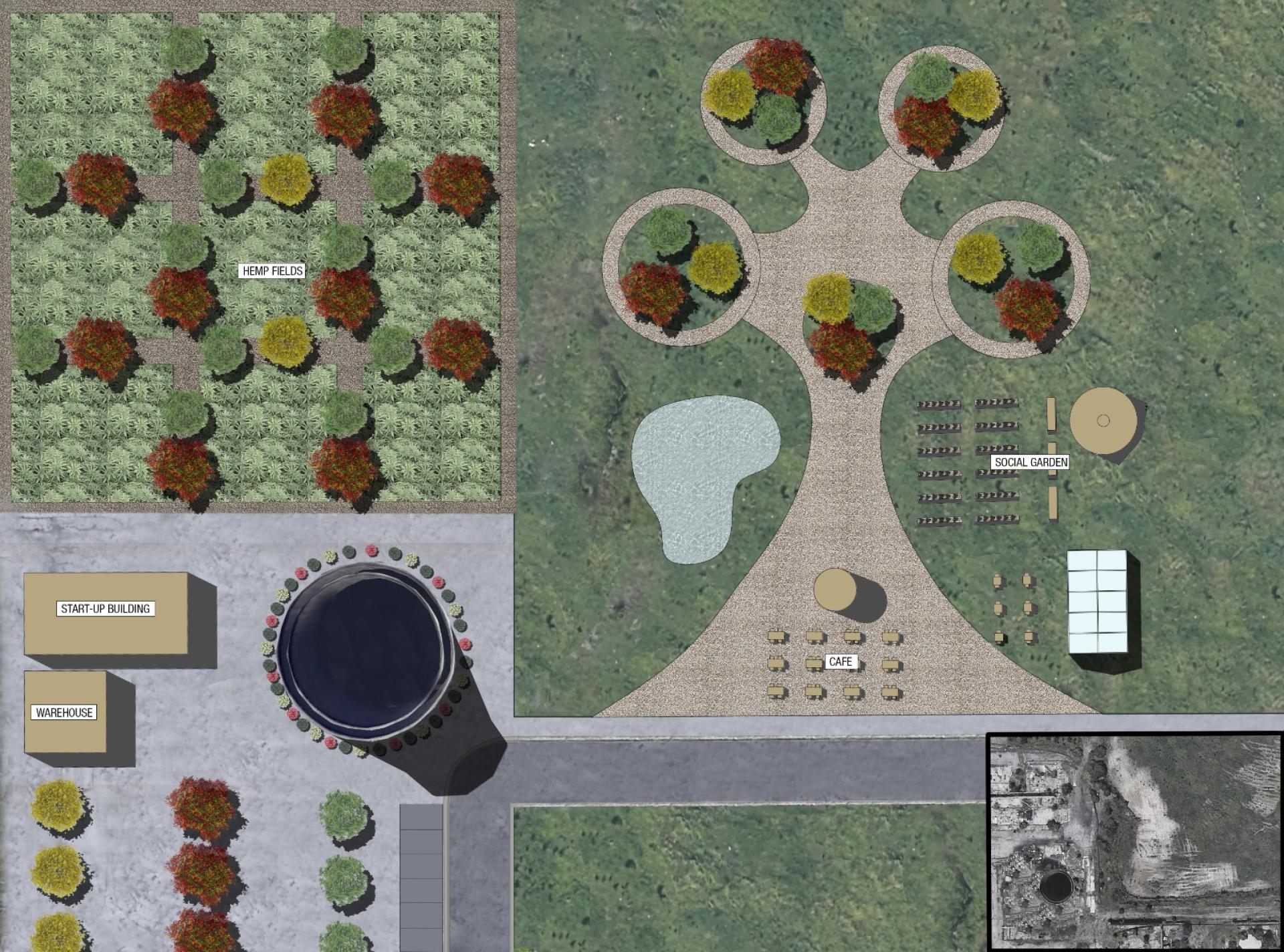
The goal of a system in which the social and environmental circles are satisfied simultaneously realizing the Doughnut Economics. By assisting different purifying cultures, with the minimum anthropic impact and precise sowing programs, we will be able to develop green art. We dream about a child laughing with their parents from an airplane window while reading what we have created from the rubble. Long green fields, corridors of trees and shrubs, grass roads, and new paths lead us to the future by passing through old cobbles. That is what we are.
Key objectives for sustainability
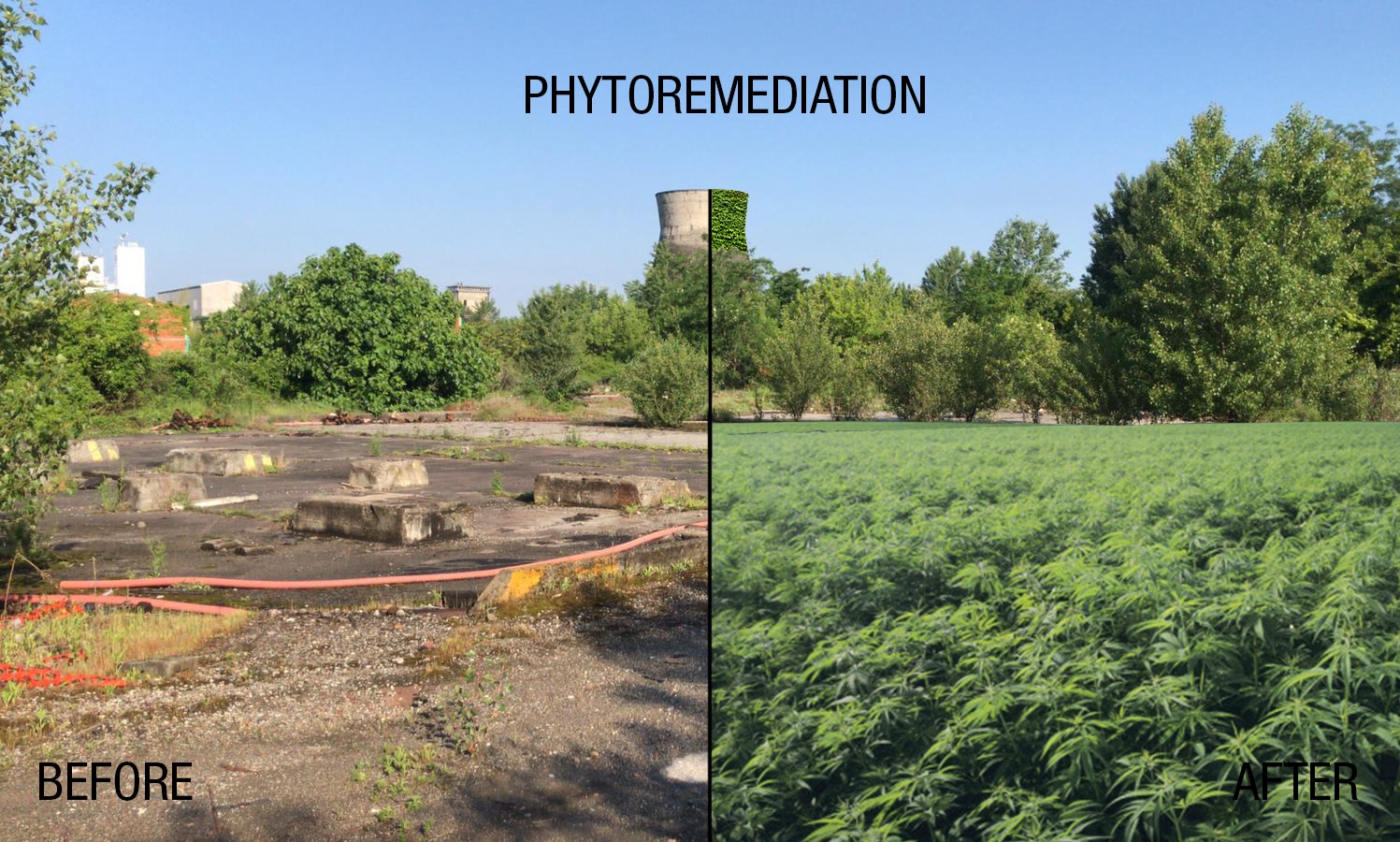
The key objectives are several and depend on the development as well as potential of each area. To start with, a significant focus is placed on generating a phytoremediation process and a circular economy from cannabis. Through the chemical and morphological analysis of the soil, and field experimentation, we can identify the most suitable variety of cannabis. Why cannabis? Hemp is a hyperaccumulator meaning that it can absorb unusually large amounts of metal in comparison to other plants.
Hyperaccumulators are often discovered as being selected to grow at a site based on the metals or salts naturally present. In our model we want to combine phytoremediation with an overused crop of commercial interest with the aim to achieve low price soil’s decontamination through the production of a commercially usable resource, namely hemp. Moreover, for this reason, we would like to choose Cannabis sativa L. due to its long-standing history (used by man for over 5000 years) and polyfunctionality. Additionally, if the contaminant concentration found within each plant exceeds regulatory limits, the crop generated by the above mentioned process can be eventually treated as a hazardous waste.
Nonetheless, we want to maintain the limits in cannabis of metal concentration according to its final use so we can use it in processes like biogas production from lignin-cellulosic material as well as in the lime-hemp compound. Last but not least, our final objective is a process of sustainable sanitation through cannabis. The process of phytoremediation require some years but the environmental impact it's extremely positive as it contributes to the C02 fixation with 15 tons per year for one hectare of land, promotes biodiversity, improves the morphological structure of the soil and has a positive impact on public health. Moreover, cannabis offers a large amount of cheap raw materials as a byproduct to be used in a new eco-cyclical production process.
Key objectives for aesthetics and quality
Starting from degraded and polluted land, we will begin with some preliminary analysis to assess the existing structures of the environment, state of pollution, the dimensions and boundaries of the land, the communication routes (railways, roads, nearby airports, etc.), the position and, last but not least, the future of the site in question.
Once the data are collected and processed, the project will dive into two important aesthetic purposes:
-Macroscopic: from the first cultural cycle we will exploit the position and communication routes of the land to "advertise", imagining and creating an arrangement of cultures and ecological corridors between them (and the consequent and variable colors) in order to launch a message using logos, agriglyphs or words.
By combining the healthy plants already present on the ground and the cultures selected by us for Phyto-extractive peculiarities and suitability for the area, we will compose a "vegetable advertisement"
-Microscopic: through the creation of profiles on the major social networks (Instagram, Facebook, Flickr) we will give attention detailed to the project, sharing the development of flora, fauna, and the ecological system.
In short, with land sanitation as the main objective, we would like to establish a thriving and biodiverse system.
The digital material created and shared on the social networks will showcase the entire phytoremediation process into images.
Once the low level of pollutants has been assessed, we plan to open the field to everyone who is interested in order to spread awareness among the local citizens and raise attention on sustainability. The guided tours and “open days” are meant to reach out schools, recreation centers, local associations and communities to educate citizens on topics such as sustainable growth and agriculture while reconnecting them with nature.
Key objectives for inclusion
Based on the area in which the polluted land is located, we are going to evaluate whether there are nearby universities, agricultural research centres, technological and biotechnological research institutes and environmental toxicology laboratories. In order to keep the levels of pollutants monitored during the operation, we will work hand in hand with the various technological institutes and toxicology laboratories. It will be possible for the universities to interact with our project also during the operative phase: by sampling the soil, rather than parts of the plants, carried out by specialized operators, such as collaborators from technological and biotechnological institutes.
Population will be involved on what should be the future of the restored land since the beginning of the phytoremediation project. Photos and presentations will be brought to the attention of civilians, adults and children, scientists, students and politicians of the city at the end of the operation; starting from the detrimental polluted land up to the complete reclamation of it, granting it a new future. Related to this last point, there will be the involvement of a particular portion of the population based on the developments, which will be made on this ground. The second life of these lands could be a playground available to local children, rather than a building used for different activities.
Our project will allow the involvement of medium-small enterprises in the agricultural sector, for a possible use of agricultural equipment. It will also encouraged the creation of new jobs for the local population; which will be done by maintaining certain safety standards due to the presence of pollutants in the soil. Thus, the project has the side-effect of supplying new jobs starting from the maintenance of the land to prepare the soil for cultivation, passing through the maintenance of the plants in the growth phase, up to the collection of the plants and subsequent process of use
Innovative character
We have created a regenerative model for polluted suburban areas applicable anywhere and designed around a holistic approach that goes beyond the aesthetic improvement of the area. In fact, the project is functional to the local population and has above all the goal of regenerating the ecosystem deteriorated by human action. Due to the action of the roots of plants that soak up heavy metals and the microorganisms present in the rhizosphere, we bring back life into the soil. This involves the repopulation of plants, microorganisms, animals, birds, insects as well as less air and water pollution which translates into an improvement in the welfare and health of people living in these areas. Among the many plants that have this power, hemp is definitely one of the best options, since it has a very deep and developed root system, it needs very little external input for its cultivation and above all it is a hyperaccumulator of heavy metals and other pollutants. Furthermore, this plant produces a significant amount of biomass that can be used in bio-construction and biodigesters, thus closing the loop of this remediation process.
The innovativeness of our project lies in the fact that we want to use an alternative method that has little application upon the requalification of polluted areas such as the territory we have taken into consideration, i.e. the industrial area of Pioltello. Currently, the remediation’s methods involve the removal of soil by bulldozers which is then reclaimed on-site or off-site. This process causes the emission of black fumes during the movement of the land as well as the pollution caused by vehicles whereas phytoremediation absorbs greenhouse gases and other pollutants in the air while producing biomass useful for example to create biogas. In addition, this method of reclamation saves a significant amount of money, thus local governments can invest more on larger scale to those areas that otherwise would have remained abandoned.