Pula Urban Revitalisation
Basic information
Project Title
Full project title
Category
Project Description
Pula Urban Revitalisation is a vision of sustainable growth and development of the city, aimed to improve the quality of life of its residents. Revitalisation of the city has been envisioned as the Green Ring, integrating the city with its natural surroundings. Unburdening its narrow streets and solving infrastructural, communal, and economical problems, and promoting sustainable growth, symbiotic relationship with the sea, agricultural fields and environment.
Project Region
EU Programme or fund
Description of the project
Summary
Pula Urban Revitalisation is a vision of sustainable growth and development of the city, aimed to improve the quality of life of its residents.
Pula, the city at the peak of the Istrian Peninsula, has been evolving for almost 3000 years. Founded by Ancient Ilirians and later ruled by Ancient Greeks and most prominently Ancient Romans. Seeing Venetian and Austro-Hungarian rule, surviving turbulent 20th Century to define itself firmly as modern Croatian and European City.
Vision of future sustainable development and growth of Pula, as a political initiative introduced in 2021 local elections, has been visualised by urbanist and architectural concepts.
Historic layers have always been a defining feature of Pula, especially the city core which requires sensible and timeless interventions. Ones respecting extraordinary historical monuments and further integrating them in the urban fabric.
Revitalisation of the city has been envisioned as the Green Ring expanding in two directions. One being the Revitalising Ring affecting the city center, unburdening its narrow streets and solving infrastructural, communal, and economical problems, and promoting sustainable growth. And another being the Development Ring, focusing on suburbs and periphery, integrating the city with its natural surroundings. Introducing symbiotic relationship with the sea, agricultural fields and forests. Defining the city boundaries while also blurring them with nature, resulting in a more fluent transition from urban to rural escape.
Revitalising Green Ring is defined by points of new activities defining future direction of city development. Its shape is reinforced by urban gardens and farmlands, cycle paths and potential future tram line.
Key objectives for sustainability
Introduction of the Green Ring consisting of local farmlands and urban gardens catering to the local population. Sports and recreational zones encompassing the city, creating a symbiotic relationship of the city with the sea (Riva) and easing the transition between urban and rural realm. Reduction of motorised traffic in the city core, by building parking plazas at thresholds of the city. Those parking plazas would be designed to be adaptable to different functions, as the city expands, they can be reutilised for different uses. Introducing a green public transit system in the form of electric trams running on existing but disused train tracks. This tram would run wirelessly within the city core, to protect the street aesthetics. Improving cycling infrastructure and reclaiming urban spaces for pedestrian use. Respecting and enhancing cultural heritage by finding them new uses and designing their surroundings to better integrate them in urban fabric. Allocating spaces for contemporary industries (IT, modern technologies) within the urban fabric.
Key objectives for aesthetics and quality
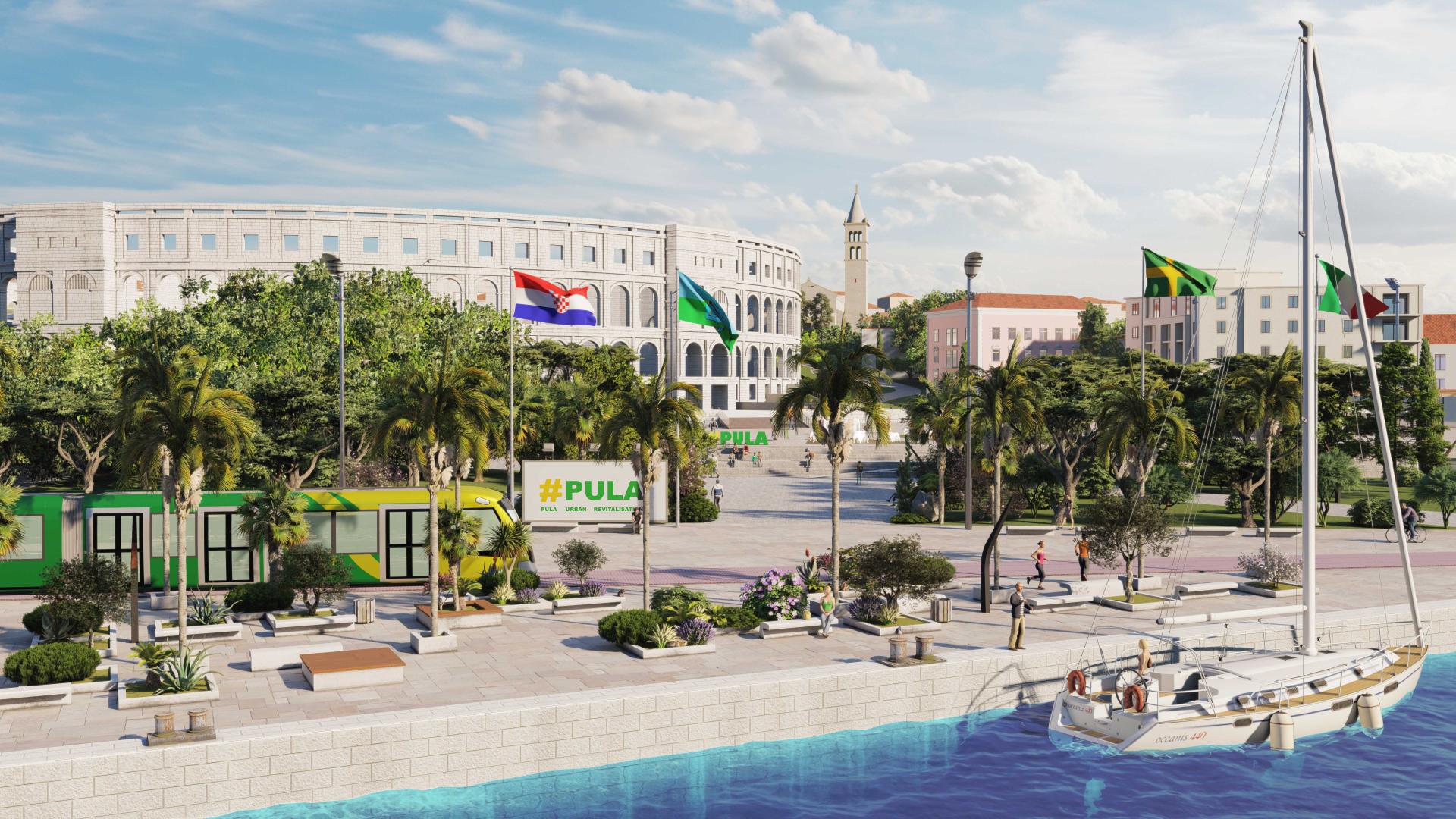
Absence of Riva (waterfront walkway), the defining characteristic of many Croatian coastal towns, in Pula will be resolved by urban revitalization of underused waterfront, as a space for recreational walks, socialisation and various events.
Arena, the ancient roman amphitheater,is the symbol and pride of Pula, hosting many cultural manifestations, most prominently the Pula Film Festival. However, its current surrounding area is not celebrating its magnificence. Reclamation of urban realm for pedestrians, extension of public space between the Arena and Riva, currently used as a parking lot, will be exploited as a square with cultural, social and commercial activities. Integration of existing parks in one continuous pedestrian realm, with natural shade cast by vegetation and contrast between the ancient Arena on one side and sea with distant Uljanik shipyard with lightshow illuminating its cranes, create an almost surreal atmosphere.
Valorizing and presenting cultural heritage through new exhibition space in the open. Complimenting ancient ruins with contemporary light show, and revitalizing it as a space for cultural and social events will further enhance Pula in whole.
Repurposing old military barracks built in venetian inspired neoclassical architecture, as a new Science Museum.
Valorising existing baths as social center during the summer months, new walkways, spaces catering various activities and baths extensions that respect and valorise existing structure in combination with mediteranean vegetation for natural sun shade would make for a recreational space Pula needs.
All of these interventions follow the path of the Green Ring.
Key objectives for inclusion
New and extended nursing homes would be integrated in residential zones made to integrate to the community. Adjacent to recreation zones and cultural and social activities.
New kindergartens and nurseries in natural surroundings. Youngest generations in urban context must have appropriate contact with nature and playgrounds, inclusive to those with disabilities to promote culture of tolerance and understanding from youngest ages. Montesory concept of learning through play should be applied.
New schools with adjacent urban gardens to promote sustainable way of life. Continuation of education should follow the principles introduced at Kindergarten chapter, with schools being integrated in urban fabric. Integration of school grounds with communal urban gardens would promote the idea of cohesion, sustainability and responsibility.
Subsidised housing would be designed to form pedestrian communities with plenty of public and private open space. With local small shops and areas for commercial use, promoting the idea of communal living.
Underutilised green spaces have to be adapted for sports and recreational use with spaces catering both professional and amateur sports, recreation and amusement activities.
Increasing interest in culture will be achieved through integration of trends and including young residents as stakeholders in renovation and revitalisation of abandoned buildings located within the fabric of the city center.
Innovative character
The concept of the Green Ring pulsating and expanding in two directions. One being the Revitalising Ring affecting the city center, unburdening its narrow streets and solving infrastructural, communal, and economical problems, and promoting sustainable growth. And another being the Development Ring, focusing on suburbs and periphery, integrating the city with its natural surroundings. Introducing symbiotic relationship with the sea, agricultural fields and forests. Defining the city boundaries while also blurring them with nature, resulting in a more fluent transition from urban to rural realm.
Applying the latest design trends and technological solutions in the design of every aspect of this vision.