L.I.F.E
Basic information
Project Title
Full project title
Category
Project Description
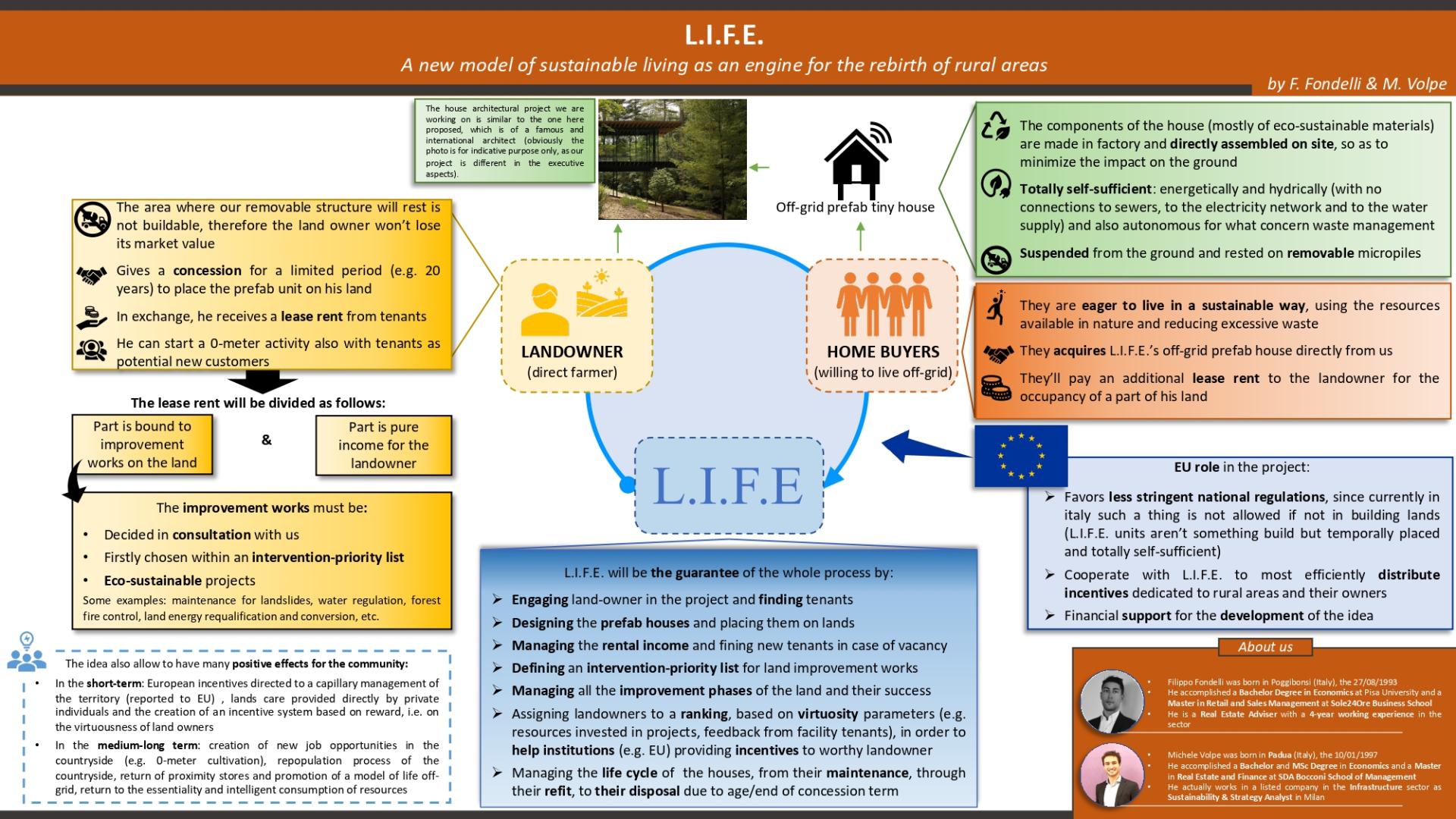
Generate a virtuous circle that brings wealth back to rural areas through the production of income from the implementation - not permanent - of prefabricated housing units with zero environmental impact and totally self-sufficient (with their income and management) on semi-abandoned land owned by private individuals, with the consequent re-use of a percentage of that income by allocating it to activities of value made on the land itself.
Project Region
EU Programme or fund
Description of the project
Summary
The L.I.F.E. concept will allow people to embrace a sustainable lifestyle, proposing new housing cells which are:
- Prefabricated structures ready to be assembled on site, elevated on steel poles and designed with medium-small sizes (80-150 sqm), avoiding waste of space;
- Placed on land in rural areas thanks to a concession contract by landowner. So, nothing is built on it and the concept of buildability and the related regulations (e.g. building regulations, payment of urbanization charges) are overcome;
- Totally self-sufficient in energy, water and waste (reusable waste used for the soil, wastewater filtered and reused for land irrigation, electricity produced by photovoltaic panels).
The concession will create a perpetual annuity for the landowner, helping him to maintain the land and his activity. However, part of the annuity is bound: a part of it (e.g. 20%) will be destined, in a preliminary way, to maintenance works (e.g., regulation of rainwater, maintenance in good condition, etc.), and then to the valorization of the land itself, decided in agreement with us. The latter interventions are aimed at contributing to a green conversion over time of the land (e.g., installation of systems for energy efficiency, funding innovative projects such as agro-photovoltaic, etc.). We will suggest and prioritize the works (after an initial inspection on the ground), acting as guarantee and supervisor of the all system.
In addition, we will assign to a merit score the landowners based on virtuosity parameters (e.g., invested resources, feedback from house owners, etc.), creating a ranking. Then, we will dialogue with main institutional bodies (e.g. EU) to suggest the worthy landowners in order to provide incentives based on the merit score obtained.
This system will create two benefits: the increase in value of lands for the new projects activated by landowners and the access to incentives from third parties as a result of the virtuous behavior.
Key objectives for sustainability
The main objectives in terms of sustainability are basically four:
- Introduce a new type of house that does not consume the land and related resources, but fits in harmony;
- Allow people to live using the resources available in nature and reduce excessive waste (e.g., autonomous production of energy, moderate water consumption and related recycling, etc.);
- Bring new economic resources to rural areas in order to relaunch their value and the economic cycle related to them, also through new technologies (e.g., sustainable cultivation, non-intensive farming, production of energy through solar panels, etc.);
- Offer a system of allocation of incentives that allows to have a more concrete measure of the merit (e.g., the resources invested in the land) to receive them.
These goals will be achieved thanks to our project and our supervision of the entire process in all its phases, their management and related services.
Key objectives for aesthetics and quality
Aesthetics and quality are the values on which our housing structures are based on. These are designed directly by us thanks to our architectural skills, construction and deep knowledge of materials, and designed to fit in harmony with the surrounding nature. In addition, the sustainability model of these structures (energy, water and waste) is based on new technologies available in the market that will be implemented through partnerships with leading companies.
In addition, even the land will be subject to a process of functional and aesthetic revaluation, thanks to the income that will be available to the owner of the land and who will invest in it.
Key objectives for inclusion
Our idea starts with the principle of inclusion. Our concept aims to redistribute part of the wealth in rural areas and to bring people back to live in those areas. This concept will be available to anyone wishing to embark on a new path that leads to responsible and conscious living, allowing a reduction of waste and GHGs emissions related to housing. In addition, our concept could create new communities of value in rural areas, which would allow the creation of a new offer of 0-meter products and new forms of economic revitalization. Bringing people back to suburban and rural areas also means giving many young people the chance to think about opening small businesses in these areas.
Innovative character
The innovativeness of our idea lies in creating a new model of living that allows people to live in a more sustainable way today and, at the same time, to create a new source of income related to rural land.
From the point of view of housing modules, the proposed houses are very innovative, both thanks to their almost total self-sufficiency from external resources and needs, and through the use of recycled materials and low impact, but especially thanks to their mobility feature, which does not make them anchored to specific areas.
From the point of view of the land, the new constant form of income and partially tied to specific land redevelopment projects is certainly a new innovative proposal. This feature will have three positive effects: to improve the quality of the living and non-environment, to invest in the land making it grow in value and creating new economic sources, and finally to implement the new innovative solutions to create value for the whole country (e.g. agro-voltaic). The innovative nature of the project lies in the fact that we will become a forge and incubator of innovative projects aimed at the efficient consumption of resources, implemented directly on the ground.