Photovoltaic paint
Basic information
Project Title
Full project title
Category
Project Description
The world is changing, and we have to change with it. We must respect our planet and a way to do so is by creating sustainable energy. Solar light is the most powerful source of energy we can ask for, a source that we already use through solar panels, but it is not enough. We need to extend our possibilities to acquire renewable energy and what could be better than photovoltaic paint? A thin layer of light and aesthetic varnish, capable of producing energy wherever you apply it.
Project Region
EU Programme or fund
Description of the project
Summary
The photovoltaic effect is a physical and chemical phenomenon that consists of generating voltage and electric current in a material upon exposure to light. Since the end of the 1800s, we have learnt to understand this phenomenon, building ever more advanced and efficient solar panels. A lot of work has been done, but there is still a long way to go also considering that in Europe only 32,2% of the energy produced comes from renewable sources.
Solar panels require a large surface area for their installation, and it is our concern that we cannot afford to ask for "more space" from our planet. The idea of the photovoltaic paint is simple: getting as much energy as we can, using all the surfaces we already have. This idea aims to stimulate the interest of scientists, artists, engineers, and designers in developing an economical, eco-friendly and sustainable process for the industrial production of photovoltaic paints.
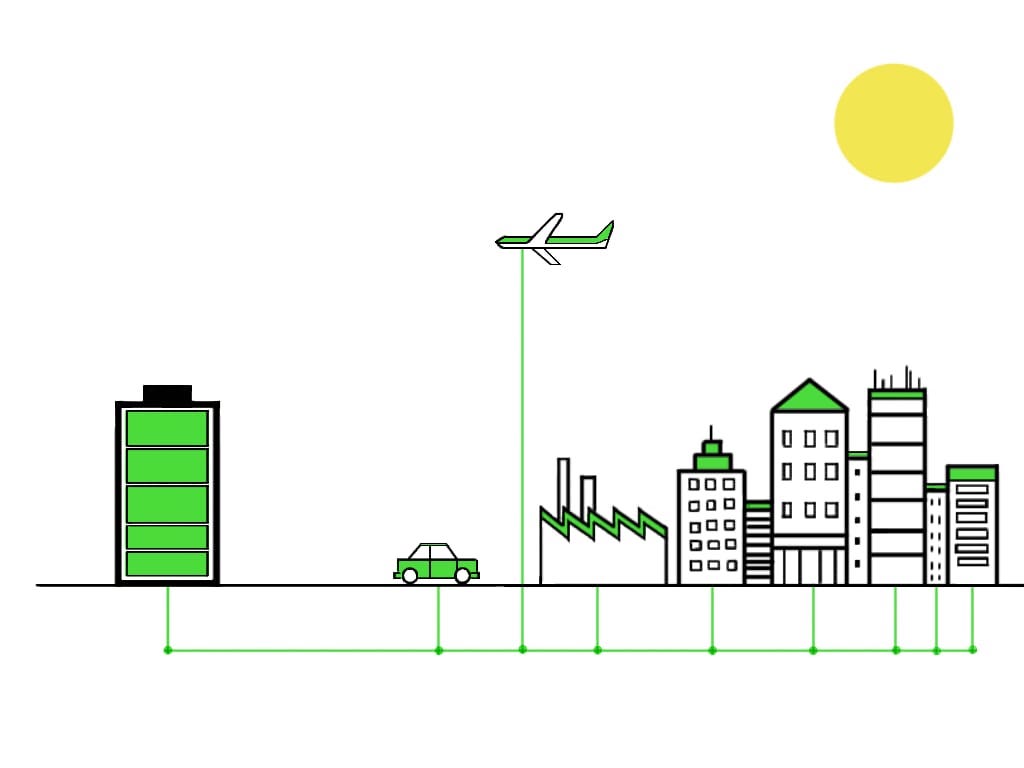
There are already some prototypes of possible compounds suitable for paints with photovoltaic properties which can produce electricity by using sunlight. What is needed now is to convert the scientific knowledge we have into a bigger project. Once we will be able to optimize a process for the scalar production of photovoltaic paints, there will be many possibilities for application. It will be enough to apply the paint on cars, airplanes, roofs of houses, buildings and, who knows, maybe even on clothes. The versatility of photovoltaic paint will allow us to make the most out of existing surfaces and obtain renewable energy for our future
Key objectives for sustainability
Sustainability means the ability of something to be affordable from an ecological, social, and economical point of view.
The photovoltaic paint project can be considered completely sustainable for several reasons.
Firstly, the working principle of this paint is related to a renewable energy source: solar energy.
This energy is given to us every day and we have to learn to take advantage of it to the fullest and reduce our dependence on fossil fuels as much as possible.
Secondly, according to recent studies, the materials that could be used for the production of photovoltaic paints have shown more than 10% better efficiency than classic solar panels which makes this a very interesting point to take into account.
Finally, we believe that it is our social duty to use the promising results that researchers are providing to design simple, accessible, and eco-friendly photovoltaic paint production processes.
We also believe that with an idea of this kind, it would be appropriate to leave aside frictions between scientists that poison the scientific world and finally cooperate for something bigger.
We live in a world that is greedy for energy, and therefore we believe that if we are unable to reduce our consumption of resources, we should at least use clean and sustainable energy and transform the way we obtain them.
Although the problems to be faced are many, we can start looking for a solution in a chemical compound, as simple as paint, that can convert not just a roof, but an entire building into a solar-generating surface (and not only).
Key objectives for aesthetics and quality
We believe that the idea of developing photovoltaic paint can be something that has a lot to do with aesthetics.
We live in Italy, a country with a very rich cultural and artistic heritage. Part of the beauty of this country undoubtedly lies in colorful urban landscapes; from small medieval villages to beautiful Renaissance cities. The problem, however, is that the artistic beauty of urban and rural landscapes is not compatible with the development of current renewable energy systems, such as classic photovoltaic panels. We do not think that one should put photovoltaic panels on Brunelleschi's dome or the Colosseum, but many Italian citizens have major bureaucratic and economic problems with even building a solar panel if they live in areas slightly protected by a whatsoever artistic heritage policy (and believe it, there are far more than one can imagine here in Italy). First, we believe that photovoltaic paint can be a solution to this problem without compromising the aesthetics of the urban or rural landscapes. Second, it could be interesting to use this technology in addition to urban renovation works to give a new life, both artistically and energetically, to buildings and significant architectural elements. This way it would be possible to enhance a beauty that is not only aesthetic but also sustainable.
Key objectives for inclusion
The opportunity behind the realization of photovoltaic paint is to convert as many surfaces as possible into clean energy sources to support the energy needs of buildings and, in the future, to transform our habitations into completely self-sufficient houses. It is a big aim to reach, but it is the direction we have to look at.
The project will involve several areas of interest such as the chemical industry, energy companies, and design studious, and it will eventually be possible to create a real interdisciplinary and international think-tank.
The combination of different sectors makes the realization of this project a unique opportunity for blending scientific and artistic areas and subsequently creating a community to share ideas and realize a successful product.
The exchange of ideas will be essential for a winning product that will respect the needs of different surfaces and environments.
It will be realized to also satisfy the needs of citizens in terms of respecting the cultural heritage of urban landscapes, ecosystems, and last but not least, Nature.
Innovative character
This idea is innovative because it will convert a niche product into a product accessible by a bigger part of our society. This will be possible if we create something cheaper than solar panels that today are unfortunately still taking over a market reserved for a few.
The realization of this paint could make many buildings self-sufficient and its easy way of application would make it accessible even to less developed and remote areas. For example, this will allow energy supplies in those places where the connection to bigger cities, and therefore to energy sources, is poor.
Solar energy produced by photovoltaic paint could also be useful for energy supply after a natural disaster.
The concept behind the photovoltaic paint is not only about producing energy from the surfaces but also for renovating rural and urban areas respecting both the environmental and cultural heritage.
In comparison with solar panels, photovoltaic paint can solve the problem of finding areas available for their application. The paint will not have this problem because it is compatible with the already-existing structures and surfaces.
Also, the application cost will be cheaper than solar panels, and its maintenance close to zero.