Inventing Brandenburgs Alhambra
Basic information
Project Title
Full project title
Category
Project Description
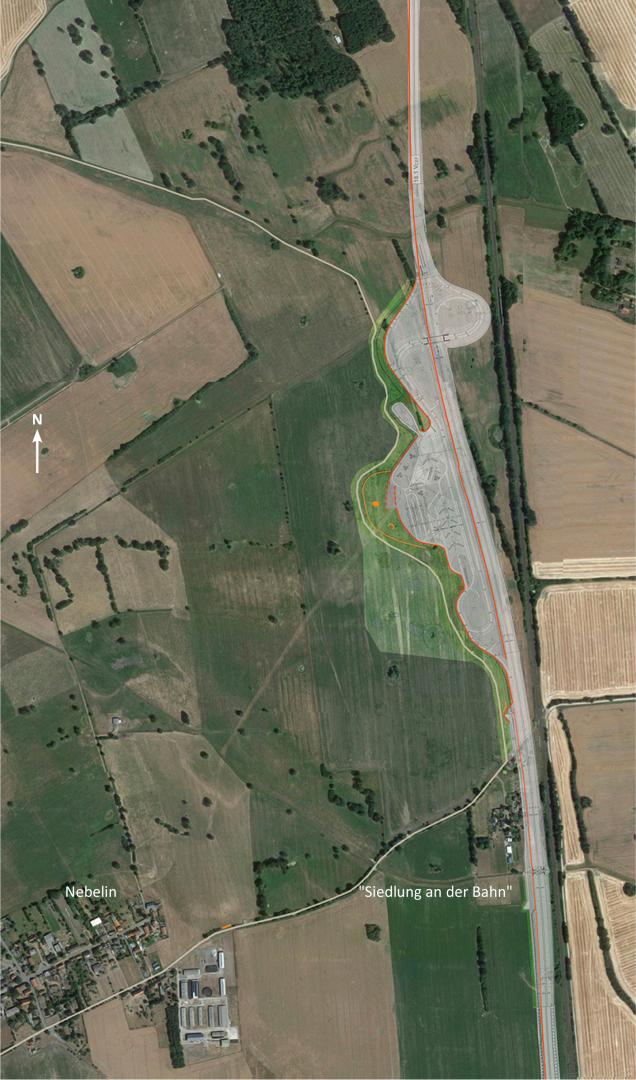
Near the village of Nebelin, the A14 federal motorway is to cut through the Elbe River Landscape Biosphere Reserve in Brandenburg. What is planned is not sufficient to protect the sensitive area. Based on the concerns of the local people the ‘Zentrum für Peripherie’ has taken the situation as an opportunity to initiate an idea development process with artistic means. Working with the potential of the region, preserving its special beauty, and in this way to initiate a forward-looking process.
Project Region
EU Programme or fund
Description of the project
Summary
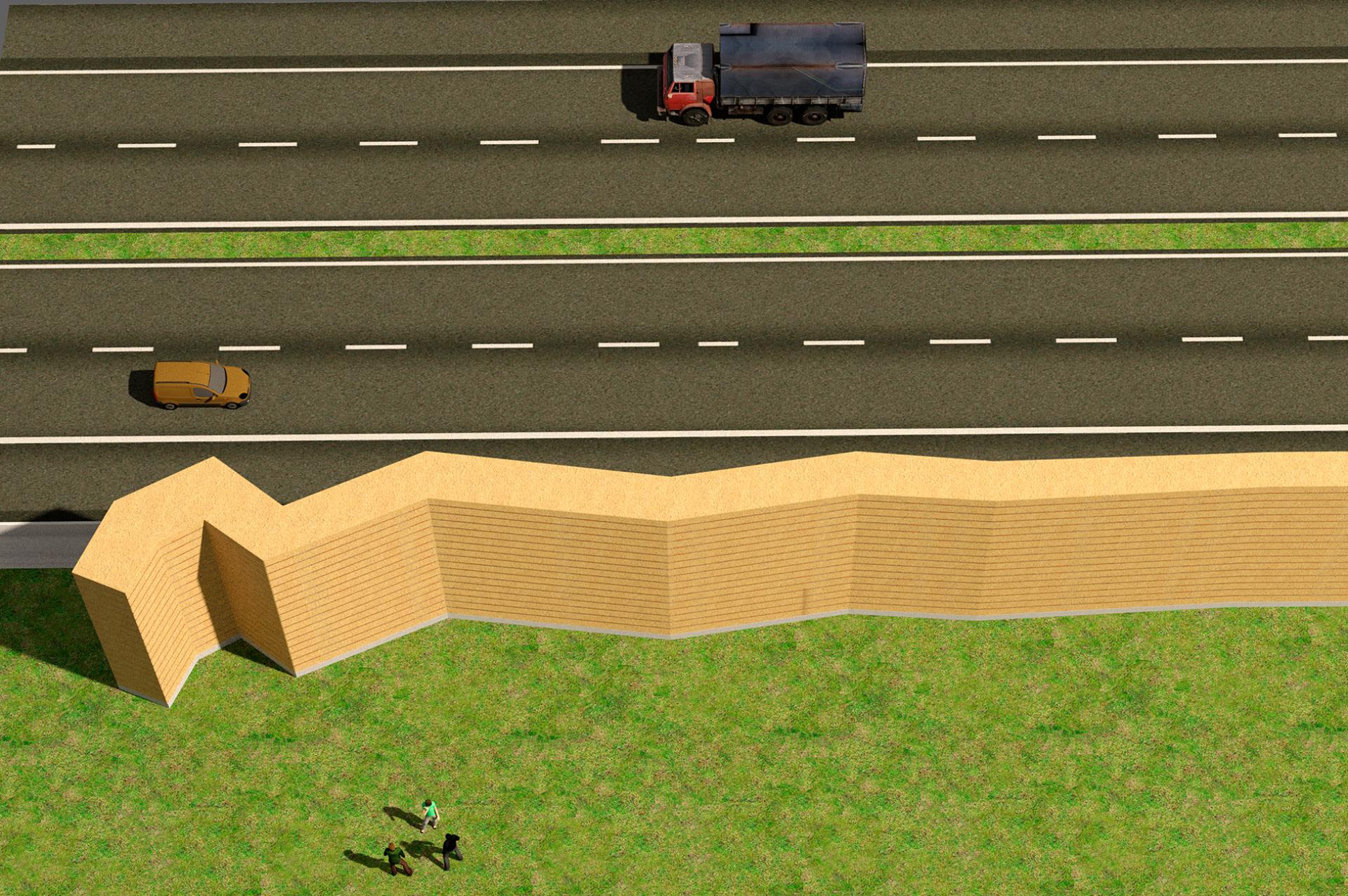
The 'Alhambra Brandenburgs' is a fuel and service station developed together with people from the region and our research team. It is designed with the people of the region as a structure that protects people, landscape and nature and combines innovative and economical process technology with contemporary design language. With a planned length of about 4.2 km, it would be the largest contemporary loam building ensemble in Europe and has the potential to become a pilot project and pioneer for the coexistence of new technologies, ecologically compatible construction, economic efficiency and collaborative planning.
The project combines noise protection, landscape protection, nature conservation and resource conservation. It is supported by the BASt (German Federal Highway Research Institute), which wants to accompany the project scientifically and provide support. "BASt has been waiting a long time for a pilot project with these qualities, and is committed to its realisation because of the interesting investigation possibilities." (Dr. Birgit Kocher, LRDir Dirk Heuzeroth, Dept. of Environmental Protection, Federal Highway Research Institute)
As a beacon project of contemporary building culture, the loam building ensemble can be an impulse generator for a regional loam building industry and contribute to setting new standards for compensation measures. By incorporating research and education, it can be a centre of attraction for trainees and international specialists.
The necessary basis for development and realisation is process innovation and technological innovation: by means of structuring using contemporary art operating with complex systems, areas are explored that seem to lie beyond the realm of the feasible. The starting point is to include the interaction of local people, culture, landscape and building culture as an expandable system. Inventions, ideas, contributions and appointments are co-designed and changed by very different social groups.
Key objectives for sustainability
The socio-political core of the project is the development of ideas together with local people and experts. The involvement of local actors strengthens regional value creation and promotes the pioneering role in the field of sustainable building in the currently structurally weak Prignitz region.
The sustainability objectives of the noise protection loam wall ensemble in the context of the construction of the A14 autobahn near and through the biosphere reserve correspond to the following 'Sustainable Development Goals' (SDGs) to which the Federal Government has committed itself: SDG Goal 12 (Use regional, natural building materials that can be reused indefinitely and do not release harmful emissions); SDG Goal 15 (The earthen wall provides habitat for insects as well as some other protected species); SDG Goal 9 (Strengthen the economic performance of businesses located in the region and local competence in earthen construction; Promoting the innovative capacity of small and medium-sized enterprises through cooperation with associated scientific institutions - TU Berlin, TH Lübeck, BASt); SDG Goal 17 (Cooperation - and not merely consultation - of the local population, enterprises, educational institutions with national and international experts).
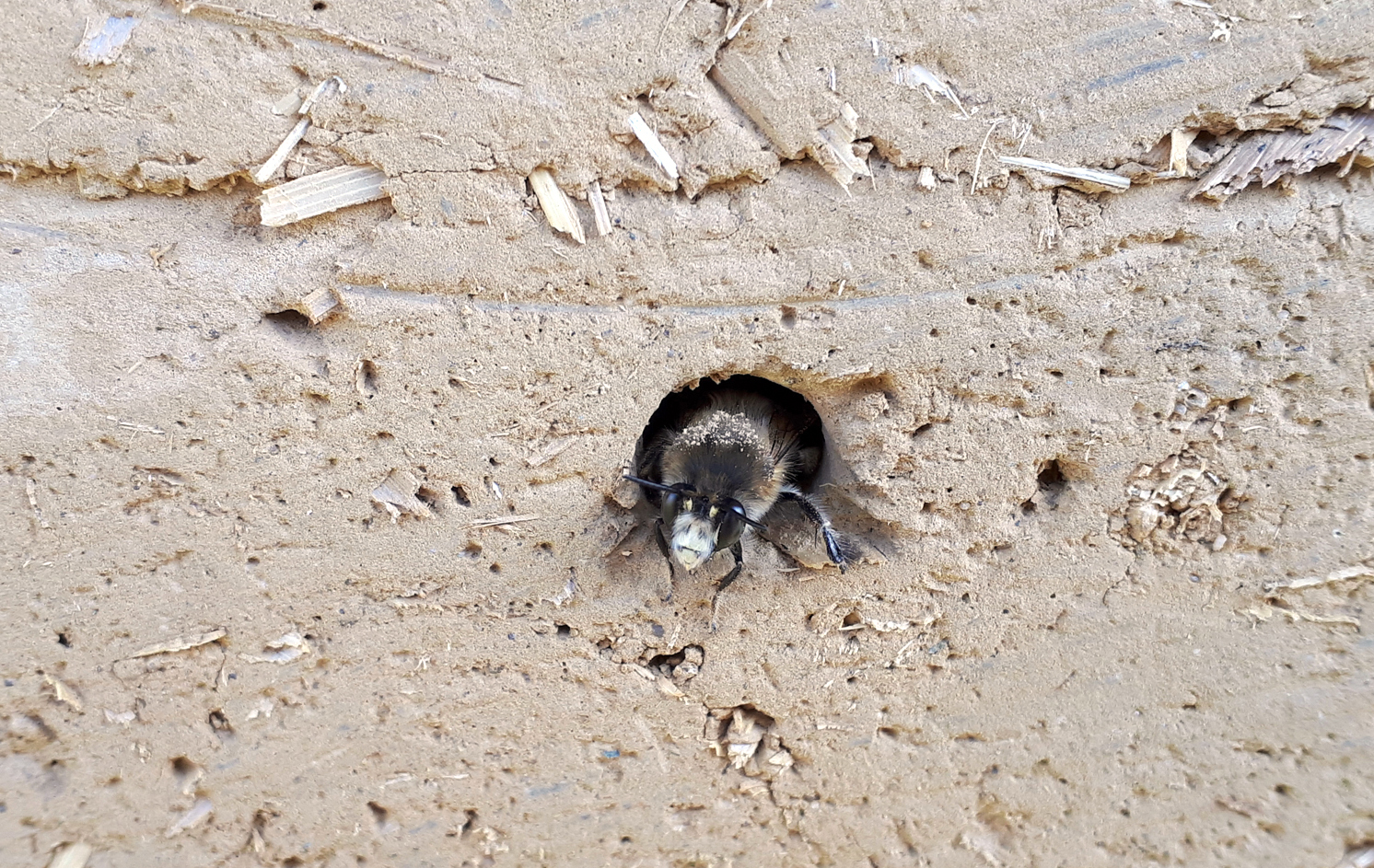
The ecological significance of earthen buildings as a habitat is fundamentally high. The forgotten technique of cob, was traditionally found in eastern Germany. It uses only loam 'reinforced' with straw and is also durable unplastered. It provides a rich habitat for insects. The clay walls designed in the project stand in a biotope network with specific habitats of the surrounding area, especially because of the specially incorporated elements that promote colonisation by insects and other species ('bee stone', 'bee clay', perforations, bat shelters), and can act as a guiding structure and stepping stone biotope for these species.
Key objectives for aesthetics and quality
The "Alhambra of Brandenburg", is conceived as a building that protects people, landscape and nature and combines innovative and economical process technology with contemporary design language. The motorway and service area at Nebelin are 2 m higher than the surrounding landscape. Over a section of the massive loam wall that has been lowered to parapet height, the view falls into the expanse of the surrounding landscape. Outside the wall and the service area is an area that can be accessed through the service area building. Its architecture results from the space between two staggered overlapping ends of the wall and connects the rest area with the surrounding landscape. The rest area is also accessible to cyclists and pedestrians from the outside. The loam walls with their natural materiality become a symbol of a completely different concept of elegant and simple building. They integrate into the landscape and are more or less a folded-up part of it, rather than a foreign body like a conventional noise barrier made of concrete and aluminium with a service area building.
When you step outside, you experience tranquillity and silence. With the mighty loam wall made from the excavated soil from the motorway grounding, a circuit path leads through various ecological mosaics, which also serve as food for the animal species that might settle in the loam wall and are looked after and researched by scientists from the biosphere reserve. In this place of intertwining ecological compensation and recreational areas, there is a meadow orchard, benches and places for movement and rest where one can experience the sounds, smells, colours and the special features of the individual zones.
We believe that in-between zones and what are in a sense non-places should be recognised and used as parts of a global (urban) development strategy. Infrastructure, roads, bridges and rest areas are connecting elements and extensions of urban spaces.
Key objectives for inclusion
With the support of the Deutsche Bundesstiftung Umwelt (German Federal Foundation for the Environment) and the Brandenburg Ministries for the Environment and Economy, we were able to investigate and prove in a feasibility study, together with an international research team, the viability of a noise barrier on the A14 using modern applied loam construction techniques.
We succeeded in this because we were able to win over people from the region, and people across all professions, to develop the ideas for the 'Brandenburg Alhambra' and to complete a pilot construction. Various innovations have emerged from the interweaving of perspectives.
The concept of a rest stop that simultaneously protects the landscape from the motorway, a research object for the construction turnaround and a place for encounters in the most sparsely populated region of Germany has emerged from such on-site cooperation.
In coordinating this project, structures were used that enable ideas to be developed across social barriers and cooperation to unfold. In contrast to the usual 'consultation' of the affected population in infrastructure projects, 'cooperation' means actual collaboration during the development of ideas, the elaboration of the concept, the exchange with experts, up to certain aspects of realisation.
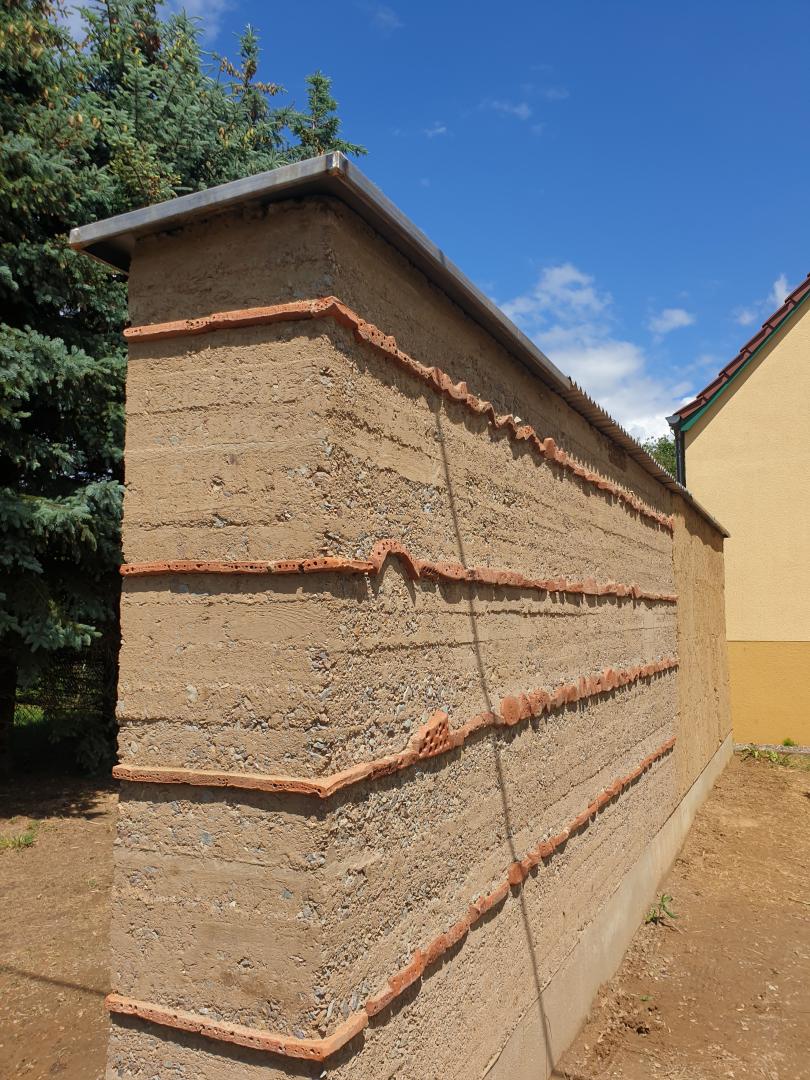
To give an example of collaboration with children: The so-called 'bee stones' as elements of fired clay integrated in the rammed earth section of the test wall have been developed and produced with children from a regional school, an entomologist, an artist, and with loam construction specialists. These different clay elements serve both as insect breeding sites and as erosion-reducing measures.
This method applies to every aspect and every innovation. The newly developed cob technology, which we believe to be groundbreaking, was created through the collaboration of an artist, a world-leading loam building pioneer, a gravel plant owner, a locksmith, young people and students.
Results in relation to category
Structural result:
Contemporary art creates open space and holes in the system. In such provided structures it is possible to develop ideas beyond all common social barriers. What has emerged could not have been developed by any of the participants or specialists alone.
Cultural outcome:
An aspect of the social function of artists is to stand on the margins, to look from different directions, to perceive complexity and references. Changes thus begin at the margins, innovations often on the sidelines. In the project, people with the most diverse political attitudes succeeded in working together constructively.
Academy:
The project and its predecessors show: Contemporary art should be included in all relevant social solution-seeking. This is in the tradition of the Bauhaus and is more relevant today than ever. For this it needs – as with compelling examples of contemporary loam building – the 'Brandenburg Alhambra' as a vision for togetherness.
Built result:
The test wall at the day care centre in Nebelin where all technological questions have been solved and can be read off. We take the 'violation' of the landscape as an opportunity to develop a construction method that relates this extended urban space to the surrounding landscape and the people, animals and plants inhabiting this landscape.
How Citizens benefit
At the opening of the test wall on 5 June 2020, political personalities from the state of Brandenburg and the municipality, the press, young people, craftsmen and students, who had all worked on the construction of the test wall, took part alongside many villagers and children from the daycare centre. On this occasion, the team of the feasibility study met with representatives of the biosphere reserve, architects and the Baukulturinitiative Brandenburg, subsequently leading to the vision of the 'Brandenburg Alhambra'.
In order to work out a specific concept, a hybrid online/physical workshop took place from 14 to 16 January 2021 in the open church barn in compliance with the Corona rules. The research and development team, people from the village and representatives of the local administration were involved.
For more information (text and picture), see the articles at: https://www.perspektiven-2030.de/
A few key points on our methodological principles:
-
Each perspective enriches complexity and beauty.
-
Physical apprehension promotes sensual understanding.
-
To start from the inside, bringing in the professionals in the second step.
-
Beauty is a goal that creates identification.
-
Problems are taken as creative challenges. They are an occasion to include, at first glance, unusual perspectives, fields of research and their specialists.
-
Architecture: Functionality and beauty of architecture created in the process is explored as an indicator of the quality of the processes. However, this also means that a lack of beauty is an indicator of processes that need improvement.
-
Urban and regional development: Architectures, processes and technologies are used in their potential to contribute to a vibrant city.
-
Art: Transformation processes are seen as a collaborative work with multiple authorship.
-
Networking of artists and researchers working with the form of processes.
Innovative character
If you combine such a strong sign as the loam noise barrier and the service area with an academy, it could have a very big impact. (Martin Rauch, rammed earth construction expert and entrepreneur)
With its academy, the Zentrum für Peripherie makes unexpected, constructive and concrete solutions conceivable and possible. In the context of the ‘Alhambra of Brandenburg’, this represents the establishment of a training and research facility that, in further development of the Bauhaus doctrine, conceives innovation, craftsmanship, construction, science and art as acting together.
As an academy in the spirit of a New European Bauhaus, it builds on artistic practices, technological innovation and making complexity comprehensible in order to meet ecological, economic and social challenges.
It brings people together in ways in which each perspective is valued and visible, thus contributing to a rich ecosystem of ideas. Dysfunctions such as those of the educational system in terms of inequality of opportunities, the overburdening of large bureaucratic apparatuses, catastrophic environmental pollution, inequality in the world, the lack of understanding between groups – each convinced of their respective truths –, all that represents the starting point for processes of change. Problems that seem unsolvable serve as indicators that other solutions are needed than those envisioned by the respective concept.
In recent years, the Zentrum für Peripherie has developed two beacon projects in loam construction from scratch, employing new participatory formats that incorporate the uncertainty inherent in the complexity of construction, space, and social interaction. In the process, technological innovations have been developed that advance loam as a sustainable material for the building sector, and procedural innovations have been made that enable participatory planning and which contribute to the constitution of problem-solving groups.