VorOrt-Haus – the Dessau „Reallabor”
Basic information
Project Title
Full project title
Category
Project Description
The VorOrt-Haus is an example of the recovery of public space as a place of participation and encounter.By taking over an old property, actors of all ages and backgrounds try their ideas directly and experience self-efficacy.The VorOrt principle was from the beginning the benefit of existing resources in the sense of recycling and do-it-yourself, of making instead of only talking. Bottom-up, low threshold and very visible and attractive – caused by a high standard of communication and design.
Project Region
EU Programme or fund
Description of the project
Summary
The VorOrt project emerged already in 2010 from a student initiative (semester project accompanied by Prof. Brigitte Hartwig) of the Design Department at the Anhalt University of Applied Sciences in Dessau. It started with an empty shop in the city center.
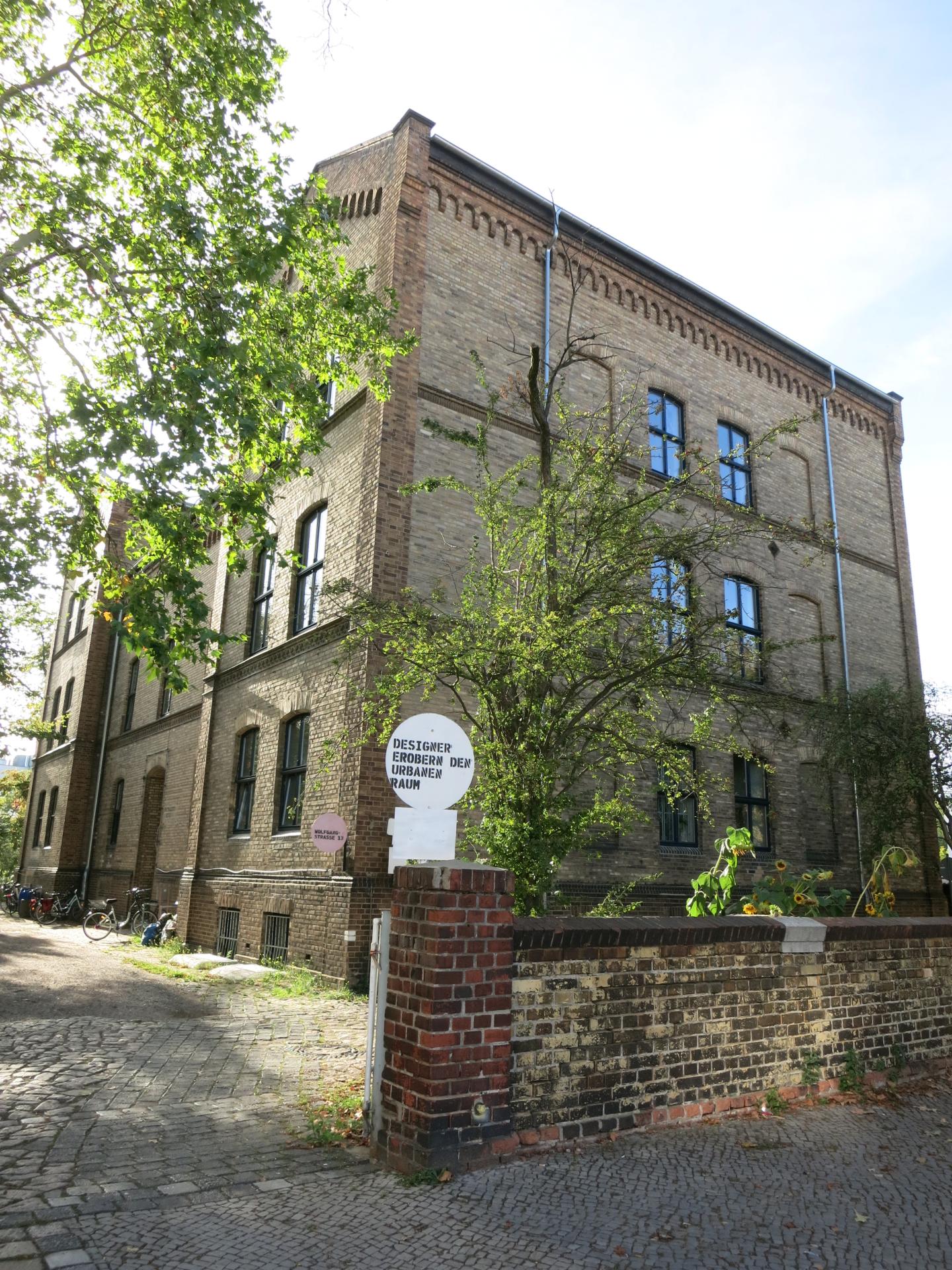
In the summer semester of 2012, the former Pestalozzi School was added as another place for "simulation and experiments" between the ”Bratwurst Tankstelle” and the police headquarters. The project received a great response from the tangible visualization of the possibilities of this old building. The press reported and: the municipal utilities were putting electricity and water back on. Students went to the town hall and demanded: "We want to keep this house."
The VorOrt-Verein was founded in September 2014 - made up of university members and civil society actors. In December 2015, the lease agreement between the city of Dessau-Roßlau and VorOrt e.V. was passed with a large majority in the city council. The association is responsible for the house for the next 50 years.
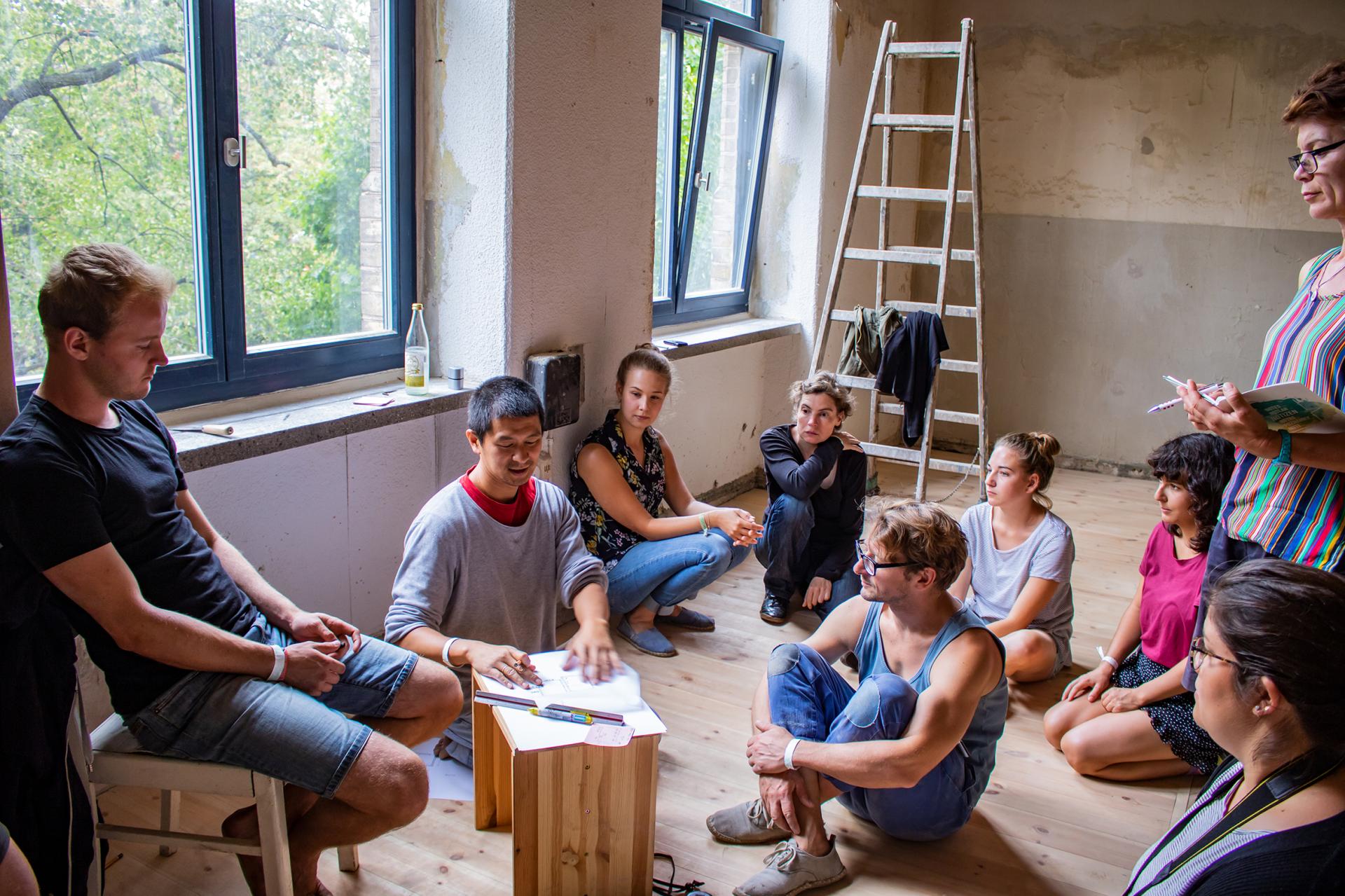
They want to help shape the city, enrich its culture and bring it to life. VorOrt also stands for the creation of a nucleus for art, design, culture and sustainable practice with supraregional potential as well as the design of communication within an urban society. Students and committed citizens jointly organize exhibitions, workshops, readings, concerts, roundtables and much more. VorOrt shows what potential lies dormant in the city: on the one hand, plenty of room for development – on the other hand, lots of committed people who just need to be brought together. Together they not only think about what the city could be like, but also create, simulate, discuss and actually implement it. Newcomers to Dessau and those starting their studies are important addressees because they decide within the first few months whether to settle locally or to commute to work. VorOrt wants to address and motivate committed people of all ages and backgrounds.
Key objectives for sustainability
First of all the idea to reuse a municipal building instead of demolish it (probably would have happened after 12 years of unsuccessful attempts to sell it) and to refuse luxury renovation, focussing on just the bare essentials.
Then to hand over space to people and trust in their ideas – instead of top-down giving advises of how to do it properly. This strategy takes a lot of patience, but the wait is rewarded. The intrinsic motivation on the part of the actors kindles a completely different passion and creates real identification. Fertile basis for anchoring in place and assuming responsibility. This is how resilience and sustainability is created. A slowly but steadily growing community is not so susceptible to disruptions, risks and unexpected challenges.
We at VorOrt think, that many microtransformations together form the great transformation. This helps us to believe that as a group one can be a valuable part to ultimately ”save the world” – starting small, local, open and connected (SLOC-theory / Ezio Manzini). Like many acupuncture stitches that target a complex organism.
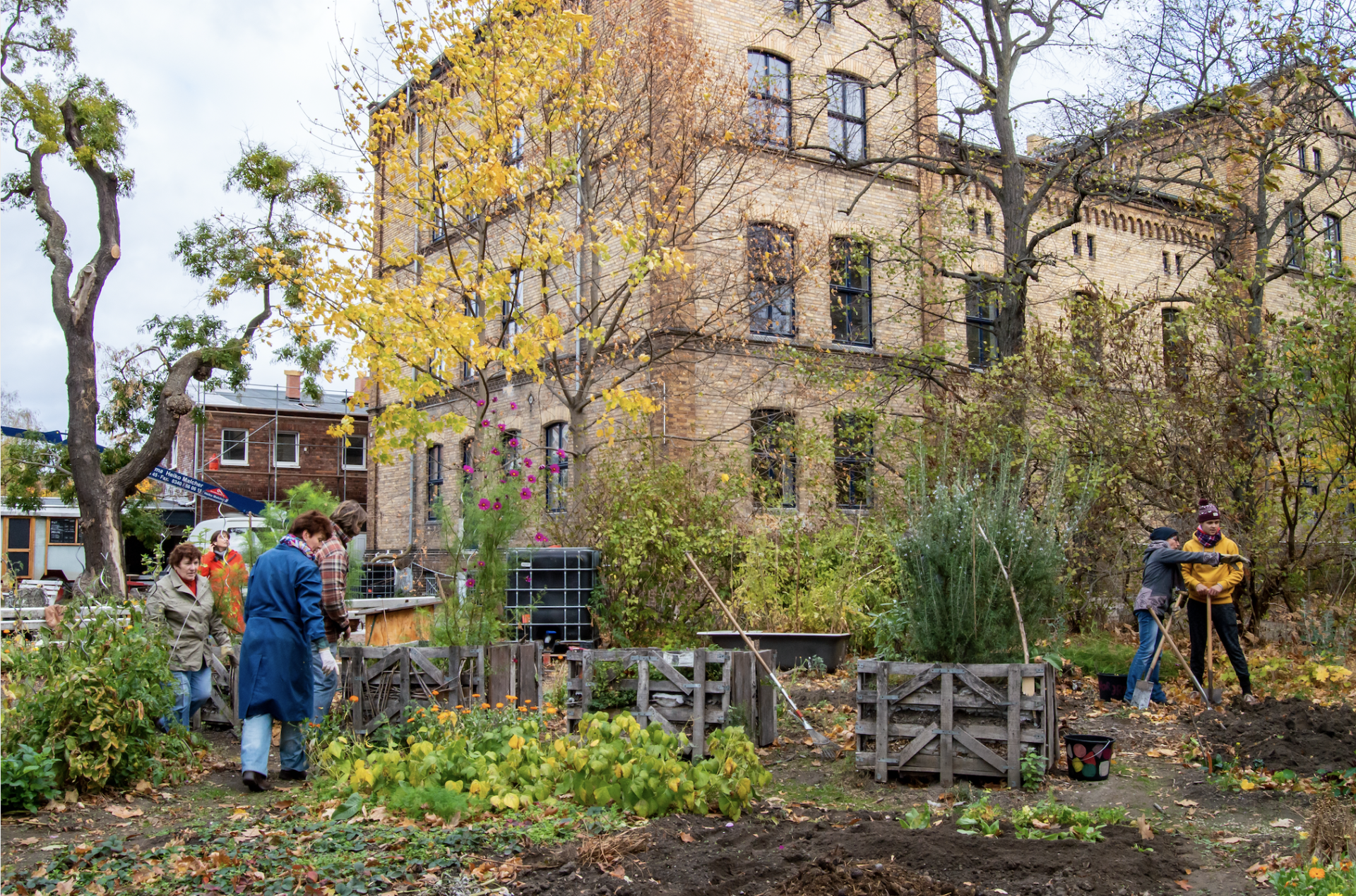
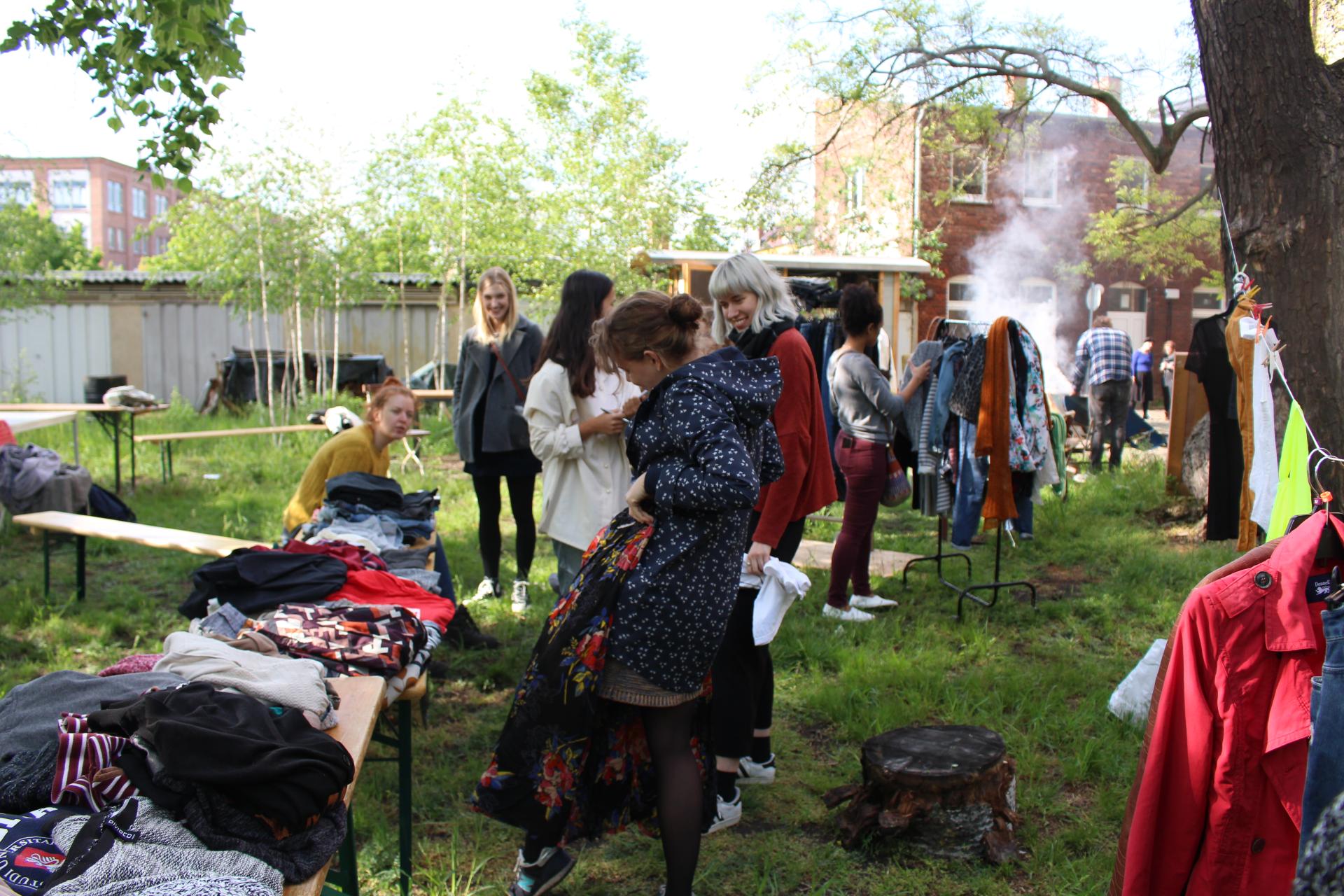
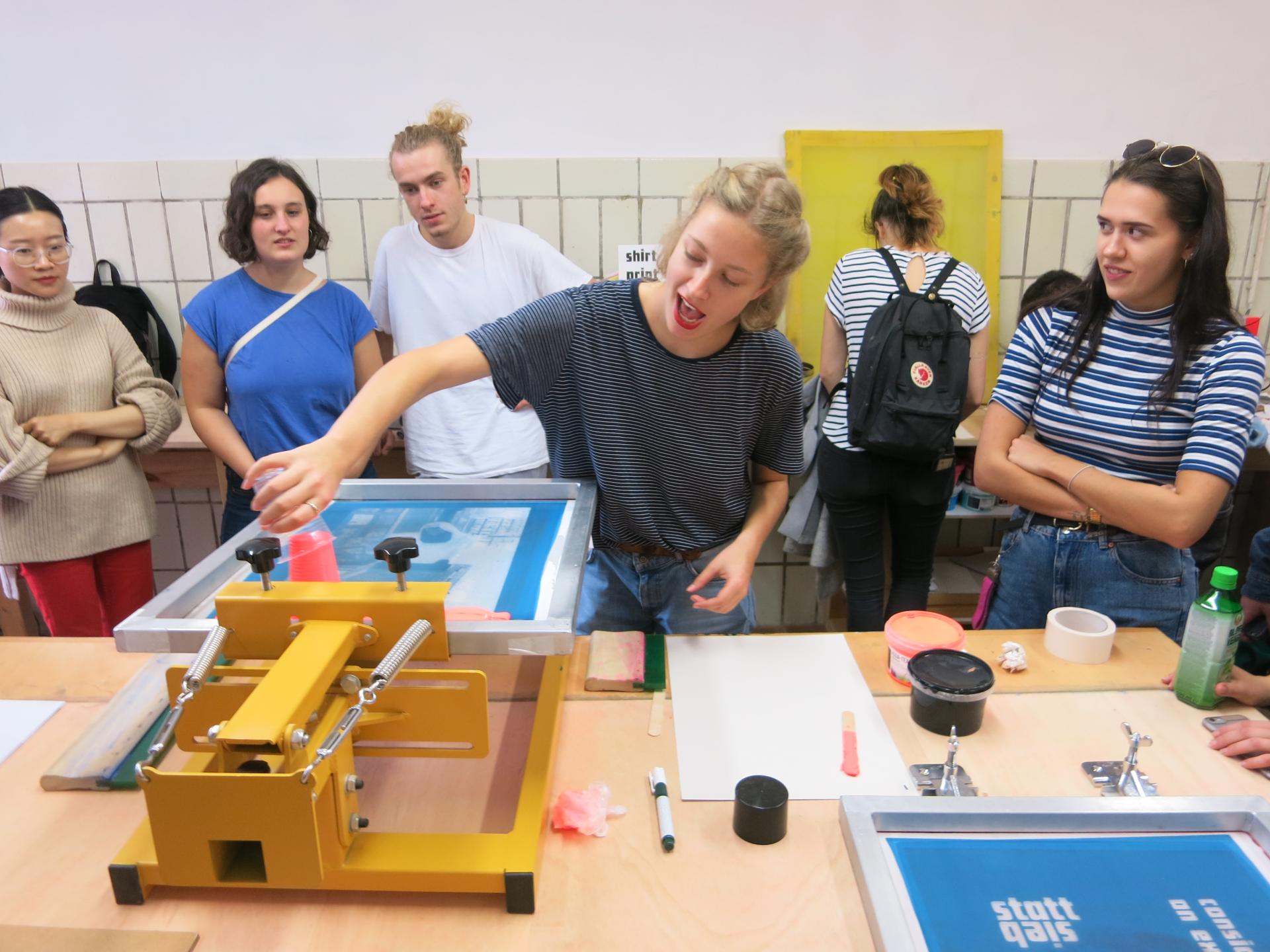
Very specific we e. g. saved our park-like community garden from being extended to the parking lot of the neighboring shopping center. And: the people at VorOrt are saving food, sharing wonderful dishes at the Küfa project, are exchanging seeds every Februrary (in coop with the Federal Environment Agency around the corner), are organising swap clothes + things markets, are using their own cargo bikes, started the 1st repair initiative in Dessau, are soon opening the 1st maker space, are rescuing old printing machines, are growing their own vegetables, are making cleaning agents themselves etc.
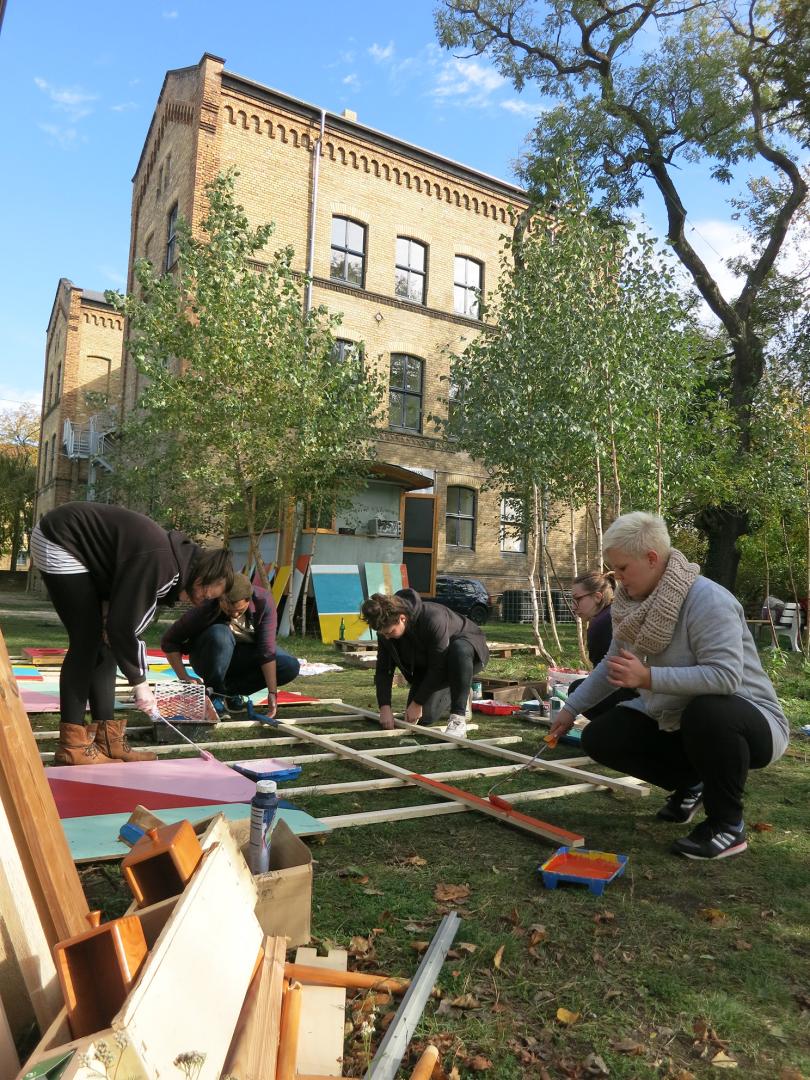
The VorOrt principle is from the very beginning based on recycling. We are building nearly everything we need from gifts and junkyard finds. If it's a mobile kitchen, tables for a screenprinting workshop, a shop for design products or the furniture and interior for our café and meeting space.
Key objectives for aesthetics and quality
VorOrt has been developed within a student seminar. VorOrt stands vor „at the spot” and addresses everyone who dares to really get involved with the city – instead of commuting daily from Leipzig or Berlin. VorOrt stands for an attractive and appropriate visual design and communication at a high level from the start.
For the very 1st communication issues we used the pink office paper we found in the abandoned house. As a characteristic typeface for the project a student designed a stencil font and produced a whole cardboard alphabet – to be used for the signage as part of his thesis. The typeface and the colour is still used and part of the robust and typical VorOrt branding.
Key objectives for inclusion
VorOrt-Haus and garden simply offer space and opportunity for accidental unintentional encounters. Here students mix with citizens of all milieus and age groups. The postwoman joins the garden group, the pensioner helps to get the old blackmetal type printing machines (which a former student saved from the junkyard) working again. A regular appointment is established all by itself, at which more and more people meet to have coffee and chat. Everyone brings cake from time to time. The seamstress, who had to give up her shop in the city center, offers sewing courses. The percussion band rehearsing in the basement organizes the mowing of the lawn. At the neighborhood party, the young mother meets the early retiree, who has been looking after her children as a loan grandma ever since. Young mothers meet to establish a shadow theater and have breakfast in the garden. Over the time their children take over the bar service from the students, organise own parties and begin to interest themselves for studying design or joining the fridays-for-future group they meet here. The friendly association from Schortewitz is lending us a colony of bees on a trial basis. Students take courses in proper beekeeping. The young design graduate acquires funds through the youth strength fund in the quarter for a horticultural project with young people and migrants. An over 70-year-old beaver expert and nature lover is suddenly there every day. He starts rescuing pansies from green waste in cemeteries. An ever-growing sanctuary for pansies is being built in the garden. In addition to the raised beds of other ambitious gardeners, a student places 12 buckets on a container. Peppers that are watered via an app that is networked with weather data thrive here.
So many different realities of life, backgrounds and characters! Here people step out of their bubbles and start talking to one another and working together. This creates social cohesion and identification – at the spot.
Results in relation to category
To face as a design student real problems in your surrounding neigbourhood gives relevance and meaning to any project within design studies. Dealing with them requires the development of an attitude. Experiencing feedback and resonance not only from the well-known experts but from ”normal” people is crucial for the development of personality – unfortunately not self-evident in university-business (better developping quickly on the side a ”persona” at the laptop).
In the design community it used to be more important what something looked like than what it did. Today the concept of beauty has to be renewed. The beauty lies in the manner of our relationships, fruitful collaborations – the way we deal with each other. But still we have the attempt to find the right words, the appropriate typography, colours, images and shapes. The fitting atmosphere for the spaces we act in. The world we imagine is about proportionality, modesty, relevance and visibility – to a degree and at times that lead to appropriate appreciation. Away from mass consumption, growth and productivity at all costs and waste. (Design) students and citizens gather at VorOrt to co-create their own possible futures. They very often have to leave their comfort zone and step out of their bubble to learn to know other perspectives.
VorOrt is attracting visiting teachers + students from all over the world (selection): SAVVY Contemporary, Spinning Triangles – Anstoss zu einer Schule für Gestaltung + Van Bo Le-Mentzel (Wohnmaschine) / Les Compagnons du Devoir, Paris / Prof. Ulrike Brückner, Dortmund (Urban Intervention Explorer) / Alexander Branczyk, Berlin (schaubau) / Prof. Philipp Oswalt, Kassel / Prof. Steffen Schuhmann, Berlin (Anschlaege.de) / 44Flavours, Berlin / Prof. Johannes Widodo, National University of Singapore, ICOMOS /
How Citizens benefit
Dessau is one of the top cities in Europe with the most inhabitants over 65 years of age. For young people it's a huge challenge having chosen this ”boring” city (”Depressau”) as a place of study.
When the project started in summer 2012 people from the neighbourhood stared at us and said that this ist the first time they recognize students in the city. The railway line is dividing Dessau into two parts. From the perspective of the students at the campus the inner city is located ”behind” the station. The campus itself is located just next to the station. Some students never have seen the inner city, they only know the campus and the station.
Since 2012 this is changing: People in the city not only benefit from a more lively street scene, but from a green oasis and a (at least outside) renovated listed building in the middle of noisy streets and prefabricated apartment houses. They learn to know about the project by visiting events like concerts, theater performances (open air formats from the Anhaltisches Theater Dessau) garden workshops, lectures, markets or parties. They support the VorOrt-Subbotniks (voluntary work sessions on Saturday) – with a cake, a soup or the next time by tackling what has to be done. Then they really get involved and join different groups or try out new ideas they have in mind.
If you sincerely get in contact with the people, you learn to know a lot of unexpected things. E. g. some will tell you that it is very embarrassing to repair s.th. In GDR-times it used to be absolutely normal to improvise and to repair everything. But after the re-unification people learned that it is common and desired to buy everthing new. When students started a repair initiative they found out that there were much more people interested in providing their know-how of repairing e.g. electronical stuff than people who wanted to have s.th. repaired. For both ”sides” it is incredibly enriching and appreciative to get in touch with each other.
Innovative character
VorOrt is an important ”Zukunftsort” in a shrinking city which is facing demographic change in a dramatic way. VorOrt is modest in the way that it uses the ressources which are there and develops ideas and acitivities fuelled by the lack of ideas and acitivities. You can leave the empty dance floor or begin to dance and sing on your own – until more and more people join and try out their voices. VorOrt is never completed, but develops organically in continuous iteration. The people at VorOrt are gaining action competence, they learn to deal with risks and an uncertain future. Failing is part of the game, but celebrating as well. Nothing is served on a silver tray – at VorOrt you have to get your hands dirty to achieve s.th. You experience self-efficacy. Through cooperation and collaboration you develop your own position. VorOrt is not complicated and open to everyone. The initiatve offers low-threshold invitations to participate and helps to shape social live in a city – beyond the borders of institutions or specific scenes.
Within design education students can experience how it feels to set up their own business in a very playful and applied manner. Semester topics start from scratch and develop a tremendous dynamic because they are getting real: students are setting up their own design shop, design + build a mobile kitchen, transform a room used as stock in a screenprinting workshop or pretend to be a design office (this is only a selection ...). All projects include the handling of pricing, dealing with copyright issues and writing offers / invoices.
Currently it is not uncommon for graduates that they remain in Dessau after studies. The possibilities for funding their own small business – within a lively community – are so appealing to them that they refuse to follow the traditional path of being employed by the big agencies in the metropolises. By experiencing a sharing culture they are triggered to find out what they really need to lead a satisfied life.